
Most buyers meet this choice late. They have already settled on a store type and a quantity, and then a supplier asks whether the basket should be plastic, welded wire or sheet metal. The three look similar in a catalog photo, and they behave very differently after a year on a shop floor. A plastic shopping basket survives a thousand drops in a way a wire basket does not, while a wire basket survives a hot delivery van and a pressure wash in a way some plastics do not.
This guide compares plastic, wire and metal baskets on the points that matter after delivery, which are weight, strength, stacking, cleaning, branding, noise and the way each one fails. It uses the figures for the plastic baskets we build, taken from our product pages. We do not make wire or metal baskets, so for those two the guide gives the principles and the questions to ask a supplier, not numbers from us. It does not cover price, which depends on the material, the quantity and freight.
If you are choosing a size first, read the guide to shopping basket size, capacity and dimensions. Baskets and carts work together in a store, and the cart side is covered in plastic against steel shopping carts.
The Three Basket Materials in Plain Terms
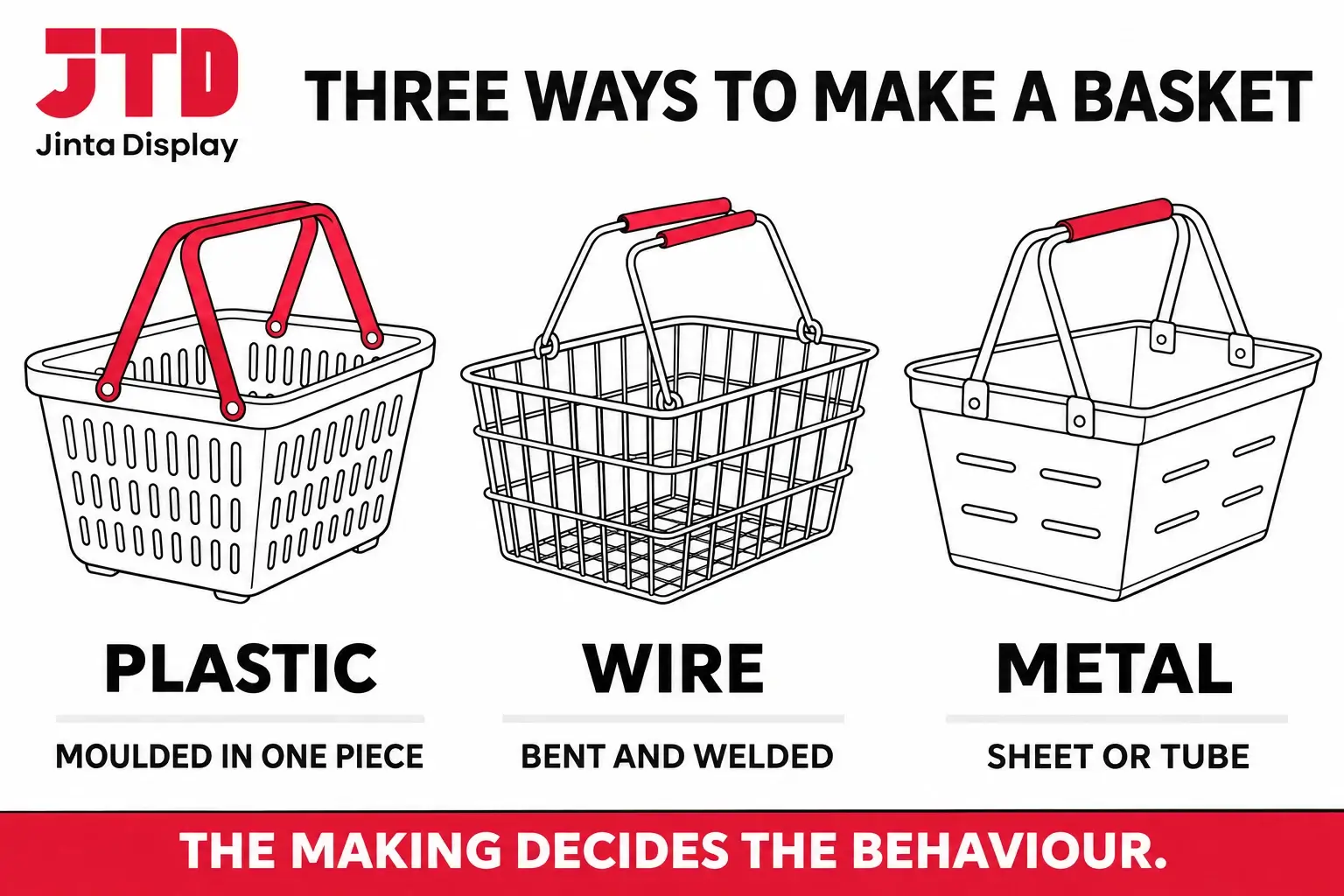
The three materials are three different ways of making the same open container, and the way a basket is made decides most of how it behaves.
Plastic. A plastic shopping basket is injection moulded in one piece, usually from polypropylene or high density polypropylene, which our product pages list as PP and HDPP. The walls, handles and base come out of one mould, so there are no welds and no coating to chip. Colour is mixed into the plastic and does not wear off.
Wire. A wire shopping basket is made from steel wire that is cut, bent and welded into a mesh. The mesh is then coated, most often with zinc, powder or a plastic dip. Every cross wire is a weld, and the coating is the only protection the steel has.
Metal. A metal shopping basket in the strict sense is formed from sheet or tube, or from heavy wire in a stainless grade. The term is used loosely in searches, and many pages that say metal basket mean a wire basket. Stainless steel baskets exist and do not rust, but they cost more and weigh more, and they are rare in ordinary retail.
What We Build and What We Do Not
It is better to say this early. The shopping baskets on our site are all plastic. They are moulded in PP or HDPP in Changshu, China, and they run from 18 L hand baskets to 60 L rolling baskets. Every figure in this guide for a plastic basket comes from those product pages.
| Capacity | Material | Empty weight | Weight per liter |
|---|---|---|---|
| 18 L | HDPP | 0.52 kg | 0.029 kg |
| 18 L | HDPP | 0.66 kg | 0.037 kg |
| 22 L | HDPP | 0.75 kg | 0.034 kg |
| 28 L | HDPP | 0.95 kg | 0.034 kg |
| 34 L | PP | 1.5 kg | 0.044 kg |
| 35 L | HDPP | 1.3 kg | 0.037 kg |
| 43 L | HDPP | 1.6 kg | 0.037 kg |
| 45 L | HDPP | 1.65 kg | 0.037 kg |
| 60 L rolling | HDPP | 2.5 kg | 0.042 kg |
| 60 L rolling | HDPP | 2.99 kg | 0.050 kg |
The last column is our own division of the listed weight by the listed capacity. It shows that a plastic shopping basket of ordinary wall thickness lands between 0.03 and 0.05 kg per liter, and that the rolling baskets sit at the heavy end because of the wheels and the telescopic handle. That ratio is a useful check on any plastic shopping basket quote. A basket far below 0.03 kg per liter has thin walls, and one far above 0.05 kg per liter is carrying more plastic than the shopper needs.
For wire and metal baskets we have no product figures. Where this guide describes them, it describes how the material behaves in general. Treat that as a list of questions for your supplier and not as a specification.
Weight and What It Does to the Shopper
Weight is the first difference a shopper feels, and it matters more than buyers expect. A shopper carries the basket by one handle, with the load pulling on one arm.
Take a convenience store basket of 28 L at 0.95 kg. A shopper who fills it with 8 kg of goods carries 8.95 kg. If the basket itself were twice as heavy, the same shopper would carry 9.9 kg, which is 11% more for no benefit. Across a day of baskets that is a small difference per person, and it shows up as shoppers who put a basket down, or who stop taking one and buy only what fits in their hands.
A welded wire basket can be as light as a plastic one at small sizes, because wire is a lean way to build a container, and it can be much heavier at large sizes when the wire gauge goes up to carry the load. The reliable way to compare is to ask for the net weight of the exact model and divide by the capacity in liters, the same division we did above. For plastic the answer should be 0.03 to 0.05 kg per liter. For wire the answer depends on the wire gauge, so ask for it.
Rolling baskets are the exception to all of this, because the shopper does not carry the weight. A 60 L rolling basket at 2.5 to 2.99 kg has wheels and a telescopic handle and is pulled like a small trolley. Plastic and wire both exist in this format, and the choice again comes down to noise, cleaning and branding.
Strength and How Each Material Fails
Every material fails in its own way, and the failure that matters is the one your store will actually meet.
Plastic fails at the rim, the handle root and the base corners. A cracked handle is the usual end of a plastic basket. It comes from repeated overloading, from baskets dropped onto hard floors and from cold storage, since polypropylene turns more brittle as the temperature falls. Good moulding puts extra thickness at the handle root and uses a grade with enough impact resistance for the climate. Ask for the resin grade and for the drop test the factory uses, and ask where the handle joins the wall.
Wire fails at the welds and at the coating. A cross wire can break away from the frame after many loads, and the broken end can catch a hand or a bag. Once the coating is scratched, the steel under it starts to rust, and a rusting basket stains goods and hands. Ask for the wire diameter, the weld count, the coating type and the coating thickness.
Metal fails by denting and rusting. A sheet metal basket can dent when stacked heavily or dropped, and a dent cannot be undone. Painted steel rusts where the paint is scratched, and stainless steel does not. If a quote says only metal, it has not told you which of these you are buying.
The same logic applies to our carts, where the steel frame and the plastic parts divide the work. The cart guide on what shopping carts are made of shows how a specification should name the grade, because a quote that says only steel and plastic has told you very little.
Stacking and Floor Space
Baskets are stored and moved in stacks, and the way a basket stacks decides how much space it takes at the entrance and in the container.
A plastic shopping basket is tapered. The top is wider than the base, so one basket sits inside the next and each basket adds only a small step to the stack, called the nesting pitch. Our product pages say the baskets stack into a compact column when not in use, and the same shape means a shopper can pull one basket from the top without the stack tipping.
To see why the pitch matters, take an example with a made up figure. If a basket is 250 mm tall and nests at a pitch of 40 mm, a stack of 20 is 250 plus 19 times 40, which is 1,010 mm. With a pitch of 80 mm the same 20 baskets stand 1,770 mm, which is 75% taller and may not fit under a shelf at the entrance. The pitch is a number on the specification sheet, and it is worth asking for.
Wire baskets nest too, because the sides slope, and they often nest well. A rigid wire basket with a straight side, or one with a folding handle, can lose that advantage. Ask whether the handles are fixed or folding, because a fixed handle can stop two baskets from nesting fully.
Cleaning and Food Contact
A basket is handled by every shopper and sits near food, so cleaning is part of the choice.
A plastic shopping basket has a smooth surface and no seams, so a wipe or a wash removes spills, and the moulded colour is the same all the way through. Wire is open. Dirt does not collect on a flat surface, and water drains straight through, but small items can fall through the mesh and hold on to the wire corners. Cleaning wire by hand takes longer because of the weld joints, and the coating is easier to damage with harsh cleaners or abrasive pads.
If baskets will be washed with hot water or a sanitizer, ask the supplier what the material tolerates. This applies to plastic as well, since polypropylene has a heat limit, and a basket that warps in a hot wash no longer nests properly.
Branding, Colour and Shape
A basket is the most carried object in a store, so it is also an advertising surface.
A plastic shopping basket takes colour through the whole body. Our product pages list colour as customized and say you can print your own logo, and the printing is done on the flat side wall, where it is seen by shoppers and by staff. A change of colour for a new store is a change of material order and not a repaint.
Wire offers little room for a logo, and the coating colour is a finish and not a body colour. A tag or a printed card can be clipped on, and the basket itself stays plain. A wire basket is a good choice when the store wants the products to be the display, and a poor choice when it wants the basket to carry the brand.
Shape follows the same logic. A moulded basket can carry a lip for a price card, a recess for a hand and a base that stands steadily on a counter. A wire basket can add a fold or a hook, but the shape is limited by what a bent wire can do.
Noise in the Store
Noise is easy to overlook until the store is open. A wire basket rattles when it is put down on a hard floor or on another basket, and a stack of wire baskets being pulled apart is loud. Plastic is quieter. This matters in pharmacies, in small shops with a quiet atmosphere and in stores that are open late, where a staff member is stacking baskets while customers are shopping.
It is a soft factor and does not decide the order, but when two materials are close on the other points, noise is a reasonable tiebreaker.
Tooling, Minimum Order and Customizing
The cost pattern of a plastic shopping basket, a wire basket and a metal basket is different, and it shapes what you can ask a factory to do. We do not give prices in this guide, so this section is about structure.
A new plastic shopping basket shape needs a mould, which is a one off cost, and a basket in a new colour needs a minimum run of material in that colour. A standard shape in a standard colour avoids the mould cost, and a custom logo is usually a print and not a new mould. Our standard plastic baskets are already moulded, and our product pages list a production time of 15 days and FOB, CNF and CIF price terms, with exact specifications, minimum order quantity and lead time confirmed by our team.
A wire basket does not need a mould, so a change of size is a change of wire length and jig. That makes custom sizes cheaper to start for wire than for plastic. It is the main reason some buyers choose wire for an odd size.
In both cases the useful question is the same. Ask what changes between the standard model and your version, and what it adds to cost and to lead time.
What to Specify on a Plastic Shopping Basket Order
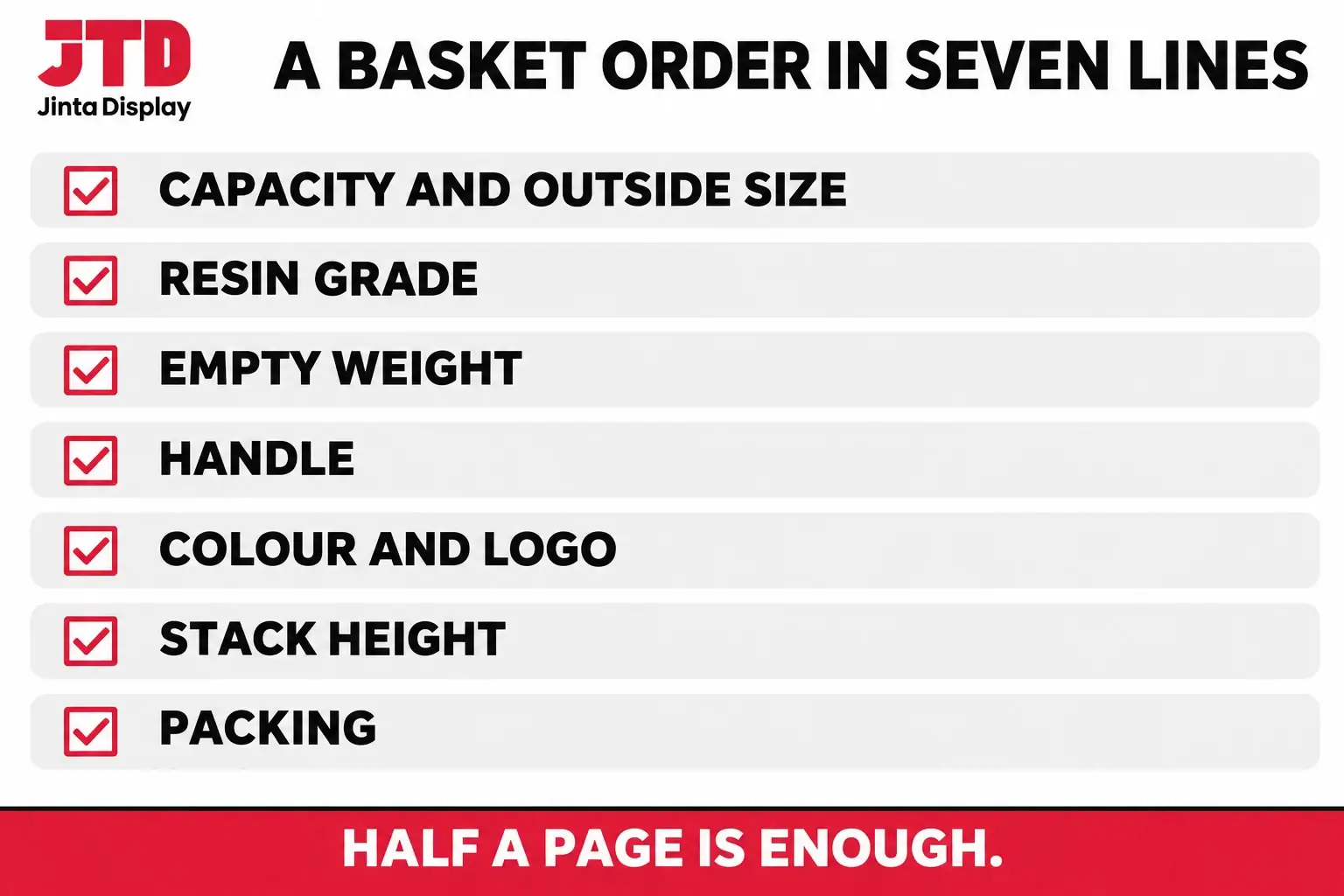
A plastic shopping basket is bought from a short specification, and most of the problems buyers report a year later could have been caught on that sheet. These are the lines worth writing down before a plastic basket order is placed.
Capacity and outside size. Give the rated capacity in liters and the outside length, width and height in millimeters. The outside size is what has to fit the stand and the shelf, and the capacity is what the shopper can load. Our 43 L basket is 560 × 400 × 430 mm outside, so the two numbers describe different things.
Resin and grade. Name the plastic. Our pages list PP and HDPP, and a supplier should be able to say which grade goes into the basket and whether it carries a recycled share. A plastic hand basket that is moulded from a weak grade looks the same on delivery day and splits at the rim within a season.
Empty weight. Ask for the net weight of the model and check it against 0.03 to 0.05 kg per liter. A 28 L hand basket should be near 0.95 kg, as ours is, and a quote that says 0.6 kg for the same size deserves a question about wall thickness.
Handle. Ask how the handle is attached and what it is rated to carry. A fixed handle moulded into the wall is stiff and a folding handle saves stack height, and each has its own failure point. Say how much weight a shopper will actually load, because an 8 kg load on a handle built for 5 kg is the usual cause of a broken basket.
Colour and logo. Name the colour by a reference code and say where the logo goes and how large it is. Our product pages list colour as customized and say that a logo can be printed. Confirm whether the colour is mixed into the plastic or applied on top, because colour mixed into the body does not wear off.
Stack height. Ask for the height of 10 baskets and of 20, so the stand and the shelf can be checked against a real number. This is the nesting pitch from the stacking section, written as the figure a store actually needs.
Packing. Our product pages list pearl cotton and foam for some baskets and plastic wrapping film and steel belt for others, with 15 days of production time and FOB, CNF and CIF terms. Ask how many baskets go in a carton and a container, because a nested basket packs far more densely than an empty box suggests.
A good plastic shopping basket order fits on half a page. The same seven lines, adapted, also work as questions for a wire or metal supplier, with the resin line replaced by wire diameter and coating and the handle line replaced by weld count.
Which Material for Which Store
The choice usually comes straight from the store. The table below pairs store types with the material that fits them, from the principles above and from the baskets we build.
| Store | Fits best | Reason |
|---|---|---|
| Convenience store, small shop | Plastic, 18 to 28 L | Light to carry, quiet, store colour and logo |
| Pharmacy | Plastic, 18 to 22 L | Quiet, easy to wipe, light for small purchases |
| Supermarket entrance | Plastic, 34 to 45 L | Colour and logo at the point every shopper passes |
| Heavy goods, narrow aisles | Plastic rolling, 60 L | Wheels carry the weight, and less floor than a cart |
| Warehouse club, trade counter | Wire or metal, size varies | Stronger for dense loads, and the brand matters less |
| Wet or cold displays, hot washing | Check the material in use | Water, cold and heat each limit one of the three |
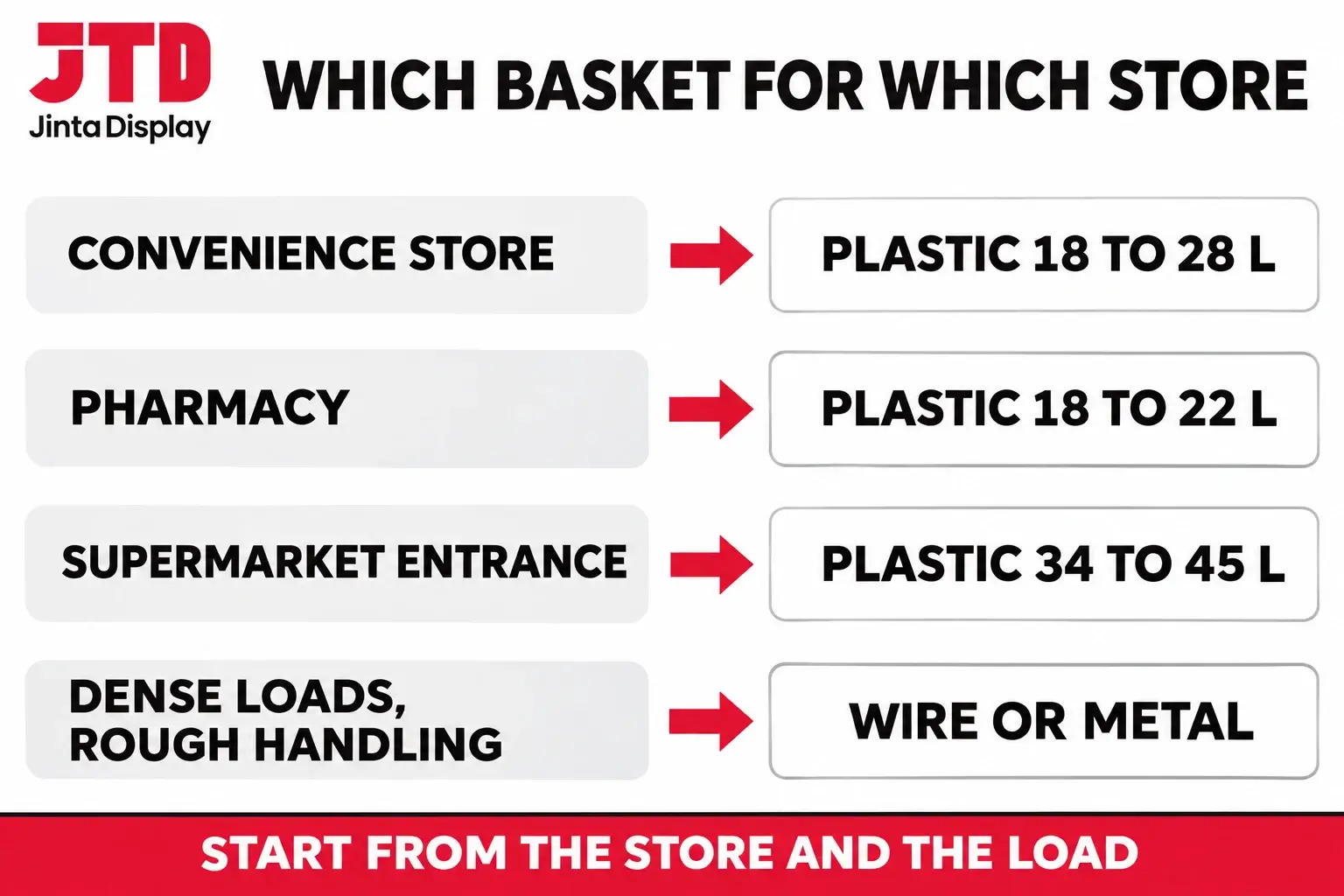
A plastic shopping basket dominates the first four rows because most of those stores want a light basket, a branded colour and a quiet floor. Wire and metal earn their place where the load is dense, where baskets are handled roughly and where the basket is a tool and not a brand surface. A store that mixes both can use plastic at the entrance and wire in a stockroom or a back area.
Watch a Short Video
Our channel has a short video on the difference between a shopping cart and a basket, which is a useful picture for a buyer who is deciding what to put at the entrance.
Mistakes First-Time Buyers Make
Four mistakes come up again and again, and each one is cheap to avoid.
The first is ordering by picture. Two baskets that look the same can differ in wall thickness, resin grade or wire gauge, and the difference shows up only in use. Ask for the net weight and divide it by the capacity.
The second is ignoring the climate. A basket that is fine in a mild store can crack in a cold chain environment or warp in a hot storage room. Say where the baskets will live.
The third is leaving the nesting pitch out of the specification. A basket that is the right size and stacks too tall for the entrance stand is the wrong basket. Ask for the stack height of 10 and of 20.
The fourth is choosing wire for branding or plastic for heavy loads without checking. Each material has a job, and using it for the other job is the usual source of complaints a year later.
How to Order Baskets and What to Send
A short message gets a useful reply. Send the store type, the quantity, the capacity you have in mind, the colour and logo, and the climate the baskets will live in. For plastic baskets we reply with the model, the capacity, the external size, the net weight and the production time. For the full size ranges, see our shopping basket range, and for the 43 L supermarket model see the 43 L plastic basket page.
If you are choosing between basket materials for a store, send us your store type, quantity and climate and we will reply with the plastic models and figures that fit.
Frequently Asked Questions
What is the difference between a plastic and a wire shopping basket?
A plastic basket is moulded in one piece, is quiet, takes colour through the whole body and can carry a printed logo. A wire basket is welded from coated steel wire, has an open mesh and gives little room for branding. Plastic suits stores that want a light branded basket and wire suits dense loads.
Is a metal shopping basket better than plastic?
Not in general. A metal shopping basket is stronger for dense loads and does not crack, but it is noisier, can dent or rust, and gives little room for branding. Plastic is lighter and quieter and suits most convenience stores and supermarkets. We build plastic baskets only.
How much does a plastic shopping basket weigh?
In our range an empty plastic shopping basket weighs 0.52 kg at 18 L, 0.95 kg at 28 L, 1.65 kg at 45 L and 2.5 to 2.99 kg for a 60 L rolling basket. That is about 0.03 to 0.05 kg per liter of capacity, which is a useful check on any plastic basket quote.
What is a plastic hand basket made of?
Most are injection moulded from polypropylene, and our product pages list PP and HDPP. Polypropylene is light, takes colour through the body and does not rust. It turns more brittle in the cold, so ask for the resin grade if the baskets will be used in a chilled area or a cold climate.
Do wire shopping baskets rust?
They can. Wire baskets are steel with a coating, and once the coating is scratched or worn the steel underneath rusts. Zinc, powder and plastic dip coatings last differently. Ask for the coating type and thickness, and check that the welds are coated as well as the straight wire.
Which basket is best for a convenience store?
A plastic basket of 18 to 28 L is the usual choice. It is light to carry, quiet at the counter and can be moulded in the store colour with a printed logo. In our range these baskets weigh 0.52 to 0.95 kg, so a shopper carrying goods adds little weight of their own.
How do I choose between plastic and wire baskets for a supermarket?
Choose from the way the baskets are used. At the entrance, where branding and a light basket matter, plastic is the better fit. In a stockroom or a trade counter where loads are dense and handled roughly, wire is stronger. Check the net weight, the nesting pitch and the climate for either.
Can you make a wire or metal shopping basket?
No. The shopping baskets we build are all plastic, in sizes from 18 to 60 L. We make metal shopping carts, and the baskets on our site are moulded in PP or HDPP. For wire or metal baskets you would need another supplier, and the questions in this guide still apply to them.