
Choosing between shopping cart suppliers is harder than it looks, because the product gives so little away. A cart is formed wire, a tubular chassis, four casters and a handle. Two suppliers can send photographs of the same silhouette while one uses thinner wire, a lighter coating and cheaper wheels. Nothing on the web page shows the difference. It shows up in the store two years later.
This guide is a method for comparing suppliers, written by a manufacturer that expects to be compared. It covers how to tell what kind of supplier you are talking to, what to ask for in writing, how to judge a sample and what a quotation should contain before you pay a deposit. It does not cover price, because that depends on steel, finish and freight and is explained in our guide to how much a shopping cart costs. It does not cover sizes either, which are in the guide to shopping cart dimensions, weight and capacity.
Where a statement is about our own range, it comes from our product pages and is marked as ours. Everything else is a buyer method that works with any supplier, including ones that compete with us.
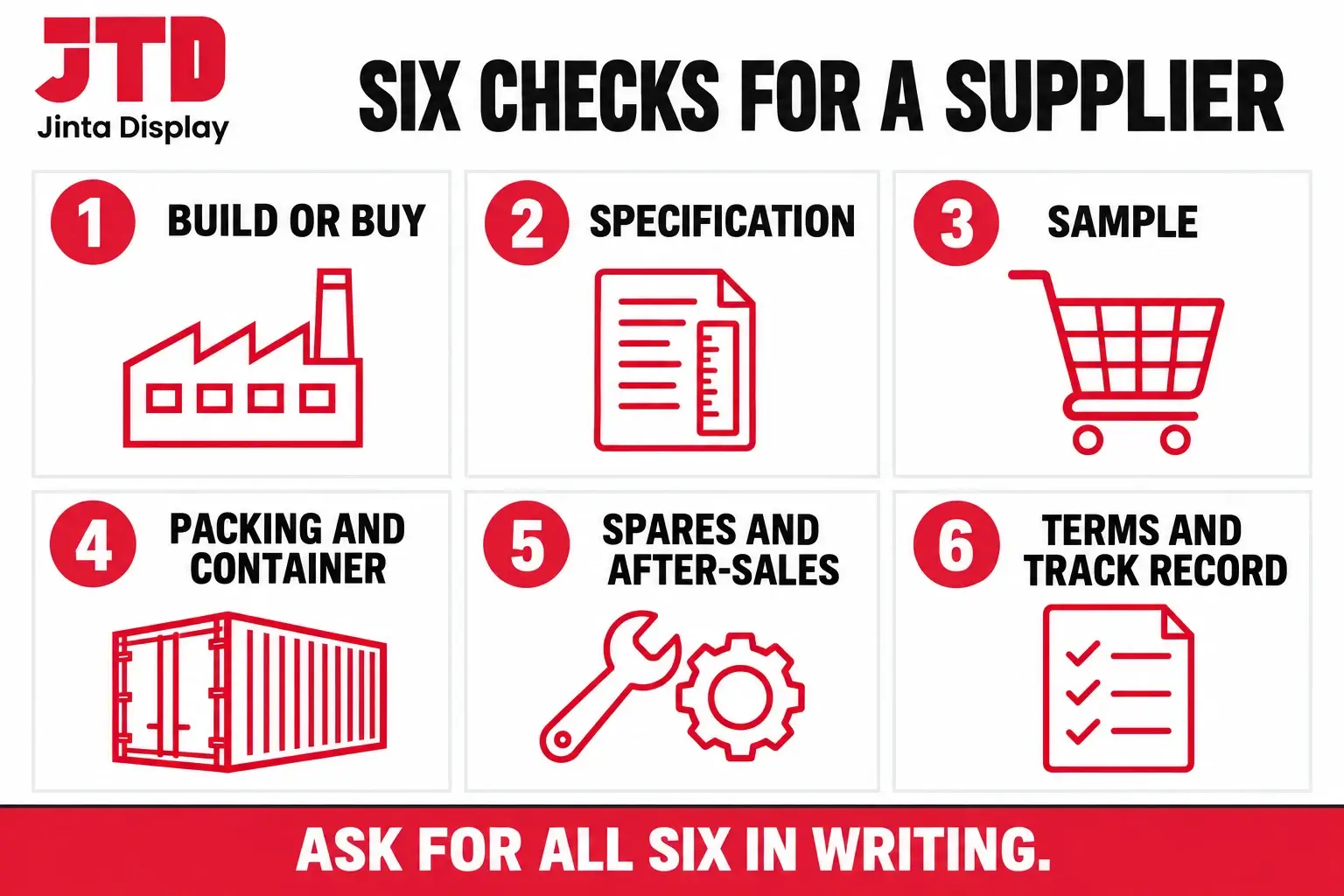
Three Kinds of Shopping Cart Suppliers and What Each One Can Tell You
Start by deciding which kind of supplier you are dealing with, because it changes what you can ask them and who will answer. The three groups overlap, and the same website can belong to any of them.
| Supplier type | What they do | What they can answer | What to watch for |
|---|---|---|---|
| Factory | Forms, welds, plates and assembles the cart | Wire diameter, tube wall, finish process, tooling, production time | Fixed styles and minimums that suit their own line |
| Trading company | Buys carts from one or several factories and resells | Price, shipping, mixed orders from several makers | Cannot change the specification and may not know it |
| Local distributor | Stocks carts in your country and sells in small lots | Delivery time, local service, returns | Margin and handling in the price, limited customizing |
None of the three is wrong. A distributor is the right choice for eleven replacement carts. A trading company is useful when you need carts, baskets and counters from several makers in one shipment. A factory is the right choice when you need a specific style, a color or a printed logo, and when the specification has to stay the same across repeat orders.
The problem comes when a buyer believes they are talking to a factory and they are not. Shopping cart manufacturers and shopping trolley manufacturers all describe themselves as factories on their pages, and the first check exists to find out who actually makes the product.
Where to Find Shopping Cart Suppliers and How to Build a Shortlist
Buyers usually find shopping cart suppliers in four places. Trade directories and marketplaces list the most names and carry the least verification. Trade fairs let you handle carts and meet the people who build them. Referrals from other retailers or fit-out contractors carry the most weight, because the referrer has already lived with the cart. Direct web search finds the suppliers who publish detailed pages, which is itself a useful filter.
Search with several names, because the same business appears under different words. Shopping cart manufacturers, retail cart manufacturers, grocery cart suppliers and shopping trolley manufacturers are all names for suppliers of the same product, and each market prefers a different one. A buyer in the UK or Australia searches for trolleys, and a buyer in the United States searches for carts.
Keep the shortlist to three to five suppliers. Fewer than three gives you no comparison, and more than five means you will not read the replies carefully. Send the same brief to each one and score the answers with the same six checks. The first reply often tells you more than the price, because a supplier that answers precisely and asks about your aisle width is working on your project and not copying a catalog line.
Check One, Does the Supplier Build the Cart or Buy It
The question is simple and the answers are revealing. When a shopping cart manufacturer says it builds the cart, ask which steps happen in its own plant. A cart passes through wire and tube cutting, forming, welding of the basket and chassis, surface finishing, plastic parts, casters and final assembly. It is normal for a factory to buy casters, plastic moldings and sometimes plating from specialist makers. What matters is that the supplier controls the specification of those parts and can say who makes them.
Ask for evidence that a trading company cannot easily produce. A short video of the welding of a basket to a chassis, taken today and not copied from a catalog, is one example. The factory address and a willingness to receive a visit is another. A third is a production time that matches the line, such as the 15 days listed on each of our shopping trolley pages, together with an explanation of what that time covers.
A quick test is to ask for a small change. Ask whether the handle color, the basket height or the printed logo can be altered, and what it does to the minimum quantity. A factory can answer in minutes and explain the setup. A trader usually has to go and ask. Neither answer disqualifies a supplier, but it tells you who you will be negotiating with when something goes wrong with the order.
Our own position is stated on the product pages. We build our carts in Changshu, China, and the pages list the material, net weight, capacity range and production time for each style. We also say that dimensions, finish and fittings are confirmed on the drawing for each order, because they change with the style and the options.
Check Two, Read the Specification and Not the Photograph
A specification sheet is the main document for comparing shopping cart suppliers, and the useful ones list the same items. Ask every supplier to fill in the same table, and compare line by line.
| Item | Why it matters | What a vague answer looks like |
|---|---|---|
| Basket capacity in liters and external size | Sets the aisle fit and the trolley bay length | Only a size class such as large |
| Empty net weight per cart | A proxy for the amount of steel | No weight given |
| Wire diameter and chassis tube size with wall | Decides how the cart ages at the welds | Says heavy duty with no numbers |
| Finish by process name and thickness | Decides corrosion life | Says plated or galvanized only |
| Caster diameter, tread and swivel layout | Decides noise, rolling effort and complaints | Says industrial casters |
| Nesting distance and units per container | Decides bay length and freight | No figure on the sheet |
| Assembly state and packing | Decides labor on your side and damage in transit | Not stated |
Our product pages list the material, the capacity range and the net weight of each style. For example, the net weights of our plastic bodied trolleys on a Q195 carbon steel frame run from 18.4 kg at 100 L to 24.5 kg at 200 L, and the metal styles are listed as zinc plus clear coat or chrome plate. Wire diameter, tube wall, coating thickness, caster detail and the external dimensions are not on those pages, and we confirm them on the drawing for the order. That is a fair way to read any supplier. If a number is not on the page, ask for it in writing before you compare prices.
The weight is the quickest cross-check. If a supplier quotes a cart that is much lighter than the published weights for the same capacity and style, the difference is in the steel. The weights for every style we build are in the guide to shopping cart dimensions, weight and capacity, and they make a useful benchmark for any quotation, ours included.
Check Three, Judge a Production Sample Against the Sheet
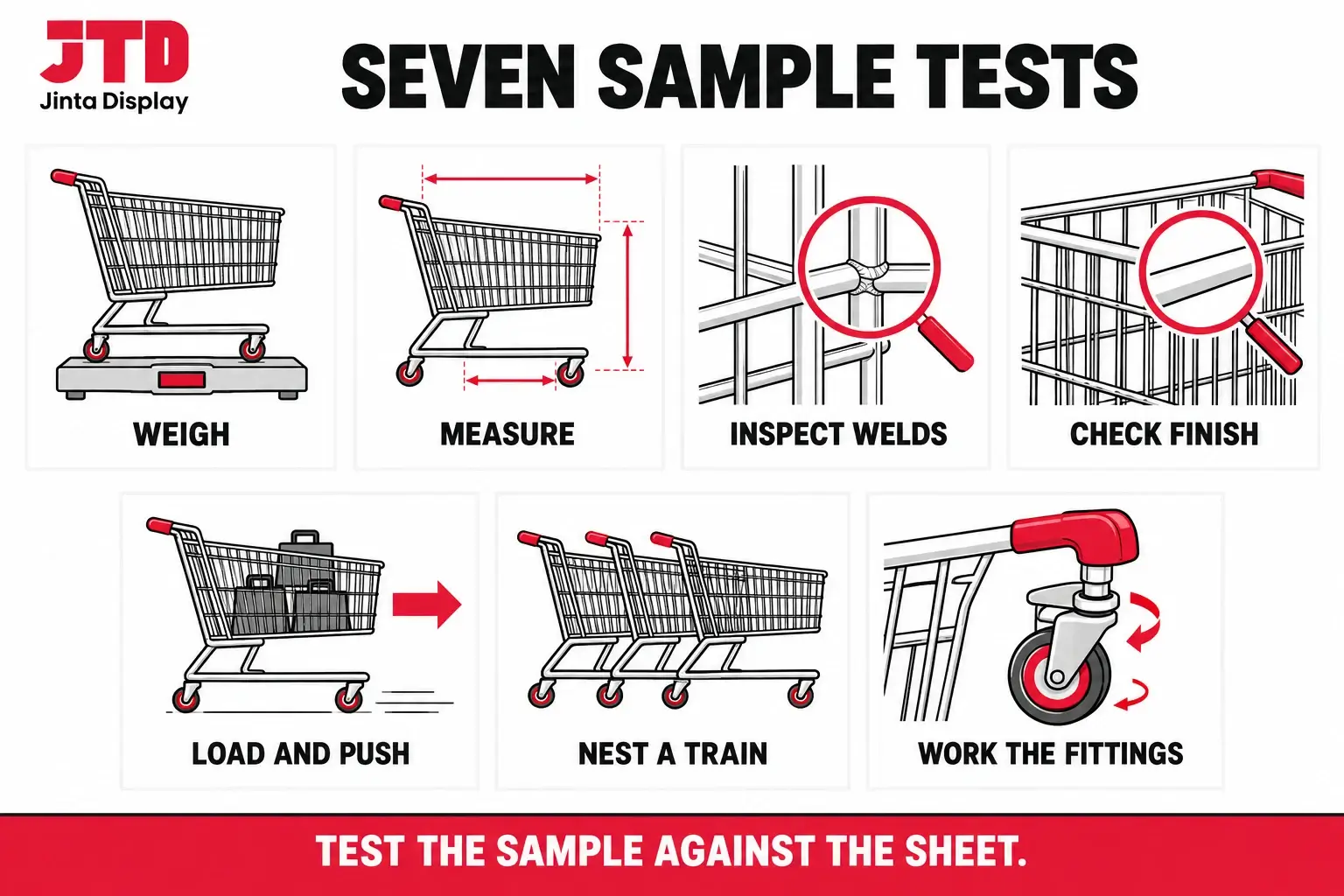
A sample is where a specification becomes physical. The point is to compare the cart in your hands with the numbers on the sheet. Ask whether the sample comes from the production line or was made by hand for show, because a handmade sample proves little about the container that follows.
| Test | How to do it | What to look for |
|---|---|---|
| Weigh it | Put the empty cart on a scale | Weight close to the sheet, not far below |
| Measure it | Length, width, height, basket depth and wire | Within the stated tolerance |
| Inspect the welds | Look at the basket to chassis joints and the handle joints | Even beads, no gaps, no sharp edges |
| Check the finish | Look at weld points, bends and wheel mounts | Even coverage, no bare steel at the corners |
| Load and push | Fill the basket with test weights and push on your own floor | Straight tracking, low noise, no flex at the joints |
| Nest a train | Push ten carts together and measure the train | Length matches the stated nesting distance |
| Work the fittings | Fold the child seat and use the lock many times | Smooth action, no loose rivets |
Run the nesting test even if the carts will not be nested often. A cart that nests poorly ships fewer to a container and takes more floor space in the trolley bay, and the buyer pays for both without seeing it on the quotation. The coating needs the same attention, because the wire looks the same until it starts to rust. For carts that will stand outdoors, ask for the test method and the result for the finish, and compare it with the conditions in your market.
Third-party inspection is an option when you cannot test a sample yourself. An inspector can weigh, measure and photograph a sample and report against your sheet. The cost is small next to a container order, and the report becomes part of the file.
Keep the sample after the order. It becomes the reference against which the first container is checked, and it settles arguments about what was agreed. Photograph it, mark the date and store it where it stays dry.
Check Four, Packing, Container Quantity and Lead Time
Freight is part of the supplier’s work and not an afterthought. A supplier who knows the cart can tell you how many fit in a 20 ft and a 40 ft high cube container for the exact style and whether they ship assembled or knocked down. A supplier who says it depends and offers nothing more has probably not loaded the cart before.
Published data sheets from cart makers show anything from about 300 to about 800 carts per 40 ft high cube, so a single figure from a supplier should come with the basis for it. Ask for the basket size, the nesting distance and the assembly state behind the number. Our pages list packing in pearl cotton and foam, and price terms of FOB, CNF and CIF. The count for your configuration is given with the quotation.
Lead time deserves the same care. Our shopping trolley pages list a production time of 15 days. That is time on the line after the order details are confirmed and not the time from the first email. Separate three clocks when you compare suppliers. The first is the time to agree the specification and the drawing. The second is production. The third is shipping to your port and customs clearance. A supplier who quotes the first two together and says nothing about the third is not lying, but the buyer should plan with all three.
How Shopping Cart Suppliers Handle Customization
Customization is where the difference between a factory and a trader shows most clearly, and it is also where minimum quantities rise. Colors, printed logos, handle styles, advertising frames and basket heights all change the line setup. Good shopping cart suppliers will tell you what each change costs in minimum quantity and lead time before you ask for a price.
Ask for the change to be shown on a drawing, with the color named against a reference and the logo size and position marked. Our shopping trolley pages list a printed logo as a standard feature and OEM color and branding as an option. The approved drawing then becomes part of the order, and the first container is checked against it. Without a drawing, a color described in an email will vary from one batch to the next.
Keep customization modest on a first order. A standard style with one color and one logo is easier to repeat exactly than a long list of options, and repeating exactly is what a fleet needs. Add options once the first container has shown that the supplier holds the specification. Experienced shopping cart suppliers will often say the same thing, because they have seen long option lists go wrong.
Check Five, After-Sales Support and Spares
A cart fleet is a long-term asset with consumable parts. Casters wear in daily service, plastic handles crack and child seat fittings loosen. What a supplier does after the container is delivered tells you more about their quality than their brochure does.
Ask four questions. Are spare casters, handles and fittings available, and are they the same parts as on the cart you bought? Does the supplier hold the same specification in later years, so a replacement cart will nest with the first fleet? What does the warranty cover, and in particular does it cover casters, which are the part most often excluded? How is a fault handled, with photographs and a replacement part shipped, or only with a return?
Order spares with the container. A buyer who waits until the first caster fails pays retail price in the local market and often cannot match the tread or the stem. Even a few percent of spare casters ordered with the fleet turns a service problem into a routine job.
Check Six, Terms and Track Record
The last check covers the commercial side. Read the quotation for what it includes, what it leaves out and who carries the risk at each stage, and apply the same reading to every one of the shopping cart suppliers you compare. The trade terms on our product pages are FOB, CNF and CIF, and each one moves the responsibility for freight and insurance to a different point. A supplier should be able to explain which they are quoting and what the price excludes, including duty and clearance at your end.
Ask for references that match your case. A factory that has supplied store fit-outs and chain stores can show projects, and a supplier that only sells a catalog may not. Our project page shows supermarket fit-outs including a regional chain in China and department supermarkets in Saudi Arabia, with gondola bays, wall shelving and checkout units made to one specification across locations. A buyer comparing suppliers should look for the same thing in any supplier, which is evidence that the specification was held across more than one order.
Put the agreement in writing. The final specification sheet, the drawing, the approved sample, the packing method and the container quantity should be attached to the order, so that the container can be checked against a document and not against memory.
Evaluating Shelving and Fit-Out Suppliers Uses the Same Checks
Many buyers source carts and shelving together, and the six checks carry over with different evidence. A supermarket shelving supplier should state the steel thickness of uprights, back panels and shelves, the surface treatment, the bay length, depth and height, and the load rating per shelf. The weak points in shelving are not wire and welds but the accessories. Hooks, brackets, end panels and price channels have to be compatible across orders, and the slot pitch has to match between the first delivery and a reorder two years later.
For shelving, ask the supplier to match the color to a reference and to say how the batch will be kept consistent. Powder coat color differences between batches show up from the entrance of a store. The sizing questions are covered in the guide to gondola shelving sizes, and the order of purchases for a whole store is in the supermarket equipment list. If one plant supplies carts, baskets, shelving and counters, the sizes and finishes agree when the container is opened, which is the practical reason to evaluate one supplier on all four lines. Our supermarket shelving, shopping trolley, shopping basket and checkout counter ranges are built in one plant for this reason.
Red Flags in a Quotation
Several patterns in a quotation are worth a second question. None proves a problem, and each one asks the supplier to clarify.
The first is a weight far below the published weight for the same style, which points to thinner steel. The second is a finish described only as plated or galvanized, with no process name or thickness. The third is a container quantity with no basis. The fourth is a quotation that lists only the cart with no caster, fitting or packing detail, so the comparison is between different scopes. The fifth is a price that is much lower than the rest with no explanation. A cart that costs half as much as three other quotations is made of something, and the buyer should know what.
The sixth is reluctance to put the specification in writing or to send a production sample. The seventh is a supplier who cannot say where the cart is made. Any one of these is a reason to ask more before paying a deposit.
A Scorecard You Can Copy for Shopping Cart Suppliers
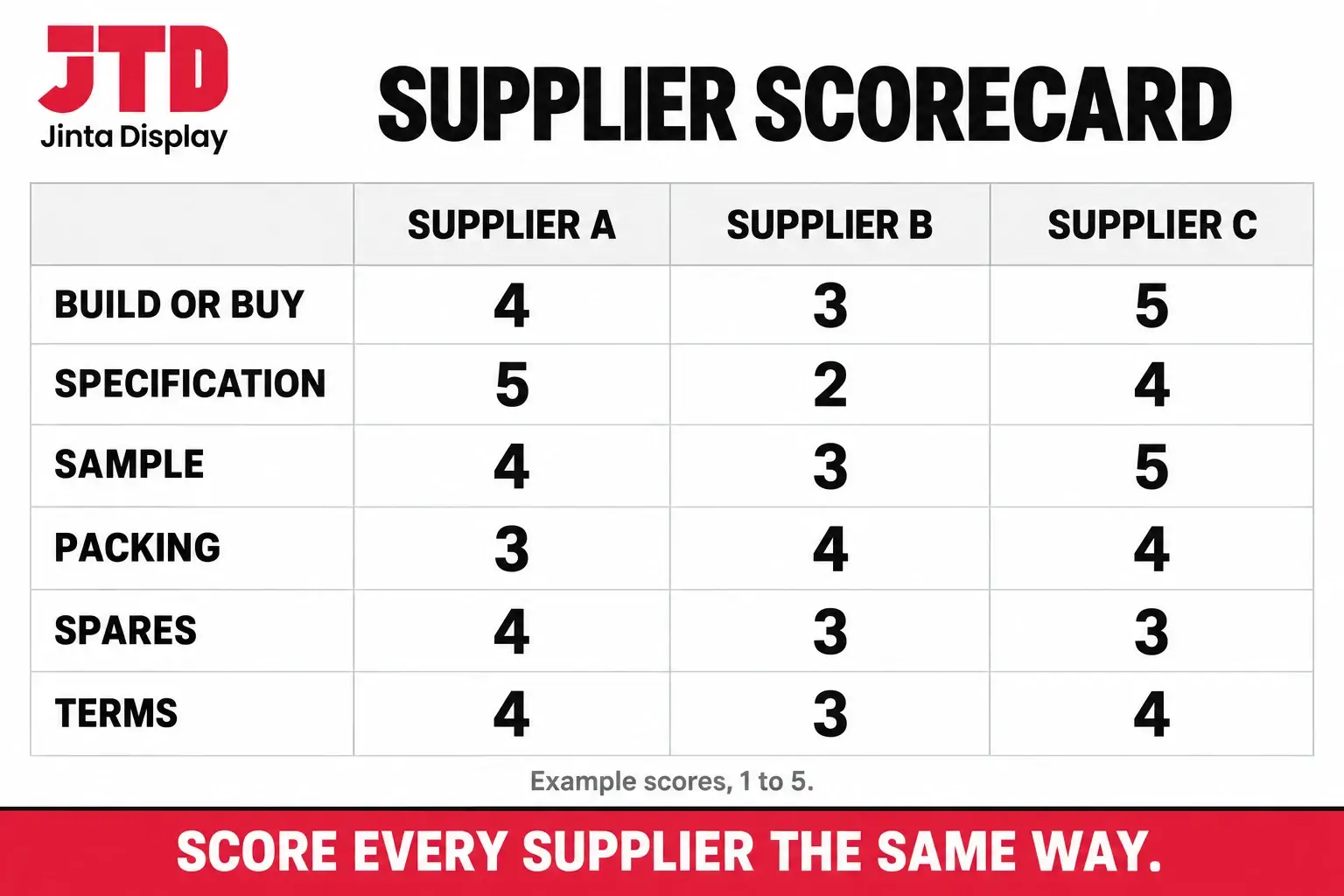
Score each of the shopping cart suppliers from one to five on every line, and write the evidence beside the score. A supplier with no evidence for a line scores one for that line, whatever they say.
| Check | Evidence to ask for | Weight |
|---|---|---|
| Builds or buys | Factory address, process video, change request answered | High |
| Specification | Completed table with wire, tube, finish, casters and nesting | High |
| Sample | Production sample and test results against the sheet | High |
| Packing and container | Units per 20 ft and 40 ft high cube with the basis | Medium |
| Spares and after-sales | Spare parts list, warranty terms, fault procedure | Medium |
| Terms and track record | Trade terms explained, references, written agreement | Medium |
Weight the lines to suit your case. A chain buying a fleet for forty stores should weigh the sample and the track record most. A distributor buying for resale may weigh packing and spares most. Whatever the weights, a supplier who scores one on any of the high lines should not receive the first order.
What a First Order Should Look Like
A first order with a new supplier should be built to learn, and not only to buy. Many buyers place a small trial order, or a first container that is deliberately simple, before committing a fleet. The trial shows how the supplier handles the drawing, the packing, the documents and the questions that come up along the way.
Agree the inspection rights before you pay. Decide who will check the cart against the approved sample before the container is loaded, whether that is your own staff or a third party, and what happens if the cart does not match. Agree how photographs of the loading will be sent. Tie the final payment to a check you have the right to make, and write that into the order.
Check the first container against the sample and the sheet on arrival. Weigh several carts, count the units against the packing list, inspect the finish at the weld points and run the nesting test again. Raise any difference at once, with photographs, because a claim made weeks later is harder to settle. If the first order matches, the repeat orders become routine and the specification stays fixed across the fleet.
What to Send When You Ask for Quotations
Suppliers answer in different formats unless you give them one. A short brief gets comparable replies. State the style you want, the capacity in liters, the finish you expect and the fittings, such as a child seat, a coin lock or an advertising frame. Give the quantity, the destination port and the date you need the fleet. Add the aisle width and the length of your trolley bay, which let the supplier check the fit and the nesting. Ask every supplier to return the specification table above, the weight per cart, the units per container, the lead time and the terms.
Send the same brief to three suppliers and score the replies. The best replies are often from the supplier who asks you questions back.
If you are comparing suppliers, send us your style, quantity and destination port and we will reply with a specification sheet, the net weight and a quotation.
Frequently Asked Questions
How do I choose between shopping cart suppliers?
Work through six checks with each of the shopping cart suppliers on your shortlist. Confirm that the supplier builds the cart, read a written specification, test a production sample, ask for container quantity and lead time, check spares and warranty, and read the terms and references. A supplier that answers all six in writing is a reasonable choice for a first order.
How can I tell a shopping cart factory from a trading company?
Ask for a current video of the welding line, the factory address and an answer to a small change, such as another handle color or a printed logo. A factory can name its minimum and its setup in minutes. A trading company usually needs to check with its maker. Both are legitimate, but they are different conversations.
What should a shopping cart specification sheet include?
It should list basket capacity, external size, empty weight, wire diameter, chassis tube size and wall, finish by process and thickness, caster diameter and tread, swivel layout, nesting distance, assembly state, packing and units per container. If any of these is missing, ask for it in writing before comparing prices between suppliers.
Should I order a sample before a full order?
Yes, and ask for a production sample and not a handmade one. Weigh it, measure it, inspect the welds and finish, load it and push it on your own floor and nest a train of carts. Keep it as the reference for checking the first container. Agree who pays for the sample and its freight before it ships.
How long does it take to get shopping carts from China?
Plan three separate times. Our shopping trolley pages list a production time of 15 days, and that starts after the specification and drawing are confirmed. Add the time to agree the details and the shipping time to your port, plus customs clearance at your end. Ask any supplier to quote each stage and not one total.
What is the minimum order for wholesale shopping carts?
It depends on the configuration and not only on the supplier. On our trade listings the minimums for shopping trolleys run from 10 pieces on some catalog models to a few hundred on others. Custom sizes, colors and printed logos carry higher minimums because the setup has to be spread across the order.
Can one supplier provide shopping carts and shelving?
Yes, and it has a practical benefit. We build carts, baskets, gondola shelving and checkout counters in one plant, which keeps sizes and finishes consistent when the container is opened. Evaluate each line on its own evidence, because strength in carts does not prove strength in shelving.
What are the red flags when comparing shopping cart quotations?
Watch for a weight well below the published weight for the style, a finish described only as plated or galvanized, a container quantity with no basis, a quotation that leaves out casters or packing, and a price far below the others. Also watch for any supplier who will not put the specification in writing or send a production sample.