
A shopping cart is made of steel and plastic, and that is the short answer. The long answer is where the value sits. What a shopping cart is made of decides how long a cart lasts, how it weighs, how it nests, what it costs to ship and where it fails first. A buyer who knows the parts and the order in which they are made can read a quotation properly, and can see which line hides a saving.
This guide goes through the material in each part of a cart, then the typical production route from raw wire and tube to a packed cart. It is written from the manufacturing side. Where we describe our own carts, the details come from our product pages. Where we describe the general industry, it is marked as a typical practice and not as a rule, because plants differ in which steps they do themselves.
It does not cover price, which is covered in the guide to how much a shopping cart costs, or sizes and weights, which are in the guide to shopping cart dimensions, weight and capacity. This page is about material and construction.
What Are Shopping Carts Made Of, Part by Part
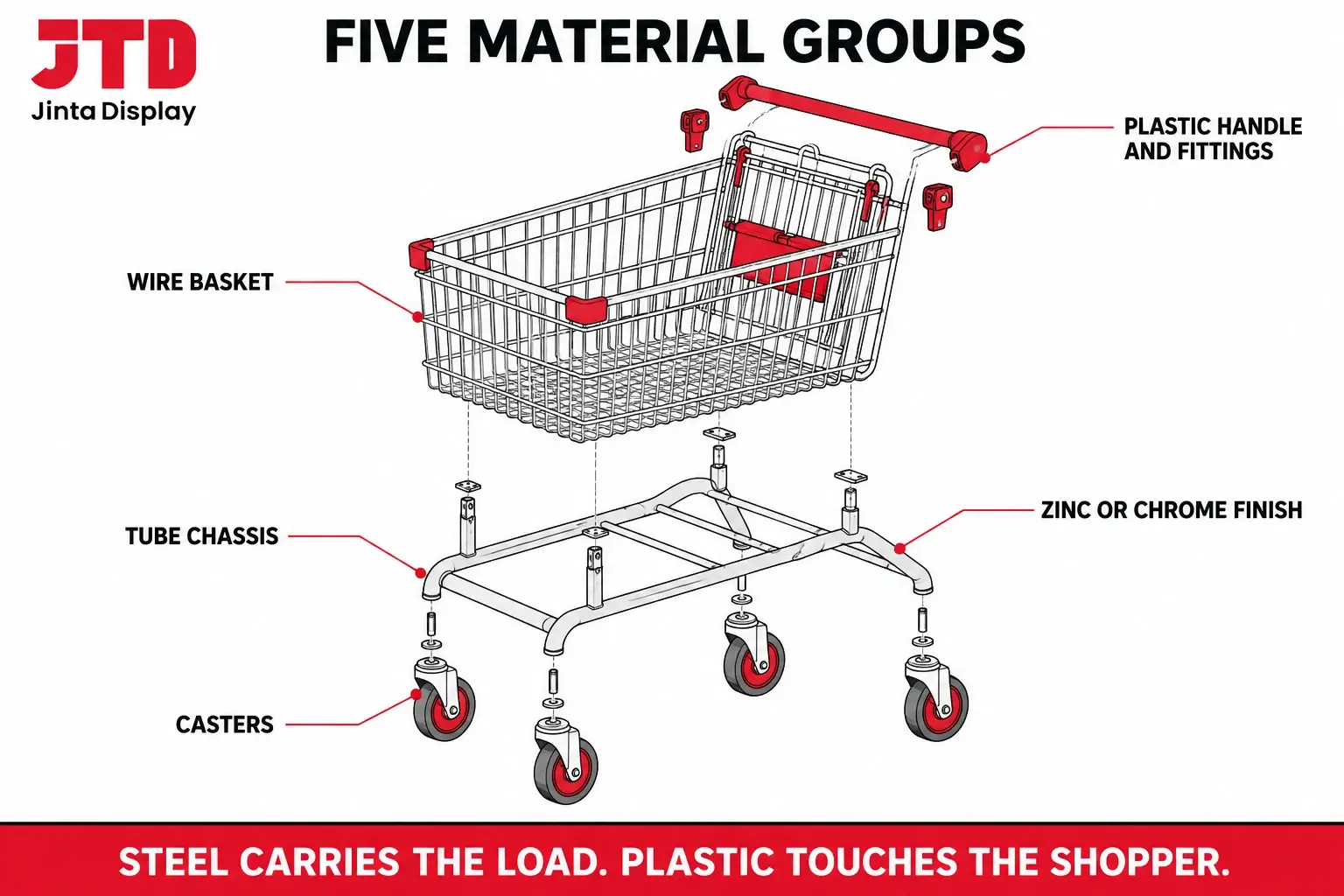
Every cart, whatever its regional style, is built from the same list of parts. The table below names the material in each one, the reason for the choice and the place where a cheaper version usually shows up.
| Part | Typical material | Why it is used | Where a cheaper version shows |
|---|---|---|---|
| Basket | Low-carbon steel wire, welded into a grid | Strong, light, easy to clean and see into | Thinner wire, fewer cross wires |
| Chassis | Low-carbon steel tube, bent and welded | Carries the basket and the pushing force | Thinner tube wall, weak joints |
| Finish | Zinc, chrome, powder coat or hot-dip zinc | Stops corrosion and gives a color | Thin plating, rust at welds |
| Casters | Polypropylene, TPR, polyurethane or rubber tread on a steel stem | Rolls quietly and carries the load | Hard tread, weak bearings |
| Handle and fittings | PVC or molded plastic, steel or plastic child seat | Comfort, safety and branding | Brittle plastic, loose hinges |
| Plastic body, on plastic bodied models | Polypropylene and polycarbonate, injection molded | No corrosion, molded in color | Thin walls, poor color stability |
The pattern is that almost everything structural is steel, and almost everything the shopper touches is plastic. Steel carries the load and plastic handles the contact. This is why a quotation that says only steel and plastic has not told you anything useful. The grade, the gauge and the process behind each word are where the difference lies.
What Metal Are Shopping Carts Made Of
Almost all commercial shopping carts are made of low-carbon steel. It is cheap, it forms easily, it welds cleanly and it takes a plated or coated finish well. Stainless steel is used in special cases such as food service or very corrosive environments, and aluminum appears on some luggage trolleys and lightweight carts. Neither is the normal choice for a supermarket cart, because the cost is higher and the weld and forming behavior is different.
Our own plastic bodied trolleys list Q195 carbon steel for the frame. Q195 is a Chinese structural steel grade named for its minimum yield strength of 195 megapascals. It is a soft, ductile, low-carbon grade, and that is exactly what a bending and welding process wants. A harder steel would be stronger but would crack on a tight bend or distort when welded, and the cart does not need that strength. The geometry of the frame, and not the hardness of the steel, gives the cart its stiffness.
The grade matters less than the gauge. A wire diameter or a tube wall that is a fraction of a millimeter thinner changes the steel content and the lifetime of the joints, even when the grade is the same. This is why net weight is a useful cross-check. The weights of every metal style we build are published in the guide to shopping cart dimensions, and a quotation well below them is describing less steel.
The Basket, Made From Welded Steel Wire
The mesh basket is the part most people picture. It is built from steel wire that is straightened, cut to length and laid out as a grid of long and cross wires. The crossings are resistance welded, which means a current passes through the crossing and fuses the two wires without any filler. The flat grid is then formed into the basket shape, with the perimeter wires bent and welded at the corners.
Industry basket wire typically runs about 4.5 to 6.5 mm in diameter, with the perimeter and load-bearing wires heavier than the infill. These are published industry ranges and not our specification, which we confirm on the drawing for each order. Wire is chosen for the load the basket must carry and for the gaps between wires, because the gap decides whether small items fall through and whether a hand can be caught.
Weld quality is the real test of a basket. A good crossing is fused evenly and does not break when the wire is flexed. A poor one is cold or uneven, and it opens up in the first years of service. The place to look is the joint between the basket and the chassis, where the wire meets the tube and the forces concentrate.
The Chassis, Made From Bent and Welded Tube
The chassis is the frame under the basket that carries the casters, the handle and the weight of the load. It is made from steel tube, typically 22 to 32 mm in outside diameter. That is a published industry range. A tube bending machine forms the tube into the shape of the lower frame, and the joints are welded.
The tube wall matters more than the diameter. A thin wall bends and flexes under a pushed fleet, while a thicker wall holds its shape. A tenth of a millimeter looks small on a drawing, yet it can change the steel in the frame by several percent. The chassis is also where the nesting geometry is built in, because the shape of the lower frame and the taper of the basket decide how far one cart pushes into the next.
The handle is usually a continuous tube bent into a loop, or a tube fitted with a plastic or PVC grip. The child seat, where fitted, is a folding steel or plastic assembly with a restraint strap, and it is a separate part with its own hinges and its own weakness.
The Finish Is Part of the Material
Bare steel rusts, so every cart has a finish, and the finish is as important as the steel it covers. The common choices are electro-zinc plating, zinc plating followed by powder coat, decorative chrome and hot-dip galvanizing. They differ by roughly an order of magnitude in corrosion protection, and the right one depends on where the cart stands.
| Finish | Typical use | Main weakness |
|---|---|---|
| Electro-zinc plating | Indoor, dry stores | Thin layer, rust at welds outdoors |
| Zinc plus powder coat | Indoor with color or branding | Chips at impact points |
| Decorative chrome | Front of store, high visibility | Costs more, pits if damaged |
| Hot-dip galvanizing | Outdoor bays, coastal and humid climates | Rougher surface, higher cost |
Our product pages list the metal carts as zinc plus clear coat, or chrome plate. The finish applied to a given order is a line to confirm on the quotation, because a name such as zinc plated covers very different coating thicknesses. The finish is applied after the steel is welded, so every weld, bend and tube end is covered, and it is one of the main reasons a cart that looks the same can last twice as long or half as long.
The Plastic Parts and What Our Plastic Bodied Models Use
Plastic enters a cart in three ways. The handle grip, the child seat, the casters and trim are plastic on almost every cart. Some carts replace the wire basket with a molded plastic body. And a few all-plastic carts replace much of the steel, though they are less common in commercial retail.
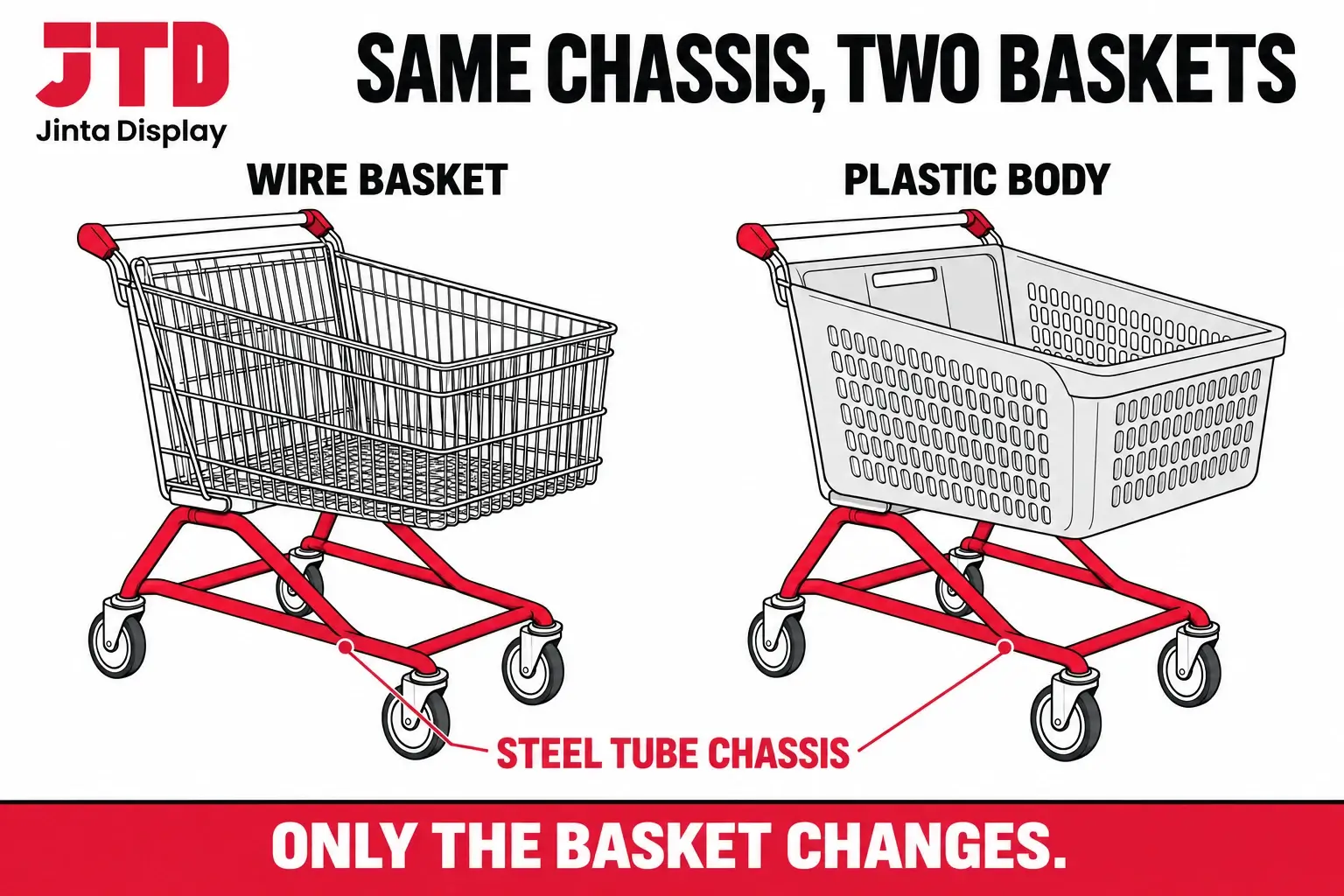
Our plastic shopping trolley pages list Q195 carbon steel together with PP and PC as materials. The plastic body is injection molded, a process in which melted plastic is forced into a steel mold and cooled. Polypropylene is a common choice for the body because it is tough, it does not corrode and it can be colored through the material and not painted on the surface. Polycarbonate is used where extra impact strength or clarity is wanted. The frame under the body is still steel.
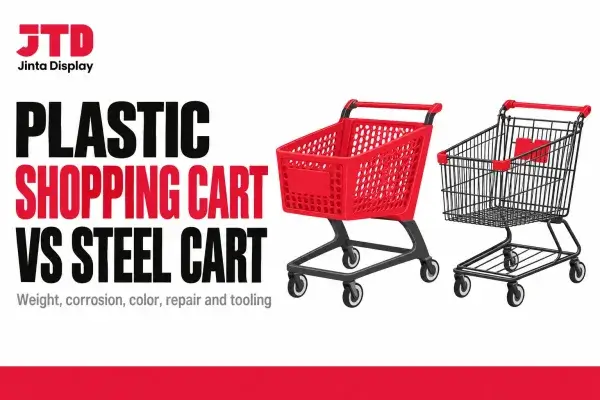
That last point surprises many buyers. A plastic bodied trolley is not much lighter than a metal one, because the frame carries the same load and is made from the same tube. Our listed net weights run from 18.4 kg at 100 L to 24.5 kg at 200 L, which is within a kilogram or so of a metal cart of similar capacity in several styles. The saving from plastic is in corrosion, color and appearance and not in weight.
The molds are the other difference. An injection mold is a large up-front tooling cost that is spread across the volume made from it. A plastic body therefore suits styles that will be made in volume, and it is one reason the minimum quantity for a custom plastic part is higher than for a standard wire cart.
Casters and Fittings
Casters are bought in and not made by the cart maker in most plants, but the choice belongs to the cart specification. A caster has a wheel tread, a bearing and a steel stem or plate. The tread is polypropylene, TPR, polyurethane or rubber, and it sets the noise, the rolling effort and the effect on floors. Commercial carts commonly use wheels of 100, 125 or 150 mm. Our trade listings show 4 in wheels in PU or rubber.
The swivel layout is a material and design decision together. Two fixed rear wheels with two swivel front wheels track straight and nest well. Four swivel wheels turn tighter but are harder to push straight on a slope. Casters wear in daily service, so a fleet should be ordered with spares of the same tread and the same stem.
Fittings are the last group. They include the child seat, the coin lock, the advertising frame, the handle grip and the lower rack. Each is a separate part with its own material and its own hinge, and each adds to the specification list. A cart with a child seat and a coin lock is a different product from a bare basket on a chassis.
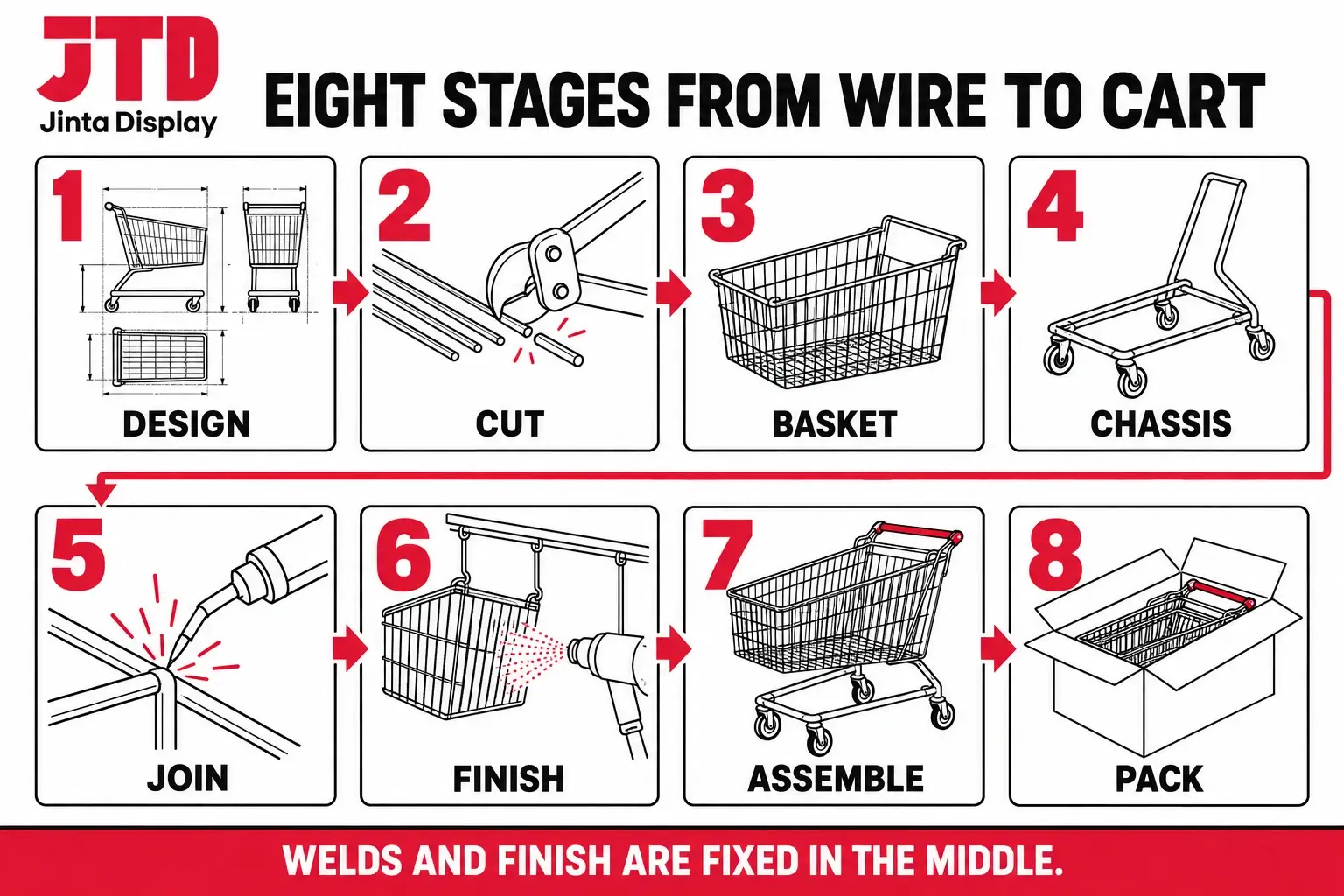
How Are Shopping Carts Made, From Wire and Tube to a Packed Cart
How are shopping carts made is easier to answer once the materials are known. The route below is the typical industry sequence for a wire cart. Individual plants differ in which stages they do in house and which they buy in, and the order can vary slightly.
Stage one is design and drawing. The style, capacity, nesting distance and options are fixed on a drawing before steel is cut. For custom orders the drawing is approved before production starts, and our product pages list a production time of 15 days.
Stage two is material preparation. Wire is straightened and cut to length. Tube is cut to length and sometimes ends are shaped. Plastic parts and casters are bought in or molded.
Stage three is the basket. Wires are laid as a grid and the crossings are resistance welded. The grid is formed into the basket shape, and the edges are bent and welded.
Stage four is the chassis. Tubes are bent on a bending machine, assembled in a jig and welded. The jig matters because it holds the frame square, and a frame that is slightly out of square will not nest.
Stage five is joining. The basket is welded to the chassis, and the handle and any supports are added. Weld quality is checked at this stage, because later stages cover the joints with finish.
Stage six is finishing. The welded frame is cleaned and degreased, then plated or coated. Zinc plating and chrome are applied in baths, powder coat is sprayed and baked. After this stage the steel is protected, and the quality of the coating cannot be improved afterwards.
Stage seven is assembly. Casters, handle grips, child seats and other fittings are fitted. Carts can be assembled completely or shipped knocked down, with the parts packed separately.
Stage eight is inspection and packing. Carts are checked, nested in trains, wrapped and loaded. Our pages list packing in pearl cotton and foam. How the carts nest decides how many fit in a container.
How Are Shopping Trolleys Made Differently in the UK and Australia
The process is the same, and only the word changes. In the UK, Ireland, Australia and New Zealand the cart is a shopping trolley or a supermarket trolley, and how are shopping trolleys made has the same answer as the one above. The differences are in style, not in process. European and Australian styles have different nesting angles, handle heights and basket tapers from American styles, and the tooling for the frame changes with the style.
We build five metal styles, American, Asian, European, German and Russian, in capacities from 60 to 240 L, plus plastic bodied trolleys from 100 to 220 L. Each style has its own bending jigs and its own frame geometry. A style change is therefore a larger change than a color change.
Where the Quality of a Cart Is Decided
Four places in the route decide how long a cart lasts, and they are the same four a buyer can check on a sample.
The first is the gauge of wire and tube, set at material preparation. The second is the weld, made at the basket and chassis stages and joined at stage five. The third is the finish, fixed at stage six. The fourth is the caster, bought in and fitted at stage seven.
Anyone asking what are shopping carts made of should also ask how thick each part is. None of these four points is visible in a photograph, and all four can be checked on a production sample. Weigh it against the published weight for the style. Inspect the welds and the corners of the finish. Load it and push it. Nest a train and measure it. A supplier who is confident in the route will welcome these checks.
The Shopping Cart Manufacturing Process and Where Plants Differ
The shopping cart manufacturing process looks the same on paper everywhere, and the differences between plants are in what is done in house. Some plants draw and weld their own wire grids. Others buy the mesh and form the baskets. Some run their own plating or powder coating lines, while others send frames to a specialist. Casters and plastic parts are bought in by most.
None of these choices is wrong. What matters is that the cart maker controls the specification of each outside part and can say who supplies it. A plant that plates in house can change the thickness for a particular market. A plant that sends frames out needs a clear instruction and an incoming check. Ask the supplier which stages are in house and which are not, and ask how the outside stages are inspected.
Volume changes the route as well. A large fleet order of one style justifies a dedicated jig and a longer run, and the per-cart cost falls. A small order of many styles spends more time on changeovers. This is one reason minimums vary by configuration. A buyer who wants a specific color and logo is asking the plant to stop a line and set it up again.
Stainless Steel, Aluminum and Other Materials You May Be Offered
Outside the normal steel and plastic cart, three other materials come up in quotations. Stainless steel is used for food service, for carts in wet or corrosive places and for some airport trolleys. It resists corrosion without a coating, but it costs more, and it is harder to form and weld in the thin sections a cart uses. For a supermarket fleet that stays indoors, it buys protection the store does not need.
Aluminum is light and does not rust. It is used on some luggage trolleys and on specialty carts where weight matters more than cost. Our airport trolley pages list stainless steel and aluminum alloy models for that reason, and they sit in a different product line from the supermarket carts.
All-plastic carts replace most of the steel with molded plastic. They are used in some markets for hygiene and noise reasons. They need large molds, they are less common in high volume retail, and they behave differently under impact. If a supplier offers an unusual material, ask for a sample and a written specification, and test it the same way as a steel cart.
Material Questions to Put on a Quotation
A quotation that names the materials precisely is easier to trust than one that names them loosely. A buyer should be able to answer what is a shopping cart made of from the quotation alone. Before you compare prices, ask each supplier to state the steel grade of the frame, the wire diameter and the tube size with its wall, the finish by process and thickness, the caster tread and diameter, and the plastic used for the body and fittings. Ask for the empty weight so you can check the figure against the published weight for the style.
Write the answers into the order. The same words on the quotation, the drawing and the approved sample leave little room for a quiet change later. If a supplier will not name the material, the quotation cannot be compared, and it is better to know that before a deposit is paid.
Matching Material to the Store
The answer to what are shopping carts made of depends on where the cart will live. An indoor cart in a dry, air-conditioned store does well on electro-zinc with a clear coat, and heavier protection buys nothing the environment will test. A cart that stands outdoors in a trolley bay in a coastal or humid market needs a heavier finish, because corrosion starts at the welds and wheel mounts.
Plastic bodied models suit stores where color matters, because the body is colored through, and where the cart is washed or exposed to moisture. Wire baskets suit stores that want visibility into the basket and the lowest weight. The choice between plastic and metal is covered in more depth in the comparison of plastic and steel shopping carts.
If you want a material and finish matched to your store, send us your style, capacity and where the carts will be used and we will reply with a specification. The full line is in our shopping trolley range.
Frequently Asked Questions
What are shopping carts made of?
A shopping cart is made of welded steel wire for the basket, bent steel tube for the chassis, a zinc, chrome or powder finish, plastic or rubber casters and plastic handles and fittings. Plastic bodied models replace the wire basket with a molded plastic body on the same steel chassis.
What metal are shopping carts made of?
Low-carbon steel, almost without exception. It is cheap, forms easily, welds cleanly and takes plating and coating well. Our plastic bodied trolleys list Q195 carbon steel for the frame. Stainless steel and aluminum are used in special cases, but they cost more and behave differently in forming and welding.
How are shopping carts made?
Wire is cut and welded into a grid and formed into a basket. Tube is bent and welded into a chassis. The basket and chassis are joined, then plated or coated. Casters, handles and fittings are fitted, and the finished carts are inspected, nested and packed. Plants differ in which stages they do themselves.
Why are shopping carts made of wire and not solid metal?
Wire gives strength with little steel, so the cart is lighter and cheaper to make and ship. The open mesh lets staff and shoppers see the contents, and it is easy to clean. A solid-sided metal basket would use more steel, weigh more and nest less well in a container.
Are plastic shopping carts lighter than metal ones?
Not necessarily. Our plastic bodied trolleys have a Q195 carbon steel frame, and their listed net weights run from 18.4 kg at 100 L to 24.5 kg at 200 L. That is close to metal carts of similar capacity. The gain from plastic is in corrosion resistance, color and appearance.
How are shopping trolleys made in the UK and Australia?
The same way as in the United States. Trolley is only the local word for cart. The route is wire and tube preparation, basket and chassis welding, finishing, assembly and packing. What changes is the style, including nesting angle, handle height and basket taper, which sets the frame tooling.
What finish do shopping carts have?
Steel carts are plated, coated or galvanized, because bare steel rusts. Common finishes are electro-zinc, zinc with powder coat, decorative chrome and hot-dip galvanizing. Our metal carts are listed as zinc plus clear coat or chrome plate. Confirm the process and the thickness on the quotation, because zinc plated covers a wide range.
What should I check on a cart sample?
Weigh it against the published weight for the style, and inspect the welds and finish at the corners and wheel mounts. It also shows what a shopping cart is made of in practice. Load the basket and push it on your own floor, and nest a train to check the nesting distance. These four checks cover gauge, weld, finish and caster, which decide how long a cart lasts.