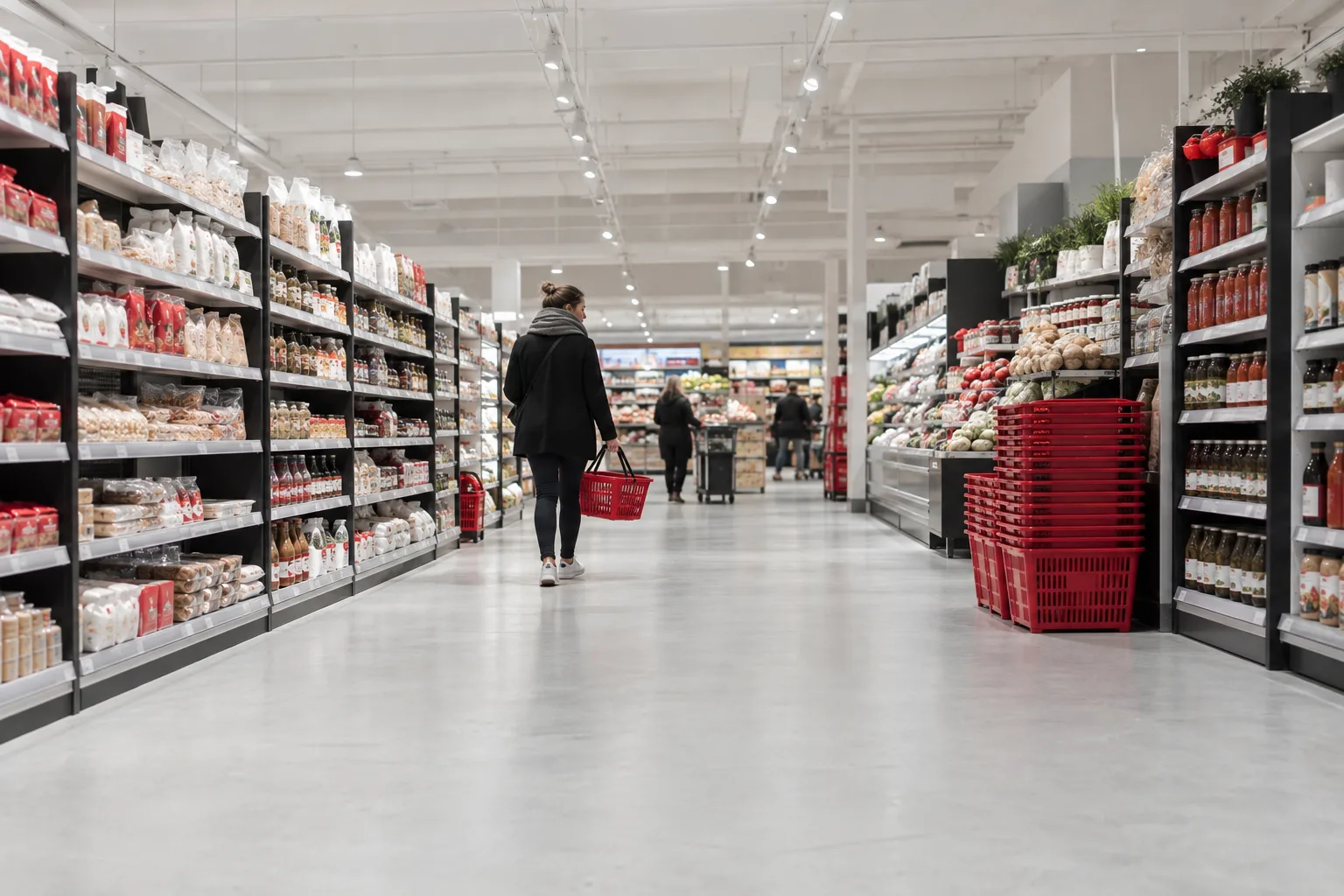
A shopping basket looks like the simplest product in a store, and its size is still the number buyers get wrong most often. A catalog says 28 L, a shopper says it feels small, a store owner finds the stack too tall for the stand, and a freight quote assumes a different carton. Every one of those problems comes from treating one number as if it described the whole basket.
This guide explains shopping basket size, capacity and dimensions, and gives the real figures for the baskets we build. It covers hand baskets, supermarket baskets and rolling baskets, the weight of each, how to choose a size and how to work out how many a store needs. It is written from the manufacturing side, and figures for our baskets come from our product pages. It does not cover price, which depends on the material, the quantity and freight.
Baskets and carts work together in a store, and the sizing of carts is covered in the guide to shopping cart dimensions, weight and capacity.
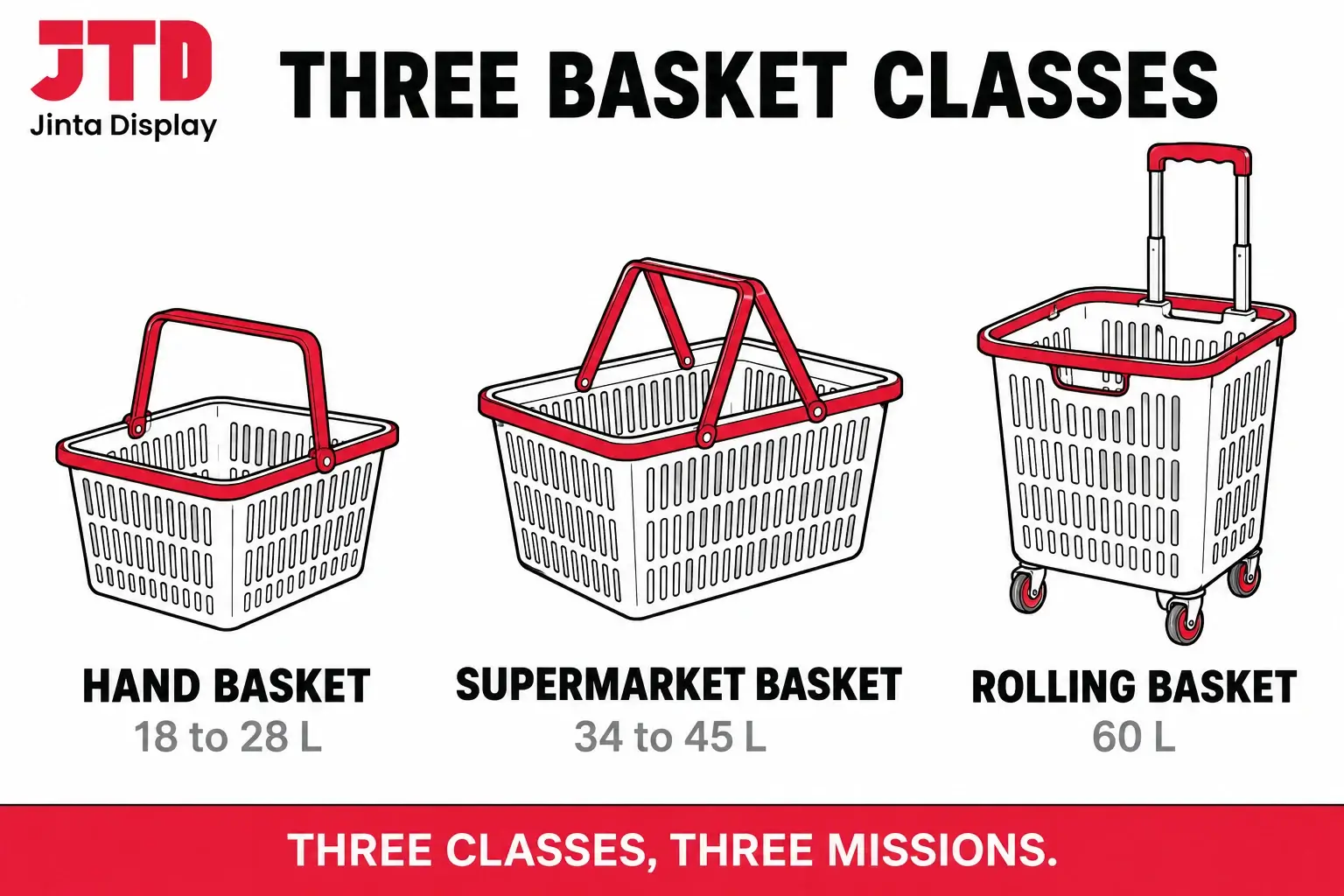
What Shopping Basket Size Means
Shopping basket size is described by three kinds of number, and suppliers answer them in different places.
Capacity. The volume the basket holds, in liters. It tells you how much a shopper can load, and it is the figure catalogs lead with. It does not tell you how big the basket is on the floor, because the walls taper and the rim and handles add size.
External dimensions. The length, width and height of the basket, in millimeters. They decide whether the basket fits a stand, a shelf, a counter or a carton, and how much room a stack takes.
Weight. The empty weight in kilograms. It tells you how much plastic is in the basket and how heavy it is to carry before any goods go in. It also hints at the thickness of the walls, which decides how the basket ages.
A quotation that lists only the capacity is incomplete. A quotation that gives the capacity and the dimensions but not the weight hides the amount of material. Ask for all three on the exact model, because the figures change from one model to the next.
Shopping Basket Sizes in Our Range
Our baskets are molded in HDPP or PP plastic. The table gives the capacity, the external size where the page lists it and the empty weight. Where a page lists two sizes together, the figures are shown together in the order the page gives them.
| Capacity | External size in mm | Empty weight | Typical use |
|---|---|---|---|
| 18 and 22 L | 450 × 330 × 250 and 400 × 300 × 210 | 0.52 and 0.75 kg | Convenience store, pharmacy |
| 18 and 28 L | 430 × 300 × 230 and 480 × 330 × 260 | 0.66 and 0.95 kg | Convenience store, small shop |
| 34 L | Not listed | 1.5 kg | Small supermarket |
| 35 and 45 L | Not listed | 1.3 and 1.65 kg | Supermarket entrance |
| 43 L | 560 × 400 × 430 | 1.6 kg | Supermarket entrance |
| 60 L rolling | 425 × 460 × 860 and 490 × 385 × 845 | 2.5 and 2.99 kg | Larger loads, with wheels |
All of them stack into a compact column when not in use, and they can carry your logo. The listed production time is 15 days, and the minimum quantity and the exact specification are confirmed with the quotation. Our shopping basket category lists every model.
Why the Outside Size Is Larger Than the Rated Capacity
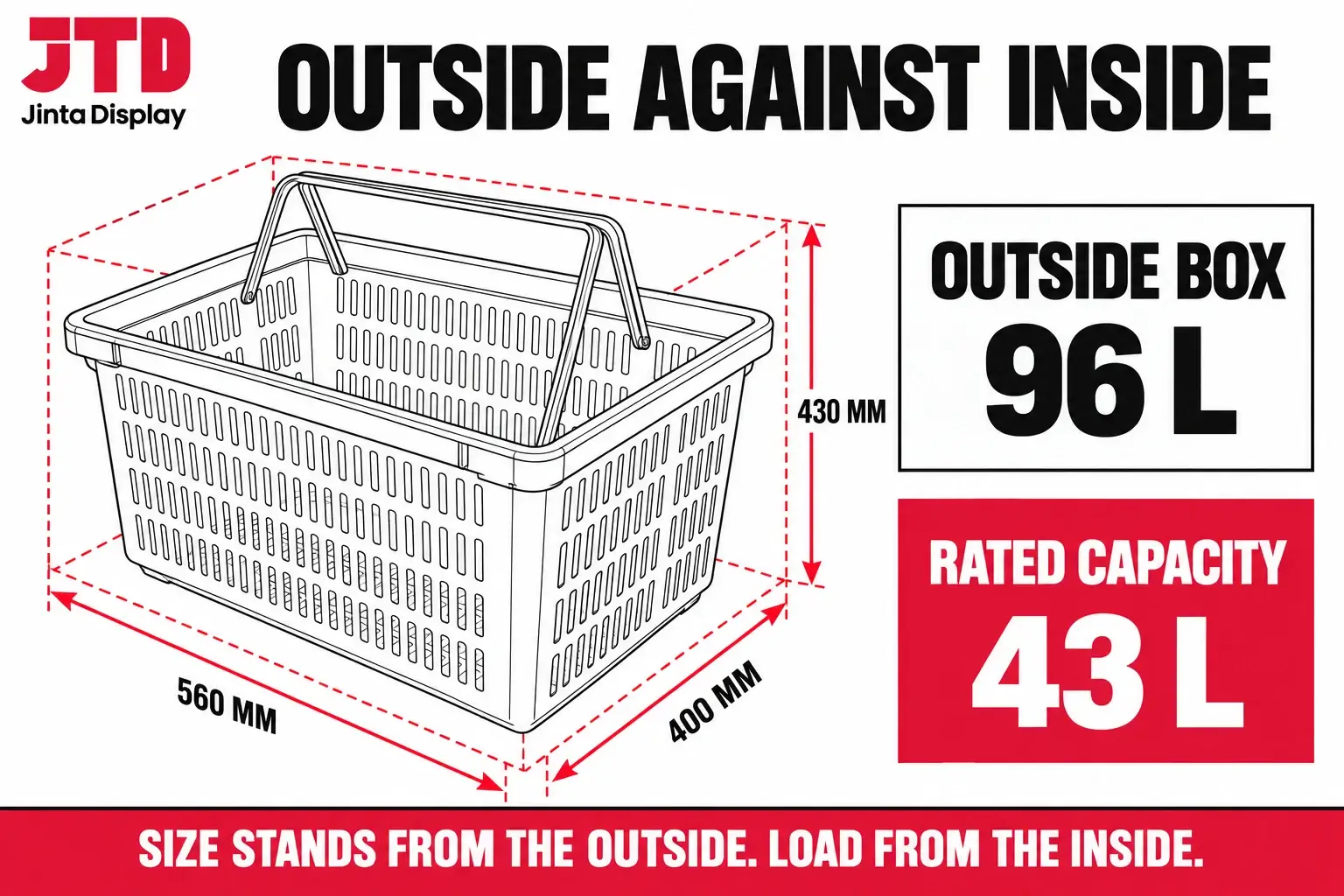
Buyers who multiply the external dimensions are often surprised. Take the 43 L basket at 560 × 400 × 430 mm. The box around it is 560 × 400 × 430 mm, which is 96 liters. The rated capacity is 43 L, less than half of that.
The difference is shape. A basket tapers from a wide rim to a narrower base so that it nests and stacks. The walls slope, the corners are rounded, the rim and handles stand proud and the floor is raised on feet. All of that adds to the outside envelope and takes nothing from the usable volume. The rated figure measures the space inside, up to a fill line.
This matters in two places. For shelving and stands, use the external dimensions, because that is the space the basket occupies. For a shopper, use the capacity, because that is what the basket holds. Never size a stand from the capacity, and never judge a basket by its outside size alone.
Shopping Basket Capacity and How It Is Measured
Shopping basket capacity is the volume of the space inside, up to a fill line, and it is usually found by filling the basket with water or by calculating from the inside shape. A basket is not filled to the very rim in use, because goods would spill when it is carried. The rated figure assumes a sensible fill, and the fill line marks it on many models.
Two baskets of the same rated capacity can differ in shape. One may be long and shallow, and another short and deep. A shallow basket shows its contents and keeps soft goods from being crushed. A deep basket holds tall bottles and boxes. Choose the shape from the goods you sell, and not from the rated number alone.
Capacity in liters does not translate directly into weight carried. A liter of bottled drinks weighs about a kilogram, while a liter of snacks may weigh a few hundred grams. A shopping basket size that suits a store of light goods can be too big in a store of heavy goods, since a full basket will be too heavy to carry far.
Shopping Basket Dimensions for Stands, Shelves and Counters
The shopping basket dimensions that matter to a store layout are the outside ones. A stand, a shelf or a counter has to take the basket as it is, with its rim, handles and feet. Our 43 L basket is 560 × 400 × 430 mm, so a shelf for it needs at least that much depth and width, with clearance to lift it out.
Stacks add height. A column of baskets is taller than one by an amount that depends on the nesting. Ask the supplier for the stack height for ten baskets, and use it to set the height of the stand. A stand that is too low lets the stack lean, and one that is too tall is hard to reach.
Counters need space too. At a checkout, the shopper sets the basket on the counter, and the counter must be wide enough for it. A counter of 600 mm width takes a standard basket with room beside it for the goods taken out. A very narrow counter makes the shopper hold the basket, which slows the queue. The sizes and names for counters are covered in the guide to what a cash wrap is.
Hand Baskets for Convenience Stores and Small Shops
The smallest baskets, from about 18 to 28 L in shopping basket size, are carried on the arm or by one handle. They suit a shopper who is picking up a few items, such as a drink, a snack and a household item. A convenience store, a pharmacy, a petrol station shop or a corner shop uses this size because the average basket is small, and a larger basket would sit half empty.
Keep the empty weight low. Our smallest basket is listed at 0.52 kg, and the heavier hand sizes at about 0.75 to 0.95 kg. A light basket is comfortable to carry when full, and a shopper who carries a heavy empty basket picks fewer items. The handle should be shaped for the hand, and a second handle helps once the basket fills.
In a very small shop, a mini shopping basket is useful beside the counter. It lets a customer pick up a few impulse items without taking a full-size basket. The size should match the average purchase, and the stack should be easy to reach at the door.
Shopping Baskets for Supermarkets
The mid-size baskets, from about 34 to 45 L, are the standard for supermarkets. The shopper who picks up a basket at the entrance is often making a top-up trip for a dozen items. A basket in this size carries a meal’s worth of goods, and it is still manageable on the arm when loaded.
Weight in a loaded basket rises quickly. A 45 L basket filled with tins, bottles and produce can weigh well over 10 kg, which is a lot to carry by one handle for long. Two handles let the shopper carry it with both hands or lift it from either side, and they spread the load. Choose the handle layout with the typical load in mind.
Place baskets at the entrance, beside the cart bay, so that shoppers pick between the two at the door. A basket stand that holds a stack keeps the entrance tidy. The stand must fit the external dimensions of the stack, so ask for the footprint and the stack height of the exact basket.
Rolling Shopping Baskets and Baskets on Wheels
The 60 L rolling basket is for loads that a shopper would struggle to carry. It has wheels and a telescopic handle, and it is pulled like a small trolley. Our listings give 425 × 460 × 860 mm and 490 × 385 × 845 mm, at 2.5 and 2.99 kg. The height of about 860 mm comes from the handle, and the basket itself is much lower.
A rolling shopping basket sits between a hand basket and a cart. It takes less floor than a cart, it nests in a smaller bay and it works in stores where aisles are narrow. It is a good answer for older shoppers, for stores that sell heavy items such as water and drinks, and for stores that want to offer something between a basket and a cart. A shopping basket on wheels also suits smaller supermarkets that cannot spare the space for a full fleet of carts.
The wheels and the handle are wear parts. Ask for the wheel diameter, the tread and the way the telescopic handle locks. A handle that does not lock firmly collapses under a load, and wheels that are too small catch on thresholds and floor joints.
How Much Does a Shopping Basket Weigh
The empty weight of a basket depends on its size and the thickness of its walls. In our range it runs from 0.52 kg for the smallest hand basket to 2.99 kg for the largest rolling model, and the plastic weighs about 0.03 to 0.05 kg for each liter of rated capacity. The rolling models are heavier per liter because of the wheels, the axle and the handle.
| Capacity | Empty weight | Kg per liter |
|---|---|---|
| 18 L | 0.52 kg | 0.03 |
| 22 L | 0.75 kg | 0.03 |
| 34 L | 1.5 kg | 0.04 |
| 43 L | 1.6 kg | 0.04 |
| 45 L | 1.65 kg | 0.04 |
| 60 L rolling | 2.5 to 2.99 kg | 0.04 to 0.05 |
Weight is a cross-check on quality. A basket that is much lighter than these figures for its capacity has thinner walls, and thin walls crack at the handle and the rim. A basket that is much heavier may be over-built, which adds cost and carrying weight. Use the table as a sanity check on any quotation, ours included.
Choosing the Right Shopping Basket Size for Your Store
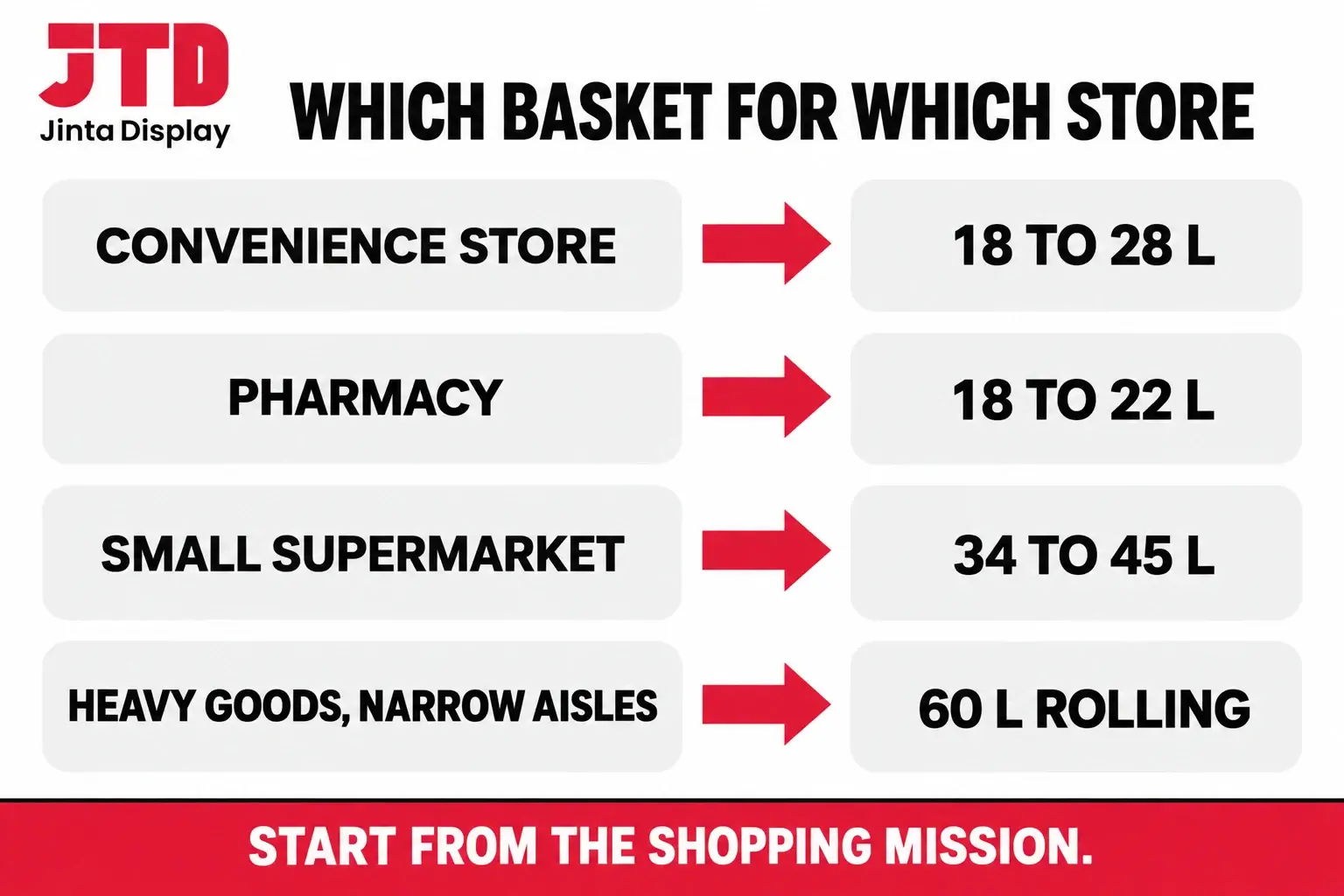
Choose the shopping basket size from the shopping mission and the store, and not from the largest number in a catalog. A bigger basket costs more per piece and less per liter, but a basket that is too big sits empty and takes room. One that is too small is outgrown and left in the aisle.
| Store | Typical mission | Leans toward |
|---|---|---|
| Convenience store, petrol shop | A few items | 18 to 28 L hand basket |
| Pharmacy, small shop | A few light items | 18 to 22 L hand basket |
| Small supermarket | Top-up shop | 34 to 45 L basket |
| Supermarket entrance | Top-up beside the carts | 35 to 45 L basket |
| Store with heavy goods or narrow aisles | Heavier loads without a cart | 60 L rolling basket |
Some stores stock two sizes. A small basket sits at the door for quick trips and a larger one sits beside the carts. Two colors help shoppers to tell them apart, and they help staff to see which stand needs refilling.
How Many Shopping Baskets a Store Needs
The number depends on the customers in the store at the busiest time, and not on the floor area. The method is the same as for carts. Estimate the peak customers per hour, multiply by the average visit in minutes and divide by 60 to find how many are in the store at once. Apply the share who take a basket, then add a margin for baskets in transit or left in aisles.
Work an example for a small convenience store, with every input an assumption. At a peak of 60 customers an hour and a visit of 10 minutes, 10 customers are in the store at once. If 90% take a basket, 9 are in use, and adding 20% gives about 11. Order 12. For a store with longer visits or a higher share of basket users, the number rises. Test a low case and a high case before ordering.
A supermarket works the same way with two groups, cart users and basket users. The full method with a worked store is in the supermarket equipment list. Baskets are cheap to hold in reserve, and a stack of spares is a sensible allowance.
Handles, Stands and Stacking
The handle is the part the shopper touches most, and it should suit the load. A single handle is enough for a small hand basket. Two handles, or one handle with a side grip, suit a larger basket. A telescopic handle suits a rolling model. The grip should be shaped so that it does not cut into the hand under a load.
Baskets nest when empty and form a column. The height of the stack decides the stand and where it can go. A tall stack is easy to reach for a tall shopper and hard for a short one, so keep the stack height in a range that most customers can reach. Check the footprint of the stand as well, since a stand that takes too much floor at the door is a nuisance.
Some stores use a stand with a frame or a wire holder, and some use a simple floor space. The stand should keep the baskets stable and stop them from sliding. Ask the supplier for the stack height for ten baskets of the model you buy, and size the stand from that figure.
Materials, Color and Branding
Our baskets are molded in HDPP or PP plastic. These are tough, light and easy to clean, and they hold color all the way through. Plastic is not affected by damp, and a basket that is wiped down regularly stays clean. A basket for a food store should be easy to wash and have no deep crevices where dirt can sit.
Color is a quick way to brand a store. A chain can specify its own color, and a second color for a second size. A printed or molded logo on the side adds identity, and our listings state that you can print your own logo. A bright color also makes baskets easy to see in a store and easy to spot when left behind.
Ask for the resin and for how the color is held across batches. A color that drifts between orders is visible when old and new baskets sit in the same stack. Keep a sample from the first order and send it with each reorder, so the supplier can match it.
Baskets and Carts Together
Most stores that use baskets also use carts, and the two should be planned together. The basket stand should sit beside the cart bay so that the shopper chooses at the door. The sizes of the two should leave a clear gap, so that a shopper who needs more than a basket moves up to a cart. Carts come in sizes from 60 to 240 L in our range, and the comparison of plastic and steel carts is in the guide to plastic and steel shopping carts.
A convenience store may use baskets only, because carts need aisle width the plan cannot spare. A supermarket uses both. A hypermarket may use rolling baskets as well. Choose the mix from the shopping mission, and write the sizes into the equipment list so that the shelving, the counters and the baskets agree.
Shopping Basket Size and the Shopper
Shopping basket size is also a human question. A shopper carries the basket by the handle, and the load hangs from one arm. A heavy load pulls the shoulder down and tires the arm, and a shopper who feels this will stop picking items. A basket that is too big for the store’s goods is therefore a hidden cost, since it lets the shopper put more in than is comfortable to carry.
The handle height and shape matter as much as the size. The handle should sit at a height where the basket clears the ground when held at the side, and the grip should be wide enough for the fingers. For a child, a smaller basket is better, and a mini shopping basket gives a young shopper something to carry. A shopper in a wheelchair or with limited strength may prefer a rolling basket on a stand.
Watch how shoppers behave in your store. If baskets are often left in aisles half full, the size may be too large, or the weight too heavy. If shoppers pile goods on top, the size may be too small. A short observation of a busy hour tells you more than a catalog.
Mistakes in Choosing Shopping Basket Size
A few errors come up again and again. The first is choosing the largest basket because it looks generous, which costs more and sits empty. The second is sizing a stand from the rated capacity and finding that the basket does not fit. The third is ignoring the empty weight, which means a basket that is heavy before any goods go in.
A fourth is mixing sizes in one stand without a plan, which leaves stacks that do not nest. A fifth is ignoring the handle, which leaves a basket that is hard to carry when full. A sixth is not checking the color match between old and new baskets, which shows when they stack together. Each of these is avoided by asking for the dimensions, the weight and a sample before the order.
What to Send a Supplier
A supplier can quote baskets from a short brief. Give the capacity or the size class you want, and the handle style. State the color, any logo and where it should go. State if you need a stand and how many baskets it should hold. Add the quantity, the delivery date and the destination port. If you have a basket you like, send a photograph and its dimensions.
If you are choosing a basket size, send us your store type and quantity and we will reply with a specification and the sizes that fit.
Frequently Asked Questions
What is the standard shopping basket size?
There is no single shopping basket size. It depends on the class. Hand baskets for convenience stores are about 18 to 28 L, supermarket baskets about 34 to 45 L and rolling baskets about 60 L. In our range the outside sizes run from about 400 × 300 × 210 mm to 560 × 400 × 430 mm for hand baskets.
What are the dimensions of a shopping basket?
Our 43 L basket is 560 × 400 × 430 mm and our 60 L rolling baskets are 425 × 460 × 860 mm and 490 × 385 × 845 mm. Hand baskets of 18 to 28 L range from 400 × 300 × 210 mm to 480 × 330 × 260 mm. Confirm the figures for the exact model.
How many liters does a shopping basket hold?
Most hold between 18 and 60 L. Convenience store baskets are 18 to 28 L, supermarket baskets 34 to 45 L and rolling baskets about 60 L. The rated capacity is the space inside the basket, and the outside envelope is usually more than twice as large.
How much does a shopping basket weigh?
In our range the empty weight runs from 0.52 kg for an 18 L hand basket to 2.99 kg for a 60 L rolling basket. Plastic weighs about 0.03 to 0.05 kg per liter of capacity. A basket far lighter than this for its size has thinner walls.
What is a mini shopping basket used for?
A mini shopping basket is a small hand basket, about 18 to 22 L, used in small shops, pharmacies and beside counters for quick purchases. It is light, with an empty weight near 0.5 to 0.75 kg in our range, and it keeps shoppers from taking a larger basket they will not fill.
Why is the outside size of a basket larger than its capacity?
Baskets taper from a wide rim to a narrower base so they stack, and the rim, handles and feet add to the outside. Our 43 L basket is 560 × 400 × 430 mm outside, which is a 96 L box. Use the outside size for stands and the capacity for loads.
What is a rolling shopping basket?
A rolling shopping basket is a basket on wheels with a telescopic handle, pulled like a small trolley. Our 60 L models weigh 2.5 to 2.99 kg. It suits heavier loads, narrow aisles and shoppers who find a hand basket hard to carry, and it uses less floor than a cart.
How many shopping baskets does a store need?
Estimate peak customers per hour, multiply by the visit in minutes and divide by 60, then apply the share who take a basket and add a margin of about 20%. In an example store with 60 customers an hour and a 10 minute visit, that gives about 12 baskets.