
Buyers asking whether to choose a plastic shopping cart or a steel one are usually comparing two things that are less different than they look. Both stand on steel tube. Both carry the same weight of groceries. What differs is the basket, the finish, the tooling behind it and the way each one ages in a particular store. The right answer depends on your climate, your floor, your brand and how your fleet is handled, and not on a general rule that one material is better.
This guide compares the two for commercial retail use. It does not cover toy carts, folding household carts or consumer shopping trolleys sold one at a time. It is written from the manufacturing side, and where it quotes our range, the figures come from our product pages. It does not cover price, which is set out in the guide to how much a shopping cart costs.
The words differ by region. In the United States a cart is a shopping cart or a grocery cart. In the UK, Ireland, Australia and New Zealand it is a shopping trolley, and a plastic shopping trolley is the same item as a plastic shopping cart. The comparison is the same in both vocabularies.
Three Kinds of Cart Sit Behind the Plastic or Steel Question
Plastic versus steel hides three different products, and a supplier can mean any of them. Naming which one you are comparing is the first step.
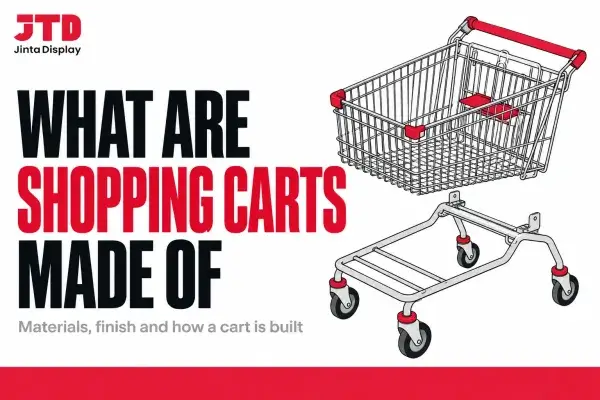
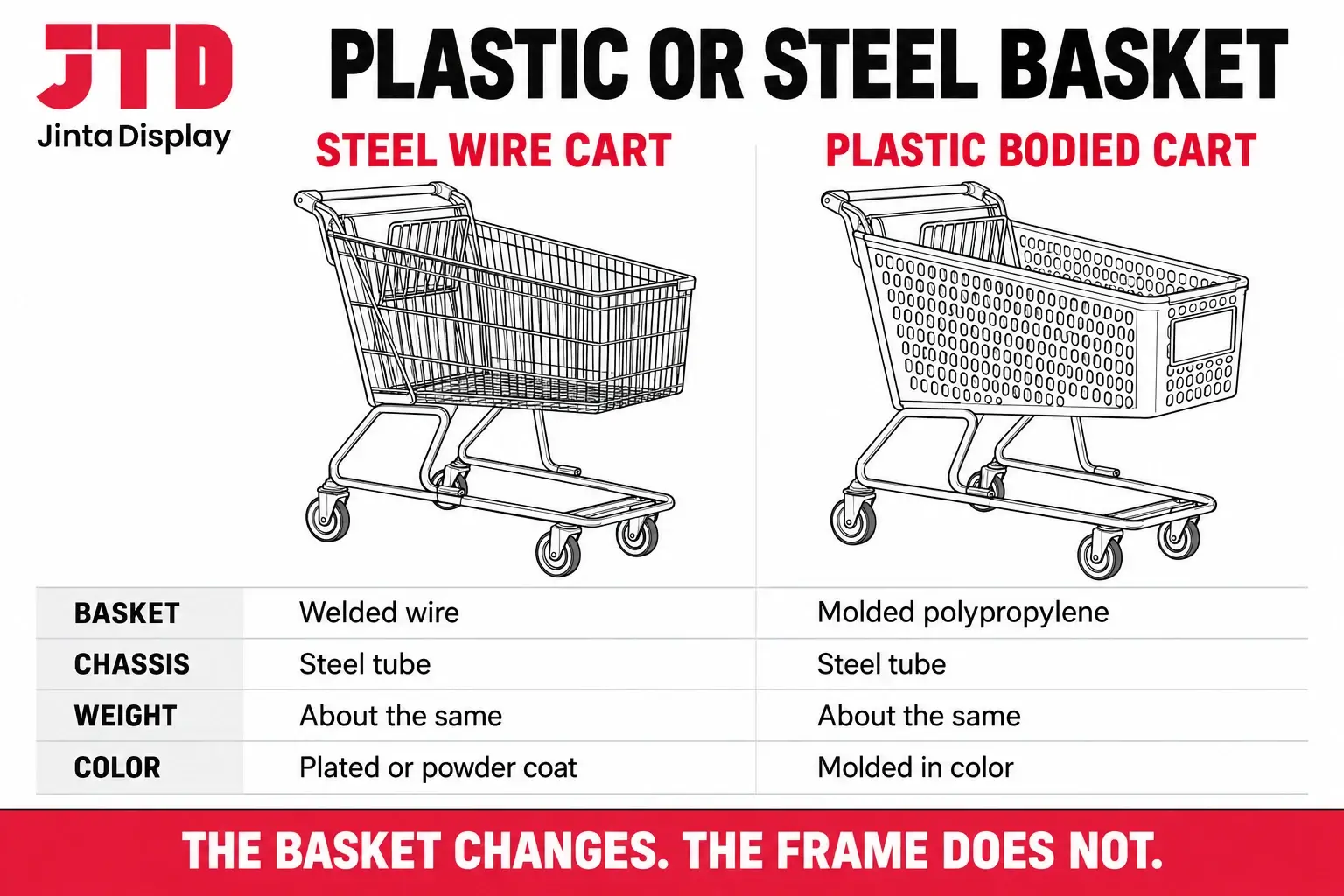
The steel wire cart has a welded wire basket on a tube chassis, with a zinc, chrome or powder finish. It is the standard supermarket cart in most of the world. Our metal range comes in five regional styles, American, Asian, European, German and Russian, from 60 to 240 L.
The plastic bodied cart replaces the wire basket with a molded plastic body, but keeps the steel chassis. This is what most buyers mean by a plastic shopping cart in a commercial setting. Ours use a Q195 carbon steel frame with polypropylene and polycarbonate plastic, in sizes from 100 to 220 L.
The all-plastic cart replaces most of the steel with molded plastic, with only small metal fittings. It exists, and it suits some hygiene and noise-sensitive uses, but it is a smaller part of commercial retail because the molds are large and the impact behavior is different. Most of this guide concerns the first two.
Plastic Shopping Cart vs Steel Cart at a Glance
The table below sets the two common types side by side on the points that decide most purchases. Each row is expanded in the sections that follow.
| Point | Steel wire cart | Plastic bodied cart |
|---|---|---|
| Basket | Welded steel wire | Injection molded polypropylene body |
| Chassis | Steel tube | Steel tube, same kind |
| Weight at the same capacity | About the same | About the same |
| Corrosion | Depends on the finish | Body does not rust, frame still needs a finish |
| Color | Plated color or powder coat | Molded in color, many shades |
| Branding | Frame or advertising plate | Large flat body surfaces for logos |
| Repair | Rebend or reweld the wire | Replace the body or the part |
| Tooling | Jigs and bending tools | Injection molds, a larger up-front cost |
| Visibility into the basket | Open mesh | Solid sides, less visible |
| Typical fit | Most supermarkets and hypermarkets | Brand-led stores, wet or coastal sites, color programs |
No row in the table declares a winner. A plastic shopping cart wins on color, corrosion of the basket and branding space. The steel wire cart wins on tooling cost, repair and visibility. The rest of the guide shows why the two stay close on weight.
Weight Is Not the Difference People Expect
Many buyers assume a plastic shopping cart is lighter. In commercial carts it usually is not, because the chassis, the wheels and the handle carry the same loads and are made from the same steel tube. The plastic only replaces the basket, and a steel wire basket is already a light structure with a lot of air in it.
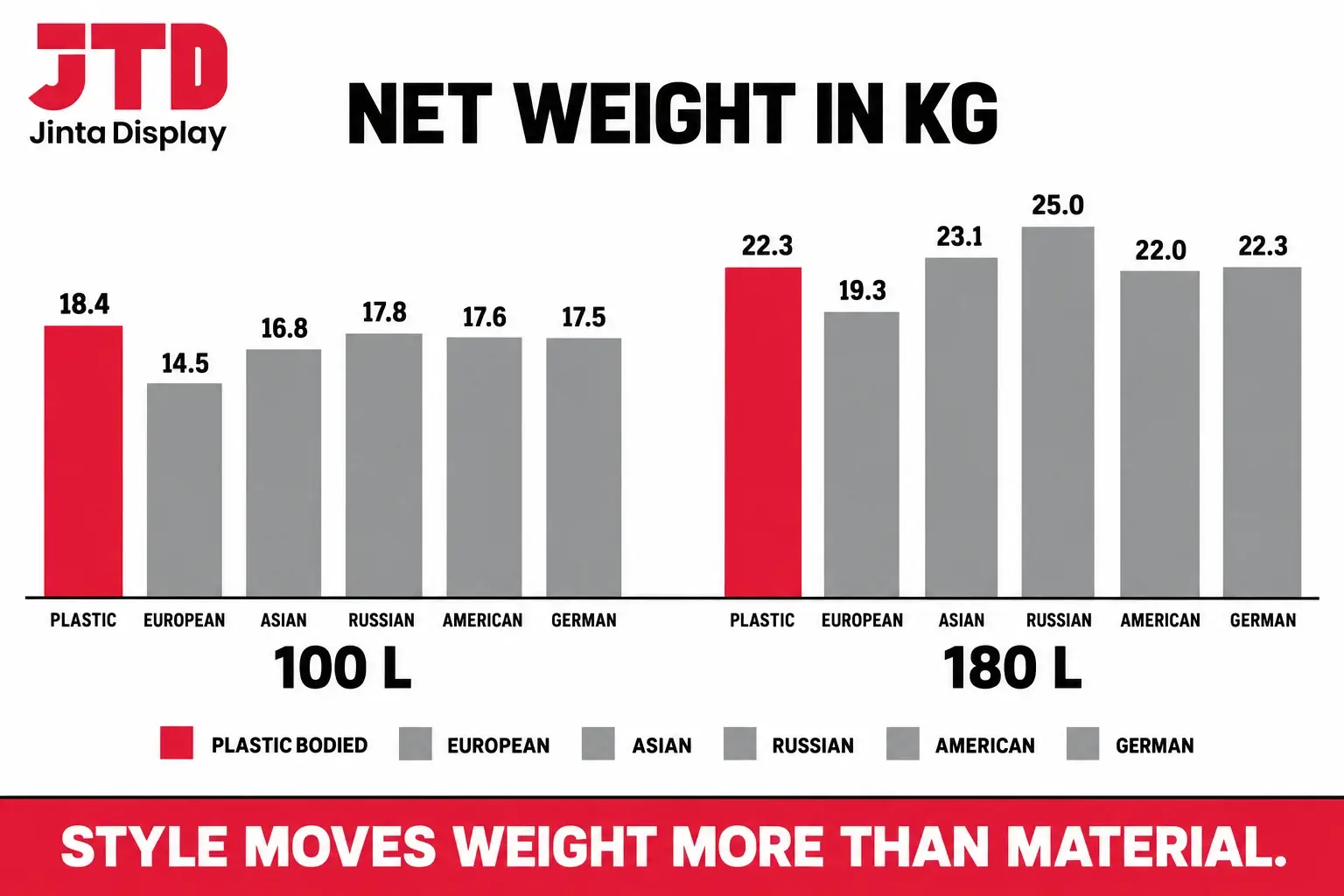
Our product pages give the net weights. A plastic bodied trolley on our Q195 carbon steel frame weighs 18.4 kg at 100 L, 19.6 kg at 125 L, 21.0 kg at 165 L, 22.3 kg at 180 L and 24.5 kg at 200 L. Compare this with our metal styles at the same capacity.
| Capacity | Plastic bodied | European | Asian | Russian | American | German |
|---|---|---|---|---|---|---|
| 100 L | 18.4 kg | 14.5 kg | 16.8 kg | 17.8 kg | 17.6 kg | 17.5 kg |
| 180 L | 22.3 kg | 19.3 kg | 23.1 kg | 25.0 kg | 22.0 kg | 22.3 kg |
At 100 L the plastic bodied trolley is slightly heavier than every metal style. At 180 L it lands inside the range of the metal styles, equal to the German style at 22.3 kg and lighter than the Asian and Russian styles. The conclusion is that weight does not separate the two types. Style does. Within the metal range the heaviest style is about 30% heavier than the lightest at 180 L, which is a bigger gap than the one between a plastic shopping cart and an average metal cart.
Where weight does matter is staff effort and freight. A heavier cart is harder to push in a long train, and a container fills by volume before weight for carts of this kind. Check the empty weight on the exact style you are buying and not the material label.
Corrosion and Climate, Where a Plastic Shopping Cart Helps and Where It Does Not
Corrosion is the strongest argument for a plastic body, and it needs to be stated precisely. The molded body does not rust. The steel frame underneath still can, and a cart usually fails at the frame joints and the wheel mounts, which a plastic body does not protect. A plastic bodied cart in a coastal trolley bay still needs a proper frame finish.
The steel wire cart is only as durable as its finish. Electro-zinc is enough for a dry indoor store. Hot-dip galvanizing or a heavier coating is better for outdoor bays and humid or coastal climates. Our metal carts are listed as zinc plus clear coat, or chrome plate, and the exact finish is confirmed on the quotation because zinc plated covers a broad spread of thicknesses.
For the plastic itself, the environment matters in a different way. Sunlight can fade color and make some plastics brittle over years, which is why outdoor carts call for UV-stabilized resin. Cold can make some plastics less tolerant of impact. Ask a supplier which resin the body uses and how the color is held. A plastic shopping cart in a hot, bright market and one in a mild indoor store are not the same specification.
Color, Branding and Appearance
This is where a plastic shopping cart has a clear advantage. The body is molded in color, so the color goes all the way through and does not chip like paint. A chain can specify its brand color and a second color for the handle or trim. The flat sides of a body also give room for a printed or molded logo, where a wire basket offers only the frame and an advertising plate.
Steel carts can be colored by powder coating, and a decorative chrome finish has its own look. Our product pages list OEM color and branding, and a printed logo, as available on the carts. A powder coat finish can chip at impact points and show the metal below, while a through-colored plastic body does not. For a store whose carts are part of its brand image, that matters.
The wire basket keeps one advantage in appearance, which is visibility. The open mesh lets staff and shoppers see what is in the basket, and some stores value that for loss prevention and for the checkout. Solid plastic sides hide the contents. Many designs use a plastic body with an open section or a lower rack to recover some visibility.
Impact, Wear and Repair
Carts take knocks from kerbs, trolley bay rails, car doors and other carts, so how each type fails matters. A steel wire basket dents and bends, and a bent wire can often be straightened or rewelded. A plastic body resists denting but can crack under a hard impact, and a cracked body is usually replaced and not repaired.
The first question to ask is therefore what spare parts the supplier keeps. A plastic shopping cart fleet is easiest to keep running when the bodies are stocked as spares and are interchangeable between carts of the same style. The second question is who will repair. A store with a maintenance team and a workshop may prefer steel, which they can fix. A store that replaces parts may prefer plastic.
Wear on casters and handles is the same for both, because both use the same parts. A fleet of either type should be ordered with spare casters of the same tread and stem.
Noise, Hygiene and the Shopper Experience
Most of the noise a cart makes comes from the casters and the nesting, and not the basket material. A plastic body can damp some rattle, and a cart with polyurethane casters is quieter than either type with hard tread. The caster is the main lever for noise, and it is a separate choice from plastic or steel.
Hygiene favors plastic slightly. A smooth molded surface wipes clean more easily than a wire grid with many joints, and it can be sanitized without trapping dirt at the crossings. This matters more for stores that handle fresh food or that clean carts on a schedule. A wire basket is still easy to rinse and dry.
The handle, the child seat and the lower rack are the same family of parts on both types. A shopper notices the handle and the wheels more than the basket material, so those parts deserve the same attention in either specification.
Tooling, Minimum Quantity and Lead Time
The difference most buyers feel in the quotation is tooling. A steel wire cart needs bending tools and welding jigs. A plastic body needs an injection mold, which is a large steel tool made for one shape, and its cost is spread across the number of bodies made from it. A custom plastic shopping cart design therefore carries a higher minimum quantity than a standard wire cart, because the mold has to be worth making.
Standard styles that the supplier already has tooling for avoid most of that cost. Our pages list sizes from 100 to 200 L and from 100 to 220 L for the plastic bodied trolleys, and the production time is 15 days. Custom colors and logos are possible, and they carry their own minimums. On our trade listings the minimums for shopping trolleys run from 10 pieces on some catalog models to a few hundred on others, and the minimum for your order is confirmed with the quotation.
If you want a custom body shape, plan for a longer first lead time and a larger first order. If you want a standard body in your own color, the lead time and minimum are much closer to those of a standard cart.
Freight and Container Loading
Freight is a large part of the landed cost of a cart. Nesting therefore matters. The number of carts in a 20 ft or 40 ft high cube container depends on the cart size and the nesting distance, which is how far each cart pushes into the one in front. A plastic body has thicker walls than wire, and its nesting depends on the body design. A cart that nests well ships at lower cost per unit.
Do not compare the two types on a quoted container count unless the basket size and the assembly state are the same. Ask for units per container on the exact style you are buying, and compare on landed cost per cart. The method is the same as in our guide to shopping cart dimensions, weight and capacity.
Durability and Service Life in Practice
Service life is the number every buyer wants and no honest supplier can promise in years, because it depends on the finish, the climate, the handling and the care. What can be said is where each type fails first, and that tells you what to specify.
A steel shopping cart usually fails at the joints. Rust starts at the welds and wheel mounts when the finish is thin, and a repeated knock can open a weld between the basket and the chassis. A plastic shopping cart usually fails at the body, where a hard impact can crack the plastic, or at the fittings, where a hinge or a lock wears. Both types fail at the casters, since the wheel is the part that turns all day.
The practical way to compare them is to look at what the warranty covers. Ask whether the casters are covered, whether the body is covered against cracking, and whether the finish is covered against rust at the welds. A supplier who covers the parts that fail first is telling you something about the cart. Ask also how a fault is handled, with photographs and a replacement part shipped, or only with a return.
Recycling and End of Life
Steel is easy to recycle, and a scrapped steel frame and basket have value as scrap metal. A plastic shopping cart is a mixed product. The body is polypropylene, the frame is steel and the casters are another plastic, so recycling means taking the cart apart and sorting the parts by material. This is simple for a store with a workshop and less so for a fleet that is discarded whole.
Ask a supplier whether the plastic body is a single resin, whether it carries any marking for the resin type and whether the body can be removed from the frame without cutting. A body that unbolts is easier to replace in service and easier to recycle at the end. In the United States a plastic grocery cart and a metal one are often scrapped by the same contractors, and in other markets the arrangements differ, so check what is available locally before the decision.
How to Run a Fair Trial of the Two Types
A plastic vs metal shopping cart trial is the most reliable way to decide, because it tests your store and not a general claim. Order a small number of each type on the same frame style, so they nest and behave alike. Put them in service in the same store for several weeks and record what happens.
Track four things. Staff should record any damage, with a photograph, and the part that failed. They should record how easy each type is to push, to nest and to clean. Customers will show a preference through use, and a short staff note about complaints or compliments is enough. The fourth is the time spent on repair, since a cart that is cheap to buy and slow to fix is not cheap in service.
Keep the trial honest by using the same finish on both frames and the same caster on both. If the frames differ, the trial tests the frame and not the basket. At the end, put the findings next to the specifications and the quotations, and decide on the full cost of ownership and not the first price.
Choosing a Plastic Shopping Cart or a Steel Cart by Store Type
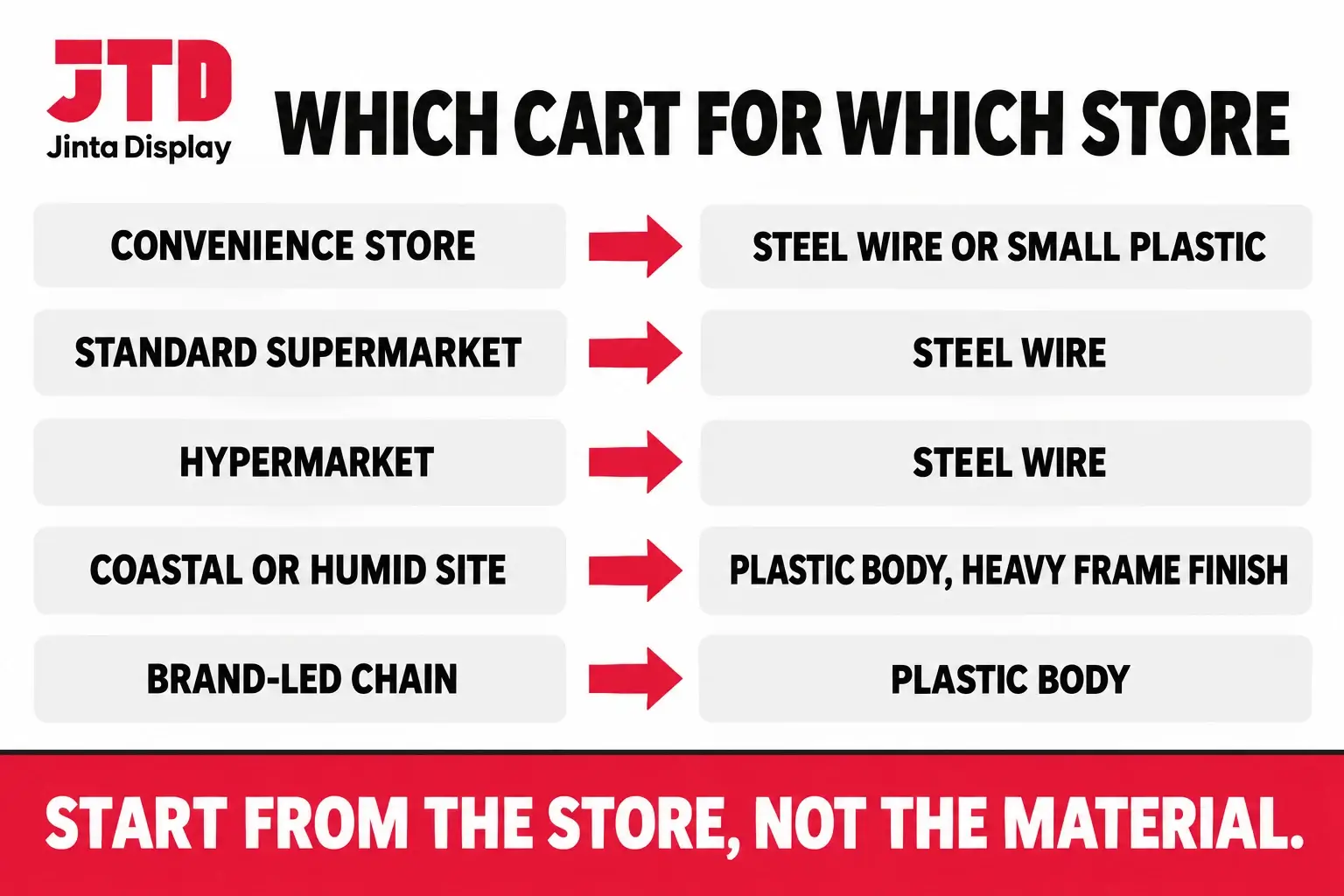
The simplest way to decide is to start from the store and not the material. The table gives a first-pass recommendation, and a supplier should be able to explain any exception.
| Store or site | Leans toward | Reason |
|---|---|---|
| Convenience store, small supermarket | Steel wire or small plastic | Small carts, tight budgets, simple handling |
| Standard supermarket, indoor | Steel wire | Lowest tooling cost, easy repair, good visibility |
| Hypermarket, large baskets | Steel wire | Large capacity on a standard frame |
| Coastal or humid site, outdoor bays | Plastic body on a well-finished frame | No rust on the body, heavy finish on the frame |
| Brand-led chain, color program | Plastic body | Through-color and logo space |
| Food retail with frequent cleaning | Plastic body | Smooth wipeable surfaces |
| Store with an in-house repair team | Steel wire | Repairable by rebending and welding |
Mixing the two types in one fleet is possible, but the carts must nest together if they share a bay. Mismatched frames do not nest. It is cleaner to buy one frame style and vary the basket. Keep the same chassis geometry where the fleet is shared. A plastic body in a second color on the same frame can serve as a color-coded variant.
Spare Parts and Fleet Management
Whichever type you choose, a fleet is managed over years, and the spares plan matters as much as the first order. Keep a stock of casters, handle grips, child seat parts and, for plastic bodied carts, a few spare bodies. Keep them in the same specification as the fleet, because a replacement that does not match the tread or the stem or the color is a visible patch.
Record the specification of each batch. Note the style, capacity, finish, caster type and body color, and keep one approved sample from each order. When a reorder comes years later, the sample and the record let the supplier match the first fleet, which matters most for color and for nesting. A fleet that nests together is easier to collect and store, and a plastic shopping cart or a steel one is equally useful in the bay if the frames agree.
Plastic Shopping Trolley Terms in the UK and Australia
In the UK and Australia a buyer searches for a plastic shopping trolley or a supermarket trolley and not a plastic shopping cart. The product is the same, and the comparison above applies. Local preferences differ by market. European styles tend to be lighter and use smaller baskets, and Australian styles have their own handle heights and nesting dimensions. Specify the regional style and ask the supplier to confirm the dimensions on the drawing.
Questions to Ask a Supplier About Plastic
A plastic body hides its specification as well as a wire basket does. Ask which resin the body uses and whether it is UV stabilized. Ask for the wall thickness and where the body is reinforced. Ask how the color is held and how closely a repeat order will match the first. Ask who owns the mold and whether it can be used for a repeat order. Ask for the spare body price and availability. Our pages list the material as Q195 carbon steel with PP and PC, and the details of the plastic parts are confirmed on the drawing.
Ask the same questions for steel as for any steel cart. Wire diameter, tube wall, finish by process and thickness, and caster specification all matter. A buyer who is comparing a plastic shopping cart quotation with a steel one should make sure both quotations name the frame in the same way, so the comparison is about the basket and not about hidden differences in the frame.
If you are deciding between the two, send us your store type, capacity and where the carts will stand and we will reply with a specification for each. Our plastic shopping trolley and shopping trolley ranges are listed on our site.
Frequently Asked Questions
Is a plastic shopping cart better than a steel cart?
Neither is better in general. A plastic shopping cart offers through-color, a body that does not rust and space for branding. A steel wire cart offers lower tooling cost, easy repair and an open basket. The right choice depends on climate, brand needs and how the fleet is repaired. The same applies to any plastic vs metal shopping cart decision.
Are plastic shopping carts lighter than metal ones?
Usually not. Our plastic bodied trolleys have a steel frame, and the net weights run from 18.4 kg at 100 L to 24.5 kg at 200 L. Metal carts weigh 14.5 to 17.8 kg at 100 L and 19.3 to 25 kg at 180 L, depending on style. Weight depends on the style more than on the basket material.
Do plastic shopping carts rust?
The molded body does not rust. The steel frame underneath can, particularly at welds and wheel mounts, so a plastic bodied cart still needs a proper frame finish. For outdoor or coastal use, specify a heavier finish for the frame and ask which resin the body uses.
Do plastic shopping carts cost more than steel ones?
Plastic bodies need injection molds, so custom designs usually carry higher minimums and a larger first order. Standard styles with existing molds are closer to a steel cart. Compare quotations on the same specification, and compare landed cost per cart and not the factory price alone.
Which is easier to repair, plastic or steel?
Steel is easier to repair on site. A bent wire can be rebent or rewelded. A cracked plastic body is normally replaced, so a plastic shopping cart fleet needs spare bodies in stock. Both types use the same casters and handles, so order spares of those parts with either one.
Can plastic and metal carts share a trolley bay?
Only if their frames nest together. The nesting depends on the chassis geometry and not the basket material. Buying one frame style and varying the basket is the safest way to mix them. Ask your supplier to confirm the nesting distance for each type in writing.
What is a plastic shopping trolley?
It is the UK and Australian name for a plastic shopping cart. In commercial retail it usually means a molded plastic body on a steel chassis, built to nest and sized from about 100 to 220 L. Our plastic shopping trolley pages list sizes in that range.
What should I ask a supplier about a plastic shopping cart?
Ask which resin the body uses, whether it is UV stabilized, the wall thickness, how color is held between batches, who owns the mold and what spare bodies cost. Also ask for the same frame details as for a steel cart, namely tube size, wall and finish.