
Buyers spend most of their time on the upright frames and the load ratings, and the beam gets one line on the quotation. That line hides a decision. The section of the beam, the way its ends are made and the lock that holds it decide how the bay behaves under a forklift, how it can be loaded and how it is checked later. A beam that looks right on paper can be wrong for the load, the decking or the truck.
This guide is about the beam itself. It explains the three forms, the connector and the lock, the way beams are counted in a run, how they are installed and inspected, and what to put on a quotation. It does not repeat the beam ratings, which are in pallet rack capacity, or the sizes and the clear opening, which are in pallet rack dimensions. The parts of a bay as a whole are in what is pallet racking.
What a Pallet Rack Beam Does
A pallet rack beam is a horizontal steel member that spans between two upright frames and carries the pallets at one level. Beams work in pairs, one at the front and one at the back of each level, and the pallet sits across the pair with its two bearers on the beams.
A pallet rack beam has three jobs. It carries the load, in bending, from the pallet to the uprights. It stays level under load, with sag limited to a set fraction of the span. And it stays connected, which means its ends hold in the upright when a forklift knocks it from below or from the side. The first job is the subject of the capacity guide. The other two are about the shape of the beam and the way it is fixed, and they are the subject of this guide.
Pallet racking is the UK and Australian name for the same system that is called a pallet rack in the United States. The beam is the same part in both.
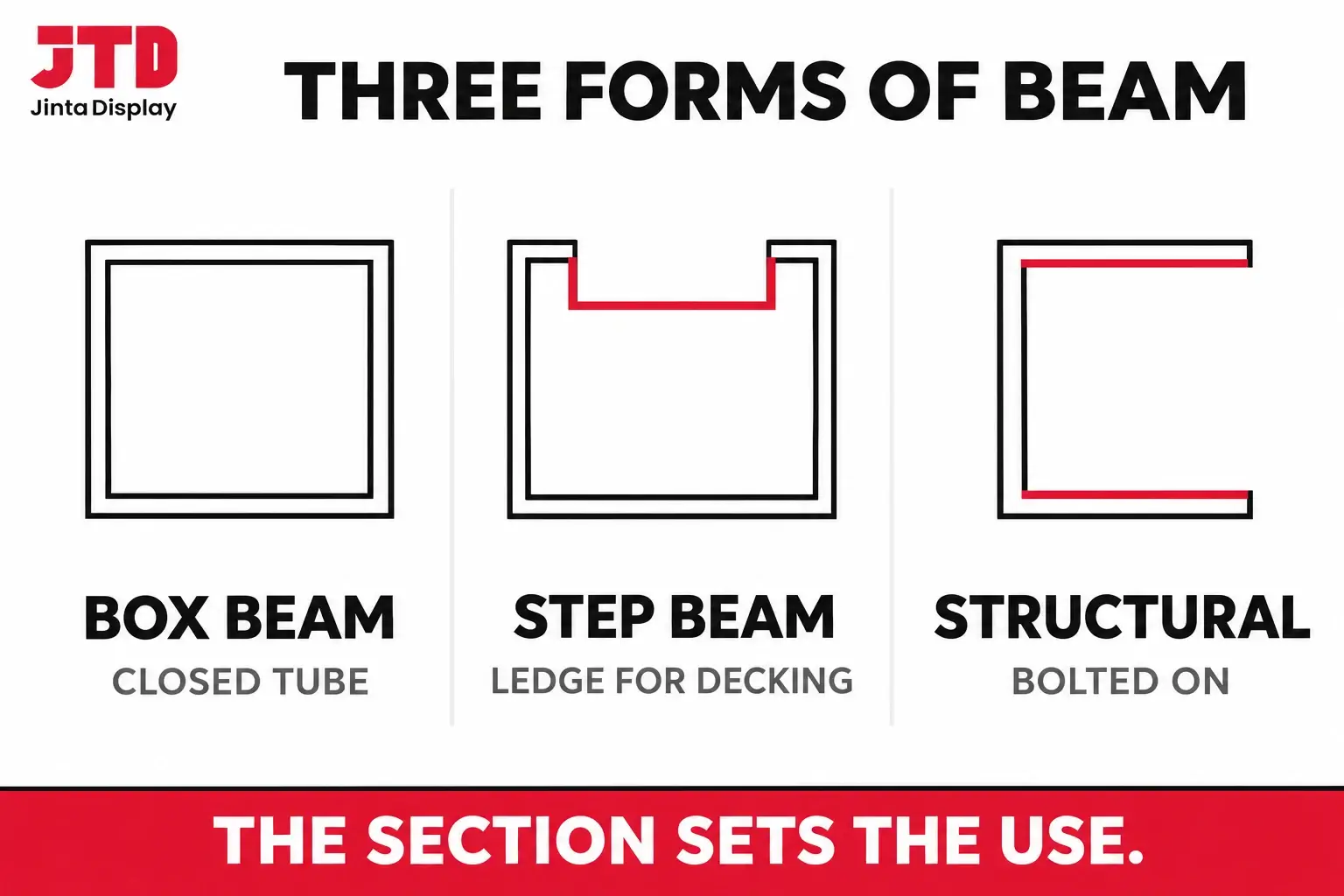
Box Beam, Step Beam and Structural Beam
There are three forms of pallet rack beam in common use, and each one suits a different set of conditions.
Box beam. A closed rectangular tube, roll formed from sheet steel and welded along a seam. It is stiff for its weight, because a closed section resists both bending and twisting. The top is flat, so a pallet or a plain deck sits directly on it. Our beams are listed as rectangular sections of 100 × 50 mm in 1.5 to 2.5 mm steel and 120 × 50 mm in 1.5 to 2.0 mm steel.
Step beam. A box beam with a ledge, or step, formed along the top inner edge. The ledge carries a deck of wire mesh, steel panel or board at a level slightly below the top of the beam, so the deck sits inside the beam and does not add to the level height. It is the usual choice where decking is used, because the deck is held in place and cannot slide off.
Structural beam. A heavier section such as a hot rolled channel or a formed C, usually bolted to the upright through a plate or a bracket. It is used for the heaviest loads and the longest spans, and where a rack is built to an engineered design. It costs more and is slower to fit and adjust.
| Form | Section | Decking | Typical use |
|---|---|---|---|
| Box beam | Closed rectangular tube | Sits on top of the beam | General pallet storage with no deck, or with support bars |
| Step beam | Tube with a ledge on top | Sits in the step, flush with the beam | Racks with wire mesh or panel decks for cartons and loose goods |
| Structural beam | Channel or formed C, bolted | On top or on added supports | Heavy loads, long spans, engineered racks |
For a plain pallet rack the choice is usually between the box and the step beam, and the question to ask is whether decking will be used now or later. A step beam keeps that option open, and it keeps the level height the same with or without a deck.
How a Beam Connects to the Upright
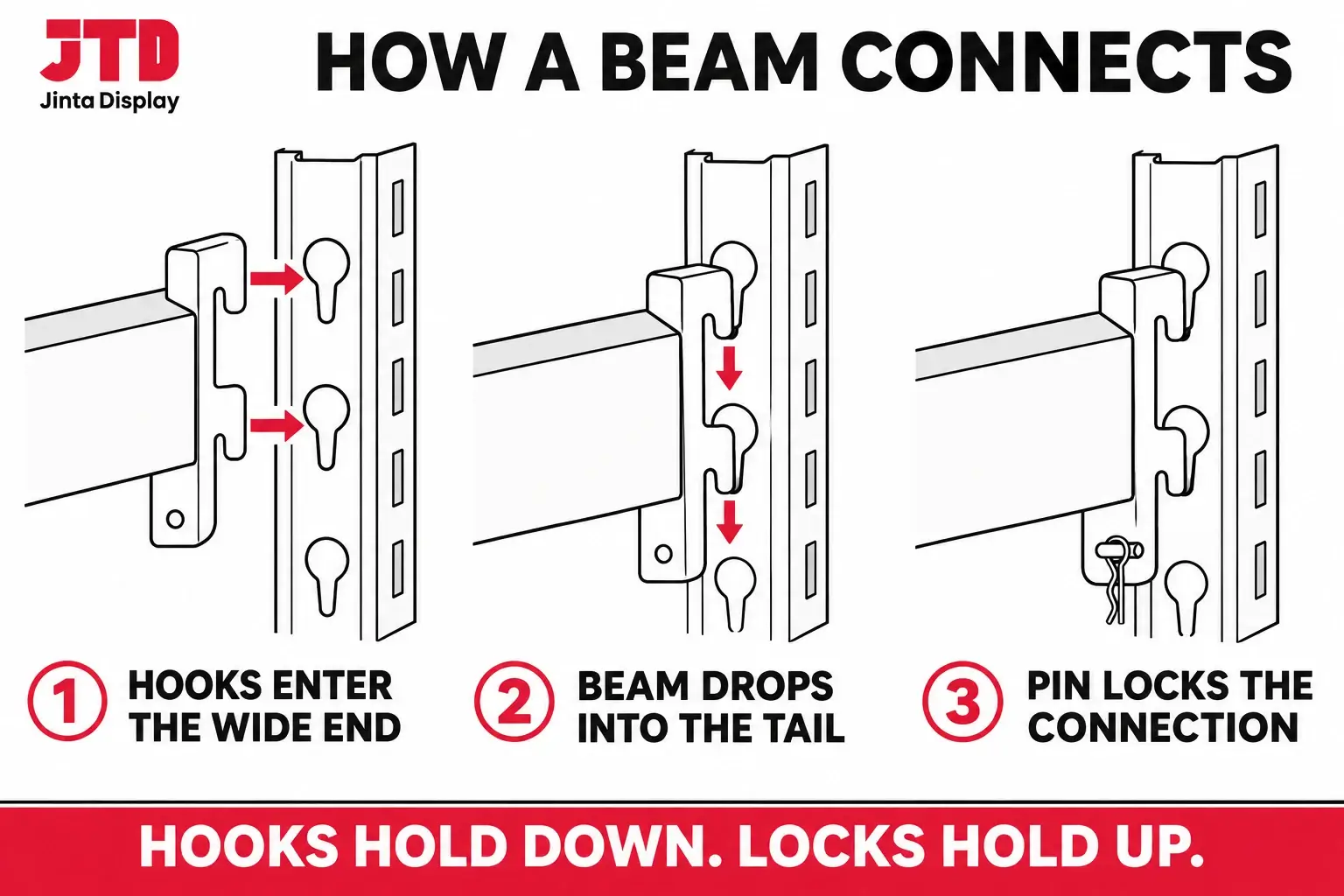
The connector is the end of the beam, and it is the part that makes a pallet rack adjustable. A beam is welded at each end to a connector plate with hooks. The hooks fit into slots in the upright, and the beam is raised or lowered to a new set of slots to change the level.
The most common slot is the teardrop, a hole shaped like a drop of water, with a wide round end and a narrow tail. The hooks on the connector enter the wide ends and drop into the narrow tails, which holds the beam against the face of the upright. The slots repeat at a fixed pitch along the upright, so the level of a beam moves in steps. Our trade listing for a pallet rack lists teardrop slots on uprights of 80 × 60 or 90 × 70 mm, with matching mesh decking.
The number of hooks on a connector varies, commonly between two and four. More hooks spread the load into more slots and give a better fit, and the quotation should say how many the connector has and how thick the plate is.
Other forms exist. A bolted connector fixes a beam to the upright with bolts through a plate, and it is used on structural beams. A clip in connector fits without a hook. Teardrop is the common form on adjustable pallet racking, and our trade listing describes it as popular in the US market, because a level can be changed quickly with simple tools.
The Lock That Holds the Beam
The hooks hold a beam against downward load, and they do not hold it against a knock from below. A forklift raising a pallet can catch the underside of a beam, and a beam that is not locked can lift out of the slots and fall. That is why every beam connection needs a lock.
The lock can be a safety pin, a locking clip or a bolt through the connector and the upright, depending on the design. The pin is small and cheap, and it is the part that is most often missing on an old rack. Ask the supplier which lock the rack uses and whether one is supplied for every connection.
Two rules follow. A lock is fitted at every connection, which means two for every beam. And a lock that is bent, loose or missing is a defect to fix before the next load goes on. A rack where a few locks are missing is a rack where a single knock can bring down a level, and the fix costs very little.
Decking on a Pallet Rack Beam
A pallet rack beam can carry more than pallets. With a deck across the beams it carries cartons, drums and loose goods, and the way the deck sits depends on the form of the beam.
Wire mesh is the usual deck on pallet racking. It is open, so sprinkler water passes through and light and air move through the rack, and it is lighter than a solid panel. Our trade listing for a teardrop pallet rack notes that mesh decking matched to the rack is provided. Steel panels give a solid surface for small items, and board decks are used for light loads. Each is rated separately, and the deck rating is the third rating in the capacity guide.
On a box beam, the deck rests on top of the beam, so the level height grows by the thickness of the deck. On a step beam, the deck sits on the ledge inside the beam and the level height does not change. That is the practical reason to choose a step beam when decking is planned, and it also holds the deck against sliding off if a pallet is pushed across it.
Check three things with any deck. Ask for the rated load of the deck and for the span it assumes, which is the beam spacing. Ask how the deck is held, and whether it locks to the beam. And ask whether the deck matches the beam section, since a deck cut for a 100 mm beam does not sit right on a 120 mm one.
Counting Beams and Locks in a Run
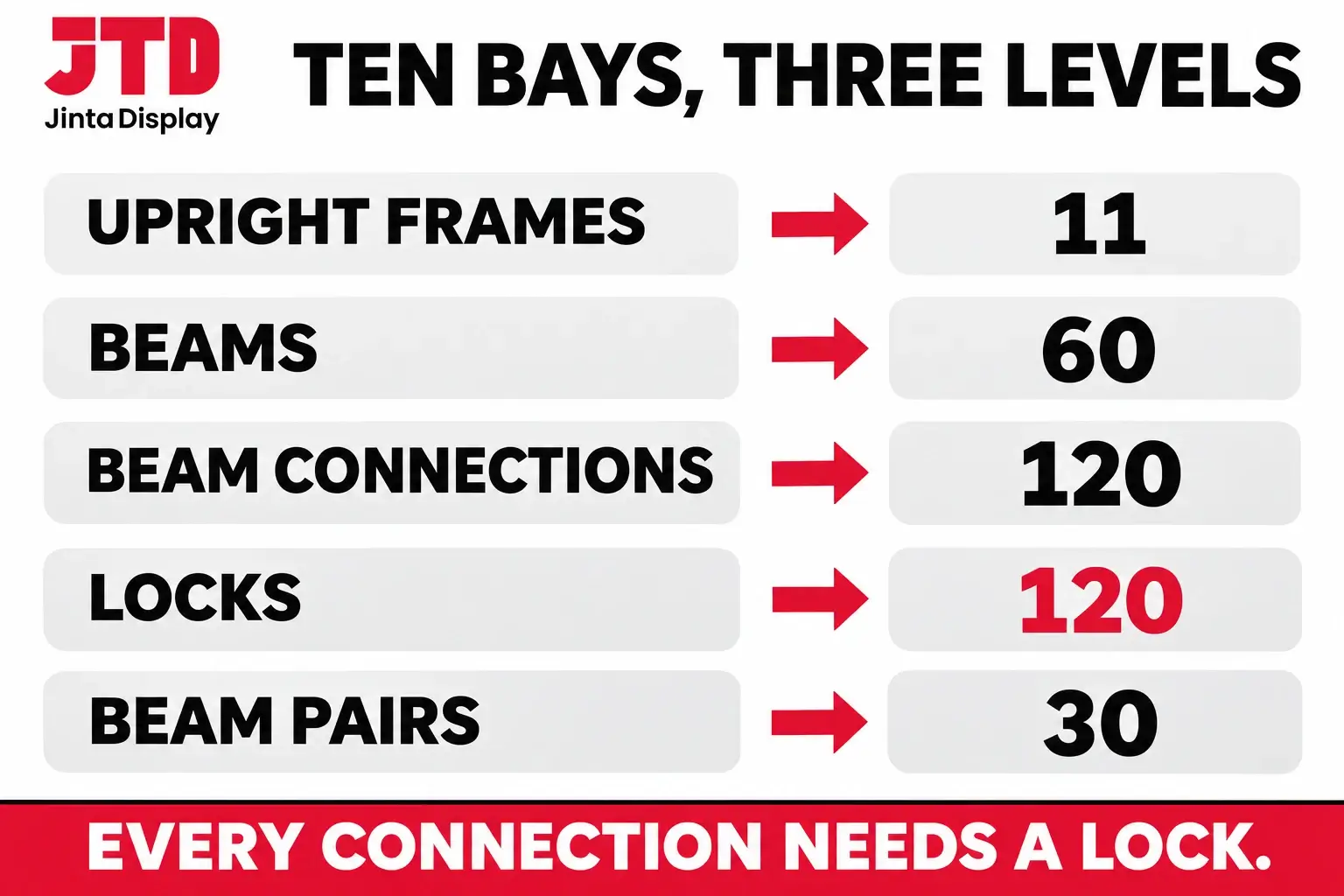
The numbers make the point about the pallet rack beam better than the description. Take a run of 10 bays with three beam levels, which is a common small installation. Each bay has two beams at each level, one at the front and one at the back.
| Item | Working | Quantity |
|---|---|---|
| Upright frames | 10 bays + 1 | 11 |
| Beams | 10 bays × 2 beams × 3 levels | 60 |
| Beam connections | 60 beams × 2 ends | 120 |
| Locks | One at every connection | 120 |
| Beam pairs | 10 bays × 3 levels | 30 |
The run has 60 beams, 120 connections and 120 locks, and the load rating is given per pair, so a quotation for 30 pairs is a quotation for 60 beams. If a supplier quotes beams per piece and the buyer thinks in pairs, the order can be out by a factor of two, and it helps to check by writing the count down.
Each connection is also a place for something to go wrong. A run of this size has 120 locks that have to be fitted by the person who installs the beams and checked by the person who inspects them. Ask for the locks to be included in the beam quantity, and ask how many spare ones come with the order.
Installing Pallet Rack Beams
Every pallet rack beam is installed after the uprights are stood and braced, and the order of work matters for safety.
Stand the frames in a line, fix the first one to the floor with its anchors and set the next at the right spacing. Hook a beam into the slots at one end, then at the other, and tap it down until the hooks seat in the narrow tails of the slots. Fit the lock at each end before letting go of the beam. Check that both ends of the beam are at the same height with a level or a gauge, and check that the front and back beams of a pair match.
Never load a beam that is not locked. The first pallets go on only when every pin is in, the frames are anchored and the bay is square. The installer should have the installation instructions and the load plaque for the rack, and the plaque goes on the first frame where staff can read it.
A video on our channel shows how a warehouse medium rack is built, with the shelf beams hanging on the frame in a few steps. It is a medium duty rack and not a pallet rack, and the principle of hanging a beam on slots is the same.
Reading Beam Deflection in Practice
Sag is the first sign that a pallet rack beam is being asked for too much, and it is easy to measure.
The capacity guide explains that beam ratings in the North American market limit deflection under rated load to one 180th of the span. On a 2,700 mm beam that is 15 mm, and on a 2,000 mm beam it is about 11 mm. Those are limits for a beam carrying its full rated load, and they are a useful reference on the floor.
To check a beam, stretch a string tight along its top edge from one end to the other and measure the gap in the middle. An empty beam should show almost no gap. A loaded beam may show a gap up to the limit above. An empty beam that is visibly bowed, or a loaded one that sags well beyond the limit, has been overloaded or struck, and it should be unloaded and replaced.
The sag of a beam also grows quickly with its length, since for a given load deflection grows with the cube of the span. That is why a longer bay carries less per pair, and why a rack that has been reconfigured with longer beams should have its ratings checked again.
Inspecting Beams in Use
A rack is a piece of structure that works for years under moving loads, and the beams take the knocks. A simple routine of inspection catches most problems before they become a failure.
Look along each beam for a visible bend or sag, and compare it with its neighbor. A beam bowed by more than the others has been overloaded or hit. Look for dents and creases in the walls of the tube, since a dent is a weak spot. Look at the connector for cracks in the welds and for hooks that are bent or not fully seated in the slots. And look for the locks, which should be present, straight and fully in.
Check the load plaque against what is stored. A rack that has been reloaded with heavier pallets than the plaque allows is a rack that is out of its rating, whatever the beam looks like. Inspect regularly, and always after any impact from a truck.
What to do with a damaged beam matters as much as finding it. A bent or dented beam is unloaded and replaced with a new one of the same specification. Beams are not straightened on site, and they are not repaired by welding, because the steel has been work hardened and heated and the rating no longer holds. Rack suppliers give this rule, and it costs little to follow.
Beam Damage, Guards and Impact
Most beam damage comes from trucks and not from loads. A fork that strikes the front beam at the aisle face dents the tube, bends the connector or knocks the lock loose, and the first sign is often a beam that no longer sits level.
Three measures reduce it. Upright guards and column protectors take the impact at the base of the frame, where a truck usually hits. Wider aisles and good lighting give the driver room. And training matters, because a driver who knows the clearance to the beam rarely hits it. After any impact, inspect the nearby beams and locks before the next load goes on.
If a beam is replaced, replace it with one of the same section, thickness, connector and rating, and record the change. A mixed rack where one pair is lighter than its neighbors is a rack where the plaque no longer tells the truth.
Plaques, Training and Records
A pallet rack beam is rated, and the rating is only useful if people know it. The load plaque, fixed to the end frame where staff can read it, gives the rated load per level and per bay. Staff should know that the plaque shows the load per pair of beams, with the pallets spread evenly, and that a heavier pallet at the end of a level is a harder case than the same weight spread.
Keep a record of the rack. It should show the supplier, the specification, the date of installation, the load plaque, the inspections and any changes or repairs. When a rack is moved or reconfigured, the record is what lets the next person check that the beams still match the design.
Train the people who load and drive. A driver who knows how to place a pallet square across the beams and how to avoid lifting into the beam above is the best protection a rack has. And a supervisor who walks the rack once a week catches a missing pin before it matters.
What to Put on a Beam Quotation
A pallet rack beam line on a quotation should say more than a length. These are the entries worth requiring.
Form and section. Box, step or structural, with the section size and the wall thickness. Our beams run from 100 × 50 mm to 120 × 50 mm, in 1.5 to 2.0 or 2.5 mm steel.
Length. The beam length and the clear opening it gives between the uprights. The sizes guide explains why the two differ.
Connector. The type, the number of hooks and the thickness of the plate.
Lock. The type and the number supplied, and whether they are included in the price.
Load per pair and its basis. The rated load in kilograms per pair of beams, with the deflection limit and the loading assumed. This is the figure that the capacity guide teaches you to read.
Finish. Powder coat, plating or paint, and the color. Beams get scratched by pallets, and the finish should be able to take it.
With these entries on both quotations, two suppliers can be compared on the same basis, and a beam that is cheap because it is thin or short of hooks shows up at once.
Mistakes With Beams
Four mistakes show up on many racks.
The first is ordering by length. Two beams of the same length can differ in section, thickness and connector, and the rating follows those. Order by specification.
The second is leaving out the locks. They are small, so they are easy to leave off an order and easy to leave off a rack. Count them as parts.
The third is mixing beams and uprights from different makers. The slots and the hooks have to match, and a beam that appears to fit can seat in the wrong way. Use one system, or confirm compatibility in writing.
The fourth is treating a damaged beam as a cosmetic fault. A dented beam is a weaker beam, and it should come out of use.
What to Send Us for a Quote
Send the pallet size and weight, the number of pallets per level, the number of levels and the height of the room, together with whether decking will be used. Tell us the forklift or truck. We reply with the beam section, the length, the connector and the load per pair. For the range, see the heavy duty warehouse rack and the warehouse rack range.
For the order of the work on site, see pallet racking installation.
If you are choosing pallet rack beams, send us your pallet size, load and levels and we will reply with a beam specification and the load per pair.
Frequently Asked Questions
What is a pallet rack beam?
A pallet rack beam is the horizontal steel member that spans between two upright frames and carries the pallets at one level. Beams work in pairs, one at the front and one at the back, and each end hooks into slots in the upright and is locked in place.
What is the difference between a box beam and a step beam?
A box beam is a closed rectangular tube with a flat top. A step beam is a box beam with a ledge along the top inner edge that carries decking flush with the beam. Both carry pallets, and a step beam keeps the option of a deck without changing the level height.
What is a teardrop connector?
It is the end of a beam fitted with hooks that fit into teardrop shaped slots in the upright. The hooks enter the wide end of the slot and drop into the narrow tail, which holds the beam against the upright. The slots repeat at a fixed pitch, so levels move in steps.
Do pallet rack beams need safety pins?
Yes. Hooks hold a beam against downward load, and a pin or lock holds it against a knock from below, such as a pallet lifted by a forklift. Fit a lock at every connection, two for each beam, and replace any lock that is bent, loose or missing before loading.
Can you repair a bent pallet rack beam?
No. A bent or dented beam is unloaded and replaced with a new one of the same specification. Straightening or welding a beam on site changes the steel and the rated load no longer holds. Check the load plaque and the beam rating before choosing the replacement.
How many beams are in a pallet rack bay?
Two at each level, one at the front and one at the back. A bay with three levels has six beams, and a run of 10 bays with three levels has 60 beams and 120 connections that each need a lock. Load ratings are given per pair, so count pairs and beams carefully.
What size are pallet rack beams?
Our beams are 100 × 50 mm in 1.5 to 2.5 mm steel or 120 × 50 mm in 1.5 to 2.0 mm steel. The length follows the bay width less the uprights, and the section and thickness set the load per pair. The capacity and dimensions guides explain how to read both.
How often should pallet rack beams be inspected?
Inspect them regularly, with a simple routine of walking the rack, and always after any impact from a truck. Look for bends, sag, dents, cracked welds at the connectors, bent hooks and missing locks. Many sites also arrange a formal inspection at set intervals, which a supplier can advise on.