
A cantilever rack stores long material on arms that stick out from one side of a column, with no front upright in the way. Removing the front upright is what lets pipe, bar, timber, board and extrusions slide straight onto the rack. It is also the reason cantilever rack capacity is worked out differently from beam racking. There is no beam spanning between two uprights to share the load. Every kilogram lands on one arm, and the arm passes it to the column as bending and not as simple compression.
That is where buyers get caught. A pallet rack quotation gives a beam rating and a bay rating, and the two reconcile easily. A cantilever quotation often gives only an arm rating, and an arm rating alone says very little about what a run will hold. How much weight a cantilever rack can hold depends on the arm length, the column, the base, the slab and the way the stock is placed.
This guide explains cantilever rack capacity and design together. It shows how the three ratings are built, which design choices move each one and what a manufacturer needs from you before any figure can be quoted honestly. It is a specification guide. Inspection routines, load notices and installation are governed by the rules where the rack stands and by whoever installs it, and none of that is covered here. The market figures below are published industry ranges from rack suppliers and are marked as such. Figures from our own product pages are marked as ours.
What Is a Cantilever Rack and What Does Each Part Do
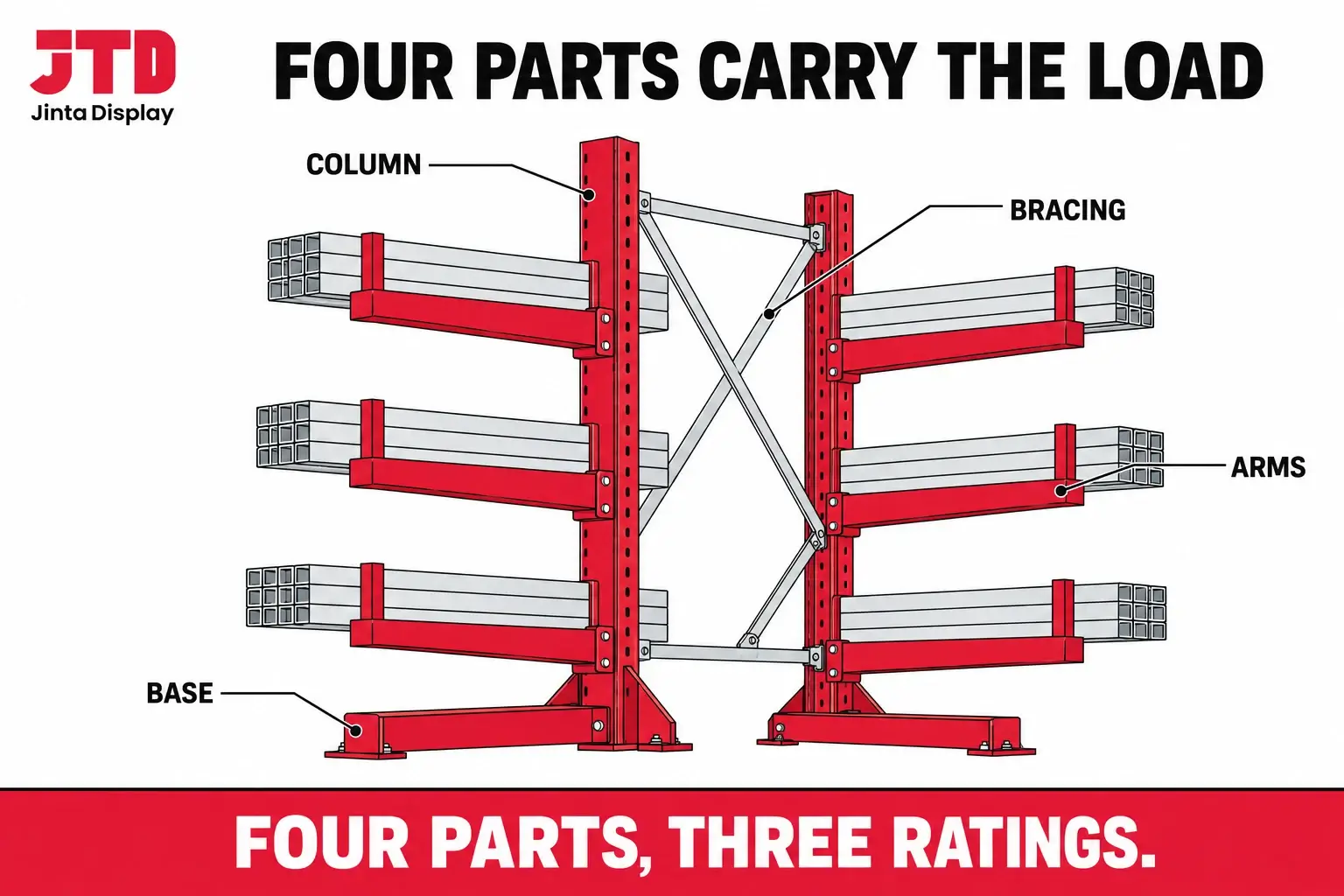
A cantilever rack is a freestanding storage frame with horizontal arms that project from a vertical column. Each arm is fixed at one end and free at the other, which is the structural meaning of the word cantilever. The open front is the whole point of the design. Long and awkward loads are placed from the side or the front by forklift or crane, and nothing has to be cut to fit a pallet bay.
Four parts carry the load, and each of the three ratings belongs to a different piece of steel.
The base is the foot that sits on the slab. Its job is less to hold weight up and more to stop the tower tipping forward, because the load hangs out in front of the column. Cantilever columns are normally anchored to the floor through the base, so the slab is part of the design. A cantilever rack capacity figure that ignores the base and the floor is not a complete figure.
The column, also called the upright, is the vertical member. On many roll-formed systems it is punched on both faces, which means a single-sided tower can be turned into a double-sided one later by adding arms on the back. Our pages list columns such as 200 × 80 × 2.5 mm for double-sided racks and 200 × 60 × 2.0 mm for single-sided racks.
The arms are the horizontal members the load rests on. They fix into the column face at a chosen vertical pitch. They are supplied straight, or inclined a few degrees upward when round stock could roll off the front.
The bracing ties neighboring columns together along a run. Without it you have a line of separate towers. With it you have a system that shares sideways load. Bracing adds nothing to arm capacity, but it decides whether the run stands up. Our double-sided racks use a 40 × 20 × 1.5 mm rectangular tube pull rod for this job.
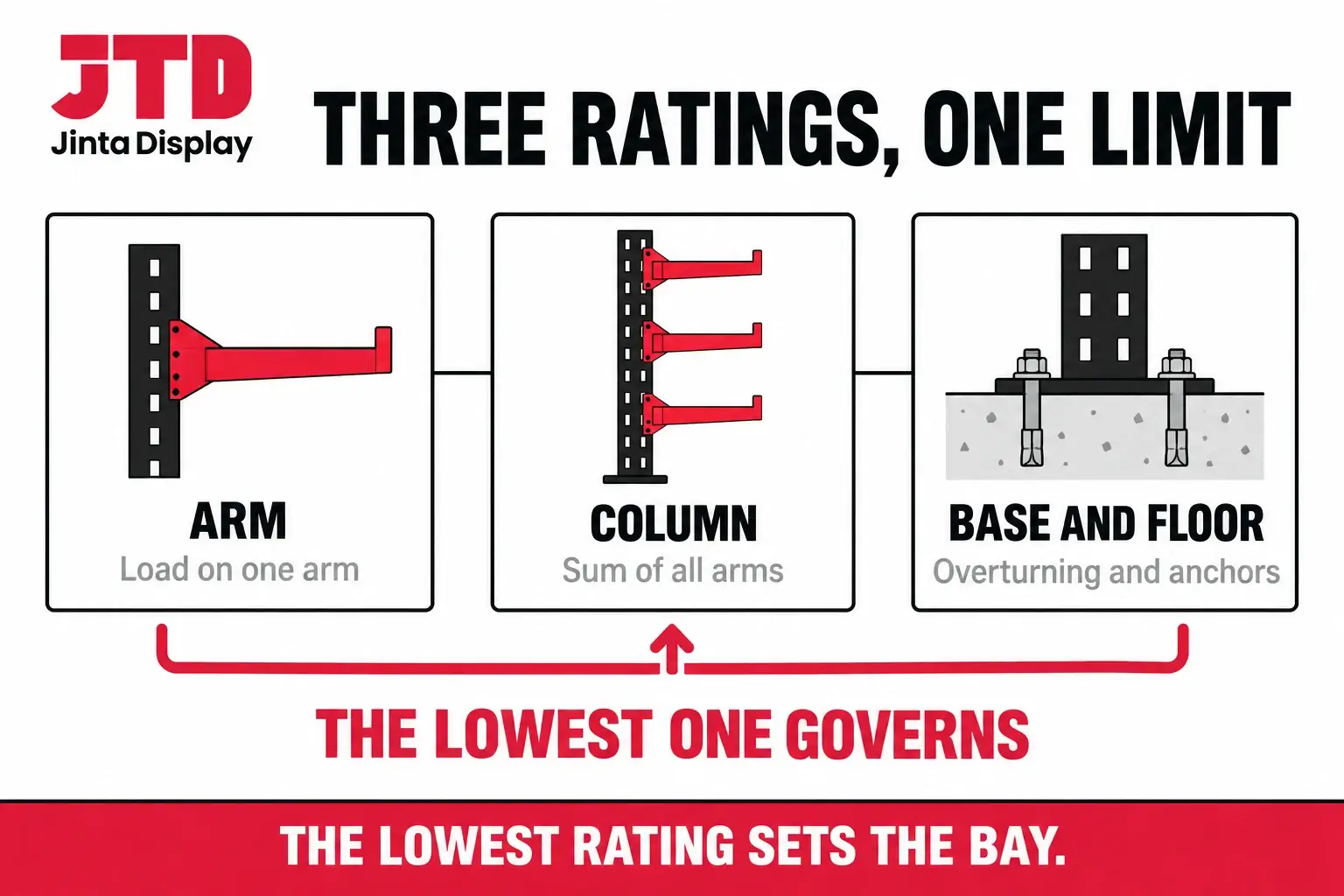
Cantilever Rack Capacity Is Three Ratings and the Lowest One Wins
This is the most useful idea in the whole subject, and it is where most specification errors begin. The three ratings are independent. They are limited by different failure modes, and multiplying an arm rating by the number of arms is a guess and not a calculation.
| Level | What the number means | What moves it | What limits it |
|---|---|---|---|
| Arm capacity | Load on one arm, spread along its length | Arm length, section depth, steel grade, connection to the column | Bending in the arm and the strength of the joint |
| Column capacity | Total of every arm on one column, both faces | Column section, height, number of levels, arm pitch | Compression and bending together in the column |
| Base and floor capacity | What the foot and the slab take | Base size, anchor pattern, slab thickness and concrete strength | Overturning, bearing pressure and anchor pull-out |
Work an example with stated assumptions. Suppose each arm is rated at 1,000 kg and you fit six levels on a double-sided tower, which is twelve arms. The arithmetic says 12,000 kg for the column. Whether the column will carry 12,000 kg is a separate question with its own answer, and on a light roll-formed tower at 4 m it often will not. The arm rating is a ceiling for each level. It is not permission to fill every level to it.
The usual way to size the arms is the other direction. Divide the weight of the heaviest bundle by the number of arms that will support it. A 6,000 kg bundle lying across three arms needs about 2,000 kg of capacity per arm if the weight is shared evenly, and more if one end of the bundle is heavier than the other.
The Assumption Hidden Inside Every Arm Rating
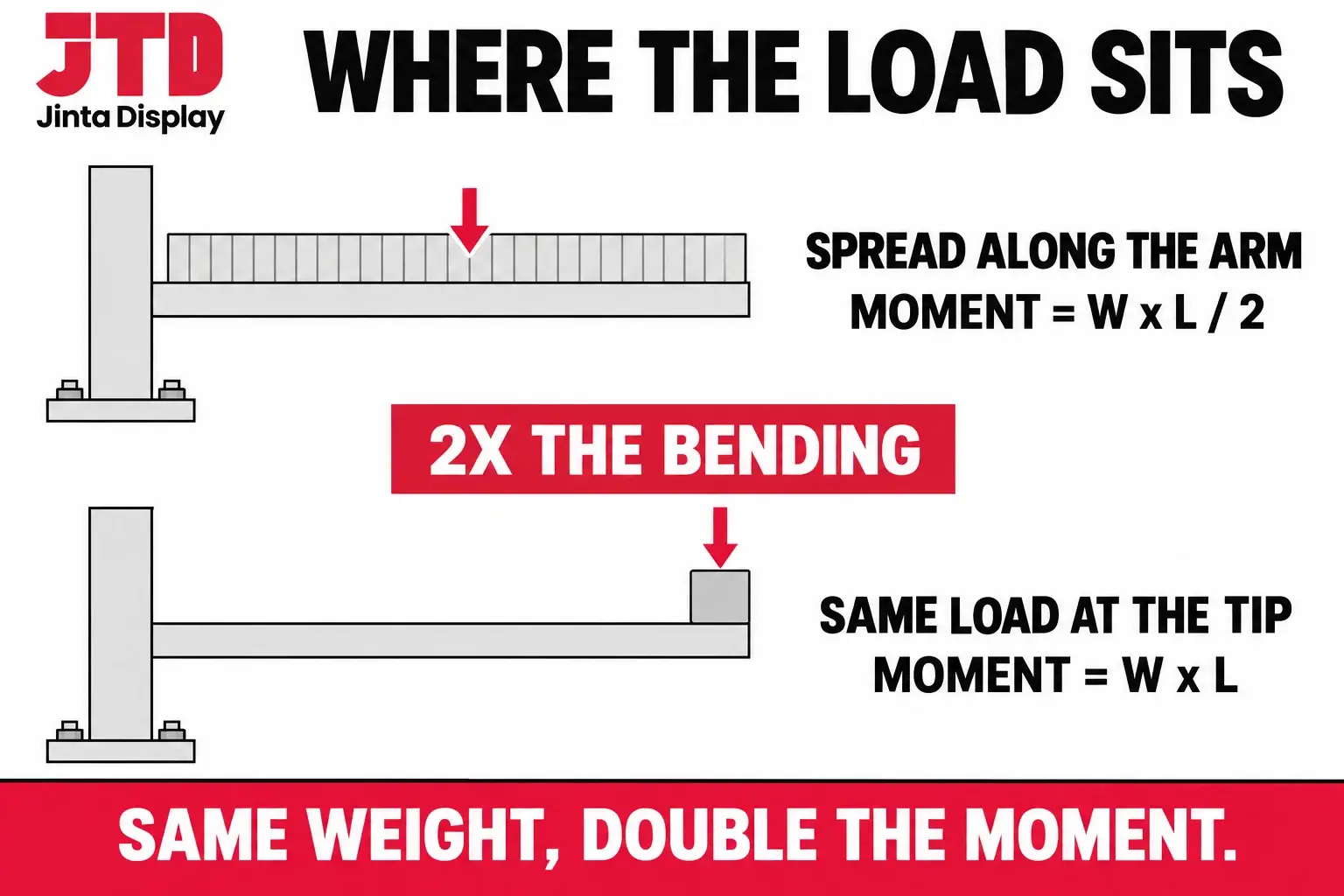
An arm rating is published as a uniformly distributed load, which means the weight is spread evenly along the arm. That assumption does more work than most buyers realize, and the mechanics are simple enough to check on paper.
Take an arm of length L carrying a total weight W. Spread evenly, the weight acts through the middle of the arm, and the bending moment at the column face is W times L divided by 2. Put the same weight as a single point load at the tip and the moment becomes W times L. That is exactly double. A point load at the tip therefore halves the weight the arm can safely take.
The in-between cases matter more, because nobody loads at the tip on purpose. Slide the effective center of the load from mid-arm out to three quarters of the arm length and the moment rises by half. That is the difference between a bundle pushed home against the column and the same bundle left hanging over the front. Arm length you do not use is not a safety margin. It invites loading in the wrong place.
How to Read a Cantilever Rack Capacity Chart
Reading a cantilever rack capacity chart starts with finding the row for your arm length. Then check the three conditions printed beside the figure. The chart should say whether the load is evenly distributed, how many levels the column may carry at that rating, and what deflection basis the arm figure uses. A chart that lists arm capacity by arm length but says nothing about the column total gives you a third of the picture.
When two suppliers publish a different cantilever rack capacity for the same arm length, the difference almost always sits in those printed conditions and not in the steel. One chart may assume a load held back toward the column. Another may assume a full-length bundle. Ask each supplier to restate the rating on the same basis before you compare prices.
What Sets Cantilever Rack Arm Capacity
Four variables set the rating of an arm, listed here in rough order of how much they move the number.
Arm length. Because the moment is weight times distance, capacity falls roughly in proportion to length for a given section. Doubling the arm from 600 to 1,200 mm on the same profile roughly halves what it will carry. Suppliers publish arm length as one of the main columns of a capacity chart for this reason. Buyers most often get this wrong by ordering long arms for material that is long and not deep. A 6 m pipe needs enough arms along its length. It does not need a 6 m arm.
Section depth. Bending strength grows roughly with the square of the section depth, and stiffness grows with the cube. A deeper arm profile therefore buys capacity faster than a thicker one of the same depth. This is why structural arms rate far above roll-formed arms of the same length. Published ranges put standard-duty arms at about 500 to 2,000 lb (227 to 907 kg) and heavy structural arms past 3,400 lb (1,542 kg).
The connection. The joint between arm and column carries the full moment, and it is often the real limit and not the arm itself. Bolted structural joints, hooked roll-formed connectors and welded brackets behave differently under repeated loading and under a fork bump.
Deflection. Arms bend visibly under load. A rating that stops the steel from yielding can still leave an arm that droops too far at the tip. For a given total load the tip deflection of an arm grows with the cube of its length, so on long arms the usable rating is often set by allowable deflection long before it is set by strength. A rating quoted without a stated deflection basis is incomplete.
On our side, the cantilever rack range is listed at 500 to 3,000 kg per layer (1,102 to 6,614 lb), in cold rolled steel. Because a layer can mean one arm pair or a full level, the per-arm figure is confirmed on the drawing for each order. Ask any supplier the same question about their own chart.
What Sets Column Capacity
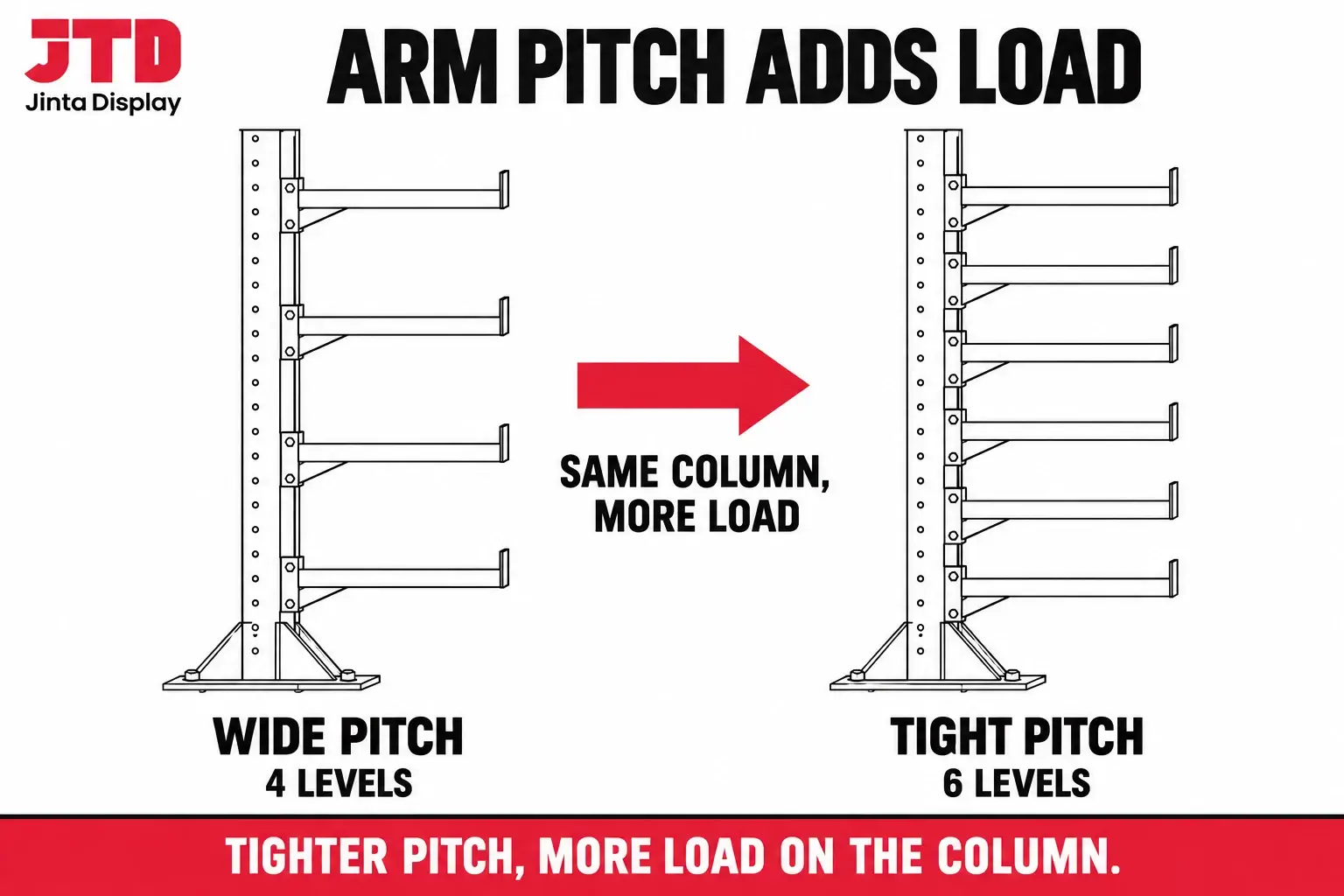
The column carries compression from every load plus the bending that each arm hands it. The interaction of the two is what limits it, and the lever most people miss is arm pitch.
Pitch is the vertical spacing between arm levels. Columns are punched on a fixed step, so pitch moves in whole steps. Tightening the pitch to fit more levels in the same height raises the total the column must carry without changing the column. It is the quietest way to overload an upright in an otherwise sound design. Set the pitch from the height of the bundles you store plus clearance for fork entry and withdrawal, and not from the number of levels you would like.
Height works against you twice. A taller column is more slender, and the top arm applies its bending farther from the fixed base. Our listed racks run from about 2,000 to 2,500 mm high. Going well beyond that moves the design toward heavier structural sections, and the capacity has to be recalculated and not scaled.
Single-sided and double-sided towers load the column differently. A double-sided tower with balanced loads is efficient because the two sides partly cancel each other’s overturning moment. A double-sided tower loaded heavily on one side only is the worst case the base has to survive, and it is a normal operating condition because stock does not run down evenly.
Punching matters as well. A punched column is not a solid section. Its capacity comes from testing and analysis of that exact hole pattern, and not from a handbook table for plain tube. Two columns of the same outside size and wall thickness can rate differently if the punching differs.
Roll-Formed and Structural Cantilever Racks Are Two Capacity Families
Almost every cantilever quotation is one or the other. Comparing prices across the two without noting which is which is how a buyer concludes that one supplier is cheap.
| Point | Roll-formed | Structural |
|---|---|---|
| Section | Cold-formed steel sheet, punched on the faces | Hot-rolled structural shapes |
| Typical arm rating in published charts | Light to medium, up to about 2,000 lb (907 kg) | From about 1,500 lb (680 kg) per arm, past 3,400 lb (1,542 kg) when heavy |
| Arm adjustment | Fine steps, easy to move | Coarser steps, moving an arm is a job |
| Handling damage | Dents and bends under fork contact | Takes contact better |
| Weight and freight | Lighter, more racks per container | Heavier, fewer racks per container |
Neither family is the better product. Roll-formed suits indoor storage of moderate-weight long goods where the layout changes often. Structural suits heavy steel, outdoor yards and any place a fork mast will meet a column from time to time. If the loads are moderate and handling is careful, paying for structural cantilever rack capacity buys freight and not capability. If they are not, roll-formed buys a replacement program. Steel section is also the largest line in what warehouse racking costs, so the choice shows up in the quotation at once. Our cantilever racks are cold rolled steel, with OEM color and logo on request.
The Base and the Floor Are the Third Rating
Arms and columns get studied closely. The base gets whatever the drawing says. Yet the base and the slab under it are the third rating, and they fail differently, by tipping and by anchor pull-out and not by bending.
The base exists to resist the overturning moment from loads that sit in front of the column. Base length is therefore a design result that grows with arm length and with the load on the arms. A single-sided tower needs a base that projects well forward under the load, while a double-sided tower gets a base that runs both ways and is more stable when loading is balanced.
The slab is a genuine constraint and not a formality. Anchors need sound concrete of adequate thickness to reach their rated pull-out. In seismic regions the base and anchor design is an input to the layout and cannot be settled after the racks arrive. This is why the slab thickness and concrete grade belong in the first email and not the last. The design standard for this type of rack in the United States is ANSI MH16.3, published through the Rack Manufacturers Institute, and your engineer of record will work from the standard that applies on your site.
Cantilever Rack Design Choices You Make Before Anyone Can Quote
Five decisions set the ratings, and all five belong to the buyer and not the manufacturer. Taking them in the wrong order produces a rack that is correct on paper and awkward on the floor.
Arm length comes from load depth, not load length. Every millimeter of arm costs capacity, so order arms long enough to carry the depth of the bundle and a little clearance, and no more.
Column spacing comes from the unsupported span of the load. Flexible material such as thin-wall tube or plastic profile sags between columns and needs them closer together. Rigid steel bar tolerates wider spacing.
Arm pitch comes from the real bundle height. Measure the stacks, add fork clearance and set the pitch from that, as described above.
Single-sided or double-sided is a floor plan decision. A double sided cantilever rack is more efficient per square meter and per kilogram of steel, but it needs an aisle on both faces. A single sided cantilever rack against a wall costs more per stored tonne and is sometimes the only layout the building allows. Our single-sided rack listings include a 600 mm deep unit for wall runs, and our double-sided listings run at 1,600 mm deep.
The aisle is sized for the load and not only the truck. A forklift or side loader carrying 6 m stock needs turning and approach room that a pallet aisle does not provide. It is the constraint most often found after the slab is poured.
Matching Arms to What You Store
Cantilever racking earns its place on material that beam racking handles badly. The load profile drives the specification more than total weight does.
| Stored material | What drives the design | Arm choice |
|---|---|---|
| Timber, board and sheet | Bundle depth and sag between supports | Straight arms, closer columns |
| Steel pipe and round tube | Roll-off risk and high density in a small volume | Inclined arms, or straight arms with stops |
| Steel bar, angle and flat | Weight concentrated in a short length | Short heavy arms, tight pitch |
| Aluminum extrusion and profile | Light but easy to mark and bend | More supports, protected arms |
| Panels, doors and worktops | Depth and clean faces | Deeper arms, sometimes decked |
| Furniture and cartoned appliances | Bulk and not mass | Long arms at a modest rating |
Two rows invert the usual assumption. Furniture and cartoned appliances are a volume problem, so the driver is arm length and deck area at a modest rating, and heavy arms there waste money. Steel bar is the opposite. Short arms at tight pitch push the column total up quickly on a rack that looks half empty. Both can be built on the same cantilever rack platform with different arms.
Where Cantilever Racking Beats Beam Racking and Where It Does Not
Cantilever is the right answer to a narrow set of problems, and its capacity is only worth paying for when the problem is real. It wins where the load is longer than a pallet, where the front upright of a beam bay would block loading, and where material is picked as full lengths and not as unit loads.
It loses on floor space, because arms and bases take depth that a beam bay uses for storage. It also loses on any load that palletizes cleanly. If your material fits on a pallet, pallet rack capacity is the number to read instead, and the broader trade-off sits inside the comparison of warehouse racking types. Cantilever uses more floor area per stored tonne, it is more sensitive to how the operator places the load, and the arms are exposed with no front upright to shield them from a fork tine. Mixed operations usually put cantilever beside warehouse racking for the palletized majority and do not replace it.
What to Send a Manufacturer Before a Capacity Is Quoted
A supplier who quotes a cantilever capacity without asking for the following is quoting a catalog line and not your rack. Seven items turn an estimate into an engineered reply.
Send the material, with its longest and heaviest bundle and the bundle depth and height. Say how the weight sits along the length, because a bundle heavier at one end changes the arm calculation. Give the stored height available and any obstruction that caps it, such as sprinklers, lighting or door headers. Say whether the run is single-sided or double-sided and how many bays it has. Name the handling equipment, its reach and its aisle requirement. Describe the floor, meaning the slab thickness, the concrete grade and whether it is a designed industrial slab. Finally give the seismic category of the site, which governs the base and anchor design and cannot be changed cheaply later.
Any cantilever rack capacity we quote is calculated against the arm length, pitch and load position you specify, with the deflection basis stated. A rating without those conditions cannot be compared between suppliers.
If you have those details, send us your material, bundle size and floor information and we will reply with an arm and column schedule and a drawing. The configurations we build are listed in the cantilever rack product range.
Frequently Asked Questions
How much weight can a cantilever rack hold?
Cantilever rack capacity depends on the arm length, the column and the base. A standard 48 by 4 in arm is commonly rated around 2,000 lb (907 kg), and heavy structural arms are published past 3,400 lb. Our own range is listed at 500 to 3,000 kg per layer. The bay holds the lowest of the arm, column and base ratings.
How do you calculate cantilever rack capacity?
You start from the tested arm and column ratings of the actual product. Check that no arm is over its rating, that the sum of all arms on one column stays inside the column rating, and that the base and slab can take the overturning load. Arm ratings assume an even load, so treat a load at the arm tip as roughly double its weight.
What are the disadvantages of cantilever racks?
There are three real ones. Cantilever uses more floor area per stored tonne than beam racking. It is sensitive to where the load sits on the arm, because weight near the tip bends the arm far more. The arms are also exposed to fork contact. For palletized goods it is the wrong tool whatever its capacity.
What is the difference between roll-formed and structural cantilever racks?
Roll-formed racks use cold-formed steel with fine arm adjustment and suit moderate loads indoors. Structural racks use hot-rolled sections that rate higher per arm and take fork contact better. Published charts show roll-formed arms up to about 2,000 lb and structural arms from about 1,500 lb upward.
Do cantilever racks need to be bolted to the floor?
Normally yes, because cantilever rack capacity assumes an anchored base. The loads hang in front of the column and create an overturning moment, and the anchors resist it. Base and anchor design is part of the rack design, and slab thickness and concrete strength need to be known before the layout is final. Your engineer of record confirms the requirement for your site.
How far apart should cantilever arms be spaced vertically?
Set the pitch from the height of the bundles you store plus clearance for fork entry and withdrawal. Columns are punched on a fixed step, so the pitch moves in whole steps. Do not choose pitch to increase the number of levels, because each extra level adds to the column total without changing the column.
Should I choose single-sided or double-sided cantilever racking?
A double-sided tower is more efficient per square meter and is more stable when both faces are loaded evenly, but it needs an aisle on both faces. Single-sided suits a wall or building line and needs a deeper base against the one-way overhang. We list both, including a 600 mm deep single-sided unit.
Is cantilever racking better than pallet racking for long loads?
For material longer than a pallet, or material that must be loaded from the front with no upright in the way, yes. That is what the design is for. For anything that palletizes cleanly, no. Beam racking stores more per square meter and is less sensitive to load placement. Many sites use both.