
An airport luggage cart is a simple machine with a hard job. It carries heavy bags through long terminals, up ramps and across tiled floors, and thousands of passengers push it every month. It gets left on slopes, loaded unevenly and knocked by other carts. The difference between a cart that lasts and one that needs repair after a year is in its specification.
This guide sets out what to specify when you buy an airport luggage cart, with the real figures for the models we build. It covers load rating, size, how many bags fit, brakes, materials, wheels, advertising panels and container loading. It also gives a method for estimating how many carts a terminal needs. It is written from the manufacturing side, and figures for our carts come from our product pages. It does not cover price, which depends on the material, the quantity and the freight.
In the UK, Ireland, Australia and New Zealand the same item is an airport trolley or a luggage trolley, and in the United States it is a luggage cart or a baggage cart. The words differ and the specification is the same. The airport luggage cart is also used in hotels, railway stations, ports and shopping centers.
What an Airport Luggage Cart Is and Who Buys It
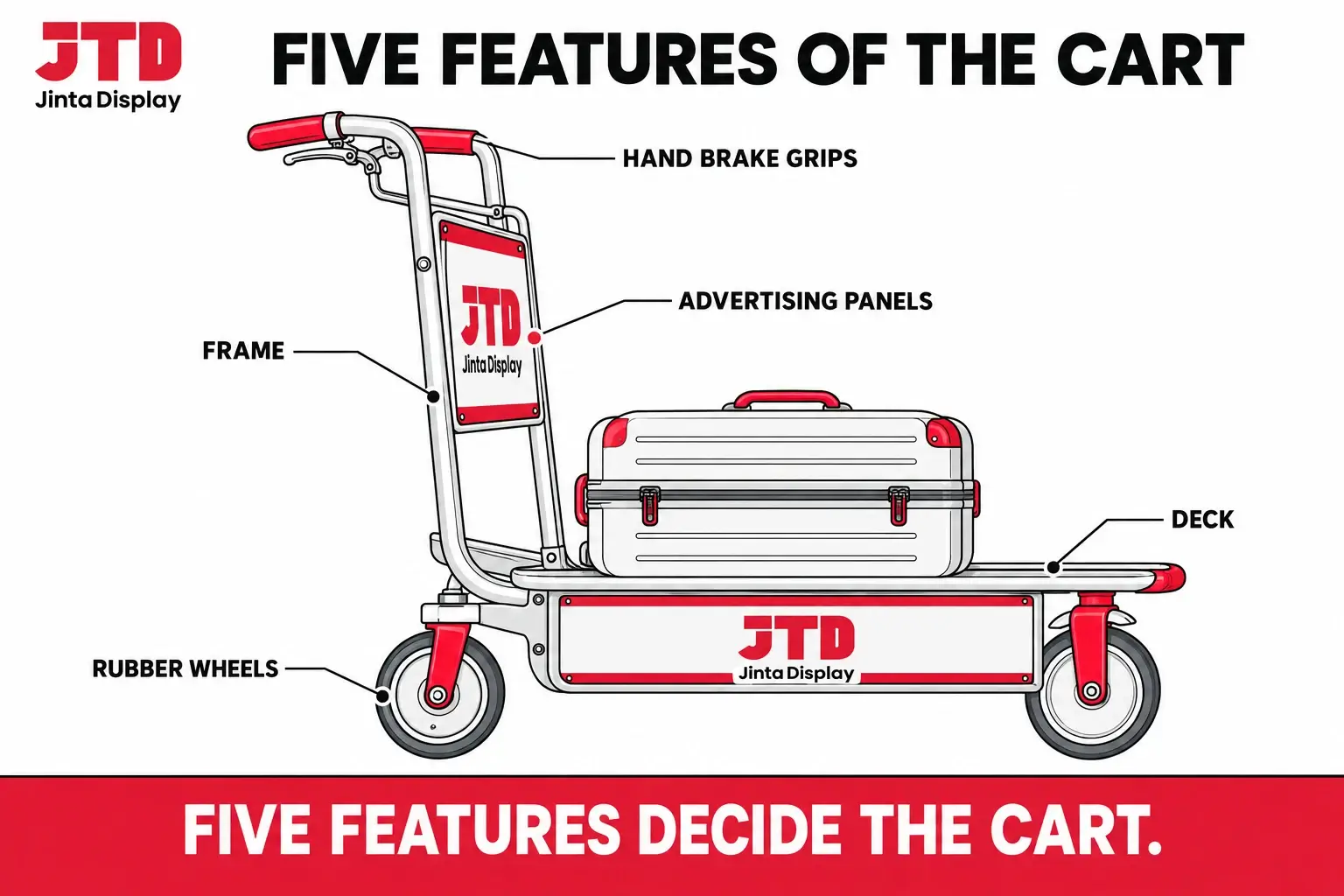
An airport luggage cart is a hand-pushed trolley with a deck for bags, a handle and large wheels. It is made to be used by passengers, collected by staff and parked in rows at the terminal. Many carts carry advertising panels, and the income from the panels helps to pay for the fleet.
The buyers are airport operators, ground handling firms and concession holders, and also hotels, stations, ports and malls. An airport buys a fleet to serve arriving and departing passengers. A concession holder buys a fleet and earns from the advertising or the hire. A hotel buys a few for the lobby. Each buyer has a different priority, from durability to appearance to income.
The cart is a long-term asset. A fleet may stay in service for years, so the specification should look past the first price. A cart that is a little heavier, with a stronger frame and a better wheel, costs more to buy and less to run.
Airport Luggage Cart Models in Our Range
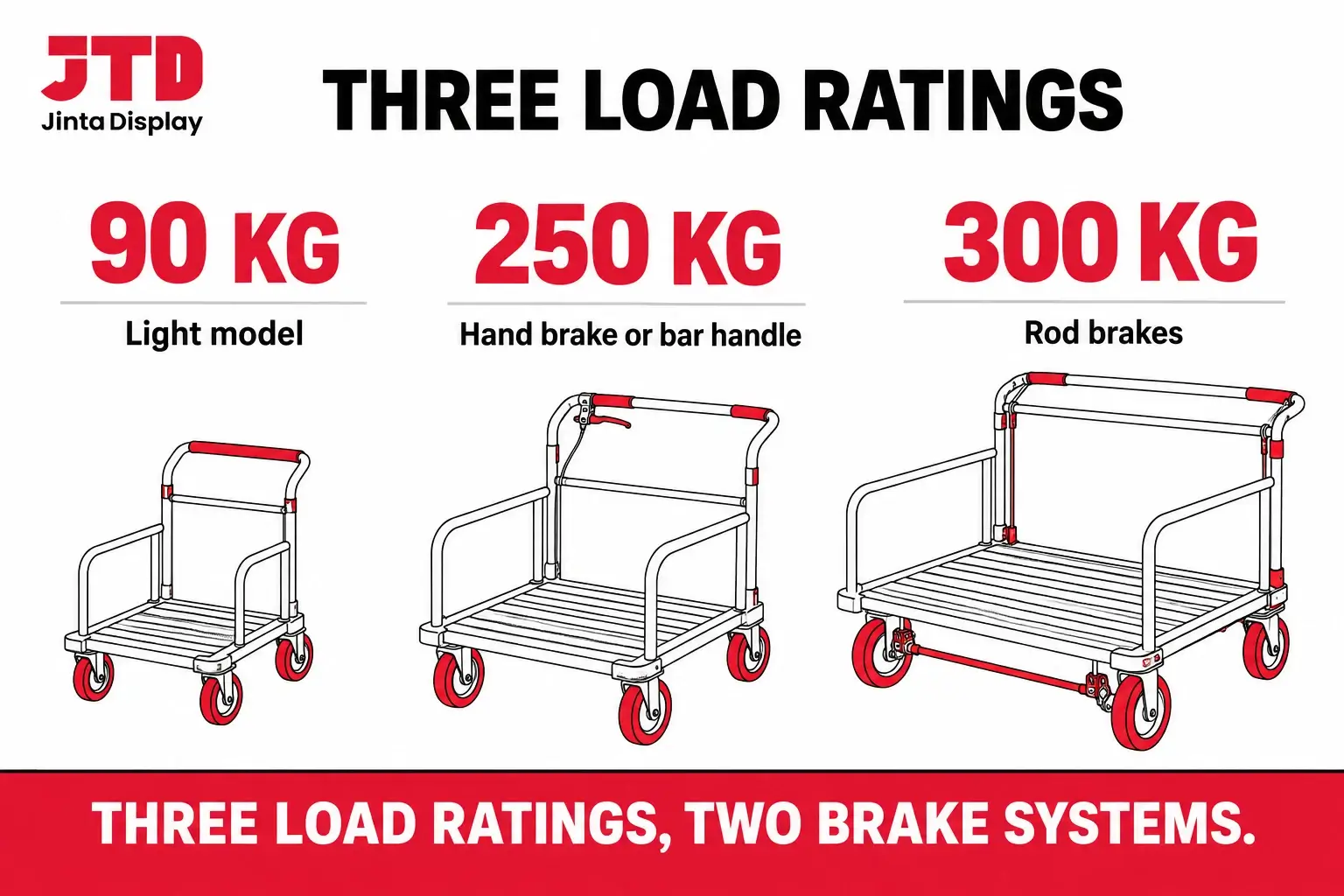
Our airport range covers three load classes and two main materials. The table lists the models and their key specification.
| Model | Material | Load rating | Handle or brake | Per 20 ft container |
|---|---|---|---|---|
| 304 stainless steel, rod brakes | 304 stainless steel | 300 kg | Rod brakes | 114, and 252 in 40 ft |
| Stainless steel, orange grip bar | Aluminum alloy and stainless steel | 250 kg | Wing grips, contrast handle bar | About 114 |
| Stainless steel, multi-bar deck | Aluminum alloy and stainless steel | 250 kg | Twin squeeze-lever brake grips | About 114 |
| Aluminum, round-knob brakes | Aluminum alloy and stainless steel | 250 kg | Twin round-knob brake grips | About 114 |
| Aluminum, bar handle | Aluminum alloy and stainless steel | 250 kg | Full-width bar handle | About 114 |
| Aluminum, ergonomic grips | Aluminum alloy and stainless steel | 250 kg | Molded ergonomic wing grips | About 114 |
| JT-TAT01 | Aluminum alloy | 250 kg | Not listed | About 114 |
| Light model | 6063 aluminum alloy and 201 stainless steel | 90 kg | Standard | About 184 |
All of them list four places for advertising and the option to print your own logo. The listed production time is 15 days, packing is in pearl cotton and foam, and the trade terms are FOB, CNF or CIF. The range is listed under our airport trolley category, and the individual models are on their own pages, such as the aluminum airport luggage trolley and the hand brake model. Supermarket carts, which follow different rules for size and nesting, are described in the guide to types of shopping carts.
Airport Luggage Cart Size and Dimensions
Size matters for two reasons. It decides how the cart moves through doors, lifts and queues, and it decides how many fit in a bay or a container. Our 304 stainless model lists the overall dimensions as 1,040 mm long, 620 mm wide and 1,040 mm high. The basket on that model measures 525 × 220 × 130 mm, and its advertising plate is 525 × 370 mm, with a smaller advertisement size of 475 × 95 mm.
The overall size is the one that counts for storage and the walk-through width of doors and gates. A cart 620 mm wide passes through a standard door easily, and two carts side by side need about 1.3 m with a margin. The length of 1,040 mm sets the length of a parking row, and it matters for how carts nest in a bay.
The deck, the surface on which bags sit, is the other size that matters, and it is confirmed on the drawing for each order. Our product pages give the overall size for the 304 model and not the deck for every model. For any supplier, ask for the deck dimensions and the height of the deck above the ground, because those decide which bags fit and how easy they are to lift.
Load Rating for an Airport Luggage Cart
Load rating is the heaviest total weight the cart is built to carry. Our models are rated 90, 250 and 300 kg. To see what that means, think in bags. Many airlines set a checked bag limit near 23 kg, so a family with eight full bags carries about 184 kg, and a 250 kg cart handles that with a margin. A 90 kg cart suits lighter loads, such as a traveller with carry-on and one or two cases.
Choose the rating from the use. An international hub with heavy bags and families wants 250 or 300 kg. A regional airport with light passenger loads can use a lighter cart. A hotel lobby, where staff load the cart and push it slowly, may use any of them. Over-specifying adds weight and cost, and under-specifying shortens life.
Ask how the rating is tested. A rating is a statement about a static or a rolling load under stated conditions. A cart that is rated for a load and is also used on a slope, with the load placed high, is working harder than the rating suggests. A good supplier can explain the basis and, for a large order, supply a sample for your own load test.
How Many Bags Fit on an Airport Luggage Cart
Buyers often ask how many bags fit on airport trolley decks, and the honest answer depends on the deck and the bags. A typical large suitcase has a footprint of about 750 × 500 mm, and a cabin bag about 550 × 350 mm. A deck that is about 600 mm wide and 900 mm long takes one large suitcase and a cabin bag side by side, and bags can be stacked above. The stack height is limited by stability and by the handle.
The load rating bounds the number as well. Eight bags of 23 kg weigh 184 kg, which is inside a 250 kg rating, but a stack of that many bags on a small deck may not be stable. A cart with a larger deck and a lower deck height is easier to load and steadier.
Our product pages give the overall size and load rating, and we confirm the deck size on the drawing. If the bag count matters to your operation, give us the bag sizes you expect to carry and the number per passenger, and we will check the deck against them.
Brakes on an Airport Luggage Cart
Brakes keep the cart where it is left. In a terminal with slopes, ramps or moving floors, a cart without a brake can roll away. A brake also lets a passenger stop and load or unload without the cart moving. Our carts use two main systems.
A hand brake is operated by squeezing a lever or turning a knob on the handle. Our models list twin squeeze-lever brake grips and twin round-knob brake grips. The brake acts on the wheels while the grip is held or released, depending on the design. A rod brake acts through a rod from the handle to the wheel brake, and our 304 stainless model uses rod brakes. Rod brakes stand up well to knocks, because the linkage is simple and stout.
Ask how the brake is applied and released, which wheels it acts on and how it is adjusted. A brake that is hard to apply will not be used. A brake that wears quickly needs replacement parts, and the spare parts should be available for the life of the fleet. Test the brake on a slope with a loaded cart, before the order.
Materials, Aluminum Against Stainless Steel
The frame material decides weight, corrosion resistance and appearance. Aluminum alloy is light and does not rust. Our light model uses 6063 aluminum alloy, and our other aluminum frames are listed in matt or anodized finishes. Anodizing adds a hard surface layer that resists scratches and keeps the color.
Stainless steel is heavier and very durable, with a bright surface that resists corrosion and wipes clean. Our 304 stainless model weighs 23 kg, and its finish is mirror polished or brushed. Grade 304 stainless is the usual choice for a durable stainless frame. Our light model lists 201 stainless steel for parts, which is a lower-cost grade with less corrosion resistance than 304.
| Material | Weight | Corrosion | Best for |
|---|---|---|---|
| 6063 aluminum alloy | Light | Does not rust | Large fleets, easy collection |
| 304 stainless steel | Heavier | Very good | High traffic, humid or coastal sites |
| 201 stainless steel | Heavier | Fair | Dry indoor use, lower cost |
The choice depends on the site. A coastal airport with salt in the air favors 304 stainless or anodized aluminum. A dry inland terminal can use any. Weight matters to staff who collect carts in long rows, and a lighter cart is easier to push and to nest. Ask the supplier for the grade of each part, because stainless is not a single material.
Handle and Deck Design
The handle and deck decide how the cart feels. Our models list wing grips with a contrast handle bar, a full-width bar handle, twin squeeze-lever grips, round-knob grips and molded ergonomic wing grips. Wing grips suit pushing with both hands at an angle, and a full-width bar suits two people pushing from either side. A grip that is comfortable for a long push matters in a big terminal.
The deck is listed as an open loop frame with an anti-slip step pad on one model and as a multi-bar tubular deck on others. An open frame is light and drains water, and a tubular deck gives more support under bags. The step pad gives a non-slip place for a foot when the cart is tilted over a kerb or a step. Check that the deck edge is rounded and the corners do not catch clothing.
Wheels and How the Cart Rolls
The wheel is the part that decides how smoothly a loaded cart moves. Our 304 stainless model lists 180 mm fixed and swivel wheels in natural rubber. Large wheels roll over thresholds, tile joints and expansion gaps with less effort, and they run quietly on terminal floors. Rubber grips the floor and is gentle on tile.
A combination of fixed and swivel wheels is common. Fixed wheels keep the cart tracking straight, and swivel wheels let it turn. Check the bearings, the mounting and the tread, because wheels are the part most often replaced. Ask for the wheel size, material and load rating, and for the availability of spares.
Advertising Panels on an Airport Luggage Cart
Advertising is a feature of many airport fleets. Our models list four different places for advertisements, and our 304 model gives the plate sizes, 525 × 370 mm and 475 × 95 mm. The panels can be printed and changed, and the income from them helps pay for the fleet and for upkeep.
For an advertiser, the size and position of the panel decide how visible the message is. For the operator, the panel must be easy to change, and its frame should protect the print from damage and weather. Ask for the panel sizes, the frame design and how the print is fixed. If you plan to sell advertising, the specification should list the panel dimensions in millimeters so that the printer can prepare the artwork.
Airport Trolley Dimensions for Doors, Lifts and Parking Bays
Airport trolley dimensions decide where a cart can go and where it can be parked. A cart 620 mm wide needs a clear opening wider than that, and a standard doorway of about 900 mm clears it easily. Lifts, gates and turnstiles are narrower, so check each route. Give the supplier the narrowest opening on the route a passenger will take.
A parking bay is worked out from the length and the nesting distance. As an assumption, take the cart length of 1,040 mm and a nesting distance of 250 mm. A row of ten then needs 1,040 plus 9 times 250, which is 3,290 mm. A row of twenty needs 5,540 mm. A cart with a shorter nesting distance makes a longer row in the same space, so ask for the real figure on the model you buy.
Turning space matters too. A loaded cart is long, and the person pushing it needs room to turn at the end of an aisle. Plan clear areas at the bay entrance and at changes of direction. The width of walkways in a terminal is usually set by the building, and the cart must fit in the busiest of them.
Airport Baggage Carts, Baggage Trolleys and Other Names
The product has many names, and a buyer who searches for only one of them misses suppliers. In the United States, the common words are airport luggage cart, airport baggage cart and airport cart. In the UK, Australia and elsewhere, the words are airport luggage trolley, baggage trolley, luggage trolley and airport trolley. Hotels use luggage cart or bellman cart for a related item with a different frame.
A baggage trolley and an airport baggage cart are the same device as an airport luggage trolley for specification purposes. The details that matter are the load rating, the size, the brakes and the finish, and a supplier can quote any name from one drawing. If you write a tender, name the item in the local term and add the other terms in brackets, so that suppliers in other markets recognize it.
Be careful with hotel luggage carts. A hotel cart is usually a taller frame with a rail, used by staff, and it is a different product from a passenger cart that nests in rows. Our range is the passenger airport type, with a deck and a handle for nesting, and it can be used in lobbies and stations as well.
Nesting and Container Loading for Airport Luggage Carts
Freight and storage depend on how carts nest. Our product pages list about 114 carts in a 20 ft container for most models and 184 for the light model. The 304 stainless model lists 114 in a 20 ft container and 252 in a 40 ft container. These counts are the figures on our pages, and they depend on the packing and the nesting, so we confirm the quantity for each order.
A cart that nests well uses less floor in the terminal and in the container. In a parking bay, carts push into one another and form a compact row, and a row of ten may be little longer than two carts. Ask for the nesting distance, which is how far each cart pushes into the one in front, and the length of a row of ten.
How Many Airport Luggage Carts a Terminal Needs
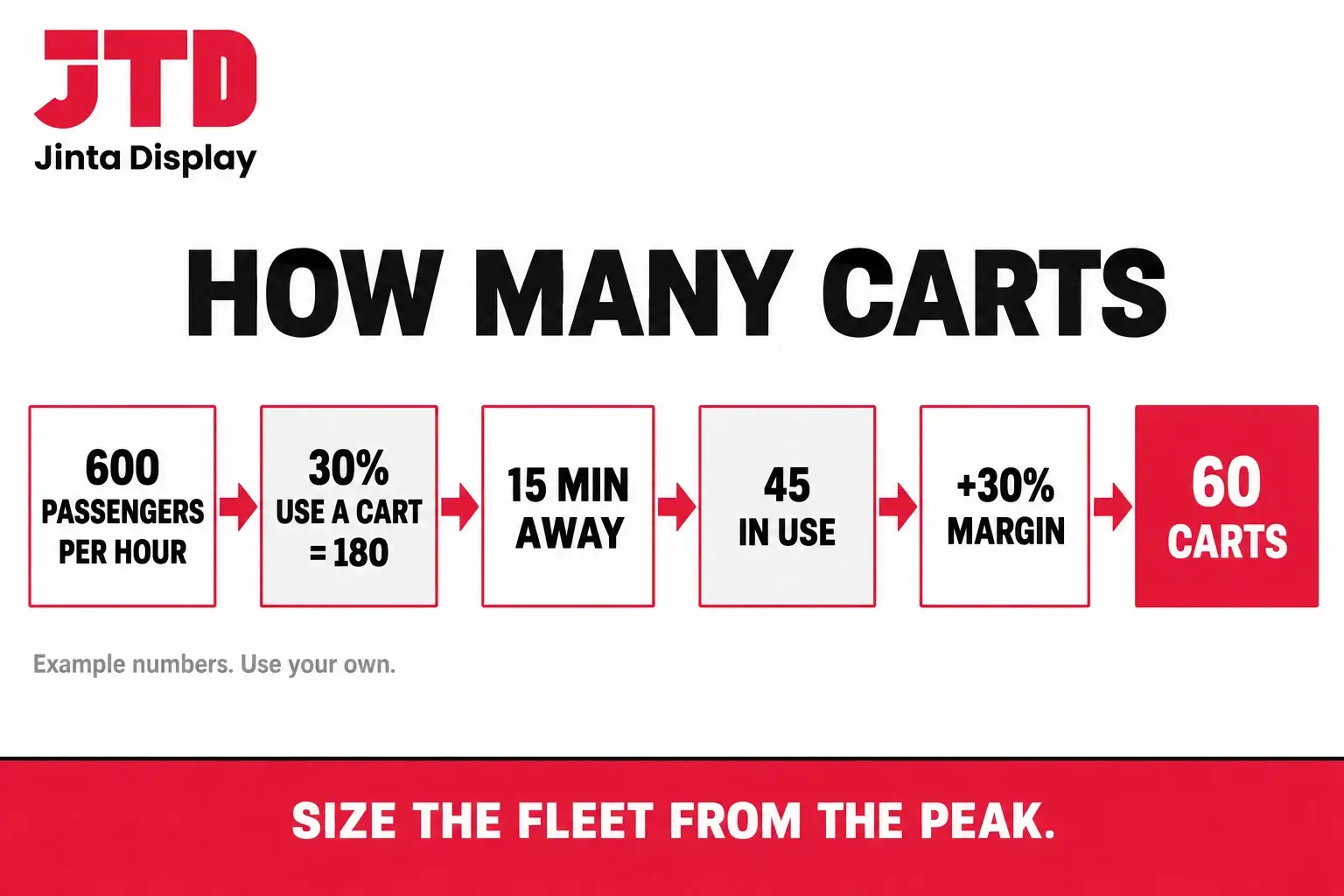
The fleet depends on how many passengers want a cart at the busiest time. The method uses the peak number of passengers per hour, the share who use a cart and how long each cart is away from the rack. All inputs are assumptions, and you should replace them with data from your own terminal.
Take a terminal with 600 passengers an hour at the peak. If 30% use a cart, that is 180 an hour. If each cart is away for 15 minutes, the number in use at once is 180 times 15 divided by 60, or 45. Add 30% for carts that are being collected, queued or parked, and the fleet is about 59, which rounds to 60. Test a low case and a high case before ordering.
Carts also need to be collected and returned. A terminal with several return points needs fewer carts than one with a single rack, because carts come back sooner. A hotel or a station has a much smaller number, and the same method applies with smaller inputs.
Customizing and Branding an Airport Luggage Cart
Color, logo and advertising panels can all be set to the operator. Our listings state that you can print your own logo, and OEM color and branding are available. Frame finish can be mirror polished, brushed, matt or anodized. Handle color can be changed, as the orange grip bar model shows. The panel frames can carry your name or an advertiser’s.
Keep the specification tidy. A fleet that is ordered in several batches should match, and it helps to hold one drawing and one approved sample. Our lead time is a production time of 15 days from a confirmed drawing, plus shipping, and the details are confirmed with the quotation.
What to Ask a Supplier of Airport Luggage Carts
A short list of questions separates a specification from a catalog line. Ask for the load rating and how it is tested. Ask for the overall size, the deck size and the deck height. Ask for the brake type and how it is released. Ask for the frame material by grade, the finish and the weight per cart. Ask for the wheel size, material and bearings.
Ask for the advertising panel sizes and the frame design. Ask for the nesting distance, the units per 20 ft and 40 ft container and the packing. Ask for spare parts and the warranty. Finally, ask for a sample, and test it with loaded bags on a slope and a long push before you order the fleet.
If you are specifying carts, send us your load rating, quantity and brake type and we will reply with a specification and a quotation.
Frequently Asked Questions
How much weight can an airport luggage cart hold?
It depends on the model. Our airport luggage carts are rated 90, 250 and 300 kg. A 250 kg cart handles about ten bags of 23 kg. Ask how the rating is tested, and confirm it for your use, especially on slopes or with high stacks.
What size is an airport luggage cart?
Our 304 stainless model is 1,040 mm long, 620 mm wide and 1,040 mm high overall, with a basket of 525 × 220 × 130 mm and 180 mm wheels. The deck size is confirmed on the drawing for each order. Ask any supplier for the deck size and height as well.
How many bags fit on an airport luggage cart?
It depends on the deck and the bags. A deck about 600 × 900 mm takes one large suitcase and a cabin bag side by side, and bags can be stacked above within the load rating. Eight bags of 23 kg weigh 184 kg, inside a 250 kg rating. Give us the bag sizes to check.
What is the difference between an airport luggage cart and an airport trolley?
There is no difference in the product. Airport luggage cart is the American term, and airport trolley or luggage trolley is used in the UK, Australia and elsewhere. The specification is the same, and a supplier can quote either name from one drawing.
Which brake is better, hand brake or rod brake?
Both work. A hand brake uses grips on the handle, and a rod brake acts through a rod to the wheel brake and is simple and stout. Our 304 stainless model uses rod brakes. Test a loaded cart on a slope, and check that the brake is easy to apply and release.
Should an airport luggage cart be aluminum or stainless steel?
Aluminum is light and does not rust, and suits large fleets that staff collect in rows. Stainless steel is heavier and very durable, and 304 grade suits busy or coastal sites. Our 304 model weighs 23 kg. Ask for the grade of each stainless part.
Can airport luggage carts carry advertising?
Yes. Our models list four places for advertisements, and our 304 model gives plate sizes of 525 × 370 mm and 475 × 95 mm. Ask for the panel dimensions and how the print is fixed, so the artwork can be prepared and changed easily.
How many airport luggage carts fit in a container?
Our pages list about 114 carts in a 20 ft container for most models and 184 for the light model. The 304 stainless model lists 114 in a 20 ft container and 252 in a 40 ft container. We confirm the count for each order.