
Ask for a shopping cart and a supplier will ask which one. A shopper sees a cart as a cart, but a buyer meets a long list of types, and the choice affects the aisle, the trolley bay, the freight and the shopper’s experience. A cart that is right for a hypermarket in Moscow is wrong for a convenience store in Manchester.
This guide sets out the types of shopping carts in the order a buyer has to decide them. It covers regional styles, size classes, materials and functions, then the special types that sit outside the standard supermarket cart. It ends with a method for choosing. It is written from the manufacturing side, and figures for our own carts come from our product pages. It does not cover price, which is explained in the guide to how much a shopping cart costs.
In the UK, Ireland, Australia and New Zealand the same object is a shopping trolley, and in the United States and Canada it is a shopping cart or a grocery cart. The words differ and the types are the same.
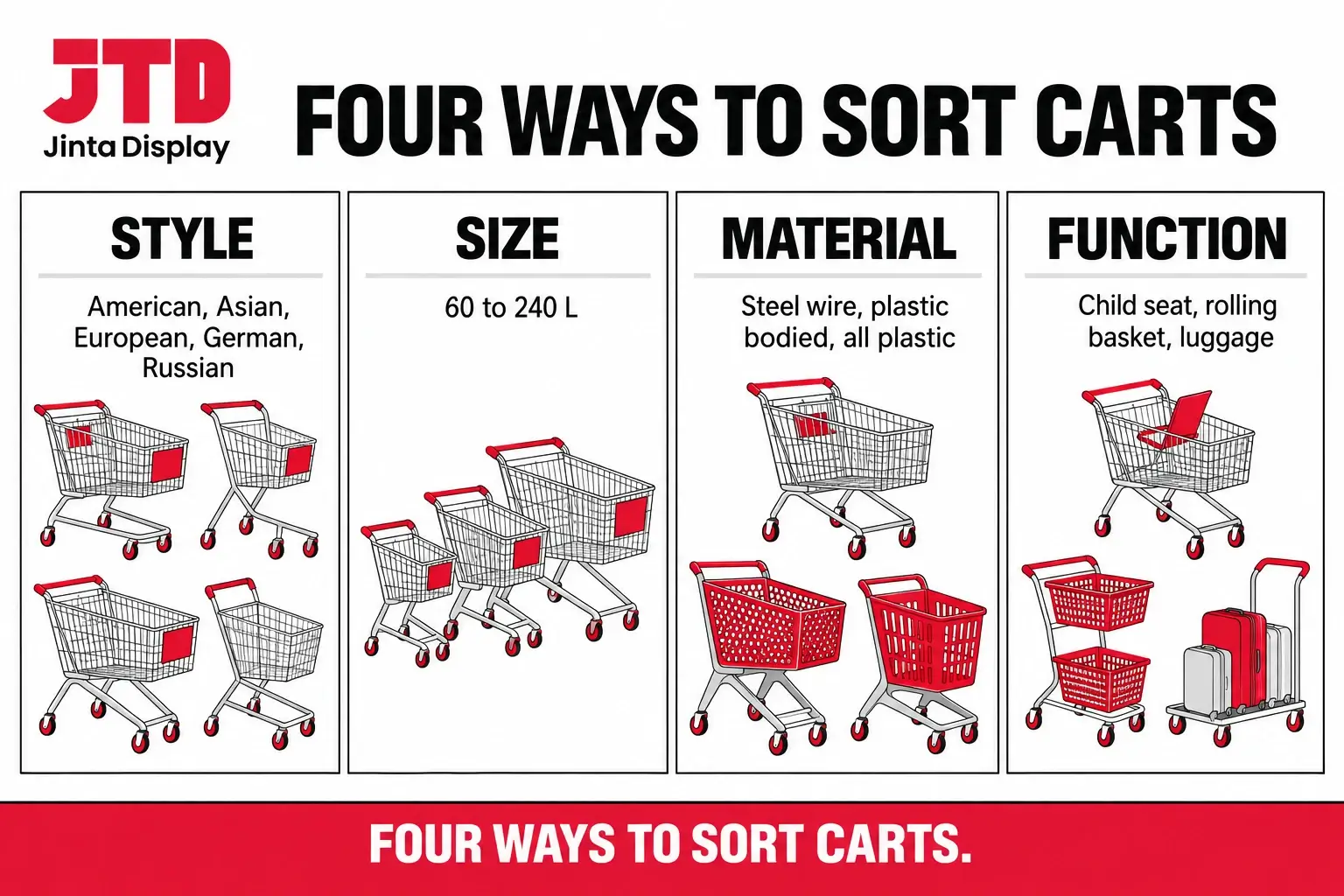
Types of Shopping Carts by Regional Style
Shopping cart styles are the first split, because each region built its carts around its own stores. The nesting angle, the handle height, the basket taper and the frame shape differ, and a cart in one style does not nest with a cart in another. We build five metal styles.
| Style | Where it is common | Net weight at 100 L | Net weight at 180 L |
|---|---|---|---|
| American | United States, Canada, Latin America | 17.6 kg | 22.0 kg |
| Asian | Asia, Middle East | 16.8 kg | 23.1 kg |
| European | Europe, UK, Australia | 14.5 kg | 19.3 kg |
| German | Germany and nearby markets | 17.5 kg | 22.3 kg |
| Russian | Russia and nearby markets | 17.8 kg | 25.0 kg |
The weights are the net weights printed on our own product pages. They show that style matters as much as size. At 180 L the heaviest style is about 30% heavier than the lightest. The full weight table for every style and size is in the guide to shopping cart dimensions, weight and capacity.
Choose the style that your market and your trolley bays expect. If you add carts to an existing fleet, match the style, because carts of a different style will not nest into the bay. If you start a fleet, pick the style for the aisle and the store type, and keep it.
Shopping Cart Styles Compared at the Smallest and Largest Sizes
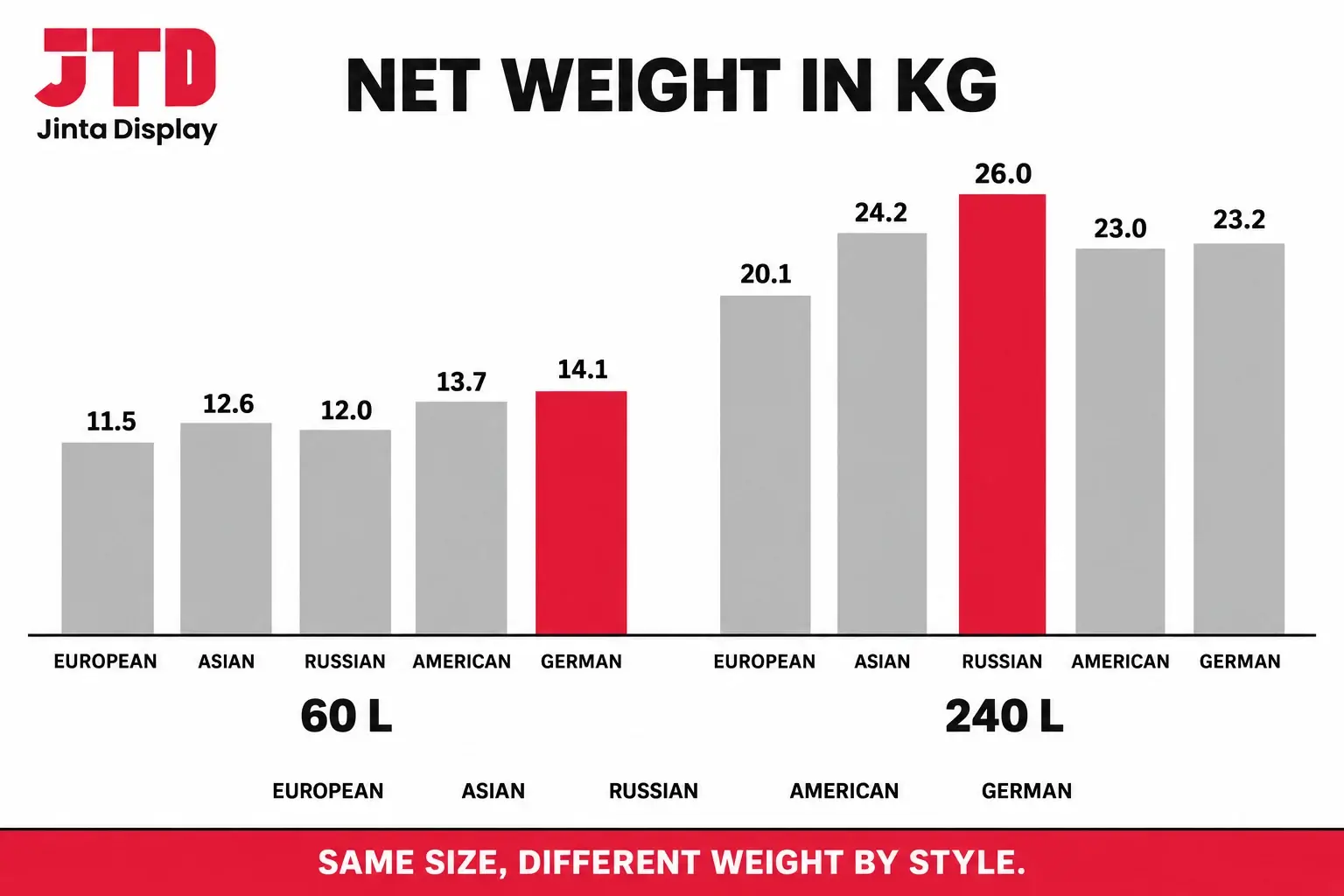
Shopping cart styles differ in weight before they differ in anything else a buyer can see on a data sheet. The table gives the net weights of the five styles at the smallest and the largest sizes in our range, taken from our product pages.
| Style | 60 L | 240 L |
|---|---|---|
| European | 11.5 kg | 20.1 kg |
| Asian | 12.6 kg | 24.2 kg |
| Russian | 12.0 kg | 26.0 kg |
| American | 13.7 kg | 23.0 kg |
| German | 14.1 kg | 23.2 kg |
Two patterns stand out. The European style is the lightest at every size, and the Russian style is the heaviest from 100 L upward. At 240 L the gap between them is almost 6 kg, which is a large difference in steel. A buyer who asks for a 240 L cart without naming the style could receive either, and the price and the freight would differ.
Use these figures as a check on any quotation. A cart that is far lighter than the published weight for its style and size has thinner wire or tube. A cart that is much heavier may be over-built. The weights do not rank the styles by quality. They describe different designs for different markets, and the right one is the one your market expects and your bays accept.
Types of Shopping Carts by Size
Size is the second split. Capacity is stated in liters, and our metal carts come in eight sizes, 60, 80, 100, 125, 150, 180, 210 and 240 L. The sizes group into classes by the shopping mission.
| Class | Capacity | Where it suits |
|---|---|---|
| Convenience | 60 to 90 L | Convenience stores, pharmacies, small supermarkets |
| Small | 100 to 125 L | Small and mid-size supermarkets |
| Medium | 125 to 160 L | Most grocery shopping |
| Large | 180 to 240 L | Hypermarkets and warehouse stores |
A neighborhood supermarket usually fits carts of 100 to 150 L, and a hypermarket uses 180 to 240 L. A bigger cart costs more per cart and less per liter. It also takes more floor, needs a wider aisle and ships fewer to a container. Do not buy the largest size because it looks generous. Buy the size that matches the average shop.
Shopping Cart Sizes From 60 to 240 L and What Changes With Them
Shopping cart sizes grow faster in volume than in weight. A 240 L cart holds four times what a 60 L cart holds, but it weighs only about 1.6 to 2.2 times as much, because the chassis, handle and wheels are almost the same size. In kilograms of cart per liter of basket, a 60 L cart carries about 0.19 to 0.24 kg per liter and a 240 L cart only 0.08 to 0.11.
The practical effect is that a larger cart is cheaper per liter and more expensive per cart. It also takes more floor, needs a wider aisle, nests deeper and ships fewer to a container. The middle sizes, 100 to 150 L, cover most grocery shopping. The top two sizes serve stores where customers shop once a week for a family.
Choose among shopping cart sizes by watching what shoppers buy. If most customers fill a third of a medium cart, a smaller size may serve them better and leave more floor for shelves. If customers pile goods on top of the cart, the size is too small. A trial of two sizes in a store tells you more than a table.
Types of Shopping Carts by Material
Material is the third split. Three kinds are common.
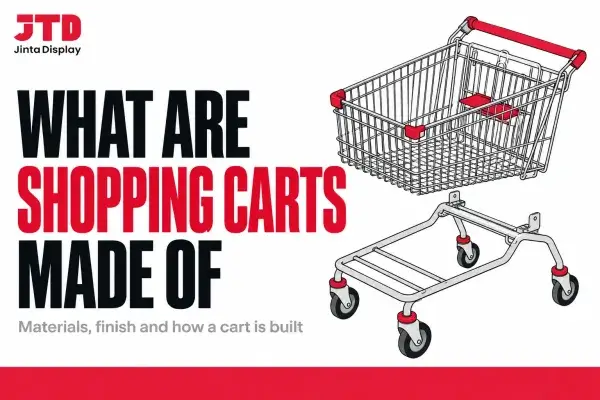
The steel wire cart has a welded wire basket on a steel tube chassis, with a zinc or chrome finish. It is the standard supermarket cart across most of the world. It is light for its size, easy to clean, repairable and the lowest in tooling cost.
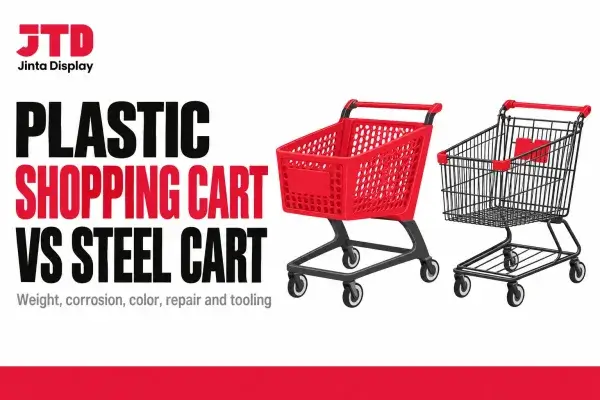
The plastic bodied cart keeps the steel chassis and replaces the wire basket with a molded plastic body. Ours use a Q195 carbon steel frame with PP and PC plastic, in sizes from 100 to 220 L. It offers molded-in color, a body that does not rust and a large surface for a logo. Its weight is close to a steel cart of the same capacity, since the frame is the same. The comparison is covered in the guide to plastic and steel shopping carts.
The all-plastic cart replaces most of the steel with molded plastic. It exists and suits some noise and hygiene uses, but it is less common in commercial retail because the molds are large and the impact behavior is different. How the materials are made and finished is explained in the guide to what shopping carts are made of.
Types of Shopping Carts by Function
Function is the fourth split, and it covers the features that change how the cart is used.
| Type | What it adds | Where it is used |
|---|---|---|
| Standard cart | Single basket on a chassis | Most supermarkets |
| Cart with child seat | Folding seat with a strap | Family shopping, hypermarkets |
| Cart with lower rack | A tray under the basket for bulky items | Warehouse and hardware stores |
| Cart with coin lock | A lock that holds a coin or token | Stores with car parks and open bays |
| Cart with advertising frame | A panel for an advertiser or the store | Chains and shopping centers |
| Rolling basket | A basket on wheels with a telescopic handle | Small supermarkets, heavy goods |
Each feature is a separate part and a separate line in the specification. A cart with a child seat, a coin lock and a printed frame is a different product from a bare basket on a chassis. Our product pages list a printed logo as a standard feature, and the fittings for each order are set on the drawing.
Child Seats, Locks and Other Fittings Across the Types
Fittings change a cart more than most buyers expect. A folding child seat with a restraint strap adds a hinge, a strap and a rating. A coin lock adds a mechanism that holds a coin or token and keeps carts in the bay. A lower rack adds a tray for bulky goods. An advertising frame adds a panel that carries a message, and it can earn income for a chain.
Each fitting is a separate part with its own material, its own wear and its own line on a quotation. Some fittings suit certain types. A child seat belongs on a family cart of 125 L and above. A coin lock suits carts that leave the store, such as those used in car parks. A lower rack suits warehouse and hardware stores. Keep the list short, and add only what the shopper and the store will use.
Handles are a fitting as well. A handle can be steel tube, PVC or molded plastic, and the grip shape affects comfort. Casters are the part that wears first, and a fleet should be ordered with spares of the same tread and the same stem. The caster choice is covered in the cost guide and the guide to what carts are made of.
Standard Shopping Cart and the Type Most Stores Buy
A standard shopping cart is the single-basket cart with four wheels that most stores use. It is the type behind most searches, and it has a standard look. A basket tapers from a wide rim to a narrow base, a handle runs across the back, and the chassis has two fixed and two swivel wheels. A child seat is common and often folds up when not in use.
The standard cart is a good default. It nests, it is easy to collect and its parts are widely available. A store that has no special need should start here, choosing the size and the style, and then adding only the fittings that it will use. Extra fittings add cost and parts that wear.
A standard shopping cart in the United States commonly holds about 110 to 255 L, based on measurements of cart baskets at major chains, and the middle of that range is a common choice. The right size for your store depends on your customers, and a sample cart in the store tells you more than a catalog.
Rolling Baskets and Carts With Wheels for Small Stores
Between the hand basket and the cart sits the rolling basket, a basket on wheels with a telescopic handle. Our 60 L models weigh 2.5 and 2.99 kg and are listed at 425 × 460 × 860 mm and 490 × 385 × 845 mm. They suit stores that cannot spare the aisle width for carts and shoppers who struggle to carry a loaded hand basket. Sizes for the whole basket family are in the guide to shopping basket size.
A small supermarket may use a mix of hand baskets at the door, rolling baskets for heavier loads and a small number of carts for the weekly shop. The mix saves floor and gives each shopper a suitable tool. The cart bay needs space only for the carts, and the basket stand sits beside it.
Airport, Hotel and Luggage Carts
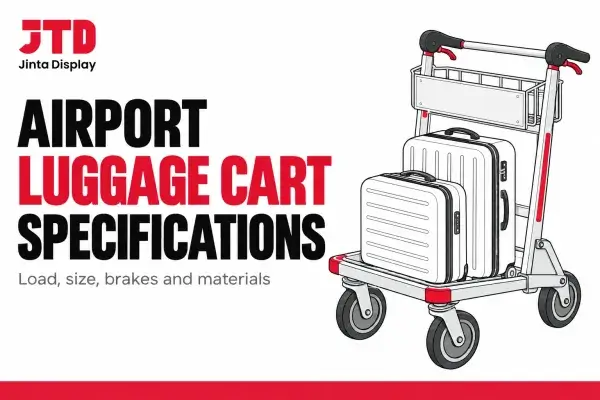
Luggage carts are a separate family. An airport luggage cart is a hand-pushed trolley with a deck for bags, brakes and large wheels, built for long use in terminals. Our models are rated 90, 250 and 300 kg, in aluminum alloy or stainless steel, with advertising panels. Hotels and stations use similar carts. They share the name cart with supermarket carts, and they differ in almost every detail. The specification is set out in the guide to airport luggage cart specifications.
Do not buy a supermarket cart for luggage use, or the reverse. A supermarket cart has a basket and small wheels for a smooth floor, and a luggage cart has a deck and large wheels for ramps and long distances. A supplier that offers both should say which model suits your use and explain the difference.
Specialty Types of Shopping Carts We Do Not Make
Several types exist that we do not supply, and it helps to know their names. Motorized carts, with a seat and an electric drive, help shoppers with reduced mobility, and they are an equipment category of their own. Self-scanning or smart carts carry sensors and a screen, and they are built by technology firms. Children’s mini carts are small carts for young shoppers, often in plastic. Folding household carts are consumer products sold one at a time.
Other specialist carts serve warehouses and trades, such as platform trolleys, hand trucks and roll cages. They share the idea of wheels and a frame, and they are different products. If a quotation lists a type you do not recognize, ask for the drawing and the load rating, and ask which of the standard types it is closest to.
How the Type of Cart Affects the Aisle, the Bay and the Container
The type changes three planning numbers. The aisle must be wide enough for two carts to pass, which for a large cart of about 700 mm width leaves little margin in a 1,400 mm aisle. Planning figures in published guidance use small carts where aisles are under 1,000 mm, medium carts for 1,200 to 1,400 mm and large carts above 1,400 mm.
The trolley bay length follows from the cart length and the nesting distance. A train of 20 carts, each 1,000 mm long and adding 200 mm when nested, makes a row about 4,800 mm long. A cart with a shorter nesting distance makes a longer train in the same bay.
The container load follows from the size and the nesting. Published data sheets from cart makers show anything from about 300 to about 800 carts per 40 ft high cube, with small, light carts at the top of the range. Ask your supplier for units per container on the exact style and capacity, and compare landed cost per cart and not the factory price alone.
Choosing Among the Types of Shopping Carts
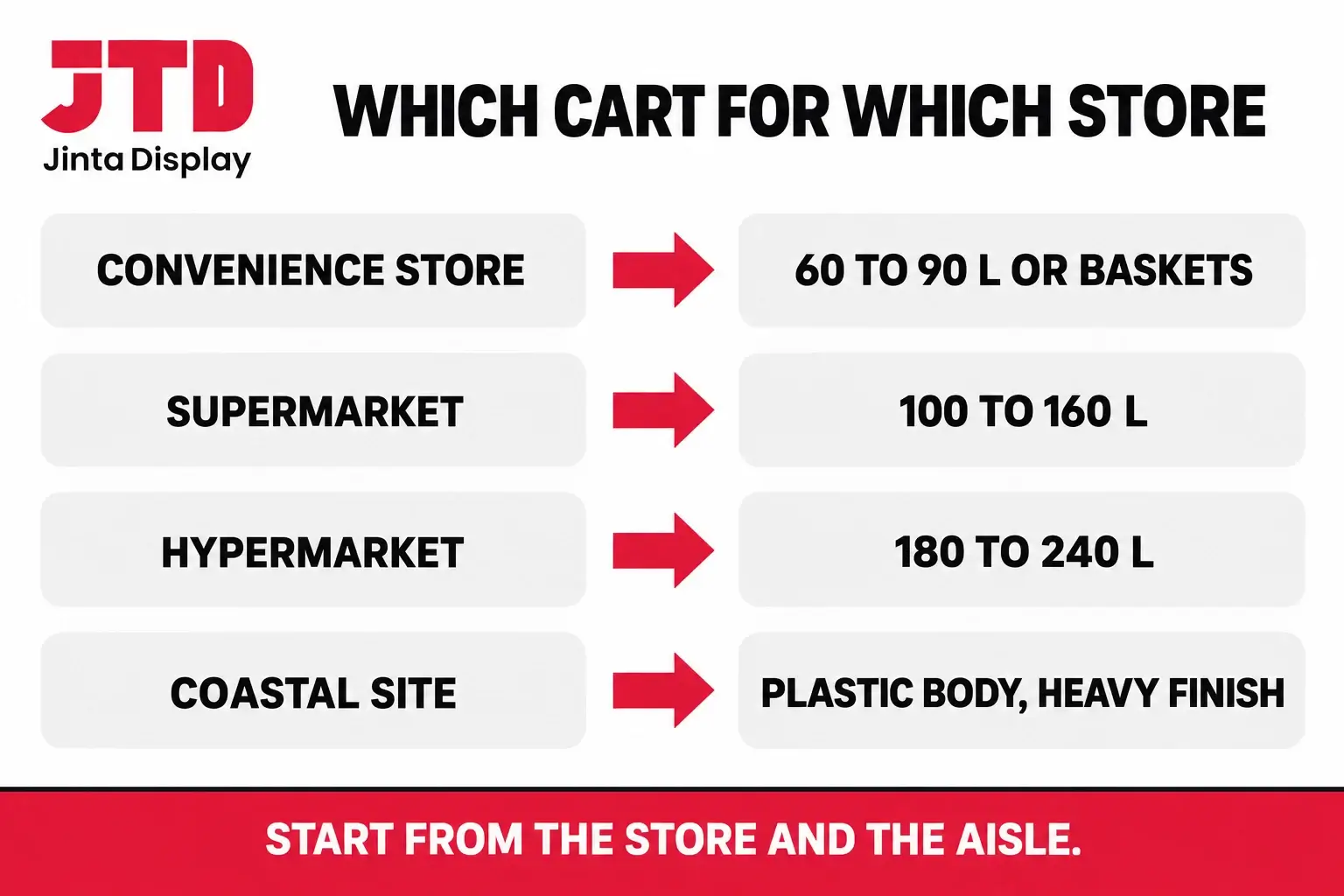
A short method turns the list of types of shopping carts into a decision. Start with the store and the shopping mission. A convenience store or pharmacy uses baskets and perhaps small carts. A neighborhood supermarket uses medium carts and baskets. A hypermarket uses large carts and may add rolling baskets.
Then take the aisle. Measure the narrowest aisle and the trolley bay. Choose the size class that passes in the aisle and fits the bay. Then pick the material from the site. A dry indoor store does well on a standard steel cart. A coastal or humid site may suit a plastic bodied cart on a well-finished frame, and a branded chain may suit a plastic body for its color.
Finally, add the fittings. A child seat if families shop with young children. A coin lock if carts leave the store. An advertising frame if you sell space. Keep the list short. A cart with only the fittings you need is cheaper, lighter and easier to keep in repair.
A Worked Example, Three Stores and Three Choices
Take three stores with different needs, and match the types of shopping carts to each. The first is a 120 square meter convenience store in a city, with narrow aisles of 1,000 mm and an average purchase of a few items. It uses 18 to 28 L hand baskets and no carts, because carts would not pass in the aisles.
The second is a 1,500 square meter supermarket with aisles of 1,500 mm and a typical weekly shop. It uses European or German style carts of 125 to 150 L, a stand of 35 to 45 L baskets at the door and a trolley bay for a train of 20 carts. The third is a 6,000 square meter hypermarket in a coastal city, with aisles of 2,000 mm. It uses large carts of 180 to 240 L with a heavier finish for the car park, and 60 L rolling baskets for older shoppers.
In each case, the type follows from the store and the aisle, and the fittings follow from the shoppers. The numbers are examples and not rules, and you should replace them with your own measurements.
Looking After a Fleet of Carts Once You Own It
The type you choose affects the care it needs. A steel wire cart needs its finish checked at the welds and wheel mounts, because rust starts there. A plastic bodied cart needs its body checked for cracks and its frame for rust. Both need casters replaced as they wear, and child seat hinges and locks checked for play.
Plan a collection routine that returns carts to the bay, and a repair routine that takes damaged carts out of service. A cart that is left in the car park for weeks wears out faster than one that is collected daily. Keep a stock of spare casters, handles and fittings, and record the specification of each batch, so replacements match the fleet.
Common Mistakes When Choosing a Shopping Cart Type
A few mistakes recur when buyers compare the types of shopping carts. Choosing the cart before measuring the aisle, which leaves carts that jam. Mixing styles in one trolley bay, which leaves carts that do not nest. Buying a plastic or steel cart for the wrong environment, which leaves rust or fading. Adding every fitting, which adds cost and parts that wear. And buying for the first day and not the fleet’s life, with no spare casters or parts.
Another is comparing quotations for different types as if they were the same. A cart with a child seat and a coin lock is a different product from a bare cart, and a plastic bodied cart is not a steel cart. Ask every supplier to list the type, the size, the style, the material and the fittings, so that the comparison is fair. The method is set out in the guide on how to evaluate shopping cart suppliers.
What to Send a Supplier
A short brief gets a quotation for the right type. State the type and the style you want, the capacity in liters and the material. List the fittings, such as a child seat, a coin lock or an advertising frame. Give the aisle width and the trolley bay length, which let the supplier check the fit and the nesting. Add the quantity, the finish, the destination port and the date you need the fleet.
If you are adding to an existing fleet, send a photograph of a cart from the side and from above, and measure the length, the width, the handle height and the nesting distance. A supplier can then match the style, or tell you honestly that the style cannot be matched. If you are starting a new fleet, tell the supplier how many stores will use the same cart, so the specification is written for repeat orders from the start.
If you are choosing a type, send us your store type, aisle width and quantity and we will reply with a specification and the sizes that fit. The full line is in our shopping trolley range.
Frequently Asked Questions
What are the types of shopping carts?
Carts differ by style, size, material and function. Styles include American, Asian, European, German and Russian. Sizes run from 60 to 240 L. Materials are steel wire, plastic bodied and all plastic. Functions include standard carts, carts with child seats, rolling baskets and luggage carts.
What is a standard shopping cart?
A standard shopping cart is a single-basket cart with four wheels, a tapered basket, a rear handle and often a folding child seat. Published measurements of major chains show basket volumes from about 110 to 255 L. The right size depends on your shoppers and aisles.
What types of shopping trolleys are used in the UK and Australia?
The same types as elsewhere, under the word trolley. European style steel trolleys are common, with plastic bodied models for color and branding. Sizes run from about 60 to 240 L, and the main choice is the size and the aisle width. Confirm the nesting for the bay.
What size shopping cart should I buy?
Choose from the shopping mission and the aisle. Convenience stores use 60 to 90 L, small supermarkets 100 to 125 L, most grocery stores 125 to 160 L and hypermarkets 180 to 240 L. Check that the cart passes in the narrowest aisle and fits the bay.
Are plastic or steel shopping carts better?
Neither is better in general. A plastic bodied cart offers molded-in color and a body that does not rust, on a steel frame, at a similar weight. A steel wire cart has the lowest tooling cost, repairs easily and shows the contents. The site and the brand decide.
What is a rolling shopping basket?
A rolling shopping basket is a basket on wheels with a telescopic handle. Our 60 L models weigh 2.5 and 2.99 kg. It suits heavier loads and narrow aisles, and it uses less floor than a cart. It sits between a hand basket and a cart.
Do you make motorized or smart shopping carts?
No. We build steel and plastic bodied carts, baskets, rolling baskets and airport luggage carts. Motorized carts and self-scanning smart carts come from specialist suppliers. We can match the colors of a standard fleet if you add them alongside.
Can different types of shopping carts share a trolley bay?
Only if their frames nest together. Nesting depends on the chassis geometry and the style, so mixing styles leaves carts that do not nest. Buy one frame style and vary the basket or the fittings. Ask the supplier to confirm the nesting distance for each type in writing.