
Every store has them, and shoppers rarely think about them. They are the shelves at the end of the aisle, stacked with the offer of the week, the seasonal range or the new line. A shopper walking along the main aisle sees them before the shelves behind them, and a good end cap turns a glance into a sale.
This guide explains what an end cap is, the types, the sizes and how to plan them. It covers how many a store needs, what to put on them and how to build them so that they match the rest of the shelving. It is written from the manufacturing side. Figures for our own shelving come from our product pages and are marked as ours, and planning figures are marked as common practice.
It does not cover pricing or supplier funding of displays, which are commercial arrangements between a store and its suppliers. The fixtures that end caps attach to are explained in the guides to what a gondola is in retail and gondola shelving sizes.
What Is an End Cap in Retail
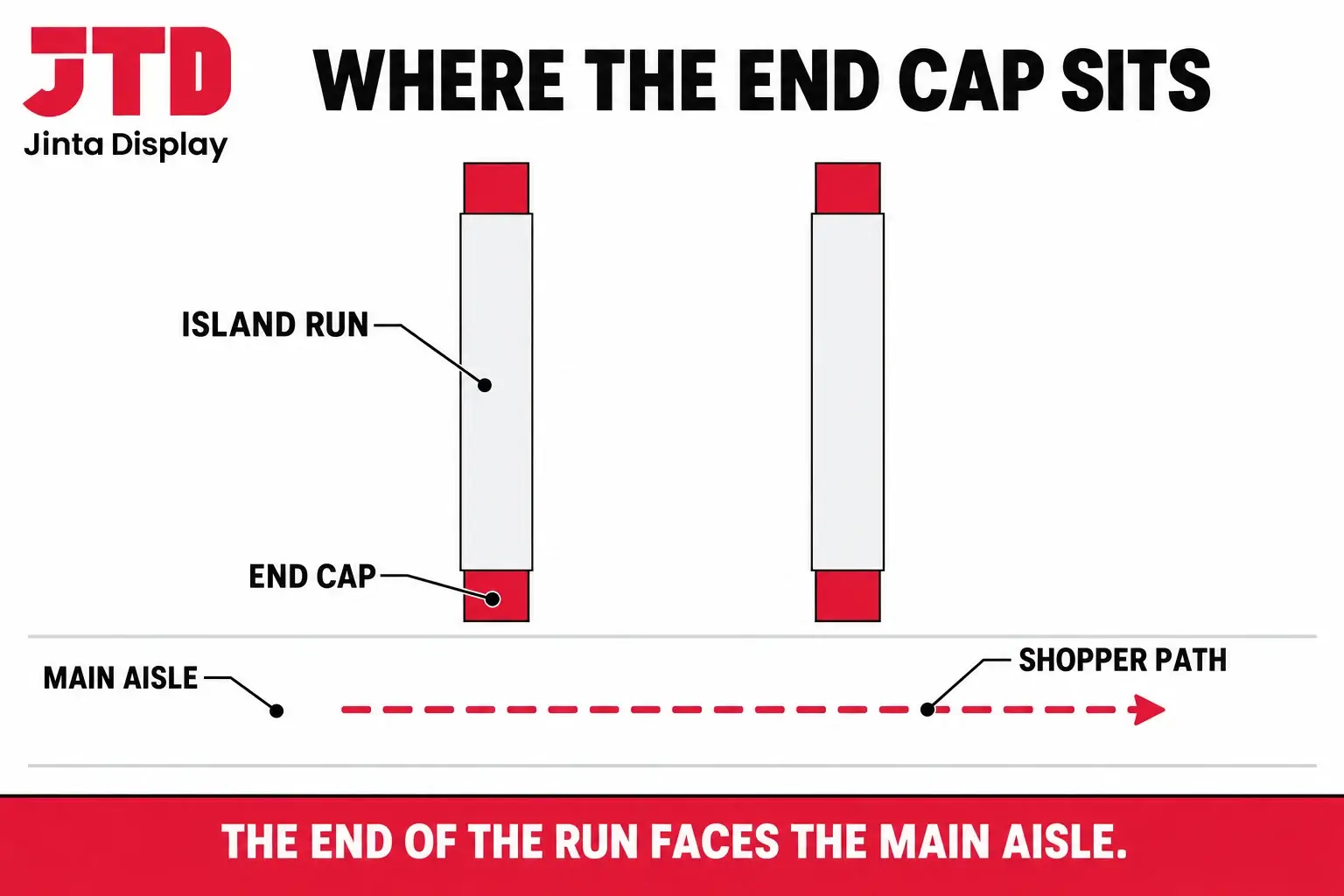
An end cap in retail is a fixture, or a display built on a fixture, placed at the end of an aisle. It closes the end of a run of shelving, and it presents goods to the cross aisle, where more people pass than in the aisle between the shelves. The name comes from the way it caps the end of the run.
The position is the whole point. A shopper in an aisle between two runs looks at the shelves on either side, and the end of the aisle is behind or ahead of them. A shopper on the main aisle sees the end of each run in turn, and each one is a small stage. That is why stores put offers and new lines there and keep staple lines on the shelves inside.
The word is written as end cap, endcap and end-cap, and all three mean the same. You will also hear gondola end, end display and end of aisle display. In the UK and Australia a run of gondolas has a gondola end at each side, and the finishing piece is called an end panel when it only covers the end.
Types of End Cap
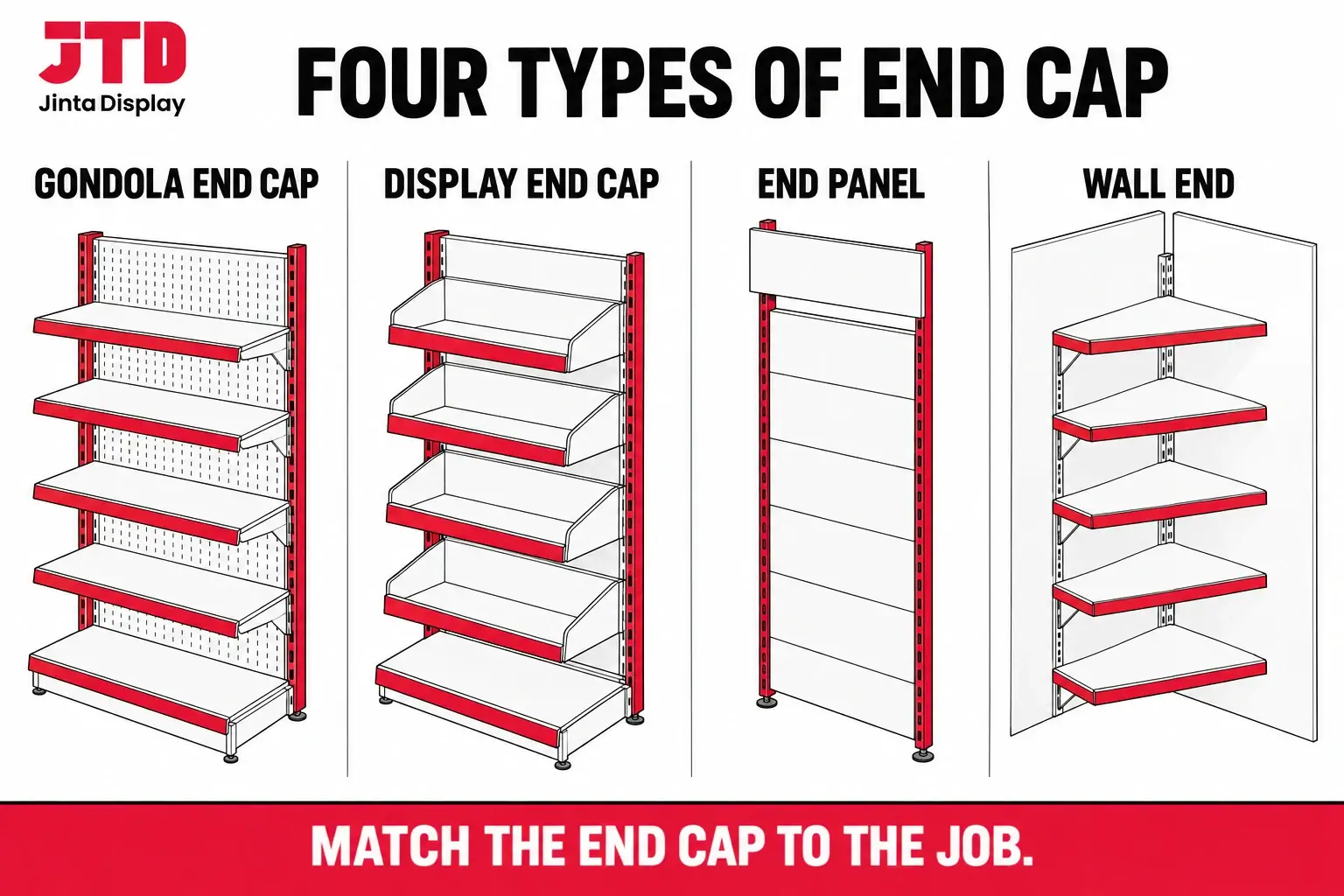
Four types cover most stores, and each one serves a different purpose.
| Type | What it is | Best for |
|---|---|---|
| Gondola end cap | A shelf unit that matches the gondola and faces the cross aisle | Promotions that use standard shelves |
| Display end cap | A fixture with bins, hooks, baskets or a table top | Seasonal and bulky items |
| End panel | A plain panel that covers the end of the run | Finishing the run, signs and graphics |
| Wall or corner end | A unit that closes a wall run or a corner | Corners and the ends of wall bays |
A gondola end cap is the most common. It uses the same uprights, brackets and shelves as the gondola, so it matches in height, color and pitch, and the shelves can be moved as the offer changes. A display end cap trades that matching for flexibility, with bins or hooks that hold items shelves cannot. An end panel is the cheapest and carries no goods, but it gives a place for a sign or a graphic.
End Cap Sizes and How They Match the Gondola
An end cap is sized from the run it finishes. The face of the end cap runs across the end of the island, so its width equals the depth of the island. Our double-sided series is listed at 1,200 × 1,000 × 1,800 mm, so the face of its end cap is about 1,000 mm wide. A 900 mm deep island has a 900 mm face. The depth of the end cap, from the face back toward the run, is often 450 to 550 mm, matching a single-sided bay.
The height normally matches the run, which is 1,800 mm for our standard bays. Stores sometimes use a lower end cap, around 1,200 to 1,500 mm, so that sightlines across the shop stay open, as a common layout practice. A taller end cap blocks the view across the floor and makes the aisle feel closed.
Check the slot pitch. An end cap built to a 50 mm pitch cannot use brackets from an inch-pitch system, and the end cap should be ordered with the gondola from one maker. The measuring method is in the gondola sizes guide. Our supermarket shelving category lists the systems we build, including Lozier compatible, hole-back and S50 series.
What Are End Caps Used For
For anyone asking what is an end cap in retail and what it is for, the answer is short. They carry the products the store wants to sell now. Promotions and price offers, new products, seasonal lines and high-margin items all go on end caps, because that is where attention is greatest. In a supermarket they may hold a drinks offer, a barbecue range in summer or a baking range before a holiday.
They also help customers find their way. A theme on an end cap, such as breakfast or school supplies, tells the shopper what lies down the aisle. A store may place a related product on the end cap as a prompt. The end cap can also be used for an event, a brand display or a regional range.
Supplier displays are common. Some brands supply a ready-made display for an end cap, with shelves, a header and graphics. The fixture must be able to take it, with the right width, depth and load. Check the size of the brand display against the end cap before agreeing to it.
How Many End Caps a Store Needs
A run of shelving has two ends. For an island, that means two end caps, one at each end. The count is therefore twice the number of islands, plus any wall ends. In a supermarket hall of 20 by 20 m with seven island runs, the count is 14 end caps, as worked through in the supermarket equipment list.
Not every run needs a full display end cap. Stores often use display end caps at the main aisle end and plain end panels at the back, where traffic is low. In the example hall, perhaps half of the 14 are display positions, and the rest are finishing panels. Plan the number from the traffic and the range of offers you can fill.
Work out the shelf length as a check. An end cap with a 1,000 mm face and five shelves gives five meters of shelf. Fourteen of them give 70 meters, which is a lot to fill with offers. If you cannot fill every end cap with a strong offer, use fewer display positions and finish the rest with panels. An empty or weak end cap wastes the best space in the shop.
What to Put on an End Cap
The goods on an end cap should earn the place. Choose products that sell on impulse, have a strong offer and look good in a pile. A single clear offer works better than a mix, because the shopper takes in the end cap in a second as they walk by. Keep the goods tidy and full, and refill them often.
Plan the change. An end cap that holds the same goods for months stops working, because regular shoppers learn to ignore it. A planned rotation, such as a change every few weeks, keeps it fresh. Keep a record of what sold, so the next offer can be chosen with evidence. A store that treats end caps as a plan, with a calendar, does better than one that fills them as space appears.
Keep heavy goods low, for stability and for easy loading. Put light and bulky goods higher. Use the shelf tilt or a riser to show the product to the shopper. Add a sign on the header or the end panel, with a price and a simple message, and make the sign readable from the cross aisle.
End Cap Display Ideas by Season and Category
An end cap display works best when it tells a story the shopper understands at a glance. Seasonal themes do this well. In spring and summer, a store may build an end cap display around outdoor eating, with drinks, snacks and disposable tableware. In autumn, it may feature back-to-school stationery or baking ranges. In winter, gift sets, hot drinks and cold remedies appear.
Category themes work all year. A breakfast end cap pairs cereal, spreads and juice. A pet end cap pairs food with a toy. A cleaning end cap groups sprays, cloths and gloves. In a pharmacy, a sun care end cap in summer and a cold and flu end cap in winter follow the same logic. The common rule is a clear theme, a clear offer and a full display.
Event displays work for a short time. A national holiday, a sporting event or a local festival can drive an end cap display that lasts a week or two. These need a quick change of shelf positions and graphics, which is easier on a fixture with an adjustable pitch and a sign header that can be swapped. Use a display that can be built and cleared quickly by one person.
Pile displays use the whole end cap as a stage, with goods stacked on a table or in bins. They suit bulky items and offers that draw on a feeling of abundance. Shelf displays suit smaller items and a cleaner look. Choose the style from the product. A pile of tins looks like an offer, and a pile of cosmetics looks messy.
Planning an End Cap Calendar
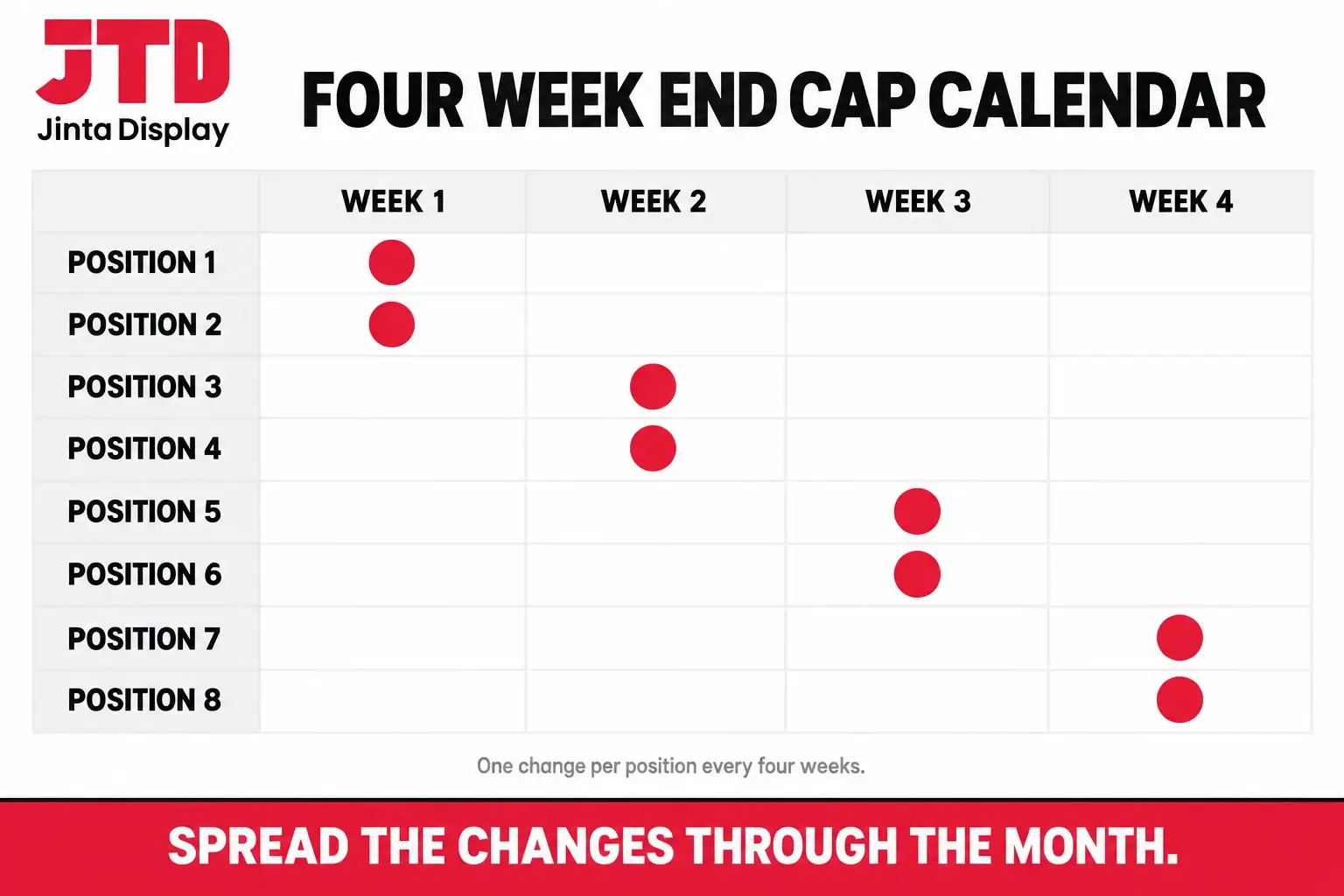
A store that plans its end caps in advance gets more from them. A calendar for each position lists what will be shown, when it changes and who is responsible. A common rhythm is a change every two to four weeks, matched to the supplier offer cycle and the season.
Work an example with assumptions. A supermarket has seven island runs and 14 end caps, with eight of them as display positions. If each position changes every four weeks, the store plans 8 displays every four weeks, or 104 changes in a year. That is a lot of work, so the plan must show who builds each display and where the goods come from. Spread the changes through the month, and do not change all eight in one day. Give each position an owner, so that a display is built on time and does not wait for someone to notice that the offer has ended.
Track what each end cap sells. A simple record of units sold per week and the space used shows which positions and offers work. If a position is weak, move a stronger offer there or turn it into a plain panel. If a position is strong, protect it. The calendar and the record together turn end caps from decoration into a tool.
End Cap Layouts for Single, Double and Corner Runs
The layout depends on the run. A double-sided island has an end cap at each end, with a face across the full depth of the island. A single-sided wall run has an end at the free end only, with a face of 450 to 550 mm. A run that ends at a corner may use a corner unit that closes two runs together.
Some stores use a T-end, in which two island runs meet a cross run and an end cap sits at the meeting point. Others use a double end cap, with two displays back to back facing opposite aisles. The right layout is the one that matches the traffic. An end cap on a quiet cross aisle does little, and one on a main walkway does a lot.
Leave room around the end cap. A display that sticks out into the main aisle reduces the walking width and annoys shoppers. As a planning figure, keep the main aisle at 1,800 to 2,400 mm clear after the end caps are in place. Measure from the face of the end cap, not from the line of the island.
Signs, Graphics and Lighting on an End Cap
A sign tells the shopper why to stop. It should state the offer in few words, readable from several meters away in the cross aisle. A header board above the end cap, or a printed end panel, carries the message. The graphic should match the offer and change with it, which means it should be quick to swap.
Lighting draws the eye. A shelf-edge light or a spot above the end cap makes a display stand out against the rest of the run. Plan for it early, since the fixture must have a place to mount the light and a way to route the cable. Lighting comes from another supplier, and the end cap drawing should show its position.
Keep the signs and graphics tidy. A faded or torn sign makes the display look neglected. Replace it when it ages, and keep spare printed panels for the next offer. A display with a clean sign and tidy goods looks like a plan, and a display with neither looks like leftover stock. Ask staff to walk the end caps once a day, straighten the goods, refill gaps and check that every price on the sign matches the till.
Ordering End Caps With a New Gondola Run, a Worked Example
Take a small convenience store with three island runs of three double-sided bays each. The runs are 900 mm deep, and the main aisle faces the entrance. The plan needs six island ends, and the front three face the main aisle. The store decides to make the front three display end caps and the back three plain end panels.
The display end caps have a 900 mm face and a depth of 450 mm, with the same height and pitch as the bays. Each has five shelves. The three give 13.5 meters of shelf in total, which is a manageable amount of offer for a small store. The three end panels carry signs. The order lists the bays, the three end caps and the three panels as separate lines, with the color and the logo.
This example shows why the count is worth planning. A store that forgets the end finishes receives a run of bays with open ends and exposed uprights, and has to order the pieces later at a delay. A store that plans them gets a finished look from day one.
Building End Caps That Match the Shelving
An end cap should look like part of the run. The uprights, the shelf color, the back panel and the finish should match, and the shelf edge should line up with those on the bays beside it. Our gondola end caps use the same frames as the bays, and we powder coat to your color and hold the specification across repeat orders.
The load on an end cap is usually light to medium, because offers are made of packaged goods. Heavy items such as drinks in cases need a deeper bracket or a stronger deck. Our standard supermarket series is listed at 80 to 120 kg per layer, and other models range from 40 to 150 kg depending on span, depth and gauge. Confirm the load for the end cap size you choose.
Stability matters because an end cap sits in a busy place and gets bumped by carts. A tall end cap with a narrow base can tip. The base should be deep enough, and the end cap should be tied to the run or fixed to the floor where the supplier advises. Keep the shelves loaded from the bottom up.
End Caps in a Grocery Store, a Pharmacy and a Specialty Shop
The idea is the same everywhere and the details change. In a grocery store, end caps carry the offers of the week and the seasonal ranges, and they are large and frequent. A pharmacy uses an end cap for health campaigns, seasonal products such as sun care or cold remedies, and new lines. A specialty shop may use an end of run for the latest collection or a brand story.
A convenience store has few runs, so it has few end caps, and each one counts for more. The ends of the first and last runs, which face the entrance and the counter, are the most valuable. In a small shop the counter itself acts as an end cap for impulse items. The pharmacy example in the guide to pharmacy shelving shows how end caps fit a small shop layout.
Mistakes to Avoid With End Caps
Several mistakes recur. Making the end cap too tall blocks the view across the store. Ordering end caps from a different system leaves a mismatch in pitch and color. Filling every end cap with a weak offer wastes the best space. Leaving the same goods in place for too long makes the position invisible.
Others are practical. Forgetting that each run has two ends, which are separate lines on a quotation. Blocking the cross aisle with a display that sticks out too far. Piling heavy goods high on a light shelf. And ignoring the sign, which turns a display into a pile of goods with no message.
What to Send a Supplier for End Caps
A supplier can quote end caps with the gondola run. Give the island depth, the bay length and the height, since the end cap is sized from them. State the type of end cap you want, such as a gondola end cap, a display end cap or a plain end panel. Say how many of each, and the loads they will carry. Add the color, the logo and the destination.
If you are planning a store, send us your floor plan and the number of island runs and we will reply with a bay and end cap count and a quotation.
Frequently Asked Questions
What is an end cap in retail?
An end cap is a display fixture at the end of a run of shelving, facing the main aisle. It catches shoppers as they pass and is used for promotions, seasonal ranges and new products. It can be a shelf unit that matches the gondola, a display with bins or hooks, or a plain end panel.
What are end caps used for?
They carry the products the store most wants to sell now, such as offers, new lines, seasonal ranges and high-margin items. They also guide shoppers with a theme and can hold supplier displays. A planned rotation every few weeks keeps them effective.
How many end caps does a store need?
Two per island run, one at each end, plus any wall ends. A supermarket hall with seven island runs has 14. Not all need to be display positions, so use plain end panels at low-traffic ends and display end caps where traffic is highest.
What size is an end cap?
The face width equals the island depth, which is 900 to 1,000 mm in many ranges, and our double-sided series is 1,000 mm deep. The end cap is often 450 to 550 mm deep. The height matches the run, about 1,800 mm, or lower at 1,200 to 1,500 mm to keep sightlines open.
What is the difference between an end cap and an end panel?
An end cap carries goods and displays them to the cross aisle. An end panel is a plain cover that finishes the run and hides the uprights, and it can hold a sign. A store needs a finishing piece at every end, and chooses which ends become display positions.
Can I order end caps separately from the gondola?
You can, but order them with the gondola from one maker. End caps must match the slot pitch, bracket shape, height and color of the run. A different system leaves a mismatch. Send the system details and a photograph if you are adding end caps to an existing run.
How much weight can an end cap hold?
It depends on the section, depth and span. Our standard supermarket series is listed at 80 to 120 kg per layer, and other models range from 40 to 150 kg. Heavy goods need a deeper bracket or stronger deck, and the rating should be confirmed for the size you choose.
What is an end cap in a grocery store?
What is an end cap in retail terms for a grocer? In a grocery store the end cap is the display at the end of a shelf run, facing the main aisle. It holds the weekly offers, seasonal ranges and new products. It is one of the busiest positions in the store, and a plan with a calendar keeps it fresh.