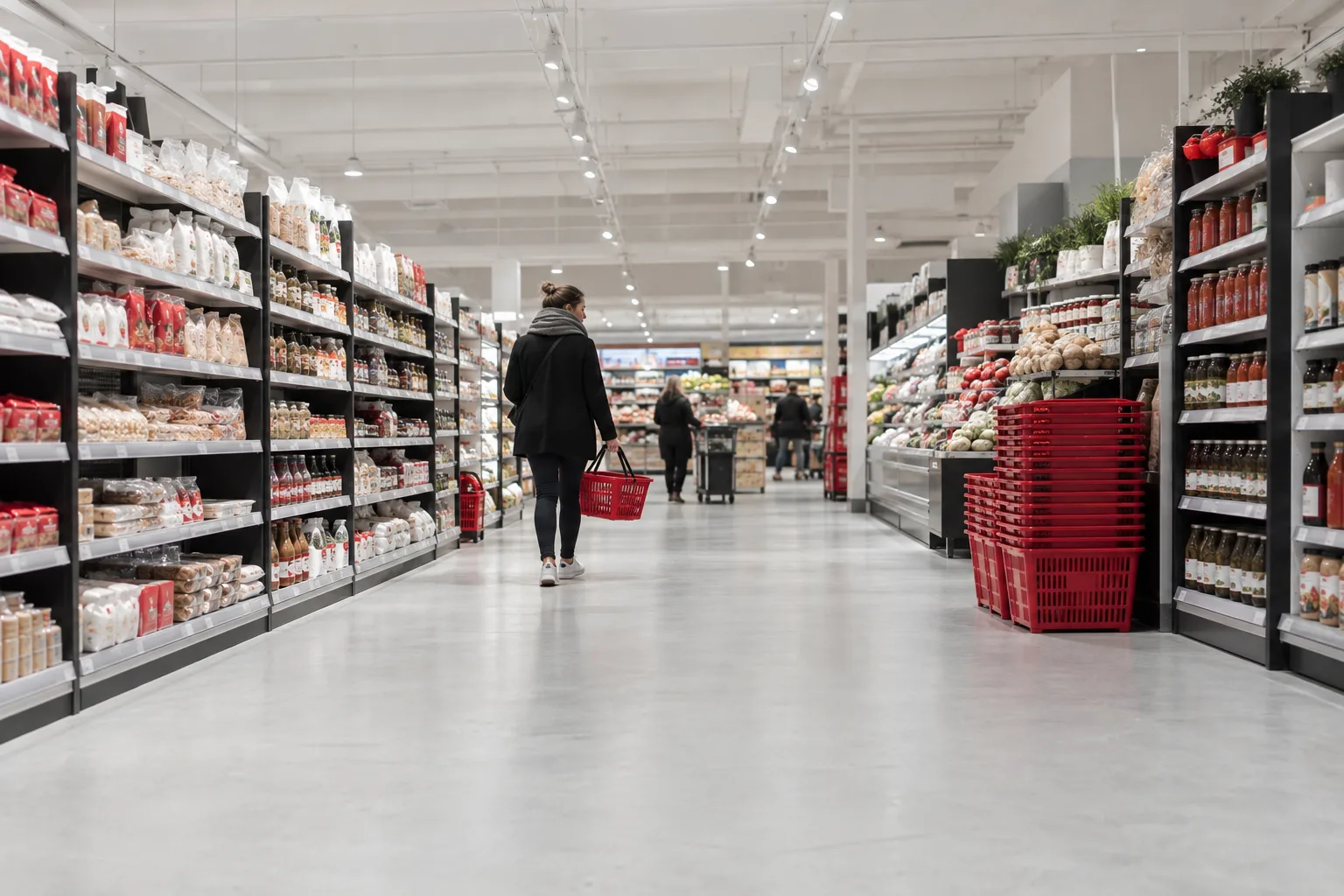
Open a new shop and the first question is not what to sell, it is what to put the goods on. Shelves, counters, display tables, baskets and a hundred smaller items have to be chosen, sized, ordered and fitted before the doors open. The words for this work differ by country, and a buyer in Manchester asks for shop fittings while a buyer in Chicago asks for store fixtures. Both are looking for the same things.
This guide explains what shop fittings are, how they are grouped and how a fit-out runs from a floor plan to a finished shop. It covers shelving, counters, baskets and carts, back room storage and the items that come from other suppliers. It also explains the choice between a shop fitter and a manufacturer. It is written from the manufacturing side, and figures for our own range come from our product pages.
It does not cover price, which depends on size, finish and quantity, or building and safety regulations, which are set where the shop trades. A worked example for counting fixtures is in the supermarket equipment list, and this guide gives the wider picture around it.
What Are Shop Fittings
Shop fittings are the fixed and semi-fixed items inside a shop that hold goods, present them, take payment and move customers around. A shelf is a shop fitting, and so is a counter, a display table, a rail, a basket stand, a mirror in a changing room and the lighting that shines on the goods. Items that are bought for the shop and not for sale are fittings.
The term covers the structure and the things attached to it. Wall shelving fixed to a wall is a shop fitting, and a freestanding island is a shop fitting as well. Some people reserve fittings for things attached to the building and fixtures for things that stand on the floor, but in practice the words overlap, and suppliers use them as one phrase.
The purpose is to turn an empty room into a shop that sells. A good set of shop fittings holds the range at the right height, guides customers along a path, shows the goods in good light and takes payment smoothly. A poor set wastes floor, hides products and forces staff to work around the layout.
Shop Fittings, Store Fixtures and Retail Equipment Across Countries
The same set of items goes by several names, and search results differ with the word you use.
| Term | Where it is common | What it usually covers |
|---|---|---|
| Shop fittings | UK, Australia, New Zealand | Shelving, counters, display, the whole fit-out |
| Shop fitting | UK, Australia | The work of fitting out, and the equipment |
| Store fixtures | United States, Canada | Shelving, racks, counters and displays |
| Retail fixtures | United States and others | The same group, with a retail focus |
| Shop fitting supplies | UK | Items a shop fitter or shop owner orders |
| Retail equipment | All | Fittings plus tills, scales and refrigeration |
A supplier who works across markets can quote any of these from one drawing. When you search for suppliers, use the word of your own market, and also try the others, since the best match may be filed under a different name.
The Main Groups of Shop Fittings
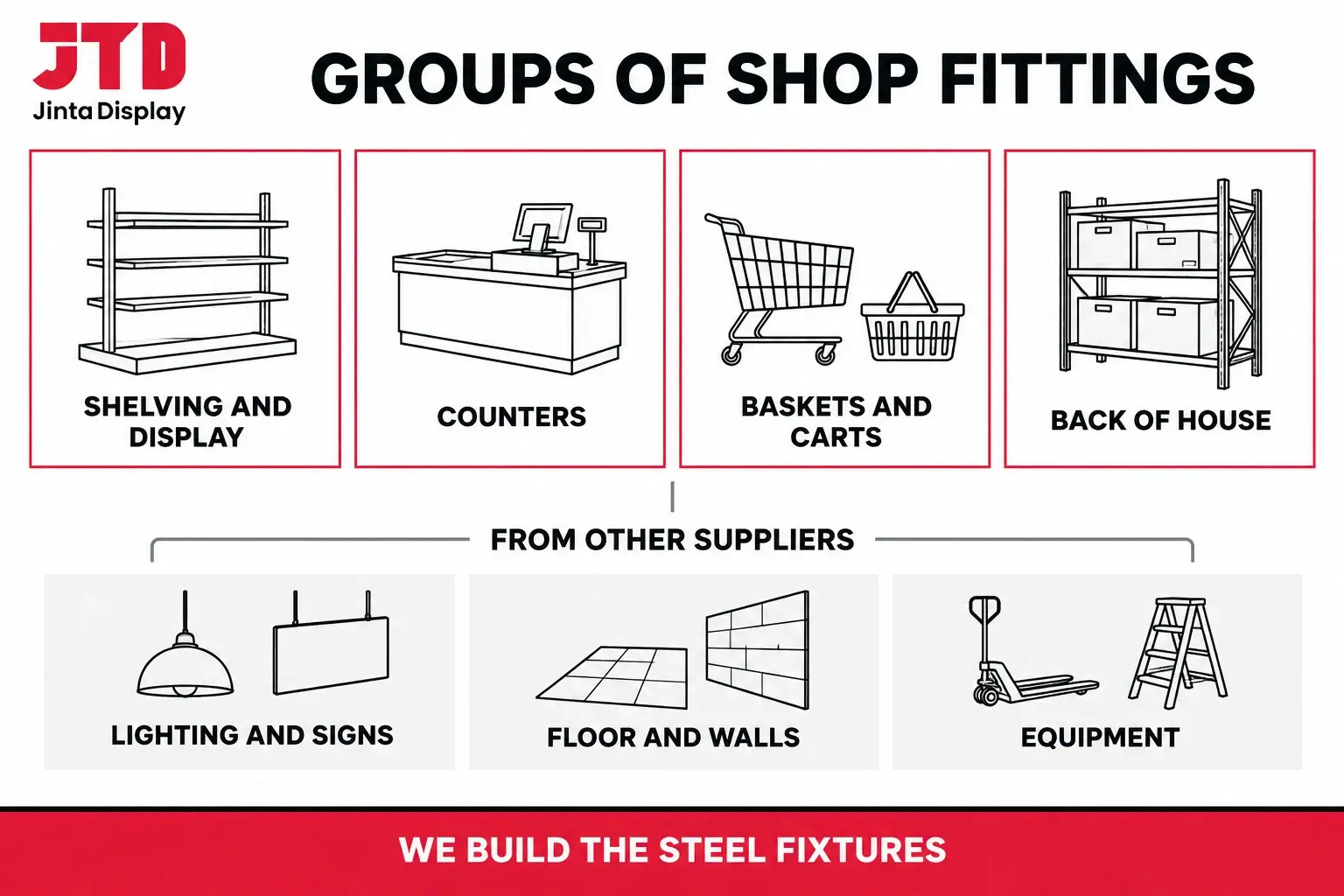
A fit-out is easier to plan when the items are sorted into groups, and each group has its own supplier, lead time and drawing.
| Group | Examples | Usual supplier |
|---|---|---|
| Shelving and display | Wall shelving, gondolas, end caps, display tables | Shelving manufacturer |
| Counters | Checkout counters, cash wrap, service desks | Counter maker |
| Customer handling | Baskets, carts, stands | Cart and basket maker |
| Back of house | Stock room shelving, racking, cages | Racking manufacturer |
| Lighting and signage | Ceiling and shelf lighting, header boards, signs | Lighting and sign specialists |
| Floor and walls | Flooring, wall finishes, ceilings | Building trades |
| Equipment | Tills, scales, refrigeration, security | Specialist suppliers |
Our own range sits in the first four rows. We build gondola and wall shelving, counters, baskets and carts, and racking and boltless shelving for the stock room, all in steel and finished to your color. The last three rows come from other suppliers, and the plan should show them early, since lighting, refrigeration and cabling decide where fixtures can stand.
Shelving and Display Fittings
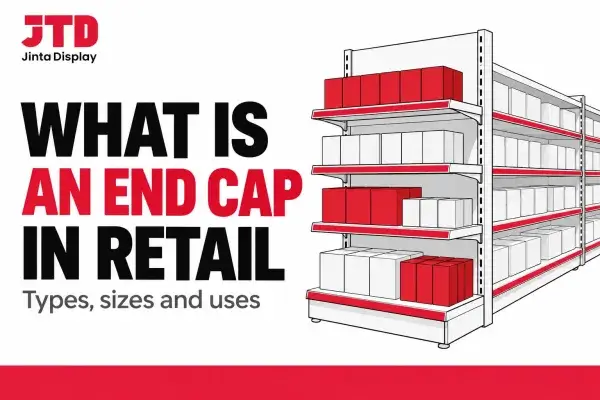
Shelving is the largest group by quantity in most shops. Wall bays line the perimeter and make use of the height. Island gondolas fill the middle and divide the floor into aisles. End caps and end panels finish the runs. Display tables and rails carry items that need to be seen from above or hung.
The choice of system matters because the parts do not mix. A bay built to a 50 mm pitch will not take brackets from an inch-pitch system, and the pitch sets which shelf heights are possible. The sizing of bays and the differences between systems are set out in the guide to gondola shelving sizes, and the definitions are in the guide to what a gondola is in retail.
Our supermarket shelving category lists single-sided and double-sided bays in Lozier compatible, hole-back and S50 systems. The same frames carry grocery and lighter merchandise, so a shop of any type can use them. For specialist retail, the shelf spacing, the back panel and the finish change, and the frame stays the same.
Counters and Checkout Fittings
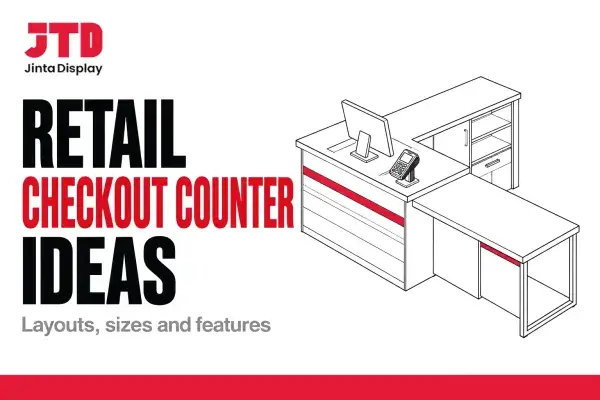
The counter is the fixture every customer stands at, and it is also where staff spend most of the day. It takes payment, packs goods and often holds small items for impulse sales. Its length, depth and height should suit the till, the card terminal and the volume of customers.
Our counters run from 1,200 to 4,000 mm long, 550 to 1,200 mm wide and 850 to 870 mm high, in cold rolled steel, with side tables for bagging. The sizes and names are explained in the guide to what a cash wrap is, and the full range is under our checkout counter category. Match the counter finish to the shelving, because a mismatch is visible from the door.
Baskets, Carts and Customer Handling
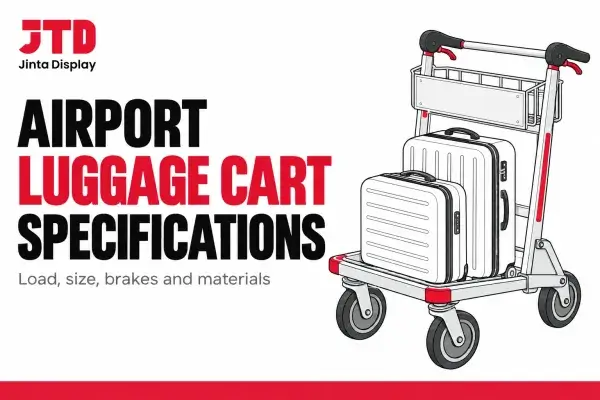
Baskets and carts carry the customer’s goods, and they are shop fittings too. A convenience store may use baskets only. A supermarket uses baskets and carts, and a hypermarket adds rolling baskets. The right mix depends on the shopping mission and the floor space.
Our baskets run from 18 to 60 L, and our carts from 60 to 240 L in five regional styles. Sizes and weights are set out in the guides to shopping basket size and shopping cart dimensions. The stands and bays for them need floor space near the entrance, and the plan should include it.
Back of House Shop Fittings
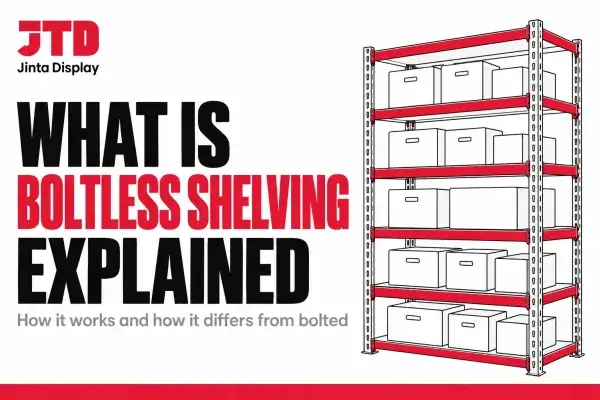
The stock room is part of the fit-out, even though customers never see it. Boltless shelving suits cartons and small stock, and long span shelving suits heavier items. Pallet racking suits stock that arrives on pallets, for shops with a warehouse-style back room. Steel cages hold loose goods and returns.
Plan the stock room so that stock reaches the shelves by the shortest route. A stock room far from the sales floor costs staff time every day. Racking and shelving for this area come from our warehouse racking and boltless ranges, and the choice between them is covered in the guide to warehouse racking types.
Shop Fitting Equipment and Supplies From Other Suppliers
Several items that a shop needs do not come from a shelving manufacturer. Lighting, both ceiling and shelf-edge, shapes how goods look and where fixtures can stand. Signage and header boards identify zones and need support from the fixture. Refrigerated cabinets and cold rooms need power and drainage, and they often take the longest walls. Tills, scanners and scales need counter cut-outs and cable routes. Security tags and gates need clear sightlines.
These items affect the plan, and they should appear in it from the start. Give the other suppliers the fixture drawing, and ask them for their power, drainage and cable needs. A shop fit-out that is planned as one drawing avoids the clash where a fridge or a light lands on a shelf.
How a Shop Fit-Out Runs From Brief to Opening
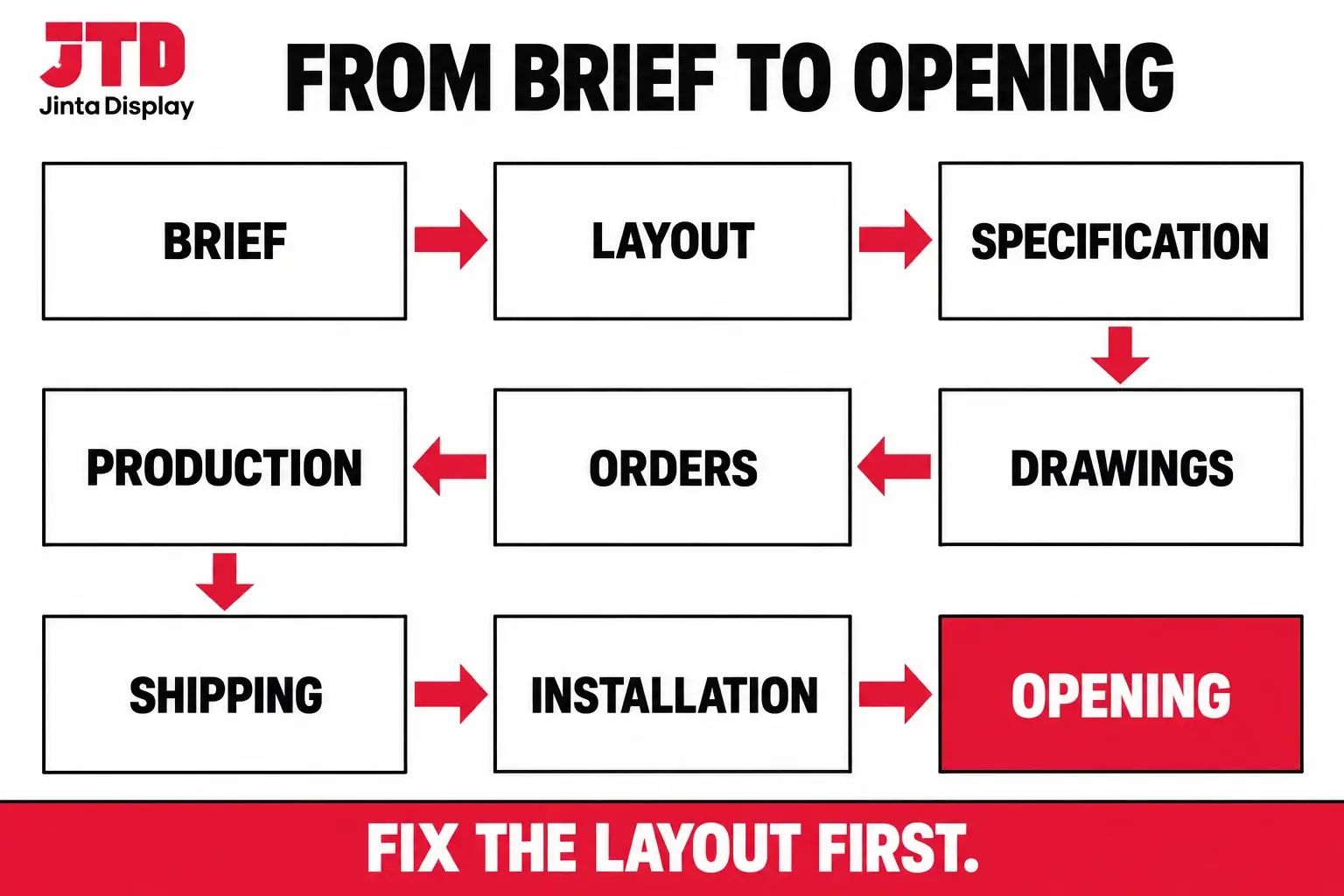
A fit-out follows a rough sequence, and the stages overlap. It starts with the brief, which states the type of shop, the range, the budget, the floor area and the opening date. The layout comes next, with the position of the entrance, the checkout, the aisles and the stock room. The specification follows from the layout, naming the systems, sizes, finishes and quantities.
Drawings turn the specification into something a factory can build. Quotations come from the suppliers against the drawings, and orders follow. Production takes time, and our counter listings state 15 days, while our shelving is made to order with a lead time of 10 to 30 days. Shipping and clearance add more. Installation comes last, and the shop opens when fittings, stock and staff are ready.
Work back from the opening date. Fix the layout early, because a late change moves everything after it. Order long lead items first. Allow time for shipping and for fitting, and leave a few days of slack at the end, because there is always something that is late.
Retail Shop Fittings for Different Types of Shop
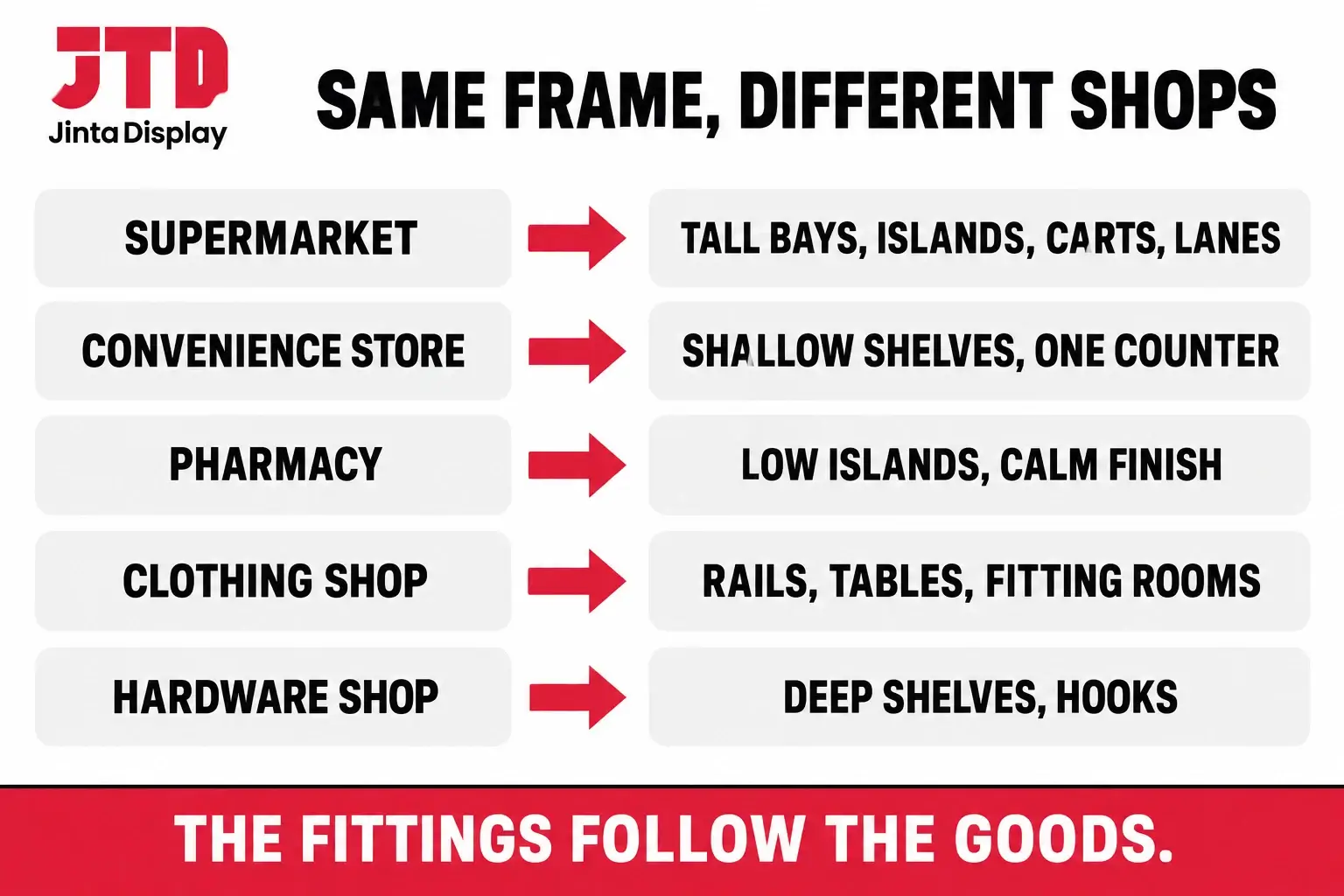
The right set of retail shop fittings depends on what the shop sells. A grocery or supermarket needs deep stock capacity, so it uses tall wall bays, double-sided islands, carts and baskets and a row of checkout lanes. A convenience store uses shallower shelves, narrower aisles, baskets only and a single counter with space for impulse lines.
A pharmacy uses clean, calm shelving with shallow shelves for small boxes, lower islands for sightlines and a counter that doubles as an advice desk. A clothing shop uses rails, tables, wall displays and fitting rooms more than gondolas, and its fittings are chosen to show a few items well. A hardware shop uses heavier shelving, deeper shelves and hooks for small parts.
Specialty retail leans on brand. The fittings carry the color, the proportions and the finish that make a shop recognizable, and the load rating is a minor concern. Grocery leans on capacity and cost per bay. In each case, the frame can be the same steel bay, with the shelf pitch, back panel and finish changed to suit the goods.
What Are Store Fixtures in the United States
For buyers in the United States, the question is often what are store fixtures, and the answer is the same group of items. Retail store fixtures are the shelving, racks, counters and displays that hold and present goods. The market for retail store fixtures in the United States is large and mature, with its own standard systems, which is why the slot pitch and bracket shape of American gondolas differ from those used in Europe and Asia.
A US buyer who imports needs to match the inch system of the local market, or to choose a metric system and keep it throughout. Our supermarket range includes a Lozier compatible series for stores that already run on the inch system, and 50 mm pitch series for others. The choice is made once and kept, since mixed systems leave parts that do not fit.
Planning the Floor Before Choosing Any Fitting
The floor plan decides the fittings. Start with the aisle. A secondary aisle of 1,200 to 1,500 mm and a main aisle of 1,800 to 2,400 mm are common planning figures. Then choose the shelf depth that leaves the aisle clear, and then the counter and the baskets or carts. Doing it in the reverse order leaves a shop that does not work.
A small example shows the effect. A convenience store 8 m wide and 15 m deep, with shelves 350 mm deep, 900 mm bays and 1,200 mm aisles, holds 3 island runs, 34 wall bays, 30 island bays and 6 end caps, as worked through in the equipment list. Widen the aisles by 300 mm and one run is lost. The aisle is the number to fix first.
Think about sightlines and flow. Keep the middle of the shop low so that staff can see the whole floor, and keep tall fixtures on the walls. Put the checkout where customers pass the whole range on their way. Leave a clear space just inside the door, where shoppers slow down and take in the shop.
Shop Fitter or Manufacturer
There are three common ways to buy shop fittings. A shop fitter designs and installs the fit-out, and often supplies the fittings from a range of makers. A manufacturer builds the fittings and sells them directly or through agents. A distributor stocks standard items for quick delivery.
A shop fitter is the right choice when you want one party to manage design, supply and installation. The service has a cost, and the fitter’s margin is part of the price. A manufacturer suits a buyer who has a plan, wants control of the specification and can arrange installation. It also suits chains and importers who order in volume. A distributor suits small, urgent orders of standard items.
Many projects use a mix. A chain may work with a shop fitter for design and install, and specify a manufacturer for the fixtures. The manufacturer needs the drawing, and the fitter needs the lead times. Clear communication between them keeps the fit-out on time.
Buying Shop Fittings From a Factory in China
Factory-direct buying suits importers, chains and fit-out contractors, and it has its own checks. Ask for a written specification with the system, section, thickness, finish and color. Ask for a sample bay or a small first batch before the full order. Confirm the minimum order and the lead time in writing. Our shelving is made to order with a minimum of 20 units, and our trade terms are FOB, CNF or CIF.
Plan the shipping. Fixtures are bulky, and the container plan decides the landed cost. Ask for the container load in units, and consider shipping the fittings together to keep the finish matched. Confirm who unloads and fits the goods at the destination, and arrange installers before the container lands.
Use one supplier for lines that must match. When shelving, counters and baskets come from one plant, the sizes and finishes agree when the container is unpacked. We build all of these in Changshu, and our site states that the specification is held across repeat orders, which suits a chain.
Materials and Finishes for Shop Fittings
Most fittings are steel with a powder coat finish, sometimes with wood, glass or laminate added. Steel is strong, durable and easy to reproduce, and powder coat gives a hard, even color. Wood and laminate add warmth and fit specialist retail. Glass shows goods well in cases and shelves but needs careful handling.
Color is a quick way to tie the fittings to the brand. Specify a named reference and ask the supplier to match it, and to hold it across orders. A white that differs between shelving and counter shows from the door. For a chain, keep the sample from the first order and send it with each repeat.
Shop Fittings for a Chain or a Rollout
A chain wants every shop to look the same, and the discipline is the same as for a single shop, repeated. Settle one specification, with the system, finish, color and sizes. Build the first shop as the reference. Record the drawings and keep a sample. Each later order then uses the same set.
The supplier should hold your drawings and confirm that the same parts will be available in later years. A chain that changes system between shops ends up with fixtures that do not fit each other. A chain that holds one system can add a bay or a shop at any time. Our site describes the principle, one specification held across repeat orders, and our project page shows fit-outs built that way.
What Drives the Cost of Shop Fittings
This guide does not give prices, because the figure depends on the shop, but the drivers are clear. Steel thickness and the section set the material in each fixture. The finish, from plain powder coat to special colors or wood, changes the cost. Size and quantity matter, since larger orders spread setup. Customizing adds cost, and so do accessories and special parts. Freight and installation sit on top.
Compare quotations by the specification and not by the total alone. A cheaper quotation may use thinner steel, a lighter coat or fewer accessories, and the difference shows in service. Ask each supplier to quote the same scope, so that you compare like for like.
Looking After Shop Fittings After the Shop Opens
A fit-out is not finished on opening day. Fixtures take knocks from trolleys, boxes and customers, and a little care keeps them looking right. Wipe shelves and counters regularly, and check the feet, brackets and end panels for damage. Replace a bent shelf or a chipped panel promptly, because a shop that looks tired loses sales.
Keep spare parts on hand, such as shelf brackets, end panels and counter side tables, in the same finish as the originals. Record the specification of each batch. When the range grows or a shop is refitted, the record lets the supplier match what is already in place.
Mistakes to Avoid When Buying Shop Fittings
The common errors are easy to list. Choosing fixtures before fixing the aisle leaves a shop that does not fit. Mixing shelving systems leaves parts that do not match. Ignoring lighting, refrigeration and cabling until late forces changes. Ordering without a sample leaves surprises at delivery. Leaving the stock room to the end leaves a long walk for staff every day.
Other mistakes are less obvious. Forgetting end caps, which are separate lines on a quotation. Forgetting the entrance zone, where customers slow down. Mismatched colors between suppliers. And planning for opening day only, when the shop will change as the range grows.
What to Send a Supplier for a Shop Fit-Out
A short brief gets a comparable quotation. Send the floor plan with the width and depth, the position of the entrance, the checkout and the stock room. State the type of shop and the range. Give the bay lengths, shelf depths and heights you want, and the counter length. Add the color reference, any logo, the quantity of shops, the destination port and the date the shop opens. If the shop is part of a chain, send the drawings and photographs of an existing shop, so the supplier can match the system and the finish. List any items from other suppliers, such as lighting and refrigeration, with their sizes and power needs, so the fixture drawing leaves room for them.
If you are fitting out a shop, send us your floor plan and store type and we will reply with a layout and a quotation. Our full range is on the project page and in the product categories.
Frequently Asked Questions
What are shop fittings?
Shop fittings are the equipment inside a shop that holds goods, presents them, takes payment and moves customers. They include shelving, display units, counters, baskets, carts, back room racking, lighting, signage and flooring. In the United States they are usually called store fixtures.
What is the difference between shop fittings and store fixtures?
There is no real difference in the items. Shop fittings is the UK, Australian and New Zealand term, and store fixtures is the US and Canadian term. Some people use fittings for things attached to the building and fixtures for things on the floor, but suppliers use both words for the same group.
What is included in a shop fit-out?
A fit-out usually includes shelving, display units, counters, baskets and carts, back room storage, lighting, signage and flooring. It may also include tills, refrigeration and security. The scope depends on the shop. A shelving manufacturer supplies the steel fixtures, and specialists supply lighting, signs and equipment.
How do you plan shop fittings for a new shop?
Start with the floor plan and fix the aisle width, then the shelf depth, then the counter and baskets or carts. Add lighting and cabling to the same drawing. Specify the finishes, order long lead items first and work back from the opening date. Fix the layout early.
Should I use a shop fitter or buy from a manufacturer?
A shop fitter manages design, supply and installation for a fee. A manufacturer suits buyers with a plan who want to control the specification, and chains and importers who order in volume. Many projects combine the two, with a fitter for design and install and a manufacturer for the fixtures.
How long does a shop fit-out take?
It varies with the size and the route. Our counter listings state a production time of 15 days, and our shelving is made to order with a lead time of 10 to 30 days. Add design, shipping, clearance and installation, and work back from the opening date with a few days of slack.
Can I buy shop fittings directly from a factory?
Yes, and it suits importers, chains and contractors. Ask for a written specification and a sample, confirm the minimum order and lead time, and plan the shipping and installation. Our shelving is made to order with a minimum of 20 units, with FOB, CNF or CIF terms.
What shop fittings does a supermarket need?
A supermarket needs shelving, carts and baskets, checkout counters and stock room racking, plus refrigeration, scales and tills from specialists. The aisle width comes first, and it sets the shelf depth and the cart size. The full method for counting each group is in our supermarket equipment list.