
Walk into a stock room, a garage or a back office and the shelves are very likely boltless. Pull one beam up and the next down, and the layout changes in a minute with no spanner in sight. That convenience is why the product has become the default for adjustable storage, and why buyers who need a fixed, rigid structure sometimes choose something else.
This guide explains what boltless shelving is, how it is built and how it differs from bolted shelving. It covers assembly, strength, parts and compatibility, and the cases where each type is the better choice. It is written from the manufacturing side, and figures for our own range come from our product pages. It does not cover price or the load rating of any one unit, which depend on the section and the span and are set out in the guide to heavy duty shelving capacity.
What Is Boltless Shelving
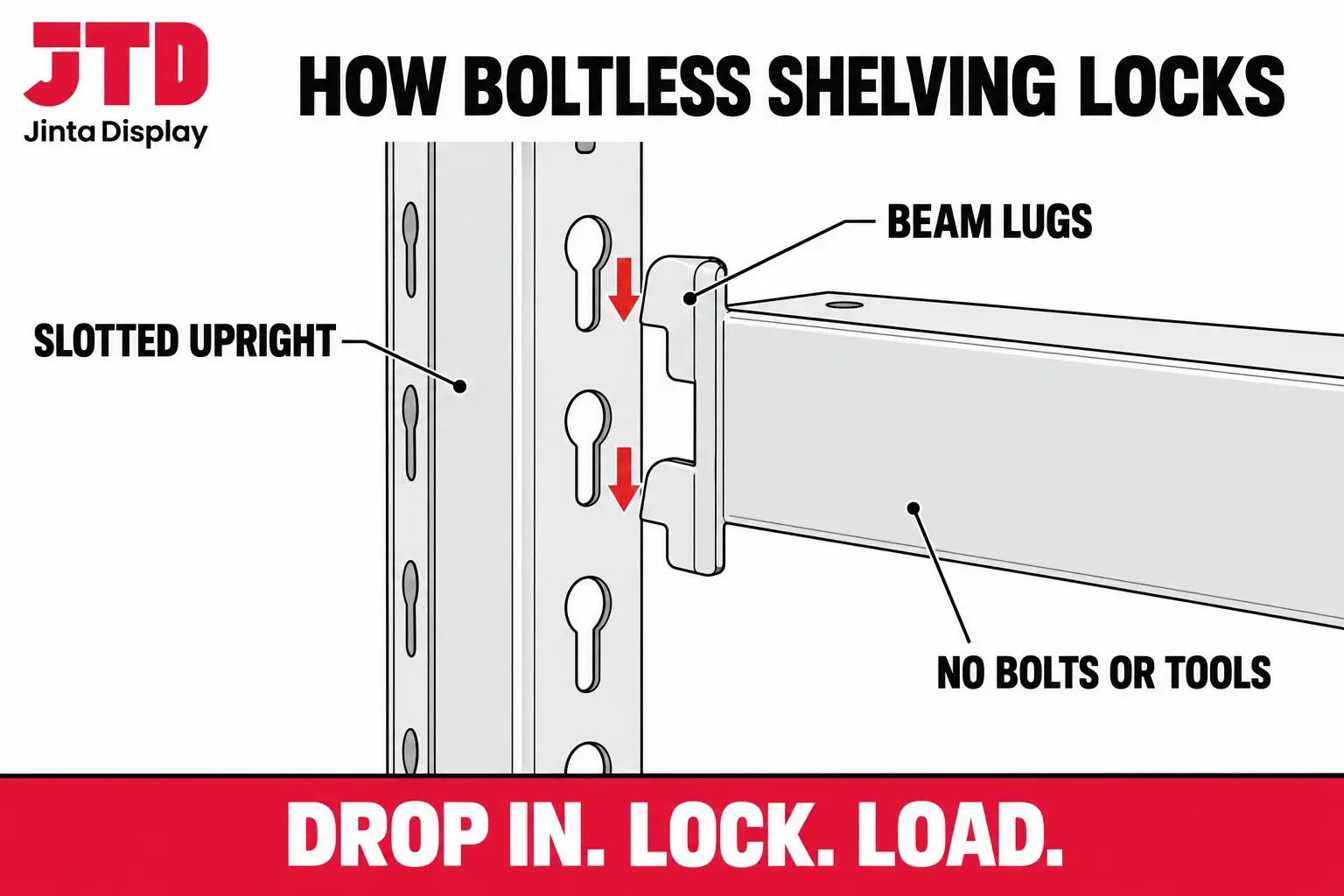
What is boltless shelving in practice? Boltless shelving is a modular storage system built from slotted uprights, beams and shelf panels. The ends of each beam carry lugs that fit the slots in the upright. The beam is set into the slots and settles down, and the weight of the load holds it in place. Because the connection is a hook and not a fastener, the shelf levels can be moved up or down in fixed steps without taking the unit apart.
The names vary. Boltless shelving is also called rivet shelving, boltless rivet shelving, and clip shelving. The words rivet and boltless point at the same idea, which is a connection that is formed by the shape of the parts and not by a loose fastener. Other names such as boltless shelves and boltless shelving system describe the product in the singular and the plural, and buyers use all of them.
The usual deck is a steel panel, and many units offer a board deck in wood or an engineered board. Standard heights run to about 1.8 m, and the shelves are shallow enough to reach across, usually 300 to 600 mm. That makes it a hand-loaded product for cartons, tools, parts and small goods, and not a product for pallets.
Why Boltless Shelving Became the Default for Adjustable Storage
Buyers who ask what is boltless shelving often want to know why it is everywhere. The answer is time. A bolted unit of the same size can take an hour or more to build and needs two people and a set of spanners. A boltless unit goes up in minutes with a mallet, and one person can build a bay. When a business builds or changes shelving often, that difference adds up quickly.
The second reason is flexibility. Stock changes with the season, the range and the supplier, and a shelf that can be moved by hand fits that change. A beam moves from one slot to the next without tools, so a stock room can follow the product and does not have to follow the shelving.
The third reason is a clean look. A boltless bay has no visible nuts or bolts, and the beams sit neatly in the uprights. That matters in shops, offices and archives, where shelving is seen as well as used. The lines are tidy, the shelf edges are finished and a powder coat gives an even color.
Where Boltless Shelving Is Used
The product fits a wide set of places. Shops use it in stock rooms behind the sales floor, where cartons and spare stock sit until needed. Offices and schools use it for files, supplies and equipment. Garages and workshops use it for tools, paint and parts. Small warehouses use it for cartons and totes that are picked by hand.
Each place asks for something different. A shop wants a tidy finish and a color that matches the front of house. An office wants quiet shelves that do not rattle. A garage wants a strong coat and shelves that tolerate knocks and damp. A warehouse wants bays that can be added in a line as stock grows. A supplier who knows the use can suggest the section, the deck and the finish.
Choosing the Size of a Boltless Shelving Unit
Size is chosen from the space and the goods. Start with the wall length available. A wall of 3.6 m holds four bays of 900 mm or three bays of 1,200 mm, and it is wise to leave a small gap at each end for clearance. Then choose the depth from the goods. Boxes and cartons need a depth that fits the box with a small overhang, and small items can use a shallower shelf.
Work an example. A stock room has a wall 4.8 m long and stores cartons of 400 mm by 300 mm by 250 mm. A shelf 450 mm deep takes the carton lengthwise with room to spare. A 1,200 mm bay holds three cartons across, so four bays hold twelve across. At five tiers, the wall holds 60 cartons in one layer deep, which is a rough measure of capacity. If each carton weighs 12 kg, a shelf of three cartons carries 36 kg, well below the rating of a standard bay.
Now check the height. Our standard bays are 1,830 mm high with five tiers, which gives a tier pitch near 350 mm. A 250 mm carton fits with room to slide it in. If the cartons were 400 mm tall, the unit would need a four tier layout or taller spacing. The tier spacing can be moved in fixed steps, so the layout can change when the cartons change.
What Drives the Quality of Boltless Shelving
Two units of the same size can differ a great deal in quality, and the differences are in the steel and the finish. Thicker uprights and beams carry more and last longer. A deeper beam is stiffer. A well-formed slot seats the beam firmly and holds the load without play, and a rough slot lets the beam rock. A good powder coat resists chipping at the slot edges, where beams are knocked in and out.
A thin shelf panel can dish under a heavy load, and a thicker panel resists it. Our panels are listed at 0.5 to 0.8 mm for cartons and light parts, and board decks or thicker panels are an option for heavier goods. Ask for the thickness of each part, and for the weight of a finished bay. A bay that is much lighter than others of the same size carries less steel.
Value is not the lowest price. A shelf that bows after a year costs more than one that holds. Compare quotations by the section, the thickness and the rating, and ask for a sample bay to be built and loaded before a large order.
Stability and Fixing for Boltless Shelving
A tall unit with heavy shelves can tip. The risk rises with height, load and the presence of children or busy aisles. Back braces or plates stiffen the unit sideways and stop it from swaying. Fixing the unit to a wall or the floor stops it from tipping. Both steps are cheap compared with an accident.
Load low and heavy first. A unit with its weight on the top shelves is top heavy and far more likely to tip. Spread the load along each shelf and keep the weight over the uprights where you can. For a run of several bays, joining the bays together with ties adds stability, since the units brace each other.
Floors are not always level. Adjustable feet let you level the unit on an uneven floor, and a level unit carries its load as designed. Check the level with a spirit level, and adjust the feet before loading.
The Parts of a Boltless Shelving Unit
A unit has a short list of parts, and each one has a job.
| Part | What it does | What to check |
|---|---|---|
| Upright | Vertical post with slots that take the beams | Section, wall thickness, slot pitch |
| Beam | Horizontal support under each shelf, with lugs at the ends | Section, thickness, length |
| Shelf panel or deck | The surface that carries the goods | Thickness, material, edge |
| Back brace | Diagonal or plate that stops the unit swaying | Fitted on tall or loaded units |
| Feet or base | Spread the load and protect the floor | Adjustable or fixed |
| Accessories | Wheels, dividers, back panels, end panels | Compatible with the system |
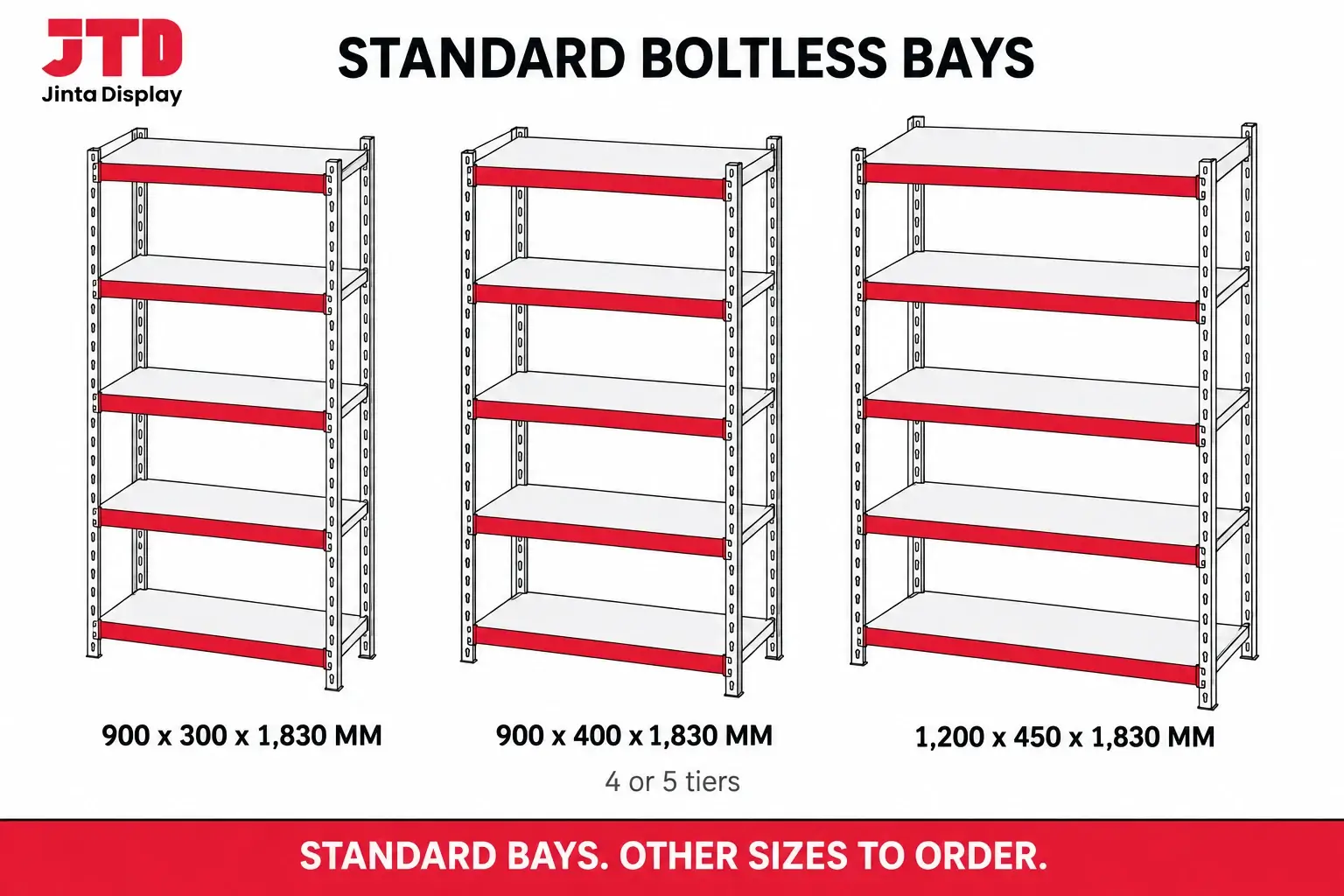
Our boltless range is built in cold rolled steel with 38 × 38 mm uprights at 1.0 to 1.8 mm, shelf panels of 0.5 to 0.8 mm and beams of 1.0 to 1.5 mm. The standard bays are 900 × 300 × 1,830 mm, 1,200 × 450 × 1,830 mm and 900 × 400 × 1,830 mm, in 4 and 5 tier versions, in black or white powder coat. Other sizes are made to order, and our boltless shelving category lists the models.
What Is Bolted Shelving
Bolted shelving is fixed with nuts and bolts. The common form is slotted angle shelving, made of steel angle with a row of slots along its length. Posts and cross members are joined with bolts through the slots, and shelf decks sit on the cross members. A related form is welded shelving, which is built in a factory as one piece and needs no assembly but cannot be changed.
The strength of bolted shelving comes from its rigid joints and the shape of the angle. A triangle formed by a bolted brace is stiff, and a unit with braced corners can carry heavy loads and resist swaying. The cost is time. A bolted unit needs tools, many fasteners and patience, and moving a shelf means undoing and refitting bolts. It suits places where the layout does not change.
Slotted angle shelving is old and well proven. It remains common in industry, schools and warehouses, where a unit is built once and left. Boltless shelving took much of its market in stock rooms and garages because it is faster to build and easier to adjust.
Boltless vs Bolted Shelving, Side by Side
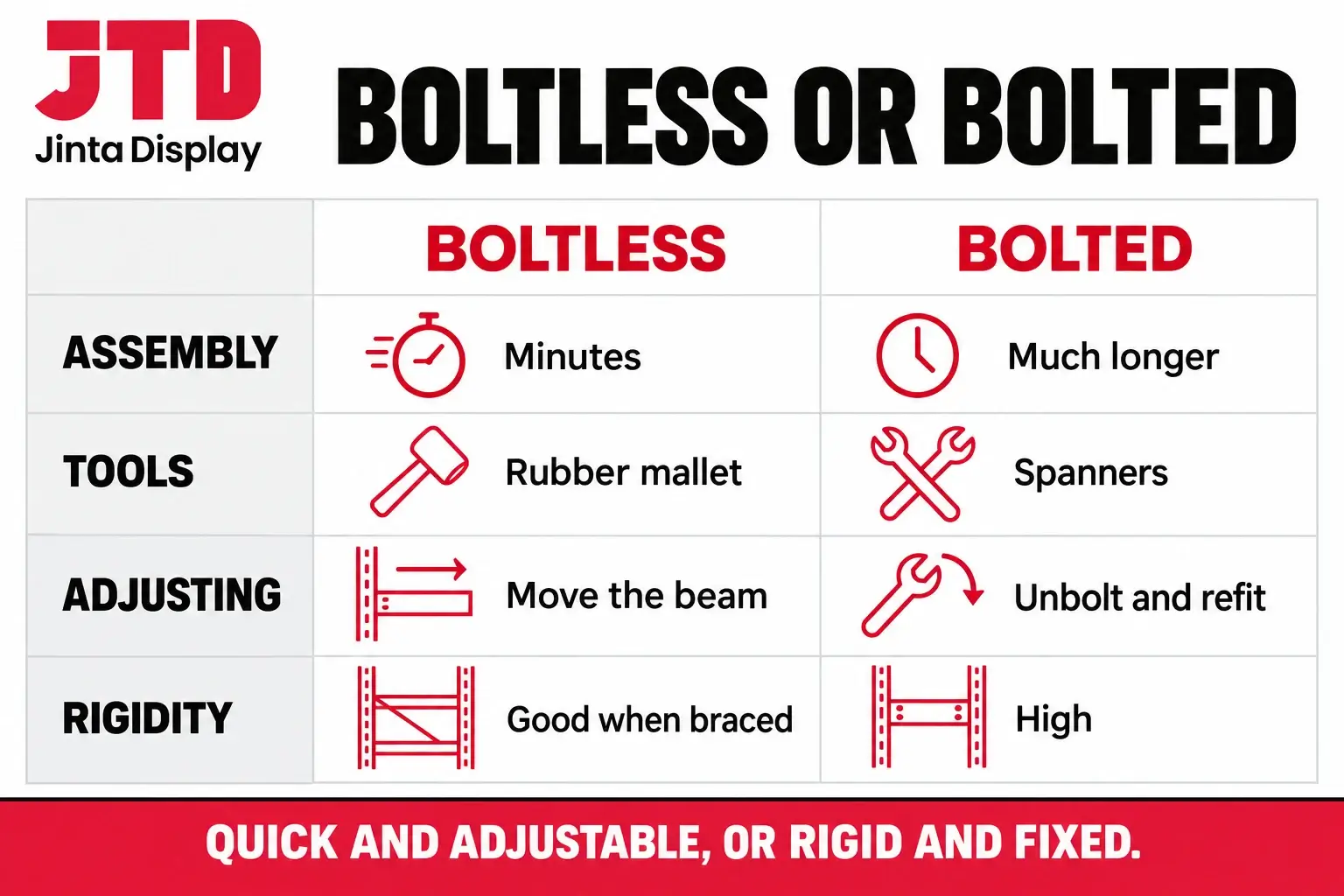
The two types differ on assembly, adjustment, strength and use. The table sets out the main points.
| Point | Boltless shelving | Bolted shelving |
|---|---|---|
| Assembly | Minutes, usually with a mallet | Much longer, with spanners |
| Tools | None or a rubber mallet | Spanners or a wrench set |
| Adjusting shelf height | Move the beam in the slots | Unbolt and refit |
| Rigidity | Good when braced, relies on the hook joint | High, joints are clamped |
| Load | Light to medium, some heavy duty versions | Medium to heavy |
| Appearance | Clean lines, neat finish | Visible bolts and holes |
| Moving the unit | Easy to take apart and rebuild | Slow |
| Best for | Stock rooms, garages, shops, changing stock | Fixed layouts, heavy known loads |
Neither is better in all cases. The choice depends on how often the stock changes and how heavy the loads are. If you move shelves each season, boltless saves a great deal of time. If you load a unit once with heavy goods and never touch it, bolted may be the stronger and more settled choice.
How Boltless Shelving Is Assembled
Assembly of boltless shelving takes a few minutes per bay, and the order matters for safety. Lay out the parts and check the counts against the list. Build the end frames by joining uprights, and stand them up. Choose the level for the lowest beam and drop the lugs of each beam into the slots at the same height on both uprights. Tap the beam down with a rubber mallet to seat it, and check that it is level.
Add the shelf panels or decks on the beams, and fit the back brace if the unit has one. Work from the bottom up, setting each pair of beams before the next. When the unit is finished, check that it stands square and does not rock. Adjust the feet on a floor that is not level. Fix tall units to the wall or floor if the supplier advises, particularly where children or heavy loads are present.
Take care with the first load. Put the heaviest goods on the lowest shelves and spread them along each shelf. Do not climb the shelves. If a beam is not fully seated, it can move under load, so listen for a click when each beam drops and check that the lugs are fully in the slots.
Strength and Capacity, Boltless Against Bolted
Capacity depends on the section, the span and the deck, whichever the connection. A boltless unit with deep beams and thick uprights can carry as much per shelf as a bolted unit of similar steel. The difference lies in rigidity. A boltless joint is a hook, and it relies on the beam sitting fully in the slots. A bolted joint is clamped, and it resists movement from side loads.
For most storage by hand, a boltless unit is strong enough. Our listings state about 150 to 300 kg per layer for the heavy duty series and under 200 kg per layer for a standard bay, which are trade listing figures and not tested ratings. For loads that exceed these, the usual choices are a stronger boltless section, a bolted angle unit or long span shelving. The full load classes are in our guide to heavy duty shelving.
For loads that arrive on pallets, neither is right. Pallet racking uses hook-in beams too, but with the sections and safety pins needed for forklift loading. The difference is set out in the guide on what pallet racking is.
Boltless Shelving Parts and Compatibility
Replacement and extension parts for a boltless shelving system are among the most searched items in this product group. The key fact is that parts are not universal. The slot shape, the lug shape and the pitch differ between makers and between ranges, and a beam from one system may not fit the upright of another.
To buy parts that fit, identify the system. Measure the upright section and the slot spacing, and photograph the slot and the beam end. Note the beam length and the shelf depth. Send the photographs and measurements to the supplier, and ask for a sample part before you buy in volume. Parts from our own range match our own units, and we confirm the fit on the drawing for any extension.
If you plan to add bays over time, choose one system and hold it. A shelving system that is chosen once and kept lets you add a bay or a shelf years later. A mix of systems leaves shelves that look alike and do not fit.
When to Choose Boltless Shelving and When Not To
For anyone still asking what is boltless shelving good for, the short guide follows. Choose boltless shelving when the stock changes, the unit may be moved and speed matters. It suits stock rooms, shops, garages, offices, archives and small workshops. It is also good for temporary or growing storage, because bays can be added or taken away.
Choose bolted or welded shelving when the load is heavy and fixed, the layout is permanent and rigidity matters. It suits heavy parts stores, industrial lines and places where the unit will be loaded and then left alone. Choose long span shelving or pallet racking when the load or the span grows beyond what a boltless bay carries, or when a forklift is involved.
A mixed approach is common. A site may use boltless shelving for small parts, bolted units for heavy items and racking for pallets. Choosing each by its load and use is better than forcing one type to do every job.
Finishes, Sizes and Customizing Boltless Shelves
Boltless shelves are sold in a set of standard sizes, and they can be made to order. The common widths are 900 and 1,200 mm, the depths 300 to 600 mm and the heights near 1.8 m. Our range includes 900 × 300 mm, 900 × 400 mm and 1,200 × 450 mm bays. Colors run from plain finishes to powder coat in a color of your choice, and a logo can be printed on request.
Customizing is useful for a chain of shops that wants the back room to match the front. It is also useful where a space is odd in size and a standard bay would leave a gap. Tell the supplier the space, the load and the finish, and they can set the bay length, depth and height to suit.
Boltless Shelving for a Chain or a Rollout
A chain of shops often wants the back room to match the front, and a distributor often buys the same shelving for many sites. The approach is the same as for any fixture. Choose one system, write down the section, the thickness, the finish and the color, and keep an approved sample. Each repeat order is then built to the same drawing.
Ask the supplier to hold your drawing and to confirm in writing that the parts will be available later. A system that is changed between orders leaves shops with mixed parts. A system that is held lets you add a bay in year three that fits the bay built in year one. We build ours to order in Changshu, and we keep the specification for repeat orders.
Looking After Boltless Shelving
Boltless shelving needs little care. Check the joints from time to time and make sure each beam is fully seated. Look for bent beams, damaged slots and worn feet. Replace any part that is bent or cracked. Keep the load within the rating, and keep the shelves tidy so that the load stays even.
Take care when moving a unit. Empty it first, and lift the beams off before you move the uprights. A loaded unit that is dragged can twist and damage the slots. If you rebuild the unit in a new place, check that every beam is seated before loading.
What to Send a Supplier
A supplier can quote boltless shelving from a short brief. Give the bay width, depth and height, the number of tiers and the load per shelf. Say what the goods are and how they are loaded, and if you want steel or board decks. Add the color and finish, the number of bays and the destination. If you are extending an existing unit, send photographs and measurements of the upright and the slots.
If you are choosing between types, send us your load, bay size and quantity and we will reply with a specification and a quotation.
Frequently Asked Questions
What is boltless shelving?
Boltless shelving is a modular system of slotted uprights, beams and shelf panels that assemble without bolts or tools. The beam ends hook into the slots and lock under load. Shelf levels can be moved later in fixed steps. It suits hand-loaded storage in stock rooms, shops and garages.
What is rivet shelving?
Rivet shelving is another name for boltless shelving. The beams lock into the slotted uprights with rivet-style lugs, and no nuts or bolts are used. You may also see boltless rivet shelving, clip shelving or boltless shelves. All describe the same type of storage unit.
Is boltless shelving as strong as bolted shelving?
It can be strong enough for most hand-loaded storage. Capacity depends on the section, span and deck, and not on the connection alone. Bolted joints are more rigid, which helps under side loads and very heavy fixed loads. For pallets, use racking and not either type of shelving.
How do you assemble boltless shelving?
Build the end frames from uprights, then drop the lugs of each beam into the slots at the same height on both sides. Tap each beam down with a rubber mallet to seat it, and check it is level. Add the shelf panels and any back brace, and check the unit stands square.
Can I mix parts from different boltless shelving systems?
Usually not. Slot shape, lug shape and pitch differ between makers and ranges, so a beam from one system may not fit another. Identify the system first by measuring the upright and the slot spacing and by photographing the beam end, and ask the supplier for a sample part.
How much weight can boltless shelving hold?
It depends on the section, the span and the deck. Our trade listings state about 150 to 300 kg per layer for the heavy duty series and under 200 kg per layer for a standard bay. These are listing figures and not tested ratings, so confirm the rating for your bay.
What is slotted angle shelving?
Slotted angle shelving is bolted shelving made of steel angle with a row of slots. Posts and cross members are joined with nuts and bolts, and decks sit on the cross members. It is rigid and suits permanent layouts, but it takes longer to build and adjust than boltless shelving.
Which should I choose, boltless or bolted shelving?
Choose boltless if the stock changes, the unit may move and speed matters. Choose bolted or welded if the load is heavy, fixed and permanent. For pallets, forklifts or loads above a few hundred kilograms per shelf, choose long span shelving or pallet racking instead.