
Pallet rack capacity is the maximum load a rack component is rated to carry in a stated configuration. The wording matters. It is a rating for a component in a configuration and not a property of the rack. Change the beam length, change the vertical gap between levels, change the decking, and the number changes with it, often by a third or more, without a piece of steel being swapped.
That is why how much weight can a warehouse rack hold has no single answer, and why two suppliers quoting the same bay height can arrive at ratings that differ by half. This guide explains where the numbers come from. It covers what physically sets beam and frame capacity, how the ratings of our own bays line up, how to read a chart and a load plaque, and what a published rating quietly assumes about the way you load it.
It does not cover the operating side, such as how often a rack should be examined, what damage triggers repair or which regulations apply. Those questions belong to your local engineer and safety authority and not to a manufacturer in China. Everything below is on the specification side, meaning the engineering that sets the number before the rack reaches your floor. Where a figure comes from our product pages it is marked as ours, and where it comes from mechanics it is shown as a ratio and not a rating.

Pallet Rack Capacity Is Three Ratings, Not One
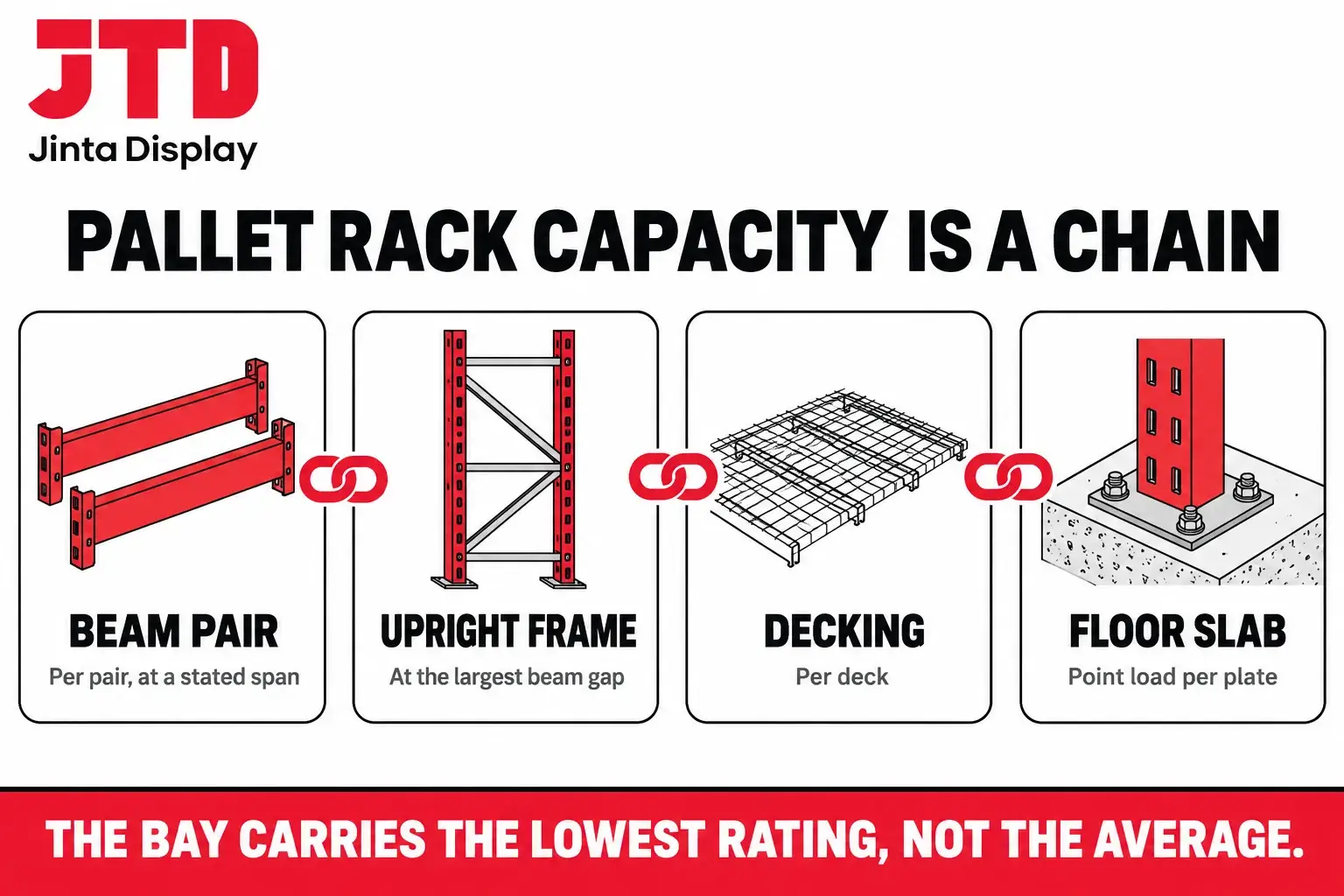
A selective bay is two upright frames with pairs of beams spanning between them. Each element is rated separately, and by a different mechanism.
Beam pair capacity is the load one pair of beams, front and back, can carry at a single level. It is almost always published per pair and not per beam, and that is the most common misreading of a capacity chart. A pair rated at 2,000 kg holds 2,000 kg of pallets at that level and not 4,000 kg. The governing failure is usually deflection and not fracture, because the beam bends further than the design standard allows long before the steel yields.
Upright frame capacity is the total load one frame can carry, added up over every level it supports. A frame in a continuous run carries about one bay’s worth of load, because it takes half of the bay on each side. Frame capacity is a column-buckling problem and is dominated by how far apart the beams are.
Level support capacity is the decking or pallet supports resting on the beams. Wire mesh decking, bar grating and channel pallet supports each carry their own rating, and it is often the lowest of the three when the rack holds anything smaller than a full pallet.
The bay behaves like a chain, and the usable capacity is the weakest link at that level, whichever element it is. A generous rating on one element buys nothing if another is the constraint, and buyers who specify heavy beams and accept light frames end up paying for steel they cannot load.
Pallet Rack Load Capacity and Weight Capacity Are the Same Question
Buyers search under several names. Pallet rack load capacity, pallet racking weight capacity and pallet rack capacity chart all point at the same set of ratings, and a good supplier answers all of them with one document, a table of rated load by section, thickness and span for the bay in question. If a quotation offers a single pallet rack capacity figure with no table behind it, treat it as incomplete.
What Decides Beam Capacity
Four variables set the rating of a beam pair, and they interact.
Section depth. Depth is the dominant term. Bending stiffness grows roughly with the cube of the section depth, and a 120 mm deep beam is up to about 70% stiffer than a 100 mm beam of the same thickness, since 1.2 cubed is 1.73. Our beams are 100 × 50 mm in 1.5 to 2.5 mm steel and 120 × 50 mm in 1.5 to 2.0 mm steel. Depth is usually the cheapest capacity on the rack, because it adds less steel than the capacity it buys.
Steel thickness and grade. A thicker wall adds capacity in proportion to the added steel, and a higher grade adds strength but little stiffness. Because deflection usually governs, a thicker wall is more useful than a stronger grade on a long beam.
Beam length, the unsupported span. This is the variable that surprises buyers. For a given total load, the bending moment grows in proportion to the span, and a longer beam carries less. When deflection governs, the effect is stronger, because deflection grows with the cube of the span for a given total load and the allowable load drops with the square. Every extra pallet position squeezed into a bay costs capacity at that level.
The deflection limit. Beam ratings in the North American market follow ANSI MH16.1, the rack design specification published through the Rack Manufacturers Institute, limits deflection under rated load to one 180th of the span. On a 2,700 mm beam that is 15 mm, and on a 2,000 mm beam about 11 mm. A visibly bowed beam is often far from failing, and it is simply loaded past the serviceability limit the rating was written to. When you compare charts, confirm both used the same limit, because a chart written to a looser limit looks stronger on identical steel.
How span changes the rating
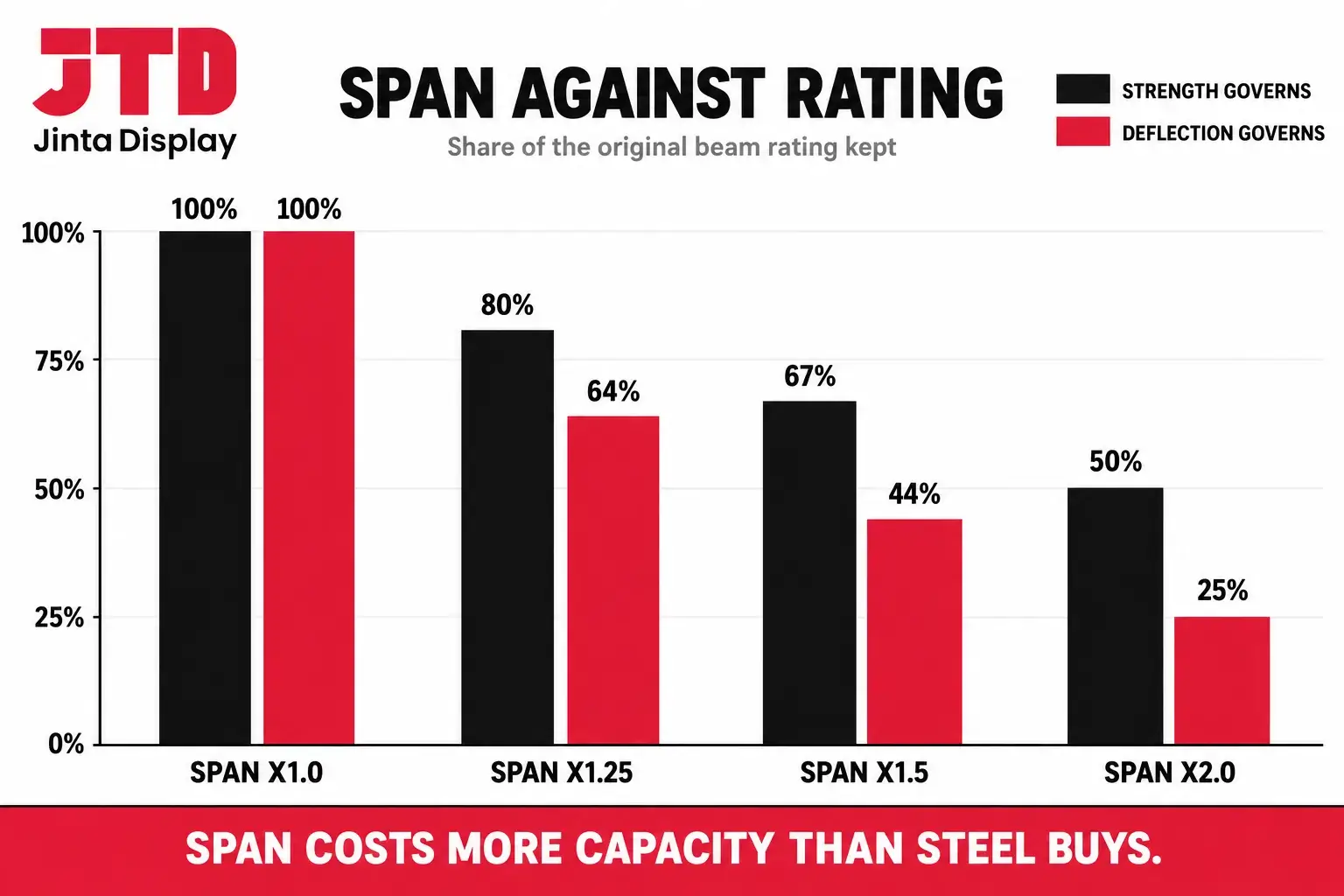
The effect of span can be shown as a ratio without knowing any section data. The table gives the share of the original rating a beam keeps when the span grows, in the two cases that bound the answer.
| Span relative to the original | Rating kept if strength governs | Rating kept if deflection governs |
|---|---|---|
| 1.0 times | 100% | 100% |
| 1.25 times | 80% | 64% |
| 1.5 times | 67% | 44% |
| 2.0 times | 50% | 25% |
Read it against our own bays. Going from a 2,000 mm bay to a 2,700 mm bay is a span 1.35 times as long, and the same beam keeps between roughly 74% and 55% of its rating. A real beam lands between the two columns, depending on which limit governs. The practical lesson is that span costs more capacity than steel thickness buys. If a bay is short of capacity, a shorter beam or a deeper section is nearly always cheaper than thickening the wall.
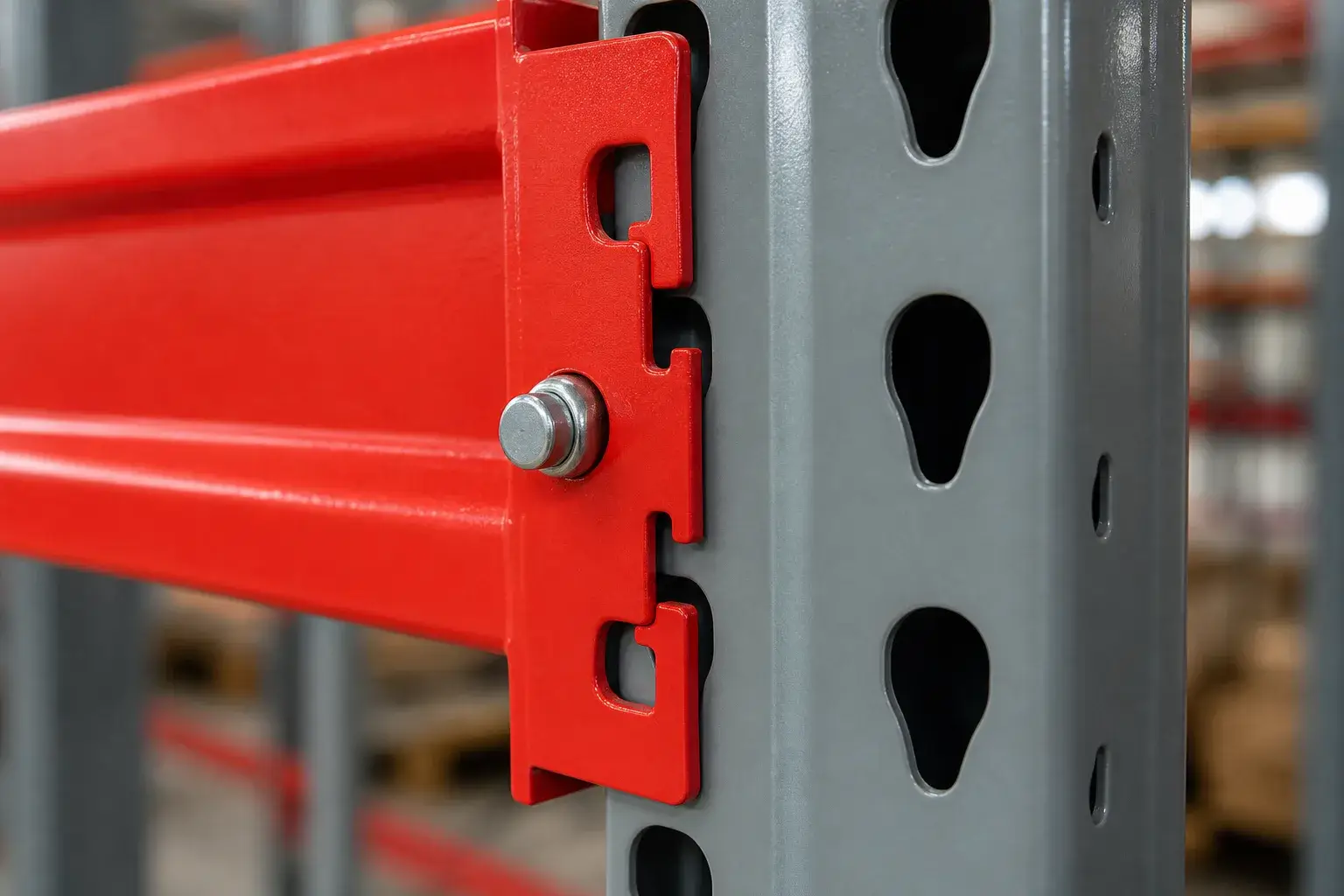
One component sits between the beam and the frame and has its own rating, the end connector. Teardrop and keyhole connectors pass the beam load into the column through a few stamped tabs, and the shear rating of the connector can be the limit on a heavy short beam. The safety pin earns its place here. It stops the connector lifting out of the column under an upward knock, a different job from carrying load.
What Decides Upright Frame Capacity
A frame is two columns joined by diagonal and horizontal bracing. Loaded, it behaves as a braced column, and capacity is set by how much unbraced length sits between points that hold the column straight.
Vertical beam spacing is the largest single lever on the whole rack. Each beam level braces the column at its height. The critical length is the largest gap between two adjacent levels, usually the bottom one between the floor and the first beam. In the elastic range a column’s buckling load falls with the square of its unbraced length. Real columns lose a little less than that, but doubling the gap can remove half the capacity or more. Nothing about the steel changed. This is why a frame rating is meaningless without the spacing it was calculated at, and why a taller bottom level for oversized loads silently derates the whole frame above it.
Column section and thickness. Our uprights are 80 × 60 mm in 1.5 to 2.3 mm steel or 90 × 70 mm in 1.8 to 2.2 mm steel. A deeper section and a thicker wall both raise the rating at a given spacing.
Frame depth. Frame depths of 1,000, 1,100 and 1,200 mm in our range are chosen from the pallet and not from capacity. Depth adds stability, but it is set by the pallet and is not a capacity dial. The sizing is covered in our guide to pallet rack dimensions.
Bracing pattern. Tighter bracing on tall frames restrains the column more often. It is what holds the rating up as height grows.
Base plate and anchoring. The base plate spreads column load into the slab and, with anchors, resists overturning. Ratings assume the frame is anchored as specified, and an unanchored frame is outside the condition the rating was derived under.
The floor is part of the system. Frame capacity assumes a slab that can take the point load under each base plate. A loaded frame concentrates its load into two small footprints. Slab thickness, sub-base and joint positions belong in the conversation before the frame thickness does, and they are the one part of the structure a rack supplier cannot supply.
How the Ratings of Our Own Bays Line Up
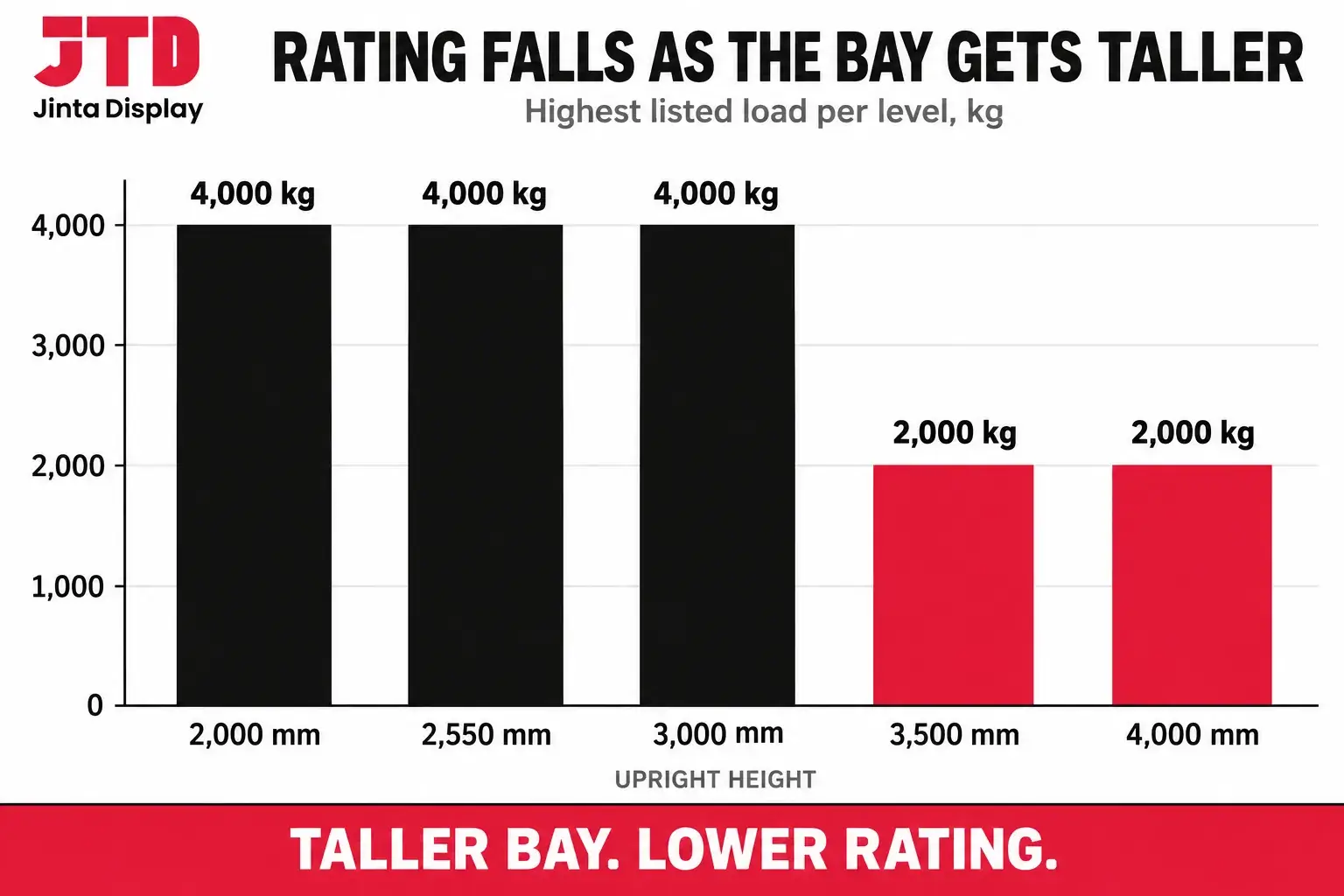
The clearest illustration of the frame effect is in our own product pages. Each lists a rated load per level for the bay, and the ratings track height in the direction the mechanics predict.
| Bay (W × D × H, mm) | Rated load per level | In pounds |
|---|---|---|
| 2500 × 1200 × 2000 | 1,000 to 4,000 kg | 2,205 to 8,818 lb |
| 2500 × 1000 × 2000 | 1,000 to 3,000 kg | 2,205 to 6,614 lb |
| 2500 × 1000 × 2550 | 1,000 to 4,000 kg | 2,205 to 8,818 lb |
| 2700 × 1000 × 3000 | 1,000 to 4,000 kg | 2,205 to 8,818 lb |
| 2000 × 1000 × 3500 | 1,000 to 2,000 kg | 2,205 to 4,409 lb |
| 2500 × 1100 × 4000 | 1,000 to 2,000 kg | 2,205 to 4,409 lb |
| 2000 × 600 × 2000 | 1,000 to 4,000 kg | 2,205 to 8,818 lb |
| 1000 × 400 × 2000 | 1,000 to 2,000 kg | 2,205 to 4,409 lb |
Three things are worth reading from it. The bays at 3,500 and 4,000 mm are listed up to 2,000 kg per level, and the bays at 2,000 to 3,000 mm go up to 4,000 kg. That matches the fall in frame capacity as the height and the beam gaps grow. A deeper 1,200 mm frame is listed higher than a 1,000 mm frame at the same height. And a wide 2,700 mm bay can still reach 4,000 kg, because a heavier section carries the longer span.
Each row is a range because the low end is a lighter section and the high end a heavier one. The figure that belongs to your configuration is the one confirmed on the drawing for the exact beam, thickness and spacing. Confirm too that the figure is per level, per pair of beams and uniformly distributed, and ask for the load table that goes with the drawing. The 3000 mm heavy duty warehouse rack page lists the sections for one of these bays.
The Third Rating, Decking and Level Supports
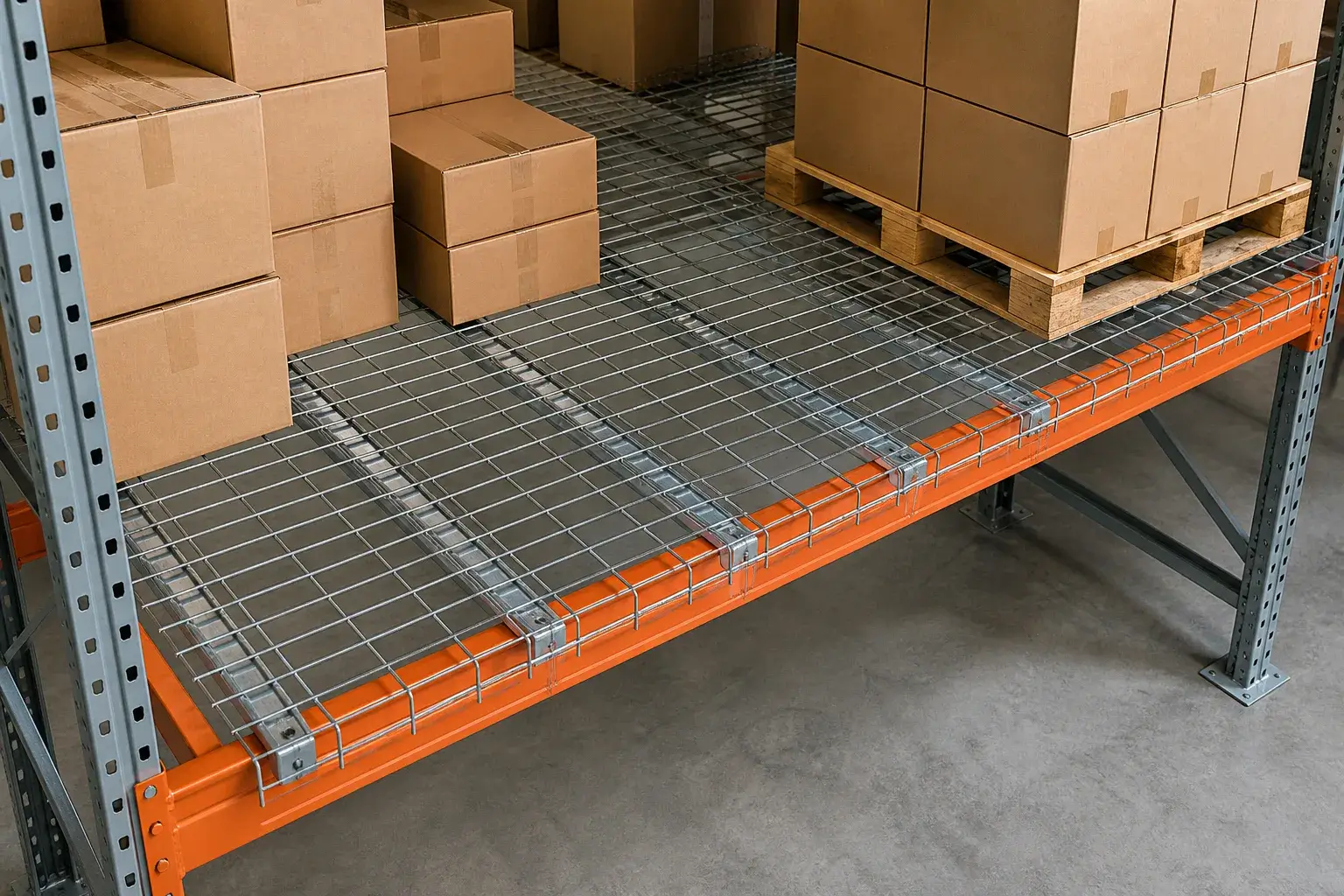
Beams alone support pallets that bridge front to back. Anything else needs a deck, and the deck has its own rating.
Wire mesh decking, bar grating and flared-channel decks are each rated per deck as a uniformly distributed load. A typical bay takes two or three decks per level, and the decked capacity of a level can land below the beam pair rating. When a rack holds cartons, totes or mixed case picking and not full pallets, the deck is usually the limit that governs. Ask for the deck rating separately and compare it with the beam rating at that level, because the lower of the two is the real capacity of the level, and write both numbers on the drawing.
Channel or tube pallet supports running front to back under the pallet are the alternative where a full deck is not wanted. They add support for damaged or undersized pallets and cost less than decking, but they do not make a level suitable for loose cartons.
How to Read a Pallet Rack Capacity Chart and a Load Plaque
A pallet rack capacity chart is a manufacturer’s table of ratings by section, thickness and span. A load plaque is the sign fixed to an installed rack that states the ratings for that configuration. They answer different questions, and both are often misread.
On a chart, check five things before reading a number. Is the beam figure per pair or per beam? What deflection limit was used? Is the load uniformly distributed? What vertical spacing does the frame figure assume? And is the figure an allowable load or a failure load? An allowable rating already includes a safety factor, and a failure rating does not. The two are not comparable, and only the allowable one belongs in your planning.
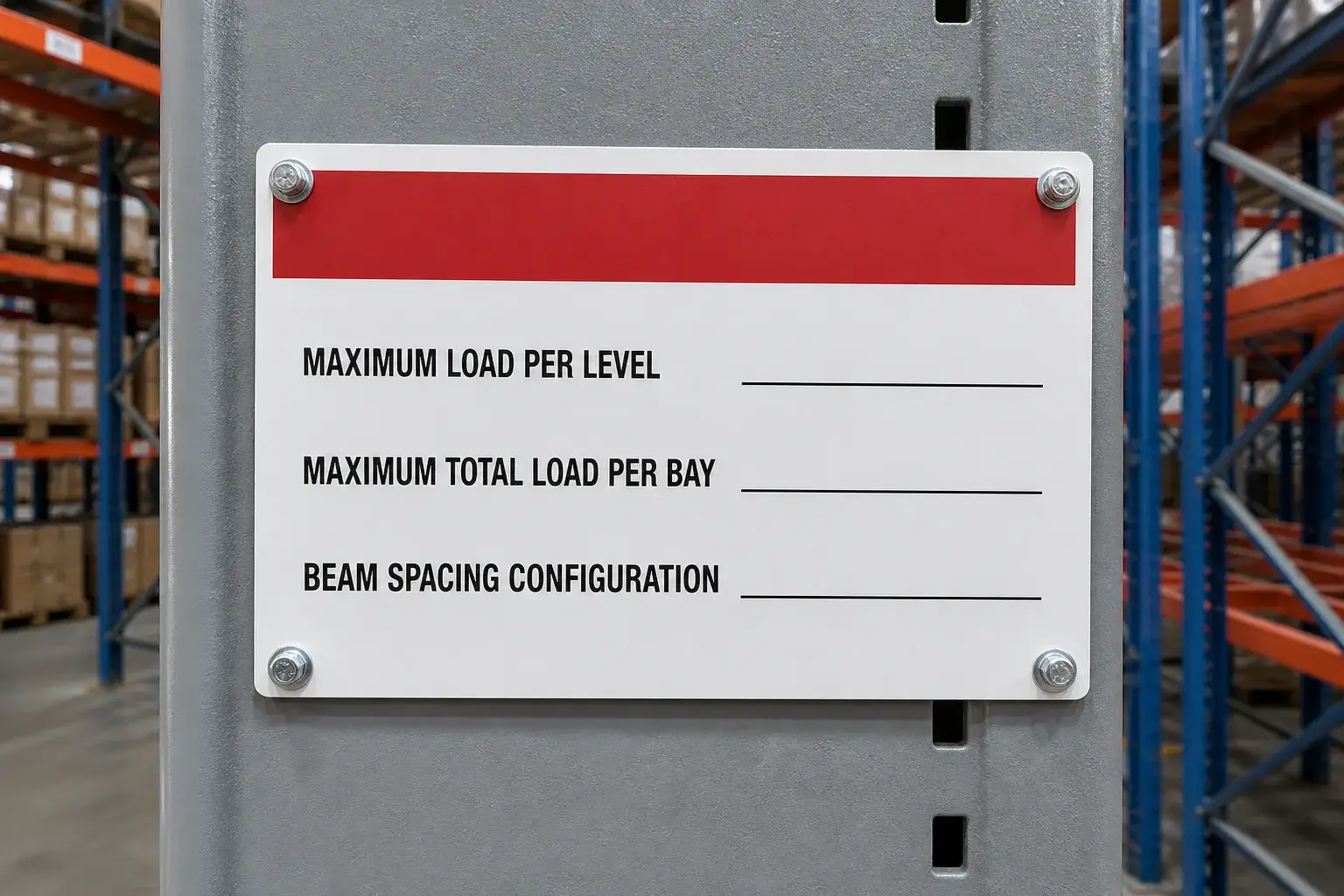
A rack load plaque should state four things. They are the maximum load per beam level, the maximum total load per bay, the beam spacing the ratings assume, and the manufacturer and date. If a plaque gives a single number with no configuration attached, it describes an assumption someone made and not your rack.
The configuration line matters most over time. Beam levels get moved when a warehouse changes its product mix, and a level lifted to fit taller cartons changes the largest gap, and the frame rating on the plaque no longer applies to the rack it is fixed to. Re-rating a changed rack is a calculation and not an estimate, and it goes back to the manufacturer or a qualified engineer.
What a Published Rating Assumes About Your Load
Every capacity figure is derived under load conditions. Depart from them and the number no longer applies, even though the rack is unchanged.
The load is uniformly distributed. Ratings assume weight spread along the beam. Two pallets side by side approximate that well. A single dense item at mid-span does not, and concentrated loads need the manufacturer’s separate point-load figures.
Pallets bridge the beams properly. A standard GMA pallet has stringers running in the 48 in direction and must be placed so they cross both beams. Turn it 90 degrees and the deck boards carry the load into the beams, a different structural path and a common reason pallets fail on a rack that is within its rating.
The load is static. Published capacities are for stored load and not for the shock of placement. A forklift setting a pallet down hard applies a force above its static weight, one reason ratings carry a safety factor.
Nothing overhangs beyond the design. Front to back overhang of a few inches is normal and accounted for. Larger overhangs move the load off the beams and change the calculation.
Seismic conditions were specified. In seismic zones, frames, base plates and anchors are engineered for lateral force as well as vertical load, and the specification can differ from the same nominal capacity elsewhere. State it when you order, because it cannot be added later without recalculation.
A Worked Example, Checking a Bay Against the Load
To check pallet rack capacity for a real bay, take a store of pallets that weigh up to 1,000 kg each, loaded two to a level on a bay with three beam levels above a floor position. The first beam is at 1,200 mm and the beams are 1,200 mm apart.
Start with the beam pair. Two pallets at 1,000 kg is 2,000 kg per level. Each level needs a beam pair rated at 2,000 kg or more, at the actual span of the bay and not at a shorter one. If the bay is 2,700 mm wide, ask for the pair rating at 2,700 mm.
Next the frame. Three beam levels at 2,000 kg each is 6,000 kg per bay. A frame in a continuous run takes about one bay’s load. The frame must carry about 6,000 kg, at a largest beam gap of 1,200 mm, the spacing to quote. The floor position takes its load straight into the slab and not through the frame.
Last the deck and the floor. If the level carries full pallets on the beams, no deck is needed. If cartons go on a deck, the deck rating replaces 2,000 kg as the limit for that level. The slab must take the point load under each base plate. The bay passes only if all four checks pass, and the weakest sets the answer.
Specifying Pallet Rack Capacity When You Order
A supplier can only calculate pallet rack capacity from what the buyer supplies. Six inputs settle almost every configuration.
The heaviest unit load you will store and its dimensions, including the pallet type. The number of pallet positions per level, fixing the beam length. The clear height needed at each level, fixing the beam spacing and the frame rating. The total frame height and the clearance under the roof. Whether levels will hold full pallets, cartons or both, which decides the decking. And your seismic category and slab specification, which decide base plates and anchors.
Send those six and a manufacturer can return a bay drawing with the beam section, the upright thickness, the spacing and a rated load per level, a document you can compare against another quotation. Send only a bay height and a pallet count and you get a price and not a specification, which is where most capacity disappointments begin.
We manufacture selective pallet racking and warehouse rack systems in Changshu, together with boltless rivet shelving for hand-loaded storage and cantilever racking for long material. The type choice is covered in our guide to warehouse racking types, and the cost structure in our guide to warehouse racking cost. For the design rules behind most North American ratings, the Rack Manufacturers Institute publishes ANSI MH16.1, and it is worth confirming which standard any supplier’s chart follows before you compare two of them.
If you want capacity checked for a specific bay, send us your heaviest pallet, pallets per level, clear height and seismic category and we will reply with a bay drawing and the rated load. The seismic category matters because it changes the load that the frames and beams must be rated for, so tell us if the site is in a seismic zone.
Frequently Asked Questions
How much weight can a warehouse rack hold?
It depends on the configuration. Our beam racking is rated from 1,000 to 4,000 kg (2,205 to 8,818 lb) per level, with the taller bays at the lower end, and the frame carries the sum of its levels. The figure that applies to a rack is on its load plaque, because it depends on the beam length, section and the beam spacing.
Is pallet rack beam capacity per beam or per pair?
Per pair in virtually every published chart. A rating of 2,000 kg means the front and back beams together carry 2,000 kg at that level. Treating it as per beam and loading 4,000 kg is a 100% overload, and it is the most frequent misreading of a capacity chart.
How do I calculate the pallet rack capacity I need?
Multiply the heaviest pallet by the pallets per level and specify a beam pair rated at or above that at your span. Multiply by the number of levels for the frame load and check it against the frame rating at your largest beam gap. Both checks must pass, and the beam check alone is not enough.
Why does pallet rack capacity change with bay width?
Pallet rack capacity depends on span. For a given total load, a beam keeps about 80% of its strength rating at 1.25 times the span and about 67% at 1.5 times. When deflection governs, it keeps about 64% and 44%. Longer beams in wider bays therefore lose capacity quickly.
Does raising a beam level reduce capacity?
It reduces frame capacity. The frame rating is set by the largest gap between levels, and widening any gap derates the whole frame, and doubling the gap can remove half the rating or more. The beams are unaffected. A reconfigured rack needs its frame rating recalculated and its plaque updated.
What capacity does wire mesh decking add?
Decking adds no capacity. It sets a limit of its own. Each deck is rated per deck as a uniformly distributed load, and a bay takes several, and the decked capacity of a level can fall below the beam pair rating. On carton picking levels the deck often governs. Ask for its rating separately.
Can I increase the capacity of racking I already own?
Within limits. A shorter beam from an added frame line, tighter beam spacing and correct anchoring all raise usable capacity. Heavier beams help only if the frame and connector can take the load. Each of these changes a rated configuration. The new rating must come from the manufacturer or a qualified engineer.
What information does a supplier need to quote the right capacity?
The heaviest unit load and pallet size, pallet positions per level, clear height at each level, total frame height, whether levels carry pallets or cartons, and your seismic category and slab details. Send those six items and the reply should be a bay drawing with rated loads, not a price with a capacity claim attached.