
Pallet racking is the standard way to store palletized goods in a warehouse. Instead of stacking pallets on top of each other on the floor, a rack holds each pallet on its own level, so any pallet can be reached without moving another and the building height does the work that floor area would otherwise do. Walk into almost any distribution center, factory store or retail back room and you will see it.
This guide explains what pallet racking is for a buyer who is new to it. It names the parts, shows how a bay is built and measured, compares it with shelving, and gives a short tour of the types. It then covers the space it needs, anchoring and what to specify when you ask for a quotation. It is written from the manufacturing side. Figures for our own racking come from our product pages and are marked as ours.
It does not cover inspection routines, operating rules or the regulations that apply to a site, which are set where the rack stands and by the people who install and examine it. Those questions belong to your engineer and your safety authority, and a factory cannot answer them for you.
What Is Pallet Racking, in Plain Terms
Pallet racking is a structure made of upright frames and horizontal beams that forms shelf levels for pallets. A forklift lifts a loaded pallet to the right level and sets it onto a pair of beams, and the pair carries the load. Because the beams hook into the frames at adjustable heights, the levels can be moved up or down to suit the goods.
Searches for what are pallet racks and what is racking lead to the same answer. The purpose is to use height. A warehouse with a floor area of a given size can store several times more pallets in racking than on the floor, because pallets sit on many levels. The racking also protects goods. A pallet on the floor under three others carries their weight, and the bottom pallet is crushed or damaged. In a rack, each pallet carries only itself.
The second benefit is access. When pallets are stacked on the floor, the one you want is often underneath. In a rack, every pallet in a selective system has its own position, and a forklift can place or remove it directly. This is why pallet racking is the default for mixed stock, where many different products must be available at any time.
Pallet Racking vs Shelving
Buyers often ask what separates pallet racking from industrial shelving, and the answer is in what each is built to carry and how it is reached.
| Point | Pallet racking | Industrial shelving |
|---|---|---|
| Built to carry | Loaded pallets | Cartons, totes and loose items |
| Loaded by | Forklift or pallet truck | Hand, often from an aisle |
| Depth | 1,000 mm or more, set by the pallet | 400 to 600 mm, set by reach |
| Load per level | Hundreds to thousands of kilograms | Tens to a few hundred kilograms |
| Aisle width | Set by the truck, 2.6 to 4.3 m typical | A person or a cart, about 1 m |
| Typical height | 2 to 12 m or more | 2 to 3 m |
The two are often used together. Pallets go on racking, and small items picked by hand go on shelving in another part of the building. Choosing the wrong one costs money in either direction. Pallet racking bought for a stock room where nothing arrives on a pallet wastes a meter of depth per run. Light shelving bought for pallets fails under the load. Our boltless shelving and the shelving side of the range are covered in the guide to warehouse racking types.
The Parts of Pallet Racking
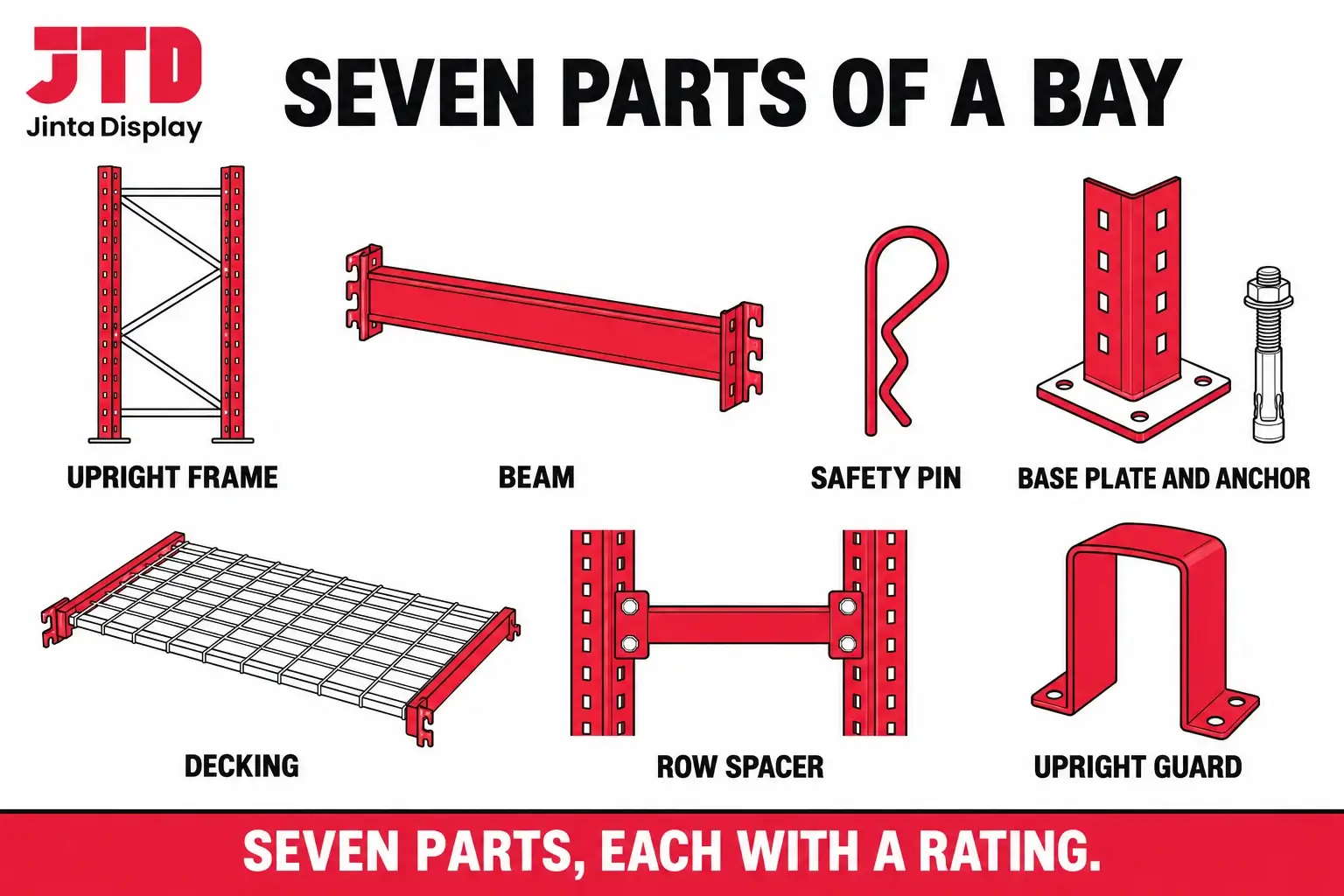
A bay has a short list of parts, and each one has a rating that depends on its section and thickness. Knowing the names makes a quotation easy to read.
| Part | What it does | What to check |
|---|---|---|
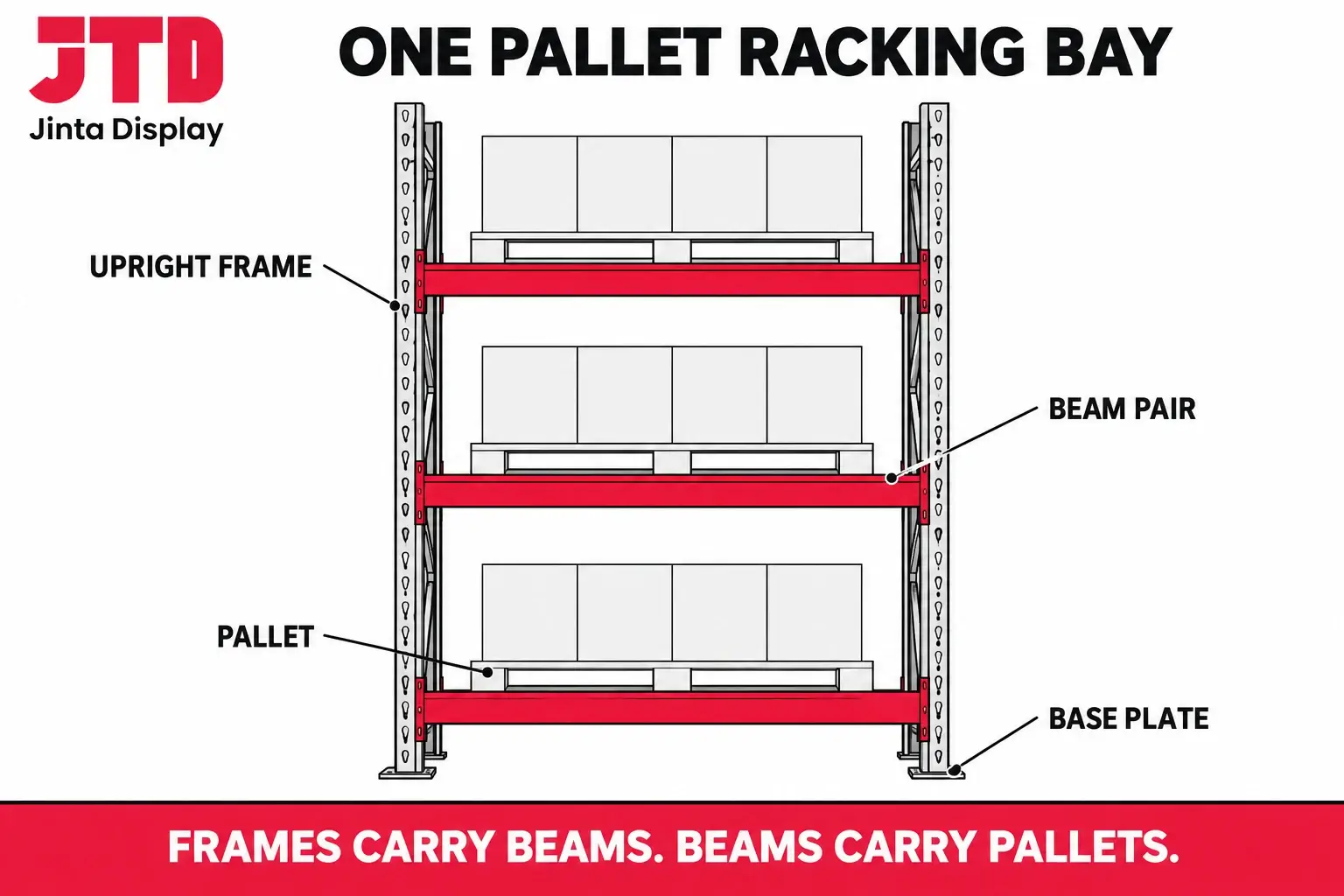
| Upright frame | Two vertical columns joined by bracing, carries the load to the floor | Column section, wall thickness, bracing |
| Beam | Horizontal member that carries the pallets, one at the front and one at the back of each level | Beam section, length, rated load per pair |
| Safety pin | Locks the beam to the upright so a bump cannot lift it out | Fitted at every connection |
| Base plate and anchor | Spreads the load on the floor and fixes the frame to the slab | Plate size, anchor type, slab quality |
| Decking or pallet support | Wire mesh, steel panel or support bars across the beams for loose goods | Rated load of the decking |
| Row spacer | Ties back-to-back frames at a fixed gap | Gap and fit |
| Upright guard | Protects the base of the frame from forklift impact | Height and fixing |
Our uprights are 80 × 60 mm in 1.5 to 2.3 mm steel or 90 × 70 mm in 1.8 to 2.2 mm steel, roll formed with teardrop slots. Our beams are 100 × 50 mm in 1.5 to 2.5 mm steel or 120 × 50 mm in 1.5 to 2.0 mm steel. The beam hooks into the slot and locks with a pin, and the slots repeat at a fixed pitch, so beam levels move in steps. These are the listed ranges on our heavy duty warehouse rack pages.
How a Bay Is Built and Measured
The basic unit is a bay. A bay is two upright frames with pairs of beams between them. A run is a row of bays that share frames, and two runs back to back with a small gap form a double row. An aisle is the space between rows where the forklift works.
Three numbers describe a bay. The width is the span of the beams, which sets how many pallets sit side by side on one level. The depth is the front-to-back size of the frame, which is set by the pallet. The height is the height of the uprights, which is set by the building and by how many levels you want. A quotation that leaves one of these out cannot be checked.
Our bays run from 2,000 to 2,700 mm wide, from 1,000 to 1,200 mm deep and from 2,000 to 4,000 mm high. A pallet is the one size you do not choose, and the bay is worked backward from it. The calculation, with the gaps and the level pitch, is worked through in the guide to pallet rack dimensions, and the pallet sizes themselves are in the guide to standard pallet sizes.
How Pallet Racking Carries a Load
The load path is simple to describe. A pallet sits on a pair of beams. The beams hand the load to the uprights through their hook connections. The uprights carry it down to the base plates, and the base plates spread it onto the floor. Each stage has its own rating, and the bay can carry only the lowest of them.
That is why a rack is rated in three parts and not as a single number. There is a rating for the beam pair at each level, one for the frame as a whole and one for the decking if it is used. The beam rating falls as the beam gets longer, and the frame rating falls as the vertical gap between levels grows. The detail is in the guide to pallet rack capacity.
The load plaque on the frame states the rated load for the configuration that was supplied. If you change the beam length or the level heights, the rating changes. For a quick sense of the range, our beam racking is listed at 1,000 to 4,000 kg per level, with the taller bays at the lower end of the range.
Types of Pallet Racking
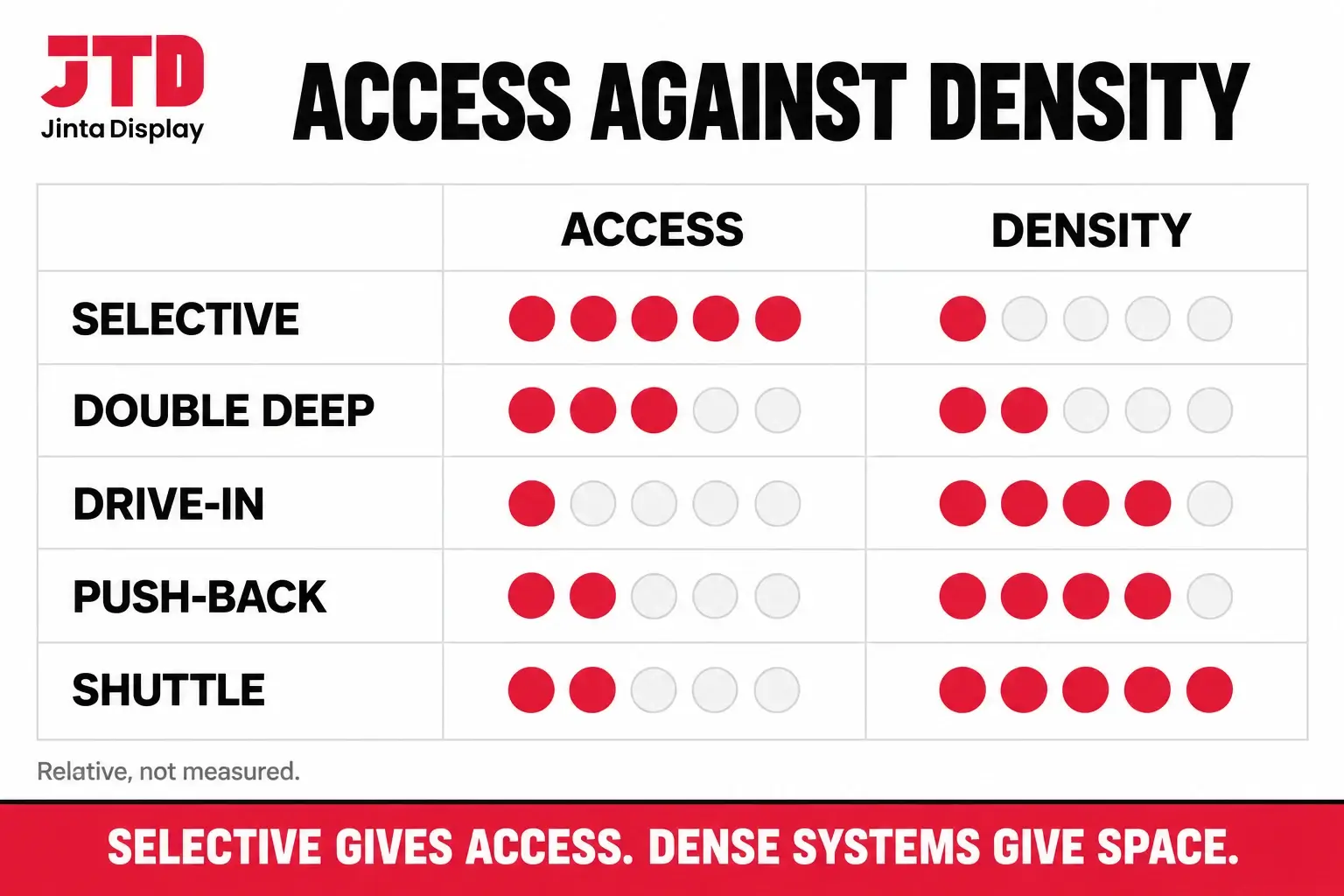
Almost every type of pallet racking trades access against density. Selective racking stores pallets one deep, so every pallet can be reached directly, and it uses the most floor. Dense systems store pallets deeper in lanes, which saves floor and costs access.
| Type | How pallets are stored | Access | Density |
|---|---|---|---|
| Selective | One deep, every pallet reachable from an aisle | Every pallet | Lowest |
| Double deep | Two deep, a reach truck with extended forks | Front pallet only | Higher |
| Drive-in and drive-through | Many deep, the truck drives into the lane | Last in, first out | High |
| Push-back and pallet flow | Pallets roll on inclined rails | Front pallet in each lane | High |
| Shuttle and automated systems | A machine moves pallets in deep lanes | Controlled by software | Highest |
We build selective pallet racking and the other main types of general warehouse storage, which are long span shelving, cantilever racking and boltless rivet shelving. We do not supply the dense systems in the last three rows of the table, and the guide to warehouse racking types says where they belong. Selective racking is the right place to start for most mixed stock, and the other types make sense when the stock profile or the building demands them.
Selective Pallet Racking in More Detail
When people ask what is pallet racking, they usually mean the selective type, and it is worth knowing in detail. A selective pallet racking system is a run of upright frames joined by pairs of beams, with pallets stored one deep and reached from an aisle on one or both sides. Each pallet has its own position, so nothing has to be moved to reach it.
Its strengths are access, flexibility and simplicity. Any pallet can be placed or removed at any time, which suits stock with many different products. The beams can be moved to new heights when the product changes. The parts are standard, so extending a run is easy. Its weakness is density. Aisles take a large share of the floor, and the system uses more floor per pallet than the dense types.
Selective racking is also the base for other systems. A double deep layout uses the same frames with deeper beams, and a push-back or flow system adds rails to a similar frame. Learning how a selective bay works gives you the vocabulary for the rest. The numbers for a bay, from beam length to level pitch, are set out in the guide to pallet rack dimensions.
Where Pallet Racking Is Used
Pallet racking appears wherever palletized goods are stored. Distribution centers use it for fast access to many products. Factories use it for raw materials and finished goods. Retailers use it in back rooms and in warehouse-style stores. Food and drink businesses use it in dry stores, and cold stores use special versions. Anywhere a forklift moves a pallet, there is likely to be a rack.
The environment shapes the specification. A rack in a dry warehouse can use a light powder coat finish. A rack in a cold store, a wet area or outdoors needs a different finish and a design that suits the conditions. A rack in an area with earthquake risk needs a design that accounts for it. Tell the supplier the site, the climate and the seismic category in the first message.
Pallet Racking Terms You Will See on a Quotation
A quotation uses a short vocabulary, and the same word can mean slightly different things between suppliers. Anyone asking what is pallet racking soon meets the terms below, and it pays to confirm each one in writing.
Bay and run. A bay is the space between two frames, and a run is a row of bays. Beam pair. Two beams, front and back, that carry a level. The rating is per pair and not per beam. Level pitch. The vertical distance from one beam level to the next, which follows the load height.
Clear opening. The space between two uprights. Pallets must fit in this opening with gaps, and it is smaller than the quoted bay width by the width of an upright. Load plaque. A label on the frame that states the rated load for the configuration. Decking. The mesh or panel laid across the beams for loose goods. Row spacer. The tie that fixes the gap between back-to-back frames.
Ask the supplier to define any term you do not recognize, and ask for the rating of the beam pair at the span you are buying. Most misunderstandings come from the rating being per pair, the width being the quoted bay and not the clear opening, or the load being given for a different configuration from the one supplied.
How Much Space Pallet Racking Needs
The rack is only half of the footprint. The aisle is the other half, and it comes from the truck. A counterbalance forklift commonly needs about 3,200 to 4,300 mm of clear aisle, and a reach truck about 2,600 to 3,000 mm, as typical industry ranges that vary by model. Narrow aisle trucks need less, at the cost of a different machine.
For back-to-back rows, add two frame depths and a row spacer. With two 1,100 mm frames, a 150 mm spacer and a 3,300 mm aisle, one module is 5,650 mm wide. A change of frame depth of 100 mm changes the module by 200 mm, and the frame depth has a bigger effect on floor area than most buyers expect. Because aisles often take a third to more than half of the floor, the choice of truck is also a choice of building footprint.
Height matters too. A taller rack stores more per square meter, but it needs a truck that can reach, a roof clear of sprinklers and lighting, and a floor that can carry the load. Check the clear height of the building to the lowest obstruction before you fix the upright height.
Pallet Racking for a Small Business or a Retail Back Room
Pallet racking is not only for large distribution centers. A small business with a few dozen pallets can use a single run of racking along a wall, and a retailer with a stock room can use it for bulk goods that arrive on pallets. The principle is the same, and the main difference is scale and truck type. A small site may use a hand pallet truck or a small stacker and a lower rack.
Match the rack to the equipment. A low rack of two or three levels suits a pallet truck and a stacker. A taller rack needs a forklift or a reach truck, and the aisle must suit it. Do not buy a rack taller than your truck can reach, and do not buy a truck for a rack you can manage without. For a store, the rack should sit where pallets can arrive and be moved without crossing the sales floor.
Small sites are also where mixed storage is most useful. Pallets go on the racking, and loose goods go on shelving beside it. A back room that holds both needs two aisles and two kinds of fixture, and the plan should show them together. The order of purchase and the way the fixtures fit each other are covered in the supermarket equipment list.
Does Pallet Racking Need to Be Bolted to the Floor
This is one of the most common questions, and the answer is normally yes. Base plates are usually anchored to the slab with expanding bolts or similar fixings. The anchors keep the frame from tipping or shifting when it is bumped, and they spread the load into the concrete.
The exact requirement depends on the rack design, the load, the height, the floor and the local rules. Some low racks are used unanchored in certain settings, and some sites require anchoring at every frame. The concrete matters as much as the anchor, since a weak slab cannot hold a bolt. The decision belongs to your engineer, and a supplier needs the slab details to size the anchor. The Rack Manufacturers Institute publishes industry information, and your local rules set the legal position.
Regulations, Inspection and Safe Use
Most countries expect racking to be designed to a recognized standard, installed correctly, marked with its load rating and examined from time to time. The details differ by country, and they cover areas such as load plaques, damage checks and who may do the examination. We do not give compliance advice. For the United States the Rack Manufacturers Institute is a starting point, and for other places your national standards body and safety regulator are the authority.
Some habits are good practice anywhere. Do not overload a level past its plaque. Set pallets centered on the beams. Replace any damaged upright or beam instead of straightening it. Keep the load plaque legible. Report any impact, however small, because damage that looks minor can reduce capacity.
Common Mistakes When First Buying a Pallet Racking System
Buyers new to racking make a small set of mistakes, and most are easy to avoid. The first is sizing the frame to the pallet exactly, which leaves no overhang or margin. The second is forgetting the gaps between pallets and uprights, so the pallets do not fit. The third is estimating the load height instead of measuring real pallets, because a few extra millimeters can cost a whole level in a tall bay.
A fourth is reading the quoted width as the clear opening. A fifth is buying for the heaviest pallet in the building at every level, which pays for steel that most positions never use. A sixth is ignoring the floor, since a weak slab can limit the load whatever the rack is rated for. A seventh is leaving the aisle until last, which leaves too little room for the truck.
A pallet racking system is a small structure that has to work with a truck, a building and a stock profile. Treat it as a system and not as a list of parts, and give the supplier the full picture. A supplier who asks questions about your pallets and your truck is working on your problem and not on a catalog line.
What to Specify When You Buy Pallet Racking
A supplier can design a bay when the brief names the pallet size and type, the loaded height and weight, and how many pallets sit on each level. Add the clear height of the building, the positions of any sprinklers or lights, and the truck type with its aisle requirement. Give the number of pallet positions you need, the finish and the color. Say where the site is, and give the floor details and the seismic category.
With those items, the supplier can send a bay drawing that you can check against the sums in this guide. Compare quotations by the specification and not by the price. A rack with thinner steel or a longer beam at the same price is carrying less, and the difference does not show on arrival. The cost structure is explained in the guide to warehouse racking cost.
New racking suits a planned layout and a known load. Used racking can save money on the capital line, but the connection profiles are proprietary, and available lots decide your bay sizes. Used works best for a known quantity of a common configuration needed quickly, and the rating of used racking should be confirmed before it is loaded.
If you are planning a store, send us your pallet size, loaded height and clear height and we will reply with a suggested bay and a quotation. The full range is under our warehouse racking category.
Frequently Asked Questions
What is pallet racking?
Pallet racking is a storage system of upright frames and horizontal beams that holds palletized goods in rows on several levels. A forklift places each pallet on a pair of beams. It uses building height, protects goods from crushing and, in selective systems, gives access to every pallet.
What is the difference between pallet racking and shelving?
Pallet racking is built for loaded pallets handled by forklift, is 1,000 mm or more deep and carries hundreds to thousands of kilograms per level. Industrial shelving holds cartons and loose items, is 400 to 600 mm deep, is loaded by hand and carries far less. Many sites use both in different areas.
What are the parts of pallet racking?
The main parts are upright frames, beams, safety pins, base plates with anchors, decking or pallet supports, row spacers and upright guards. The frames and beams carry the load, the pins lock the beams in place, and the plates fix the frame to the floor. Each part has its own rating.
Does pallet racking need to be bolted to the floor?
Normally yes. Base plates are anchored to the slab so the frame cannot tip or shift when it is bumped. The exact requirement depends on the design, the height, the load, the floor and local rules. Your engineer decides, and the supplier needs the slab details.
How much weight can pallet racking hold?
It depends on the configuration. Each bay has ratings for the beam pair, the frame and any decking, and it carries the lowest. Our beam racking is listed at 1,000 to 4,000 kg per level. The rating on the load plaque for your configuration is the one that applies.
What types of pallet racking are there?
The main types are selective, double deep, drive-in and drive-through, push-back, pallet flow, and shuttle or automated systems. Selective stores one deep and gives access to every pallet. The others trade access for density. We build selective racking and the other main general warehouse types, and not the dense systems.
What does racking mean in a warehouse?
If you ask what is racking, the short answer is this. Racking means the steel structure that holds stored goods on levels. In a warehouse it usually means pallet racking, but it can also mean long span shelving or cantilever racking for long goods. The word is more common in the UK and Australia, where a rack is also called a racking system.
What size is a pallet rack?
Size is set by the pallet. Our bays are 2,000 to 2,700 mm wide, 1,000 to 1,200 mm deep and 2,000 to 4,000 mm high. Width follows from the pallets per level plus gaps, depth is a little less than the pallet, and height follows from the building and the number of levels.