
If you search for pallet rack dimensions you will find a standard bay quoted in inches, a table of upright sizes and a chart of beam lengths. They are all correct, and none of them tells you what to order. The reason is that a pallet rack is not sized from a catalog. It is sized backward from the pallet, the load height, the building and the truck, and the standard sizes in a catalog are simply the common answers to that calculation.
This guide shows the calculation. It starts from the pallet, derives frame depth, bay width and level pitch, then covers upright and beam sections, aisle width and clearances. It ends with a worked example. The dimensions we quote for our own bays come from our product pages. Load ratings are a separate subject, covered in our guide to pallet rack capacity, and this guide does not repeat them.
The Six Pallet Rack Dimensions That Define a Bay
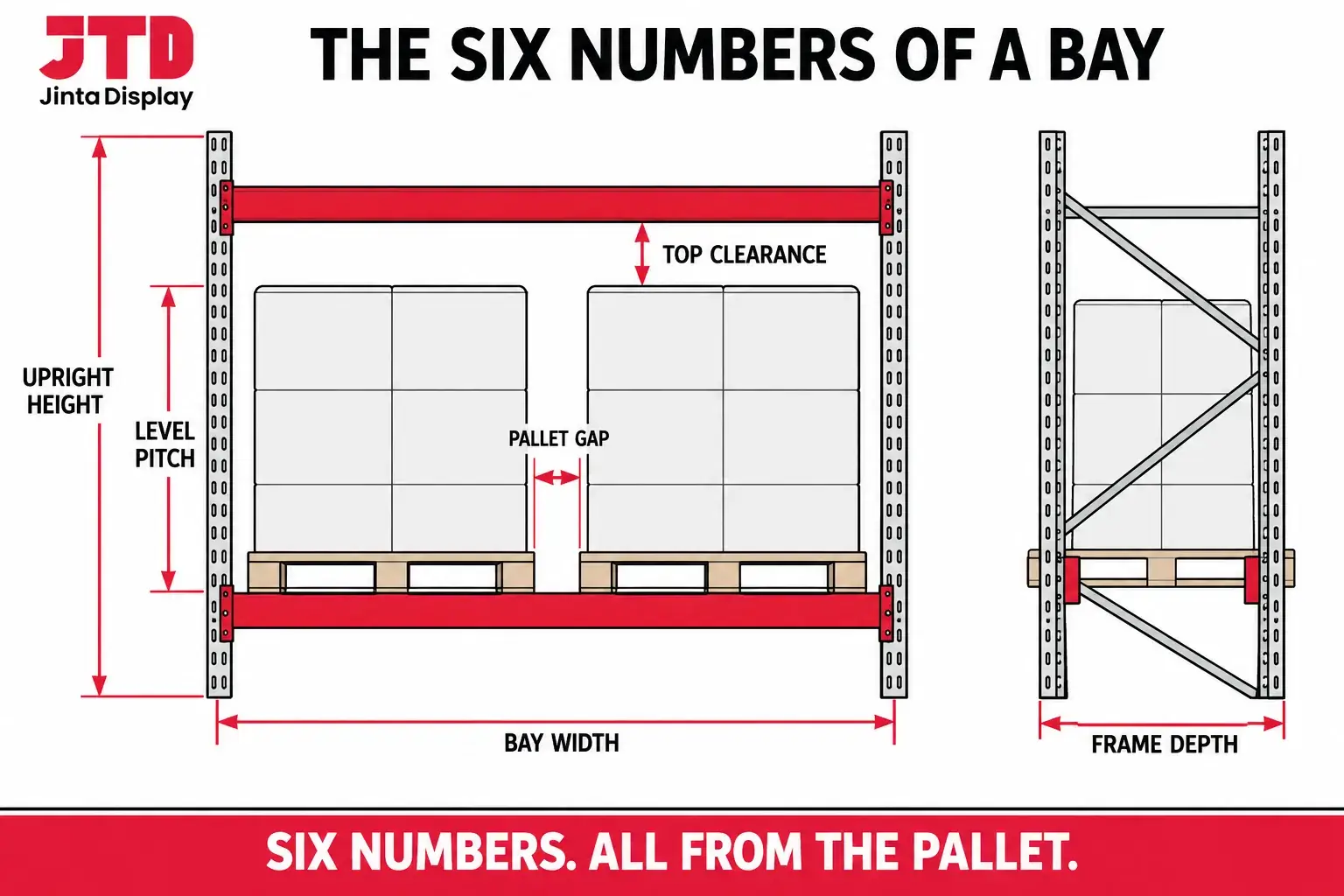
Every bay is fully described by six numbers, and a quotation that leaves one out cannot be checked.
Bay width. The horizontal span, set by the beam length and decided by how many pallets sit side by side on one level. Confirm whether a quoted width is the beam length or the overall bay width including the upright, because the two differ by the width of one upright.
Frame depth. The front to back dimension of the upright frame. It sets how far the pallet reaches into the rack.
Upright height. The height of the frame. It decides how many levels fit and is capped by your clear height.
Level pitch. The vertical distance from one beam level to the next. It follows the height of the load.
Top clearance. The gap between the top of the highest load and whatever sits above it, whether the top of the frame or a sprinkler, a light or the roof.
Pallet gaps. The space between pallets and between a pallet and an upright. It is small and easy to forget, and it is the reason a bay is wider than the pallets alone.
Start From the Pallet
The pallet is the one dimension you do not choose. Write it down first. Several pallets are in common use.
| Pallet | Size (mm) | Size (in) | Where it is common |
|---|---|---|---|
| GMA pallet | 1,219 × 1,016 | 48 × 40 | United States and Canada |
| Euro pallet | 1,200 × 800 | 47.2 × 31.5 | Europe, and widely in export cargo |
| UK standard pallet | 1,200 × 1,000 | 47.2 × 39.4 | United Kingdom and Ireland |
| Australian standard pallet | 1,165 × 1,165 | 45.9 × 45.9 | Australia and New Zealand |
Two more numbers matter as much as the footprint. The first is the height of the loaded pallet, and it sets the level pitch. The second is which way you load it. A rectangular pallet can enter the rack on its long side or its short side, and that choice changes both the frame depth and the number of pallets per level. It is a decision to make deliberately and not an accident of how the first pallet was put away.
Frame Depth, and How Far the Pallet Overhangs
Of all the pallet rack dimensions, frame depth is the one most often wrong. Frame depth is normally set a little shallower than the pallet, so the pallet overhangs the front and rear beams. This is intentional, since a pallet bears on its stringers or blocks and not on its deck boards, and the overhang gives a margin for imprecise placement. A common rule is a frame depth 100 to 150 mm, about 4 to 6 in, less than the depth of the pallet, leaving 50 to 75 mm of overhang each side.
Apply the rule to each pallet loaded its long side deep. A GMA pallet loaded 1,219 mm deep suits frames of about 1,070 to 1,120 mm. A Euro pallet loaded 1,200 mm deep suits about 1,050 to 1,100 mm, and so does a UK pallet loaded 1,200 mm deep. Pallets loaded their short side deep need shallower frames of about 870 to 920 mm for 1,016 mm and 850 to 900 mm for 1,000 mm.
Our frame depths are 1,000, 1,100 and 1,200 mm, with custom sizes on request. The 1,100 mm frame, as on our 2500 × 1100 × 4000 medium duty storage rack, is the match for a pallet loaded 1,200 mm deep. The 1,000 mm frame, as on our 3000 mm heavy duty warehouse rack, takes the same pallet with about 100 mm of overhang each side. That is at the upper end of the usual range and worth confirming for your load. The 1,200 mm frame, as on the 2500 × 1200 × 2000 heavy duty rack, takes a pallet either way round, a benefit if your stock comes from mixed origins.
Bay Width, and How Many Pallets Fit Per Level
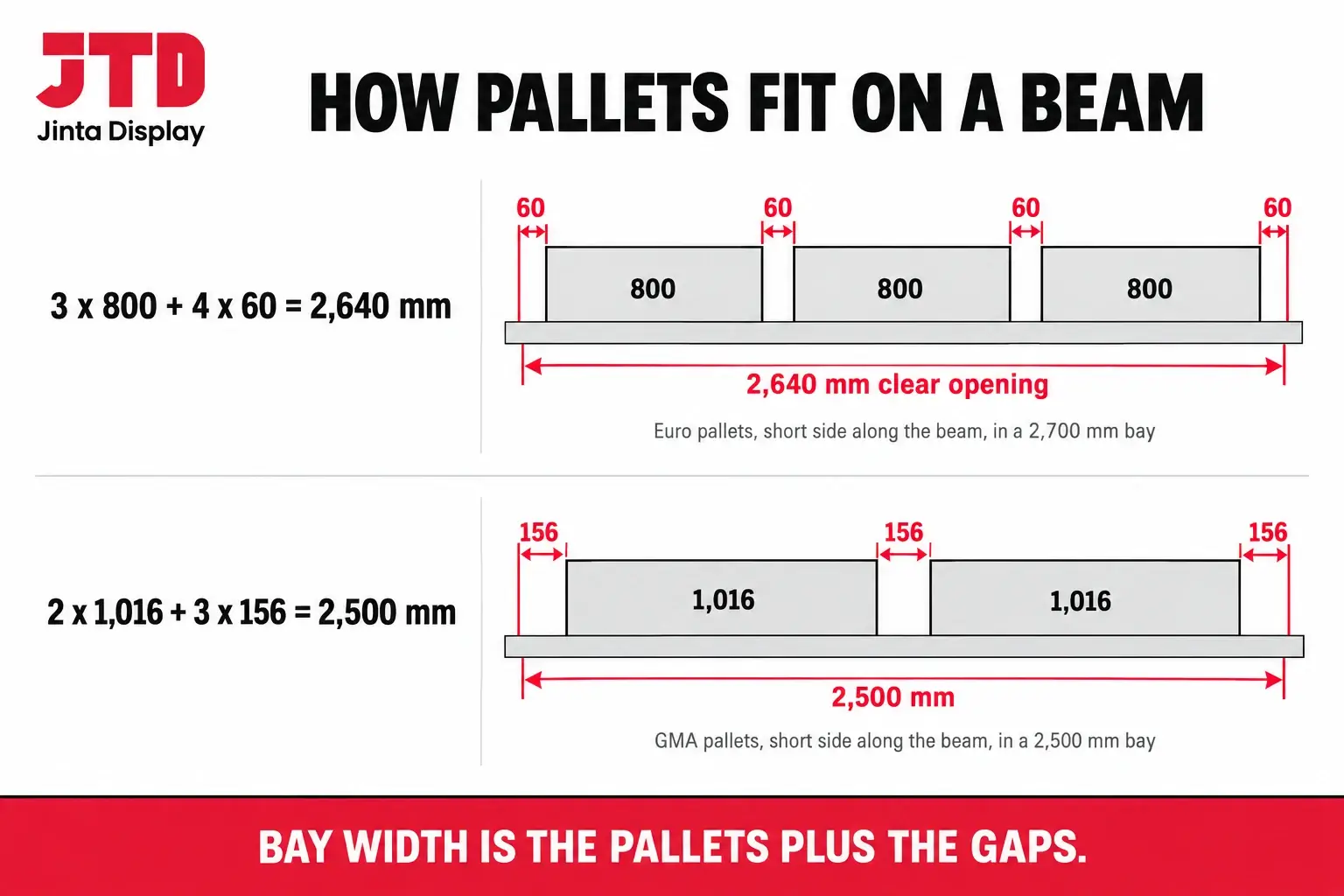
Among pallet rack dimensions, bay width follows from a simple sum. Take the pallets per level, multiply by the pallet width along the beam, then add a gap at each end and between pallets. With n pallets that is n times the pallet width plus n plus 1 gaps. A gap of 100 mm is a common planning figure, and 75 mm works on tight bays.
| Pallets per level | Pallet width along the beam | Sum | Clear opening needed |
|---|---|---|---|
| 2 | 800 mm (Euro, short side) | 1,600 + 3 × 100 | 1,900 mm, giving a 2,000 mm bay |
| 2 | 1,016 mm (GMA, short side) | 2,032 + 3 × 100 | 2,332 mm, giving a 2,500 mm bay |
| 2 | 1,200 mm (Euro or UK, long side) | 2,400 + 3 × 100 | 2,700 mm, and a 2,700 mm bay with about 2,640 mm clear gives gaps of about 80 mm |
| 2 | 1,219 mm (GMA, long side) | 2,438 + 3 × 100 | 2,738 mm, and a 2,700 mm bay with about 2,640 mm clear gives gaps of about 67 mm |
| 3 | 800 mm (Euro, short side) | 2,400 + 4 × 75 | 2,700 mm clear opening, so a bay quoted at 2,700 mm with about 2,640 mm clear gives gaps of about 60 mm, which is tight |
Read the table against our bay widths of 2,000, 2,500 and 2,700 mm. The 2,000 mm bay suits two Euro pallets short side along the beam. The 2,500 mm bay suits two GMA pallets short side along the beam, and the 2,500 × 1,100 combination is the classic arrangement for a 48 in deep GMA pallet. The 2,700 mm bay suits two long-side pallets with tight gaps. It takes three Euro pallets short side along the beam only with gaps of about 60 mm, so ask for a wider clear opening if you need 75 mm or more. It is also our widest bay, with fewer uprights per run. These fits are a calculation and not a published claim on the product page. Confirm the arrangement with the supplier before you order.
Width has a structural cost. A longer beam carries less at the same section, and design practice limits beam deflection to roughly 1/180 of the span. A 2,700 mm span is not interchangeable with a 2,000 mm span in identical steel, and the effect on load is covered in the capacity guide.
Upright Height, Level Pitch and How Many Pallets High
Of the pallet rack dimensions, height is where the building enters the calculation. Start with the clear height, the distance from the floor to the underside of the lowest obstruction, whether a sprinkler head, a light fitting or roof bracing. Fire rules often require clear space below sprinklers, and you should check your local requirement before you fix the upright height.
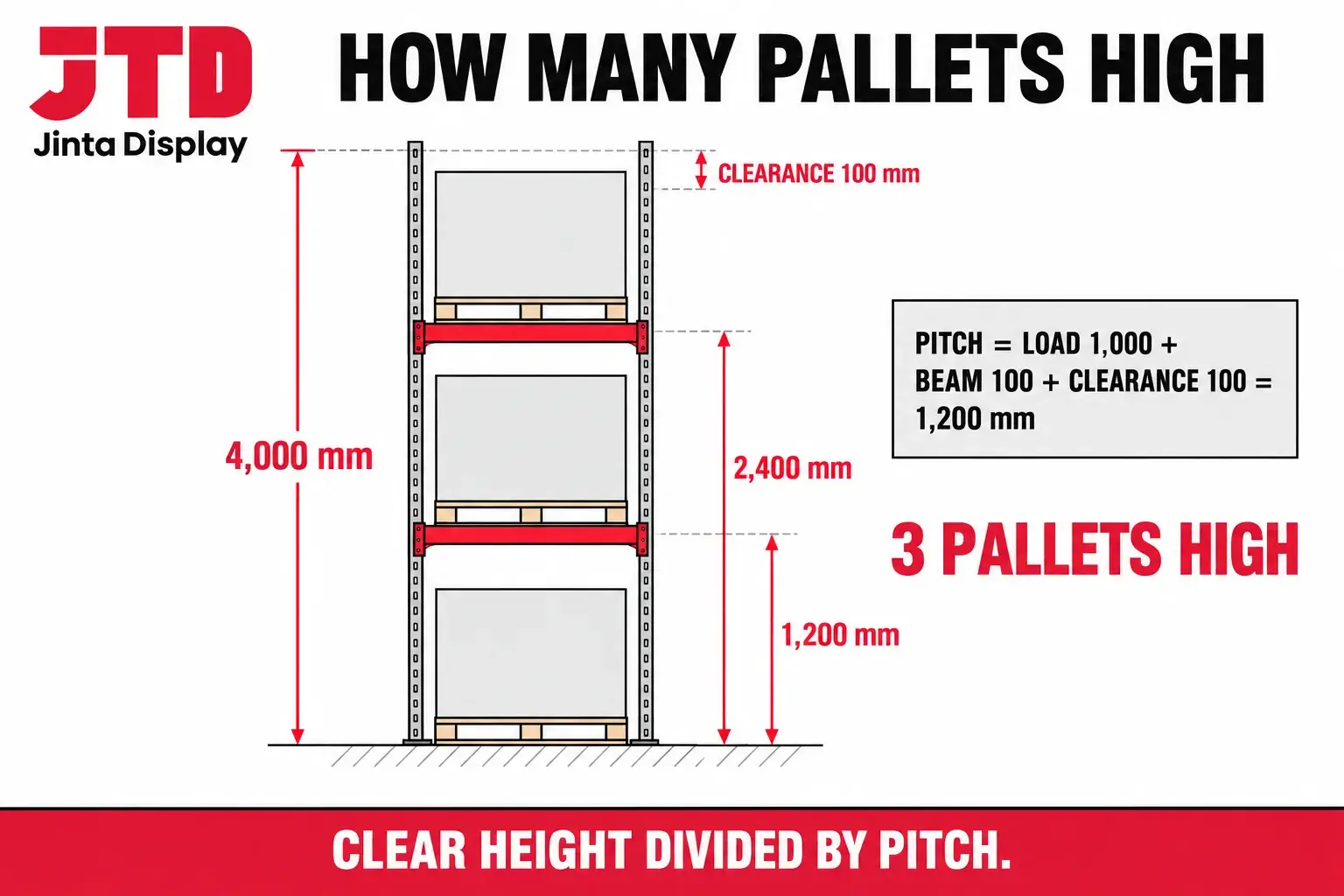
Then work out the level pitch. Pitch equals the height of the loaded pallet, plus the depth of the beam, plus the clearance above the load. A clearance of about 100 mm is a common planning figure. With a load height of 1,000 mm, a 100 mm beam and 100 mm of clearance, the pitch is 1,200 mm. Divide the usable height by the pitch and round down to find how many pallet positions high the bay holds.
The worked case makes this concrete. In an upright 4,000 mm high with a load height of 1,000 mm, the first pallet sits on the floor and the first beam top is at 1,200 mm. The second beam top is at 2,400 mm. A load on that beam reaches 3,400 mm and, with 100 mm clearance, 3,500 mm. A third beam would put the load at 4,600 mm, and that does not fit. The bay holds three pallets high, with 500 mm to spare.
Change the load to 1,200 mm and the pitch becomes 1,400 mm and the same 4,000 mm upright holds only two pallets high. That is why the load height is worth measuring on real pallets and not estimating, since 200 mm of load height can cost a whole level. Our bays are built from 2,000 mm to 4,000 mm high, with the 2000 × 1000 × 3500 order-picker bay and the 4,000 mm bay at the tall end. At 4 m the top beams are forklift work and not ladder work.
Pallet Rack Sizes in Inches for US Buyers
Much published guidance on pallet rack sizes is in inches, and the conversions are worth having beside the metric numbers above.
| Common US figure | Millimeters | Use |
|---|---|---|
| 96 in beam | 2,438 mm | Two GMA pallets per level, 40 in side along the beam and 48 in deep |
| 108 in beam | 2,743 mm | Our 2,700 mm bay is the metric neighbor |
| 42 in frame depth | 1,067 mm | A 48 in deep GMA pallet with 3 in overhang each side |
| 48 in frame depth | 1,219 mm | Flush or mixed orientation |
| 36 in frame depth | 914 mm | A 40 in deep GMA pallet with 2 in overhang each side |
The rule is the same as the metric one. Frame depth sits a few inches under the pallet depth, so the pallet overhangs the beams. A 96 in beam is shorter than our 2,500 mm bay, so a buyer who specifies in inches and a supplier who works in millimeters should agree on the clear opening in millimeters before the order, and not on a nominal inch size.
Upright Sections, and Why Teardrop Slots Matter
The upright is a roll-formed column with a slot pattern punched down its face. The section, meaning the face width by the depth, and the wall thickness set how much the upright carries and how well it resists impact. Our uprights are 80 × 60 mm in 1.5 to 2.3 mm or 90 × 70 mm in 1.8 to 2.2 mm.
The slots are the other half of the specification. A teardrop slot is a keyhole shape that a beam hook drops into and locks with a safety pin. The slot pattern repeats at a fixed pitch, commonly 2 in or about 50 mm, and beam levels move in steps of that size. That pitch is the reason a level pitch rarely lands exactly on the number you calculated. If your calculation says 1,170 mm, you will get 1,150 or 1,200 mm, whichever the slot pitch allows. Round up to the next slot and recheck the clearance.
Mixing upright makes is risky for the same reason as in gondola shelving, because the slot shape and the hook profile differ between makers. When you extend an existing run, match the profile and photograph the upright, in the same way you would for any extension.
Beam Sections and Lengths
The beam carries the pallet and sets the bay width. Our beams are 100 × 50 mm in 1.5 to 2.5 mm or 120 × 50 mm in 1.5 to 2.0 mm, in step or box form. The depth of the section, 100 or 120 mm, goes straight into the level pitch sum above, and a deeper beam costs a little height at every level.
Beam length is the bay width less the uprights. A bay quoted at 2,700 mm may have a beam of about 2,640 mm once the upright is taken out, depending on the design. The point to remember is that the pallet fit is judged against the clear opening between uprights and not against the quoted bay width. Ask for the clear opening and check the arithmetic against it. Our warehouse racking range lists the sections side by side for each bay.
Using Standard Bays to Check Your Own Numbers
The quickest way to test a calculation is to compare it with a standard bay. Each of the bays we list has a pallet arrangement it suits, and if your result lands near one of them you can order a standard size and not a custom one.
| Our bay (W × D × H, mm) | Pallet arrangement it suits | Check before ordering |
|---|---|---|
| 2000 × 1000 × 3500 | Two Euro pallets short side along the beam | Pallet 1,200 deep on a 1,000 frame, about 100 mm overhang |
| 2500 × 1100 × 4000 | Two GMA pallets short side along the beam, 48 in deep | Level pitch for your load height |
| 2500 × 1200 × 2000 | Two GMA pallets, either way round | Frame is deeper than needed for 40 in deep loads |
| 2700 × 1000 × 3000 | Three Euro pallets short side along the beam, or two long-side pallets | Gaps of 75 to 100 mm, and beam section for the span |
These arrangements come from our own fit calculation. They are a starting point for a conversation with a supplier and not a guarantee that a given pallet will sit correctly, because pallet quality, load overhang and the exact upright and beam geometry all matter.
Aisle Width and Row Spacing
The rack is only half of the footprint, and aisle width is the pallet rack dimension that most affects floor area. Aisle width comes from the truck, and the row spacing from how you arrange the frames. A counterbalance forklift commonly wants about 3,200 to 4,300 mm of clear aisle and a reach truck about 2,600 to 3,000 mm, as typical industry ranges that vary by model.
For back-to-back rows, add two frame depths and a row spacer, commonly about 150 mm. With two 1,100 mm frames, a 150 mm spacer and a 3,300 mm aisle, one module is 5,650 mm wide, as in our guide to warehouse racking types. A change of frame depth of 100 mm changes the module by 200 mm, and the frame depth has a bigger effect on floor area than most buyers expect.
Clearances to Check Before You Order
These small numbers cause most re-orders.
Pallet overhang. Keep it within the range the supplier confirms, commonly 50 to 75 mm each side.
Gaps between pallets and uprights. About 75 to 100 mm each. Less than that and a forklift cannot place the pallet without touching the frame.
Top clearance. About 100 mm above the highest load at a minimum, and more where sprinklers are present.
Protection at the ends. Upright guards and end-of-aisle protectors sit at the base of the frame and need space in the aisle. Include them when you count the aisle.
The truck mast. A forklift mast at full lift needs the aisle width and the height to match what the supplier assumed. Check the mast height against the top level.
How Pallet Rack Dimensions and Capacity Pull Against Each Other
Dimensions are not free choices, because each one moves the load rating in a known direction. A wider bay lengthens the beam, and a longer beam of the same section carries less. A deeper frame gives a pallet more support but takes more floor. A taller upright can carry the same load, though it needs a heavier section or more bracing to keep it stable, and the rated load of the frame falls as the distance between beam levels grows.
That is why a quotation should give the dimensions and the load together, on the same bay. A bay of 2,700 mm rated at a heavy load per level and a bay of 2,000 mm rated at the same load are not the same product unless the beam section differs. Size the pallet rack dimensions first, then check the rated load for that exact bay, and use the capacity guide to read the load plate. If the number is too low, the usual fixes are a deeper beam section, a shorter span or a thicker upright wall, in that order of cost.
Common Mistakes With Pallet Rack Dimensions
Four errors account for most re-orders.
Sizing the frame to the pallet exactly. A frame as deep as the pallet leaves no overhang and no margin, and a pallet placed slightly off can slip. Allow the overhang.
Forgetting the gaps. Two pallets on a beam as long as their combined width leave no space for a forklift to place them. Add the gaps.
Estimating the load height. A pallet that is a little taller than assumed costs a whole level in a tall bay. Measure real pallets.
Reading the quoted width as the clear opening. The uprights take width from the bay, and the pallet fit is judged against what is left. Ask for the clear opening.
A Worked Example, Sizing a Bay for Euro Pallets
To put the pallet rack dimensions together, take a warehouse storing Euro pallets, 1,200 × 800 mm, loaded to a height of 1,100 mm, with a clear height of 4,400 mm and a reach truck. We want three pallets per level and as many levels as the height allows.
Start with the bay width. Three Euro pallets short side along the beam give 3 times 800 plus 4 gaps of 75 mm, which is 2,700 mm of clear opening. A bay quoted at 2,700 mm gives about 2,640 mm clear, so the gaps fall to about 60 mm, and we ask the supplier for a clear opening of 2,700 mm or accept the tighter gaps. For the depth, the pallet is loaded long side deep at 1,200 mm, and the frame should be about 1,050 to 1,100 mm. We choose 1,100 mm.
Next the height. Load height 1,100 plus a 100 mm beam plus 100 mm of clearance gives a pitch of 1,300 mm. The first beam top is at 1,300 mm and the second at 2,600 mm. A load on the second beam reaches 3,700 mm, and with clearance 3,800 mm. The third beam top would be at 3,900 mm with a load to 5,000 mm, which does not fit. We leave a margin under 4,400 mm for sprinklers and choose a 4,000 mm upright. The bay is three pallets high and three wide, which is nine pallet positions.
The result is a bay 2,700 mm wide, 1,100 mm deep and 4,000 mm high. It is close to our 4,000 mm medium duty storage rack at 2,500 mm wide, and a custom 2,700 mm version of that rack would meet it. Rated loads depend on the section chosen, and the capacity guide shows how to match them to the 1,100 mm load. Nothing in this example is a rule. It shows the order of the steps.
What to Send a Supplier
A supplier can confirm pallet rack dimensions without a visit when the brief includes the pallet size and type, the loaded height and weight, which way the pallet loads and how many sit on each level. Add the clear height and the position of any sprinklers and lights. Give the truck type and its aisle requirement, the number of pallet positions you need and the finish you want. Photographs of any existing racking you must match help with the upright profile. With those details, the supplier can send a bay drawing that you can check against the sums above.
If you want a bay sized to your pallets, send us your pallet size, loaded height and clear height and we will reply with a bay drawing.
Frequently Asked Questions
What are the standard pallet rack dimensions?
There is no single standard, because bays are sized from the pallet. Common bay widths are 2,000, 2,500 and 2,700 mm for two or three pallets per level, frame depths are 1,000 to 1,200 mm, and heights run from 2,000 to 4,000 mm. In the US, 96 in beams and 42 in frames are common.
How wide is pallet racking?
Width follows the pallets per level. Multiply the pallet width along the beam by the number of pallets and add a gap of about 100 mm at each end and between pallets. Two 1,200 mm pallets need about 2,700 mm of clear opening. Check whether a quoted width is the beam length or the full bay including the upright.
What size of pallet racking do I need, and what pallet rack sizes are standard?
Work from the pallet, because pallet rack dimensions and standard warehouse racking dimensions both come from it. Frame depth is usually 100 to 150 mm less than the pallet depth, bay width is the pallets plus gaps, and level pitch is the load height plus the beam depth plus about 100 mm of clearance. Divide the clear height by the pitch to find the number of levels.
How to measure pallet racking on an existing run?
Take the pallet rack dimensions of the run you already own. Measure the frame depth, the clear opening between uprights, the upright height and the distance between beam levels. Measure the upright face and wall thickness, and photograph the slot pattern and beam hook. Note the beam section and the aisle width. These details let a supplier match or extend a run.
What is the depth of a pallet rack?
Depth is set by the pallet and is normally 100 to 150 mm less than the pallet depth, so the pallet overhangs the beams. A GMA pallet loaded 1,219 mm deep suits frames of about 1,070 to 1,120 mm. Our frames are 1,000, 1,100 and 1,200 mm deep, and custom depths are available for pallets loaded the short side deep.
What size are pallet rack uprights?
Ours are 80 × 60 mm in 1.5 to 2.3 mm steel or 90 × 70 mm in 1.8 to 2.2 mm steel, roll formed with teardrop slots. The face width, the depth and the wall thickness together set how much the upright carries. A heavier section or thicker wall gives more capacity and costs more steel.
How long are pallet rack beams?
Our bays are 2,000, 2,500 and 2,700 mm wide, with beams of 100 × 50 or 120 × 50 mm section. The beam is a little shorter than the bay width once the upright is taken out. Longer beams carry less at the same section, and a wide bay may need a deeper section.
How much aisle do I need between pallet racks?
The truck decides it. A counterbalance forklift commonly needs about 3,200 to 4,300 mm and a reach truck about 2,600 to 3,000 mm, varying by model. For back-to-back rows add two frame depths and a row spacer of about 150 mm to get the module width.