
The pallet rack upright is the part of a rack that nobody looks at until something hits it. It stands in the aisle, painted in a bright color, and it carries the whole load of the bay down to the floor. Beams get the attention in a quotation and decking gets the attention in a safety audit, and the frame sits in the middle, working harder than either.
This article is about the upright frame as a structure. It explains the columns, the bracing, the base plates and anchors, how the frame is counted in a run, how it is damaged and protected, and what a quotation should say. It does not repeat the frame dimensions and the sizing of a bay, which are in pallet rack dimensions, or the load ratings, which are in pallet rack capacity. The horizontal members are covered in pallet rack beam types, connectors and locks.
What a Pallet Rack Upright Frame Is
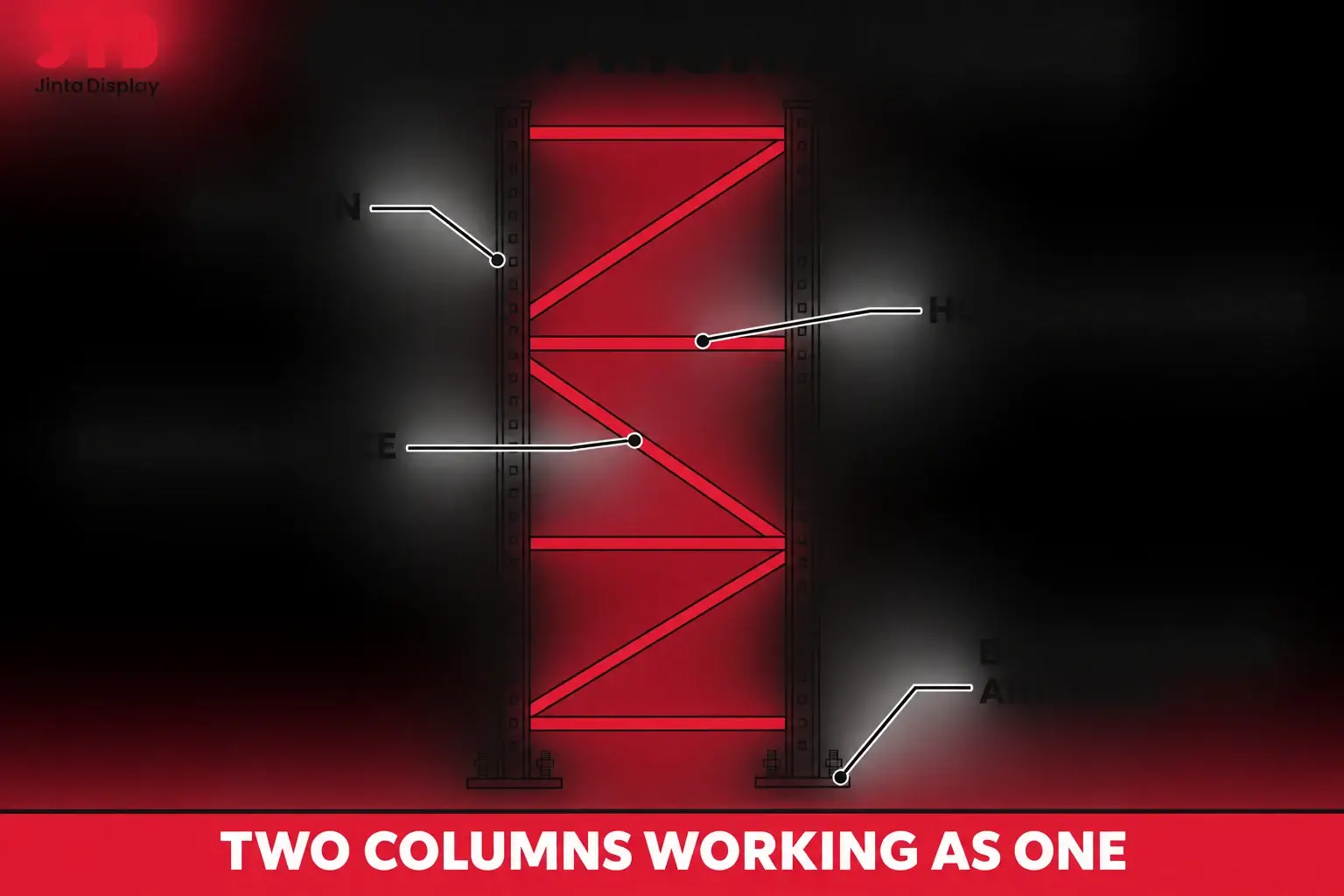
A pallet rack upright frame is a flat steel ladder that stands on its edge. It has two vertical columns, a set of horizontal braces and a set of diagonal braces between them, and a base plate under each column. Beams span from one frame to the next, and the row of frames and beams is the bay.
The frame has four jobs. It carries the vertical load from every beam level down to the floor. It resists the sideways push of a forklift and of a pallet being placed, in the direction across the aisle. It holds the beams, through the slots that run along the column. And it holds itself upright, through the base plate and the anchors, when the loads on the two sides are not equal.
Pallet racking is the UK and Australian name for the system that is called a pallet rack in the United States, and the upright is the same part in both. Some people call it a frame, a post or a column, and a quotation should use one word and define it.
The Column Section and Its Thickness
The column of a pallet rack upright is a roll formed steel section with a slot pattern punched along its faces. Its depth, width and wall thickness set how much the frame can carry and how tall it can safely be.
Our uprights are listed in two sections. One is 80 × 60 mm, in steel from 1.5 to 2.3 mm. The other is 90 × 70 mm, in steel from 1.8 to 2.2 mm. The larger section is stiffer and carries more, and in both sections the wall thickness gives a range because the column is chosen from the load and the height.
Three things follow from the section. The first is that a thicker wall adds capacity in proportion to the steel, while a larger section adds stiffness faster than it adds steel, because the stiffness of a tube grows with the cube of its depth for a given wall. The second is that a taller column is weaker than a short one of the same section, since a slender column buckles at a lower load. The third is that the slots weaken the wall, so the slot pattern and the wall thickness are designed together.
Ask for the section and the wall thickness as two numbers on every quotation. A supplier who writes only 90 mm upright has not told you which of the two sections, or which thickness, was priced.
Teardrop Slots and Beam Levels
The slots are what make the rack adjustable. A teardrop slot is a hole with a wide round end and a narrow tail, and the hooks on a beam end enter the wide part and drop into the tail. Our trade listing for a pallet rack lists teardrop slots on the upright, and describes it as popular in the US market.
The slots repeat at a fixed pitch down the column, which means a beam level moves in steps of that pitch and not continuously. The pitch is a number to ask for, because it sets how closely a level can be fitted to the height of the load. The beam guide explains the connector and the lock, and the sizes guide explains how the pitch enters the sum for level height.
Every slot position is also a place where the column is a little weaker. A column with a very tight slot pitch has a lot of holes, and a column with a wide pitch has fewer. The manufacturer sets the pattern to give enough steps for the stock and enough wall for the load.
Bracing, Horizontal and Diagonal
The bracing is the part of a pallet rack upright that turns two columns into one structure. Without it, each column would bend and buckle on its own, and the pair would sway across the aisle.
Horizontal braces tie the columns together at set heights and keep their spacing fixed. Diagonal braces run between the horizontals and form triangles, and a triangle cannot change shape without one of its sides changing length, which is why it is stiff. The bracing is usually a lighter section than the column, bolted or welded to it, and the pattern of horizontals and diagonals is repeated up the frame in panels.
The panel height is the distance between horizontals. A shorter panel makes a stiffer frame, because each column is held in place more often. A frame with taller panels has less steel in the bracing and a lower capacity at the same height. The manufacturer chooses the panel pitch from the load and the height, and the capacity chart assumes it.
The two common ways of fixing the bracing are bolting it to the column and welding it to the column. A bolted frame can be repaired by replacing a damaged brace, and a welded frame is often stiffer and cheaper to make. Ask which is used, because it decides what can be done after a knock.
Base Plates and Anchors
The base plate spreads the load of the column over the floor, and the anchors hold the frame down. Both are easy to overlook and both matter.
A base plate is a steel plate welded to the foot of the column, with holes for the anchors. A larger and thicker plate spreads the load over more concrete and resists the rocking of the column. The load under one column of a loaded rack is substantial, and a floor that is thin or cracked under it is a real limit, as the sizing guide explains for the slab.
Anchors are expansion bolts or similar fixings that go into the concrete through the holes in the base plate. They resist the lifting force that appears when a rack is loaded unevenly, when a forklift hits a frame or when a pallet is lifted into a level. Racks are anchored in most places, and the manufacturer’s installation instructions say how many anchors per plate and what type.
Our product pages do not list the anchor pattern, so ask for it with the quotation, together with the thickness of the slab the rack assumes. A plate with two anchors is a different design from one with four, and the load plaque and the installation guide should say which.
Counting Frames, Plates and Anchors in a Run
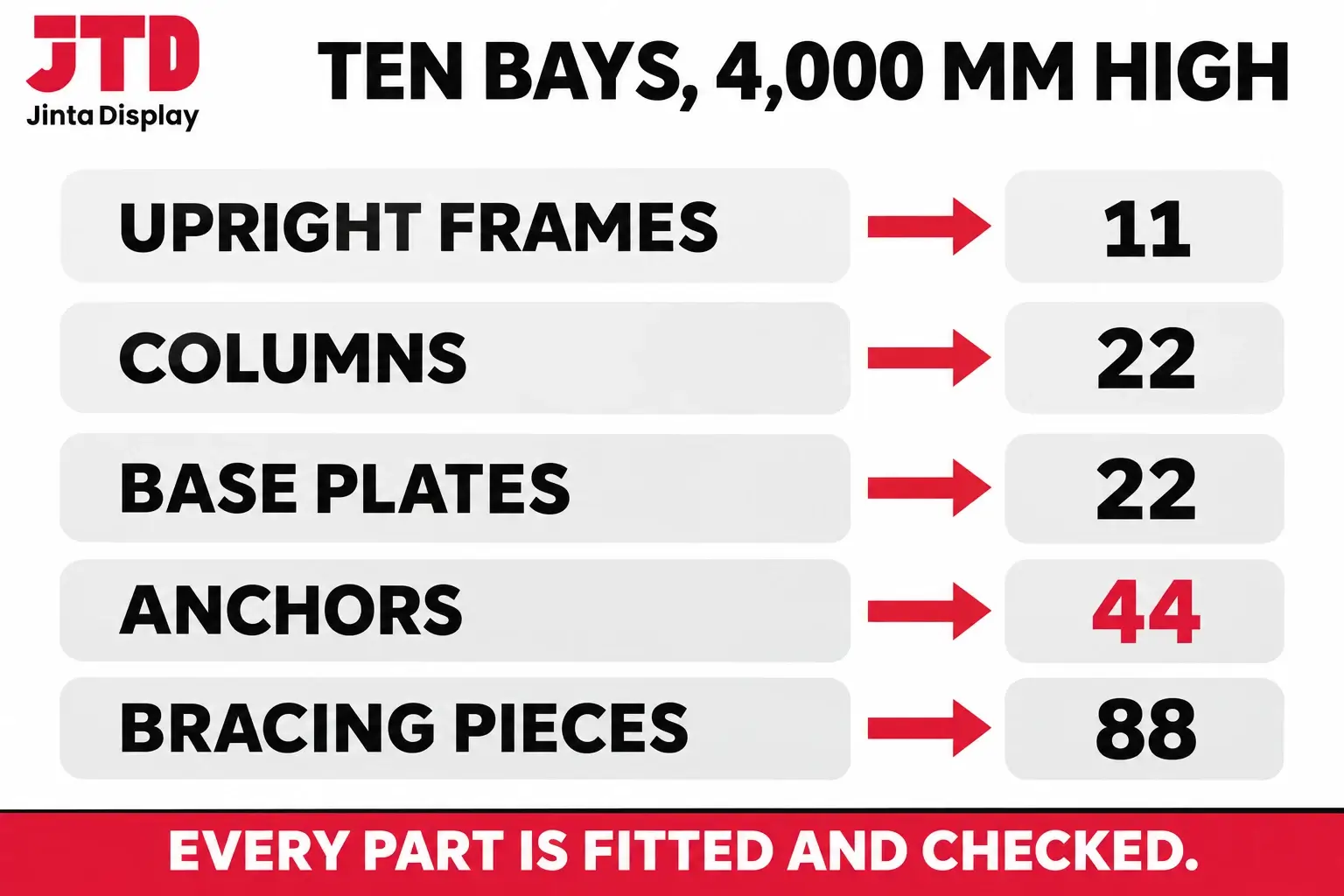
A short count shows the scale of the pallet rack upright work in a run. Take 10 bays and a frame height of 4,000 mm. Assume two anchors per base plate, and assume bracing in four panels of 1,000 mm, each with one horizontal and one diagonal brace.
| Item | Working | Quantity |
|---|---|---|
| Upright frames | 10 bays + 1 | 11 |
| Columns | 11 frames × 2 | 22 |
| Base plates | One per column | 22 |
| Anchors | 22 plates × 2 anchors | 44 |
| Bracing pieces | 11 frames × 4 panels × 2 braces | 88 |
The run has 11 frames, 22 columns, 22 base plates, 44 anchors and 88 bracing pieces. Each one is a part that has to be made, fitted and checked. The numbers are a good reason to ask the supplier whether the frames come assembled or in pieces, and whether the bracing is welded or bolted, since the answer changes the labor on site by a large factor.
The count also shows how much of the rack the frames are. Eleven frames carry 30 beam pairs in this run, and the cost of a bay is mostly the cost of its share of a frame and a few beams. A change in frame height or section affects the whole run, which is why the frame is specified before the beams.
How Much Load a Pallet Rack Upright Carries in a Run
A pallet rack upright in the middle of a run carries more than one at the end, for the same reason an inner post does in any run of bays. An inner frame has a bay on each side, and it receives half of the load of each. An end frame has a bay on one side only.
Take an example with three beam levels, where each level of a bay is rated at 2,000 kg per pair of beams. This is an assumed figure inside the 1,000 to 4,000 kg per layer range that we list, and it is used only for the sum. A full bay then carries 3 × 2,000, or 6,000 kg. An end frame receives half of one bay, so it carries 3,000 kg, which is 1,500 kg on each of its two columns. An inner frame receives half of two bays, so it carries 6,000 kg, which is 3,000 kg on each column.
| Frame | Bays it serves | Load on the frame | Load on each column |
|---|---|---|---|
| End frame | One | 3,000 kg | 1,500 kg |
| Inner frame | Two | 6,000 kg | 3,000 kg |
The inner frames carry twice the end frames, and the frame rating on the quotation has to cover the inner case. A capacity chart for an upright frame is written for the loaded inner frame, and it should state the beam levels and the level spacing it assumes. If a chart gives one number for a frame, ask whether it is for an inner frame with all levels loaded.
Choosing Frame Depth and Height for the Stock
Two dimensions of the pallet rack upright come straight from the stock. The depth is the distance from front to back, and it follows the pallet and its overhang. The sizes guide gives the arithmetic, and the short version is that the frame depth is usually a little less than the length of the pallet so the pallet overhangs the beams slightly.
The height comes from the room and from the truck. Take the clear height of the building, take away the clearance for sprinklers and lights, and take away the room the truck needs above the top level to place a pallet. What is left is the frame height, and the number of levels follows from the level height of the load. The whole sum is repeated for each candidate height, since a taller frame holds more levels and carries less at each, as the section above explains.
It helps to choose from two or three heights and ask the supplier for the load per level at each. The result is usually a small table, and the right height is where the stored tonnage per square meter is highest without a frame so slender that it needs a heavier column.
Frame Height and Why the Rating Falls
The taller the frame, the lower the load it carries at each level. The reason is buckling. A long slender column loaded at its top bends sideways at a load much lower than the load that would crush a short one of the same section.
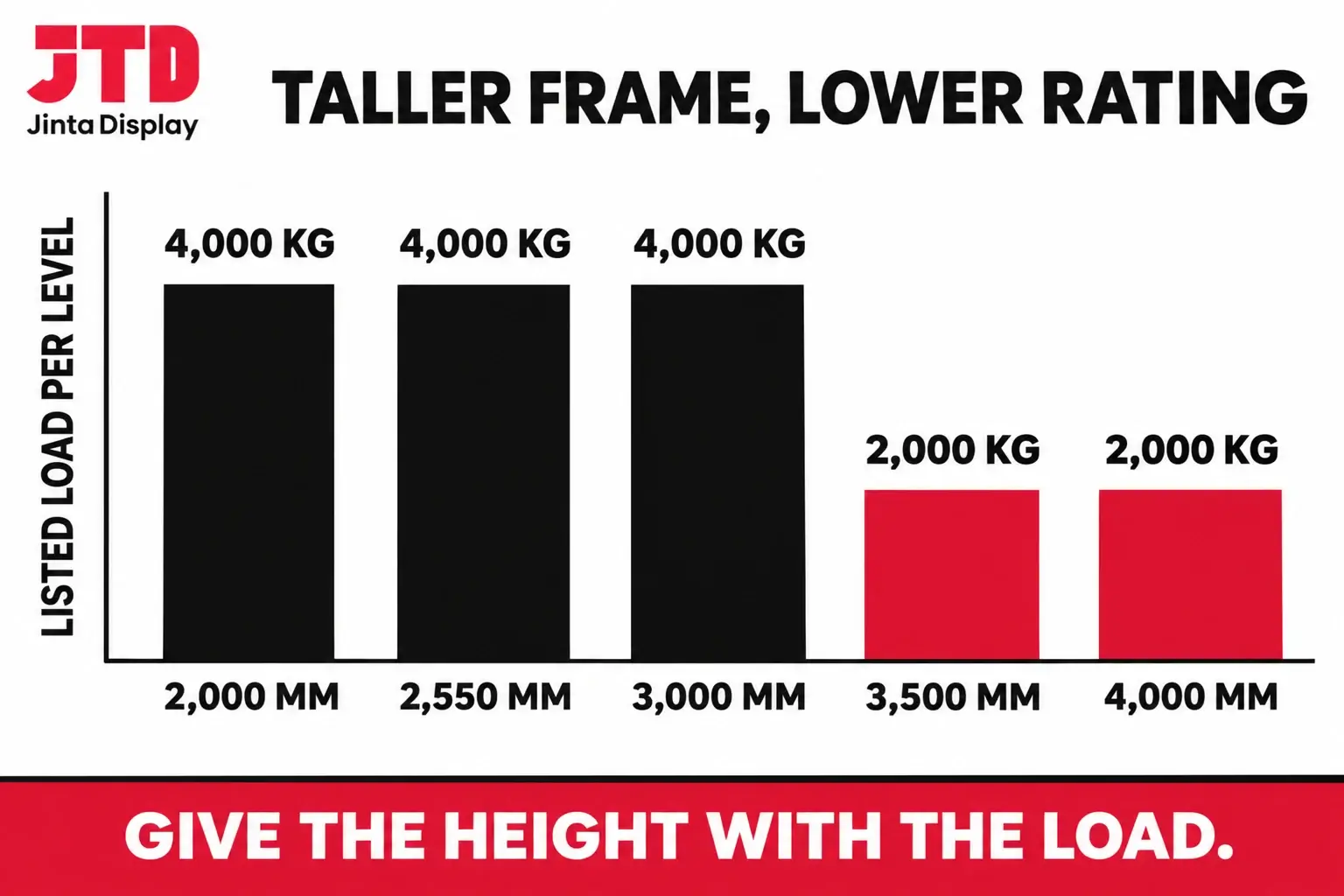
Our heavy duty warehouse rack listing shows the effect. The guide to pallet rack capacity gives the listed load per level for each upright height, and the figure falls from 4,000 kg at 2,000, 2,550 and 3,000 mm to 2,000 kg at 3,500 and 4,000 mm. A taller frame can be made stronger by using a larger section, a thicker wall or tighter bracing, and the supplier does that for you when the height is given on the order.
It is therefore wrong to treat height as a free choice. A buyer who asks for the tallest frame that fits the room, and then looks for the cheapest quotation, is asking for the weakest one. Give the height, the load per level and the number of levels together, and let the manufacturer choose the column and the bracing.
The same logic holds for the bottom level. A taller bottom level for oversized loads leaves a longer unbraced length at the foot of the column, and the capacity guide warns that this silently lowers the rating of the whole frame above it.
Fitting Frames on Site
A pallet rack upright is only as good as the way it is stood. A frame that leans or sits on an uneven slab loses part of its rating before the first pallet goes on.
Mark the floor with the line of the run and the position of each frame. Stand the first frame, check it for plumb in both directions and fix it with its anchors, then set the next at the beam spacing and repeat. Use shims under the base plate where the floor is not level, and use shims that suit the load and that stay in place. Fit the beams with their locks and check the bay for squareness before the next frame goes up.
Tighten the anchors to the figure in the instructions and not by feel. Do not load a frame whose anchors are loose or missing. Keep the installation record with the load plaque, because it is the first page of the rack’s history and the first thing an inspector asks for.
Finish and Rust at the Foot of the Column
The foot of a column is where a pallet rack upright starts to rust. It stands on the floor, it is hit by trucks and brushes, and in a damp or cold store it is wet more often than the rest of the frame.
Our trade listings give a powder coat finish for pallet racking, in colors that can be chosen, and the same finish choices are listed for our other racking. A powder coat resists scratches and holds its color. A hot dip galvanized finish is thicker and suits wet or outdoor racks, and it costs more. Ask for the finish and the thickness, and ask how the cut edges and slots are treated, since they are where rust shows first. If the floor is washed, keep the base plate off standing water, and repair any chip in the coating as soon as it is found.
Damage, Guards and Impact
Forklifts damage a pallet rack upright more than loads do. The base of the column is the part at the height of the truck, and a hit there bends the column or the plate and starts a lean that grows with every pallet.
Upright guards, also called column protectors, are steel sections fixed around the base of the column to take the impact. A guard is cheap against the cost of a column and far cheaper than the cost of a collapse. Place them on the end frames and on any column that faces the aisle at a turn.
Look at the frames regularly. A column with a visible bend, a dent in its wall, a twisted base plate, a cracked weld on the bracing or a loose anchor has to be dealt with. A damaged column is unloaded and replaced, and it is not straightened on site, since the steel has been worked and the rating no longer holds. The inspection guide gives a simple routine.
Row Spacers and Back to Back Frames
In a double row, two runs of frames stand back to back with a small gap. A row spacer is a short steel member that ties the two frames together across the gap, so that the pair acts as one. It stops the rows from moving apart or leaning when one is loaded more than the other.
The gap is a number to confirm, because it decides how far the pallets overhang and how much flue space remains for air and sprinkler water. The sizes guide explains how frame depth and the gap enter the arithmetic. For the frames themselves, back to back runs share no columns, so the count above doubles for a double row.
What to Put on an Upright Quotation
The pallet rack upright line on a quotation should say more than a height and a color. These are the entries worth requiring.
Column section and wall thickness. Both numbers, for example 90 × 70 mm in 2.0 mm steel, and the slot type and pitch.
Frame height and depth. The overall height and the depth from front to back, with the clear height of the bottom level.
Bracing. Welded or bolted, the panel height and the section of the braces.
Base plate and anchors. The plate size and thickness, the number and type of anchors and the slab thickness assumed.
Load per frame. The rated load for the frame at the quoted height and level spacing, with the basis. The capacity guide teaches how to read it.
Finish. Powder coat or paint, and the color. Frames are in the aisle and they get scratched, and a good finish keeps rust from starting.
With these entries on both quotations, two suppliers can be compared on one basis, and a frame that is cheap because it is shorter on steel shows up at once.
Height, Floor, Guards and Mixed Makers
Four decisions sit outside the frame drawing and still decide how it performs. Choose the load before the height, since height lowers the rating, and give the load and the levels with the height so that the maker can choose the section. Look at the floor, because a thin or cracked slab under a loaded column is a limit that no frame can fix, and the anchors only hold if the concrete holds them.
Put guards on the order. A guard is a small item on the order and a large item on the day a truck hits a column. And keep to one system of frames and beams, since the slot pattern and the hook shape have to match, and a beam that seems to fit can seat in the wrong way. Use one maker, or confirm compatibility in writing.
To specify a pallet rack upright, send the pallet size and weight, the number of pallets per level, the number of levels, the room height and the floor slab. Tell us if the rack is a single row or a double row and what truck will serve it. We reply with a frame section, a height, the bracing and the load per frame. For the range, see the heavy duty warehouse rack and the warehouse rack range.
For the order of the work on site, see pallet racking installation. For guards and impact energy, see pallet rack protectors and guards.
If you are choosing pallet rack uprights, send us your pallet size, load and room height and we will reply with a frame specification and the load per frame.
Frequently Asked Questions
What is a pallet rack upright?
A pallet rack upright, or upright frame, is two vertical columns joined by horizontal and diagonal bracing and standing on base plates. It carries the load of the beams down to the floor, resists sideways knocks and holds the beams through slots in the columns.
What size are pallet rack uprights?
Our uprights are 80 × 60 mm in 1.5 to 2.3 mm steel or 90 × 70 mm in 1.8 to 2.2 mm steel. The section and wall thickness are chosen from the load and the frame height, so a quotation should state both numbers and not only the height.
What is the difference between an upright and a column?
In most quotations the words mean the same vertical section. Some suppliers use upright for the whole frame of two columns and bracing, and column for one section. Ask which meaning is used, and look for the section size and wall thickness in the line.
How many anchors does a pallet rack upright need?
It depends on the design, and the manufacturer’s installation instructions say. A common arrangement is two anchors in each base plate, which gives four per frame. A run of 10 bays has 11 frames and about 44 anchors on that assumption. Ask for the anchor type and the slab thickness.
Why does the rating fall as the frame gets taller?
A tall slender column buckles at a lower load than a short one of the same section. Our heavy duty listing shows 4,000 kg per level at 2,000 to 3,000 mm and 2,000 kg at 3,500 and 4,000 mm. A larger section, thicker wall or tighter bracing can raise it.
What is the bracing on a pallet rack frame for?
Bracing ties the two columns together so they work as one structure. Horizontal braces fix the spacing and diagonal braces form triangles that resist sway. Without bracing each column would bend on its own, and the frame would move sideways under a load or a knock.
Can a damaged pallet rack upright be repaired?
No. A bent or dented column is unloaded and replaced with one of the same specification. Straightening or welding it on site changes the steel and the rated load no longer holds. A guard at the base of the column prevents most of the damage.
Do pallet rack frames need to be bolted to the floor?
Yes in most places. Anchors resist the lifting and tipping forces from unevenly loaded bays and truck impacts, and the base plate spreads the load over the slab. Follow the manufacturer’s instructions on the number and type of anchors, and check that the slab can hold them.