Supermarket shelves are the largest single purchase in a store fit-out, and the one that is hardest to change once the floor is open. A shelf that is too deep wastes stock room, an aisle that is too narrow jams carts, and a bay from the wrong system cannot take the shelves a store already owns. The names make it harder. The same fixture is sold as supermarket shelving, shop shelving, grocery store shelves, gondola shelving and store fixtures, depending on the country and the catalog.
The sections below set out what supermarket shelves are, the types in use, the sizes that stores order and the three slot systems that do not mix. Later sections cover how load and steel gauge are described, how to count shelf face on a floor plan and what to send a supplier for an accurate quotation. We write from the manufacturing side. The sizes come from our product pages and the arithmetic is ours, with the assumptions stated. There are no prices and no claims about sales, because those depend on the store and on the market.
Each section links to a longer article on its topic. If you only need the definition of the fixture, start with what a gondola is in retail. If you are working out the layout of a whole store, go to supermarket layout design.
What Supermarket Shelves Are
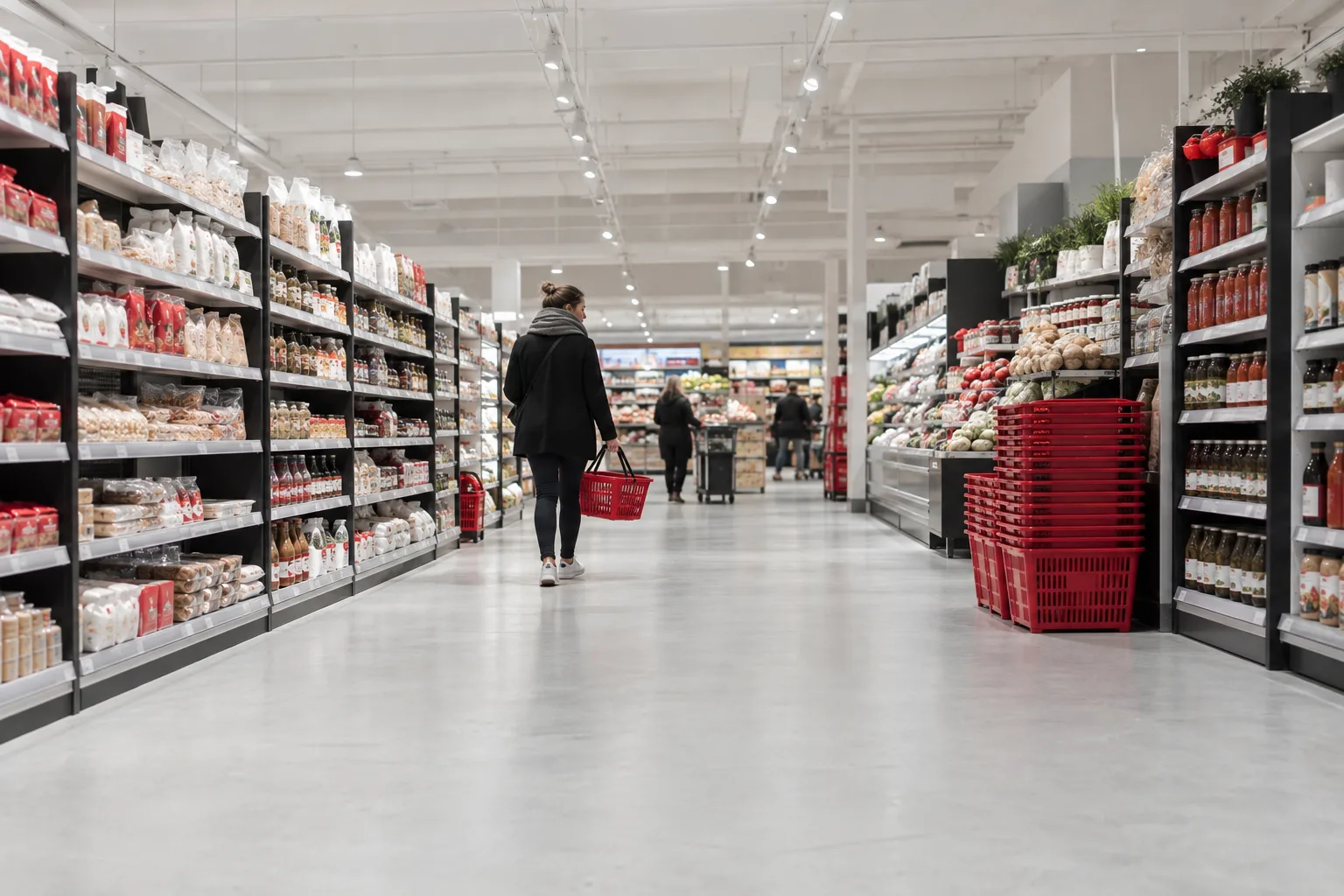
A supermarket shelf bay is a steel frame with a floor base, two or more uprights, a back panel and shelves that sit on brackets. The uprights carry slots or holes, and the brackets hook into them at a chosen height, so a shelf can move up or down in small steps without tools. A row of bays shares uprights between neighbors, which is why a run of 10 bays needs 11 uprights on each frame line and not 20.
The trade uses several words for the same thing. In North America the fixture is a gondola, and a store buys grocery store shelves or gondola shelving. In the UK and Australia it is shop shelving or supermarket shelving. In much of Asia it is supermarket shelves or supermarket racks. The word rack can mislead, since in the warehouse trade it means pallet racking, which is a different product with a different load rating. Here, supermarket shelves means retail display shelving that a shopper reaches from the floor.
Supermarket shelving differs from warehouse and storage shelving in four ways. The shelves are lighter, rated for packed goods and not for pallets. The finish is made to be seen, with paint and a back panel that holds hooks. Adjustment comes in small steps, and a store can change the range of a bay in an hour. Layout is planned around the shopper, so the aisle, the sightline and the height of the top shelf matter as much as the load. When a store needs pallets or cartons held in bulk, it needs heavy duty shelving or a racking system, and that is covered elsewhere.
Types of Supermarket Shelves
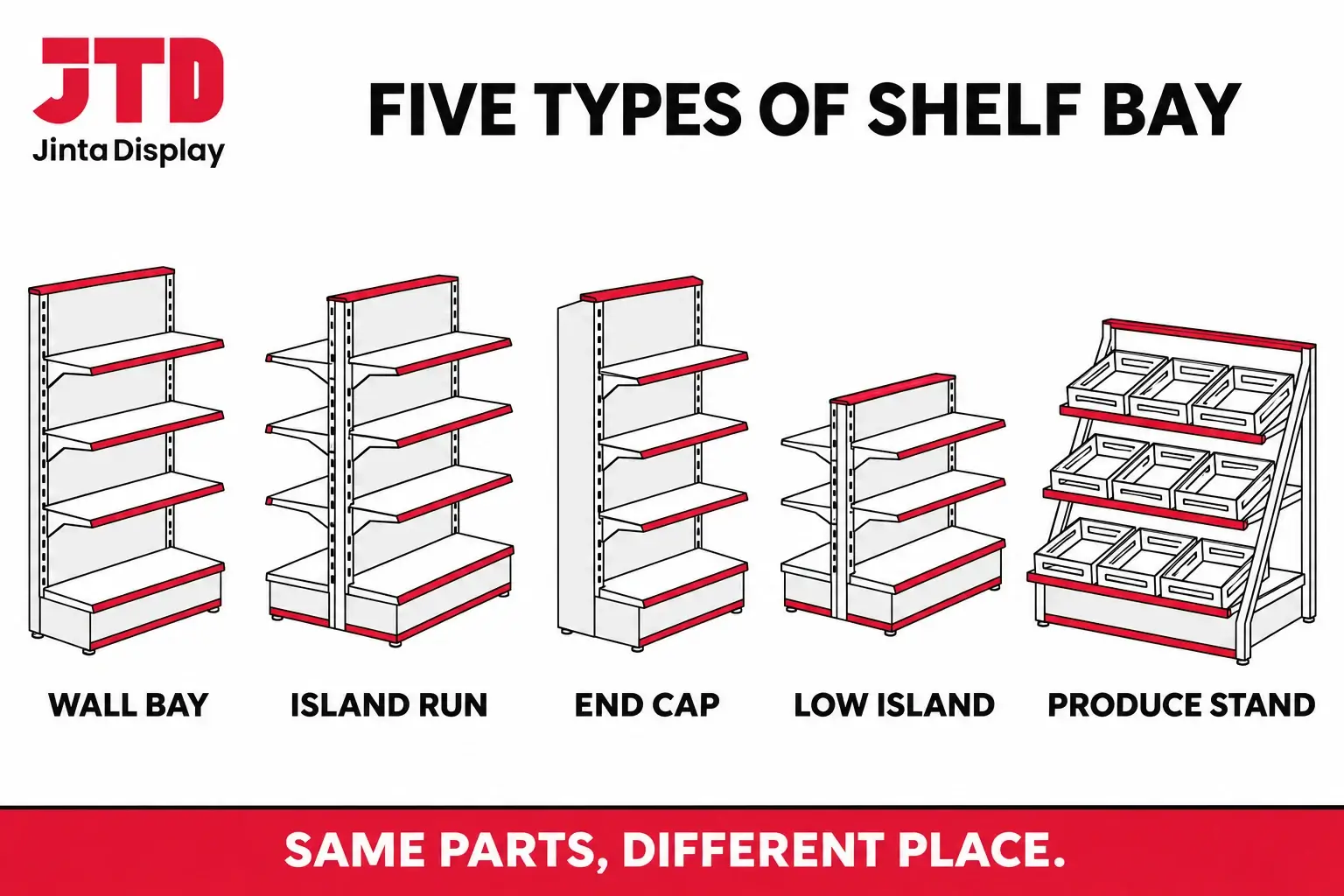
Most stores use five forms of supermarket display shelves, and almost every plan mixes them. The table gives the form, the usual place on the floor and the page that covers it in detail.
| Type | Where it stands | Faces per bay | Typical use | Detail |
|---|---|---|---|---|
| Single sided wall bay | Against a wall or on the perimeter | 1 | Widest range, heavy and bulky lines | single and double sided |
| Double sided island | Down the middle of the floor | 2 | Main grocery aisles | gondola sizes |
| End cap | At the end of an island run | Faces the main aisle | Promotions and seasonal lines | end caps |
| Low island | Front of store, around checkouts | 2 | Impulse lines, open sightlines | checkout areas |
| Specialty display | Perimeter or a feature spot | 1 or 2 | Bakery, produce, pharmacy, liquor | bakery shelves |
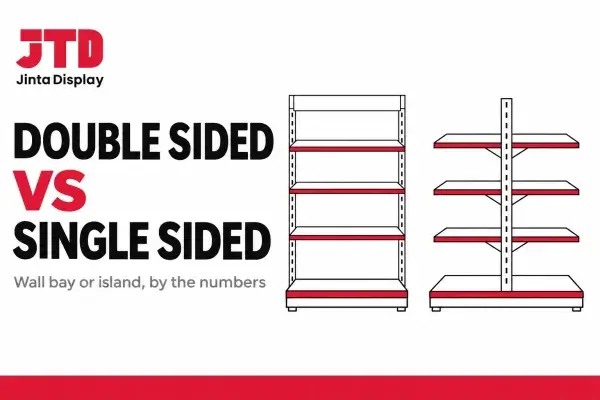
The first two do most of the work. Wall bays carry the widest range because the wall is the longest unbroken line in most shops. They hold the drinks and bagged goods, since the base can sit hard against the wall. Islands put two faces in front of a shopper walking down the middle of the floor and split the sales area into lanes. A longer treatment of this choice, with a floor count and a part count, is in single sided and double sided gondola shelving.
An end cap closes the end of an island run and faces the main aisle. It is the fixture where a store places a promotion or a new line, and it can be a shelf unit that matches the run, a bin or hook display, or a plain end panel. The planning rule in our end cap article is two per island run, sized from the island depth. See what an end cap is in retail for the types and the sizes.
A low island is a double sided run cut down to 1,200 to 1,400 mm. It stands at the front of the store or round the checkouts, and it is low enough that staff can see across the floor. It holds small lines that shoppers pick up on the way out.
Wall Bays and Island Runs in Detail
The wall bay and the island share the same parts. What changes is the number of faces on one set of uprights. A single sided bay has two uprights, a base, a back panel and shelves on one face. A double sided bay has two uprights, one shared base, a shared center panel and shelves on two faces. In a typical double sided design the two faces share the frame, so a 10 bay island of 20 faces needs 11 uprights where two single sided runs placed back to back need 22. Ask your supplier whether the model quoted shares its frame, because the price per face depends on it.
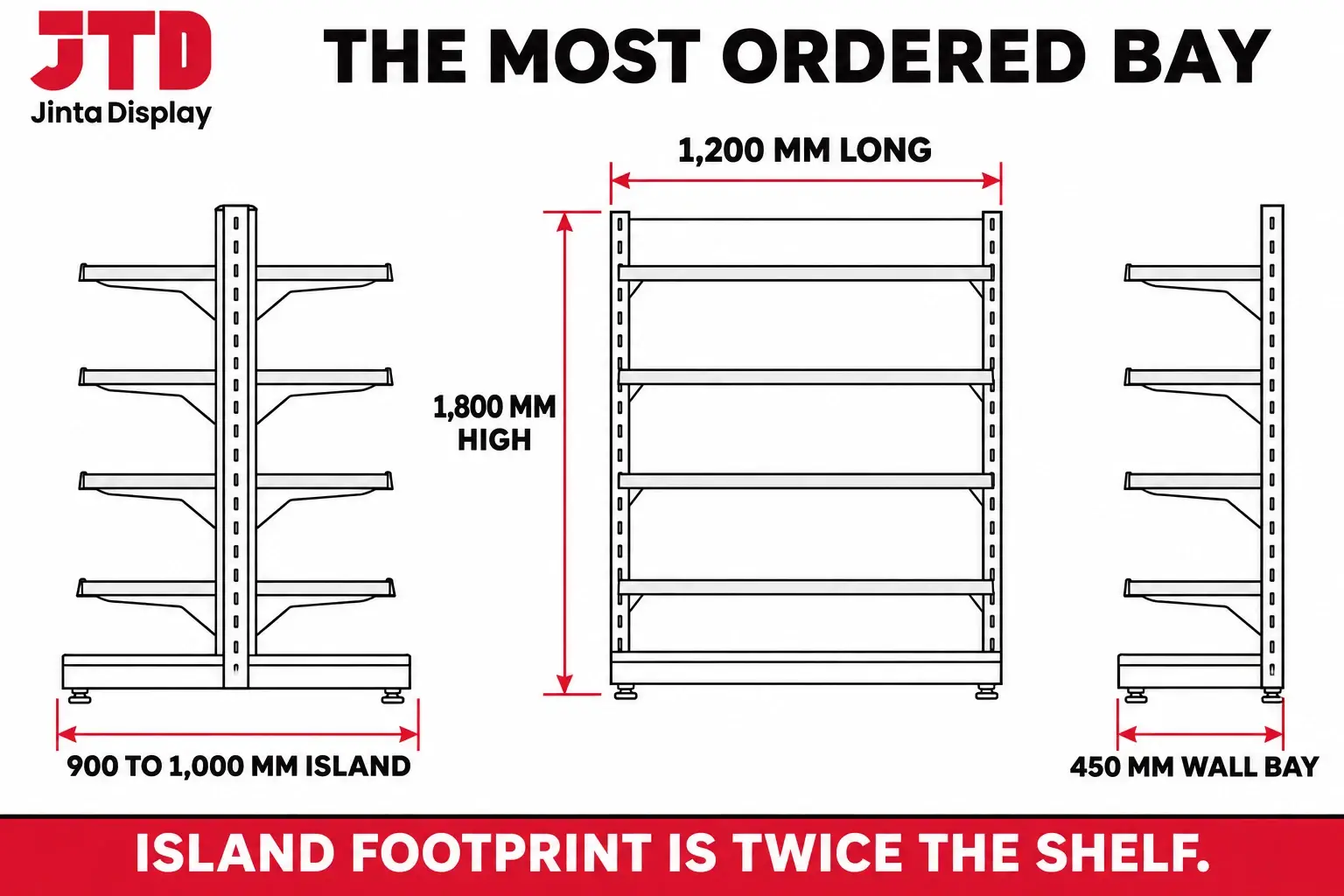
Floor depth works the other way. A wall bay takes about 450 mm of depth and an island takes about 900 mm, so the floor used per face is the same. An island does not save floor. It saves parts, and it lets one aisle serve a face on each side. Where a store has a long clear wall, it fills the wall first and fits islands to the space left.
Our supermarket range has both forms. The S50 double sided island run and the S50 single sided bay use the S50 system, and the hole back gondola is built single sided against a wall or double sided as an aisle run. Two more are built to the Lozier profile, so the uprights match an existing Lozier run. They are the Lozier compatible double sided island and the Lozier style black wall bay.
Supermarket Shelf Sizes That Stores Order
A catalog can list every possible size, while stores order a handful. A bay is fully described by five figures, the bay length, the shelf depth, the upright height, the slot pitch and the steel gauge of each part. Most quotations carry only the first three. The longer explanation, with each figure defined, is in gondola shelving sizes. The table below gives the configurations that recur most often, written as length by depth by height.
| Configuration | Size in mm | Typical use |
|---|---|---|
| Single sided wall bay, short | 900 × 450 × 1,800 | Convenience store perimeter |
| Single sided wall bay, standard | 1,200 × 450 × 1,800 | Supermarket perimeter runs |
| Single sided wall bay, deep | 1,000 × 570 × 1,800 | Bulk and multipack facings |
| Double sided island, standard | 1,200 × 900 to 1,000 × 1,800 | Main grocery aisles |
| Low island | 1,200 × 900 × 1,400 | Front of store, sightlines kept open |
| Tall wall bay | 1,000 × 470 × 2,200 | High ceilings, top stock |
Our own listings follow the same pattern. The double sided series is 1,200 × 1,000 × 1,800 mm, and the single sided bays are 900 or 1,200 mm long, 450 to 550 mm deep and 1,800 to 2,000 mm high. Sizes, colors and configuration are confirmed with the buyer for each order.
Two points catch people on a floor plan. The first is that an island’s footprint is about twice the single sided shelf depth. A 450 mm shelf becomes a 900 mm island, and a 570 mm shelf becomes a 1,140 mm island. When you subtract from the floor width to check an aisle, use the island figure. The second is that bay length is measured center to center of the uprights and not edge to edge of the shelf. A run of bays ends with one more upright, and the run is longer than the sum of the nominal lengths.
Height follows the store. Wall bays are commonly 1,800 to 2,000 mm. Center islands are often 1,200 to 1,500 mm, to keep the sightlines open across the floor, at the price of fewer shelves. Many stores mix the two, with low islands in the middle and tall bays on the walls. The top shelf should be one a shopper can reach, and stock above that is for backup and signs.
Slot Systems That Do Not Mix
Size is only half of a specification. The other half is the slot system, because shelves and brackets from one system do not fit the uprights of another. There are three in commercial use.
| System | Slot pitch | Typical bay lengths | Mixing makers |
|---|---|---|---|
| Lozier and Madix (North America) | 1 in on center, 25.4 mm | 24, 30, 36, 48 in | Not reliable, even inside the inch family |
| Tegometall pattern (Europe) | 50 mm | 665 to 1,333 mm | Broadly interchangeable |
| Asian built bays | 50 mm, H slot | 600, 900, 1,000, 1,200 mm | Broadly interchangeable at the same pitch |
The pitch of 25.4 mm and the pitch of 50 mm are never a little compatible. Brackets seat or they do not. A store that already owns Lozier shelving and wants to extend it needs bays built to the Lozier profile, and a store on a metric system needs the same pitch and the same profile as its existing runs. This is the reason we list Lozier compatible bays as a separate product from the S50 and hole back systems.
A store that is fitting out for the first time has more freedom. It can choose the system for the market it sells in, for the accessories it plans to hang and for the parts it can buy locally later. It is worth asking where the spare shelves and hooks will come from in five years, before the order is placed.
Load, Steel and Finish
The label heavy duty on a quotation says little. What counts is the rated load per shelf, stated for a shelf length, a depth and an even spread of weight. Capacity is set by the shelf panel, the bracket, the upright and the span between uprights, and it falls as the shelf gets deeper. Two bays can share the same length, height and depth and still behave differently, because one uses a 0.6 mm shelf panel and the other a 1.0 mm panel. Ask for the steel gauge of the upright, the shelf panel, the back panel and the bracket, as four separate figures.
Supermarket shelves are designed for packed goods, and a typical grocery shelf carries cans, bottles and cartons at modest weights. A bay that will hold drinks in bulk, tools or hardware needs a stronger rating and a stated figure. The loads, spans and definitions for the heavier systems are in heavy duty metal shelving, capacity and choosing. For tool free shelving with drop in beams, see boltless and bolted shelving.
Most supermarket runs are powder coated steel. Color is set by the buyer, and wood grain or wooden panels can be combined with a steel frame for bakery, produce and boutique sections. Wood needs more care in damp or cold areas, and steel needs a coating to resist marks. The choice depends on the department and on the finish of the rest of the store.
Planning Aisles and Counting Shelf Face
The useful way to compare layouts is shelf face per square meter of floor, because the face holds the product. It depends on three things, the depth of the run, the aisle beside it and the number of faces on it.
Take a hall 12 m wide and 10 m long, with a 450 mm deep wall bay along each long wall. The wall bays take 900 mm, which leaves 11,100 mm for islands and the aisles between them. The islands are 900 mm deep. With n islands there are n plus 1 aisles, so the test is n × 900 plus (n + 1) times the aisle width, and it must fit in 11,100 mm. The worked count is the same one we set out in the longer article on single and double sided runs.
| Aisle width | Islands that fit | Space left | Shelf face in 10 m of hall |
|---|---|---|---|
| 1,200 mm | 4 | 1,500 mm | 100 m |
| 1,500 mm | 4 | 0 mm | 100 m |
| 1,800 mm | 3 | 1,200 mm | 80 m |
The face counts two faces for each island and one for each wall bay. Four islands of 10 m give 80 m and the two wall runs add 20 m, which makes 100 m. Three islands give 60 m plus 20 m, which makes 80 m. The step from 1,500 to 1,800 mm aisles costs 20 m of shelf face, or 20% of the stock capacity of the room, for a change that looks small on a drawing. At 1,200 mm the room has 1,500 mm left over, which is wasted unless the aisles are widened a little or an end cap is added. At 1,500 mm the room fits exactly, which is tight in practice because plinths and end caps stick out.
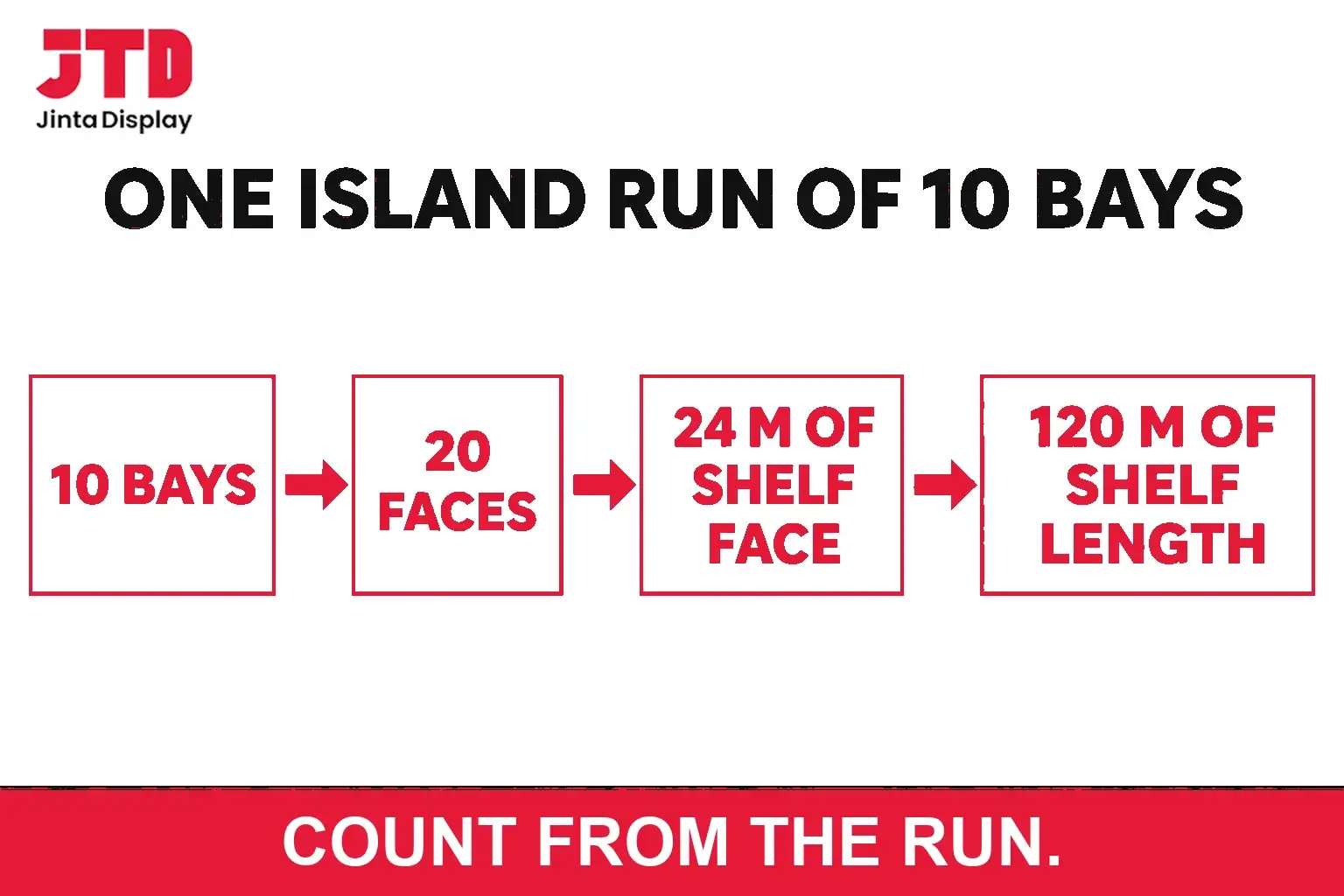
Now count one island run. A run of 10 bays at 1,200 mm is 12 m long. It is double sided, so it has 20 bay faces, and 24 m of shelf face at 1.2 m a face. With five shelf levels in each bay, the shelf length is 120 m. The run stands on a floor strip 12 m long and 0.9 m deep, which is 10.8 m². A single sided run of the same 10 bays has 10 faces on 5.4 m², and the floor used per face is the same, 0.54 m². These are assumptions to replace with your own bay length, depth and number of levels.
For a full store, with zones, flow and the count of islands, see supermarket layout design. In that worked example an 800 m² store holds 7 islands of 30 bays at a 1,500 mm aisle, and the shelving takes 28% of the sales hall. A smaller shop is covered in convenience store layout and shelving plan.
Accessories That Turn a Frame Into a Store
A bare frame is not yet a supermarket shelf. The accessories make it fit a particular range. They fall into six groups, hooks and pegs, dividers and pushers, price channels and shelf talkers, headers and canopies, end panels and bumpers, and baskets and bins. Almost all of them hang from the slots or holes of the system, so the first check is compatibility, meaning the slot pitch and the type of back panel.
They add up faster than most buyers expect. In a 10 bay wall run with five shelves per bay and 1,000 mm bays, the price channel alone is 50 m. The accessory article has the counts for each group. See gondola shelving accessories. For how the shelf is filled and faced once the frame is in place, see visual merchandising principles for shelving.
Supermarket Shelves for Small Stores and Special Formats
The same bay serves many store types, and each has its own habits.
A convenience store uses shallower shelves, such as the 350 mm in our convenience store example, and narrower aisles, with a short counter zone near the door. A grocery store in the United States, and a supermarket in the UK, Australia or India, use the deeper 450 mm wall bay and the 900 mm island. A neighborhood shop in the Philippines or India often puts a counter between the shopper and the goods, which changes the layout. Our articles on the sari sari store and the Indian kirana and general store cover those cases.
A bakery wants shallow, adjustable shelves in steel, wood or a steel frame with wooden faces. Bread is light and bulky, so depth and spacing matter more than load rating. A wall of four 1,000 mm bays with five shelves each holds about 180 loaves at 9 a shelf. See bakery display shelves. A pharmacy needs shelves that suit small boxes and a counter that suits dispensing, and a liquor store needs shelves rated for bottles. Both are covered in pharmacy shelving and liquor store shelving.
Watch Supermarket Shelving in a Store Fit-Out
Our channel has a short video on a supermarket shopping display solution. It shows a finished set of shelves in a store and gives a sense of how the pieces fit together.
How to Specify an Order for Supermarket Shelves
A supplier can only quote what you describe. A short, complete specification saves several rounds of emails and prevents the surprise on the day the container lands. Send these items, with the figures filled in.
- The floor plan with the wall lengths, the columns, the entrance, the stockroom and the front end.
- The number of single sided wall bays and double sided island bays, and the length of each run.
- The bay length, the shelf depth and the upright height for each form.
- The slot system, with the pitch, or a sample of an existing upright if you are extending a run.
- The number of shelf levels in each bay and the load you expect on them.
- The steel gauge you want for the upright, shelf panel, back panel and bracket.
- The color, the panel finish and any logo or header.
- The end caps and accessories, with the hooks and price channels counted.
- The destination port and the trade terms you need, FOB, CNF or CIF.
Ask for the quotation to state the system, the pitch and the gauges. A quotation that lists only a length, a depth and a height cannot be compared with another one. When two suppliers quote very different figures for the same bay, the difference is usually in the gauge or in what is counted as a bay.
What We Make
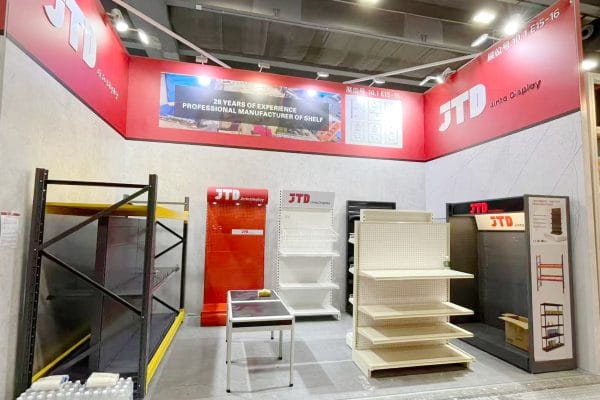
JTD Jinta is a shelf manufacturer in Suzhou, China, with 28 years in shop fittings. Our supermarket range has five listings, the hole back gondola, the Lozier compatible double sided island, the Lozier style single sided black bay and the S50 single sided bay and double sided island run. All are freestanding, with adjustable shelf pitch and a color set by the buyer. The listings carry a minimum order of 20 bays and a lead time of 10 to 30 days.
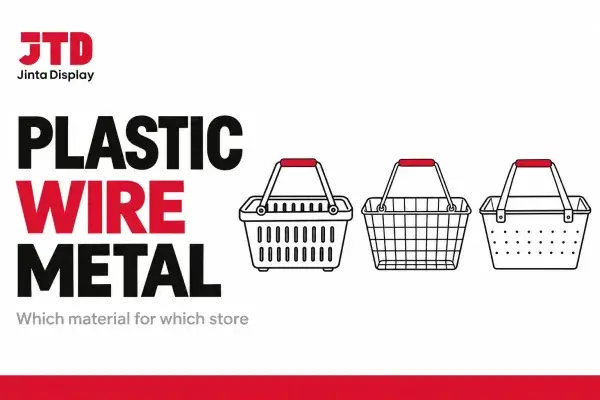
See the full supermarket shelf range and the checkout counters that go with it. We also build shopping carts and baskets, and the supermarket equipment list shows how many of each a store needs.
Seven Slips on a Supermarket Shelf Order
Six mistakes recur. One is ordering on length, depth and height alone, without the slot pitch, which leaves the shelves and hooks incompatible. Another is deciding the shelves before the aisle, which makes the aisle whatever is left. A third is taking the label heavy duty as a rating. Tall islands that block every sightline are a fourth. A fifth is counting wall and island runs together without separating one face from two. Last comes a mix of systems with no spare parts.
A seventh mistake belongs to the order and not to the plan. Many buyers fix the quantity and forget the extras. Order spare shelves, brackets and end panels with the first container. A shelf that is damaged in a busy week should not mean waiting for a second shipment.
For related reading, see what a gondola is in retail, gondola shelving sizes and supermarket layout design.
If you are planning a store, send us your floor plan and the bay sizes you prefer and we will reply with a bay layout, counts and a quotation.
Frequently Asked Questions
What are supermarket shelves?
They are freestanding steel bays made of a floor base, slotted uprights, a back panel and shelves on brackets that adjust in height. They stand against a wall as single sided bays or down the floor as double sided islands.
What is the difference between supermarket shelves and supermarket shelving?
They name the same product. Shelves usually means the fixture or its levels in everyday speech, and shelving means the system. The trade also calls it gondola shelving, shop shelving in the UK and Australia, and grocery store shelves in the United States.
What size are supermarket shelves?
The most ordered bay is about 1,200 mm long and 1,800 mm high. Wall bays are 450 mm deep and double sided islands 900 to 1,000 mm deep. Sizes change by system, so confirm the slot pitch and the gauge before ordering.
How high should supermarket shelves be?
Wall bays are commonly 1,800 to 2,000 mm high. Center islands are often 1,200 to 1,500 mm, to keep sightlines open across the store. Many stores mix both, with low islands in the middle and tall bays on the walls.
What are supermarket shelves made of?
Most are powder coated steel, with steel uprights, back panels, brackets and shelf panels. Wood grain or wooden panels can be added to a steel frame for bakery, produce and boutique sections. Color is set by the buyer for each order.
How much shelf does a supermarket need?
It depends on the floor and the aisle width. In our worked example, an 800 m² store holds 7 islands of 30 bays at a 1,500 mm aisle, and shelving takes 28% of the sales hall. Widening the aisle to 1,800 mm drops it to 6 islands.
Can supermarket shelves from different makers be mixed?
Only at the same slot pitch and profile. Lozier bays use a 1 in pitch and are not reliably interchangeable even among themselves. Most Asian and European bays use 50 mm and are broadly interchangeable. Always check a sample upright before extending a run.
What is the minimum order for supermarket shelves?
Our supermarket shelves carry a minimum order of 20 bays and a lead time of 10 to 30 days. Size, color and configuration are confirmed with you for each order, and quotations can be on FOB, CNF or CIF terms.