
Heavy duty metal shelving is one of the most searched and least defined products in storage. One supplier calls a shelf heavy duty at 150 kg, another at 800 kg, and a third uses the label for anything with a thick coat of paint. Buyers then compare prices for products that carry very different loads, and the cheapest quotation often wins until the first shelf bows.
This guide explains what sets the capacity of heavy duty shelving, how to read a rating and how to choose between the main types. It covers boltless shelving, long span shelving, angle shelving and pallet racking, with worked examples for loads in cartons and in tonnes. It is written from the manufacturing side. Figures for our own shelving come from our product pages and are marked as ours, and figures from trade listings are marked as listings and not as test results.
It does not cover price, installation rules or the regulations that apply to a site, which depend on the place and the use. For shelving that carries pallets, the rating and inspection questions belong to your engineer. Pallet-loaded racking has its own guides on pallet rack capacity and what pallet racking is.
What Heavy Duty Metal Shelving Means and Why the Label Is Not Enough
No standard defines heavy duty for shelving. The words are a marketing grouping, and the number behind them differs between suppliers and between countries. A useful way to read the label is as a prompt to ask for a figure, never as a figure itself.
Four questions turn the label into information. What is the rated load per shelf, in kilograms? Over what shelf length and depth is it rated? Is the load spread evenly or placed at a point? And is the figure a tested rating or a calculated estimate? A supplier that answers all four is selling a specification. A supplier that answers only with an adjective is selling a picture.
The unit of rating matters too. Shelving is usually rated per shelf, and a rack is rated per level or per beam pair. A 5 tier unit rated at 200 kg per shelf does not hold 1,000 kg in total unless the uprights and the floor are rated for that, because the uprights carry the sum of all the shelves. Ask for the total on the uprights as well as the figure per shelf.
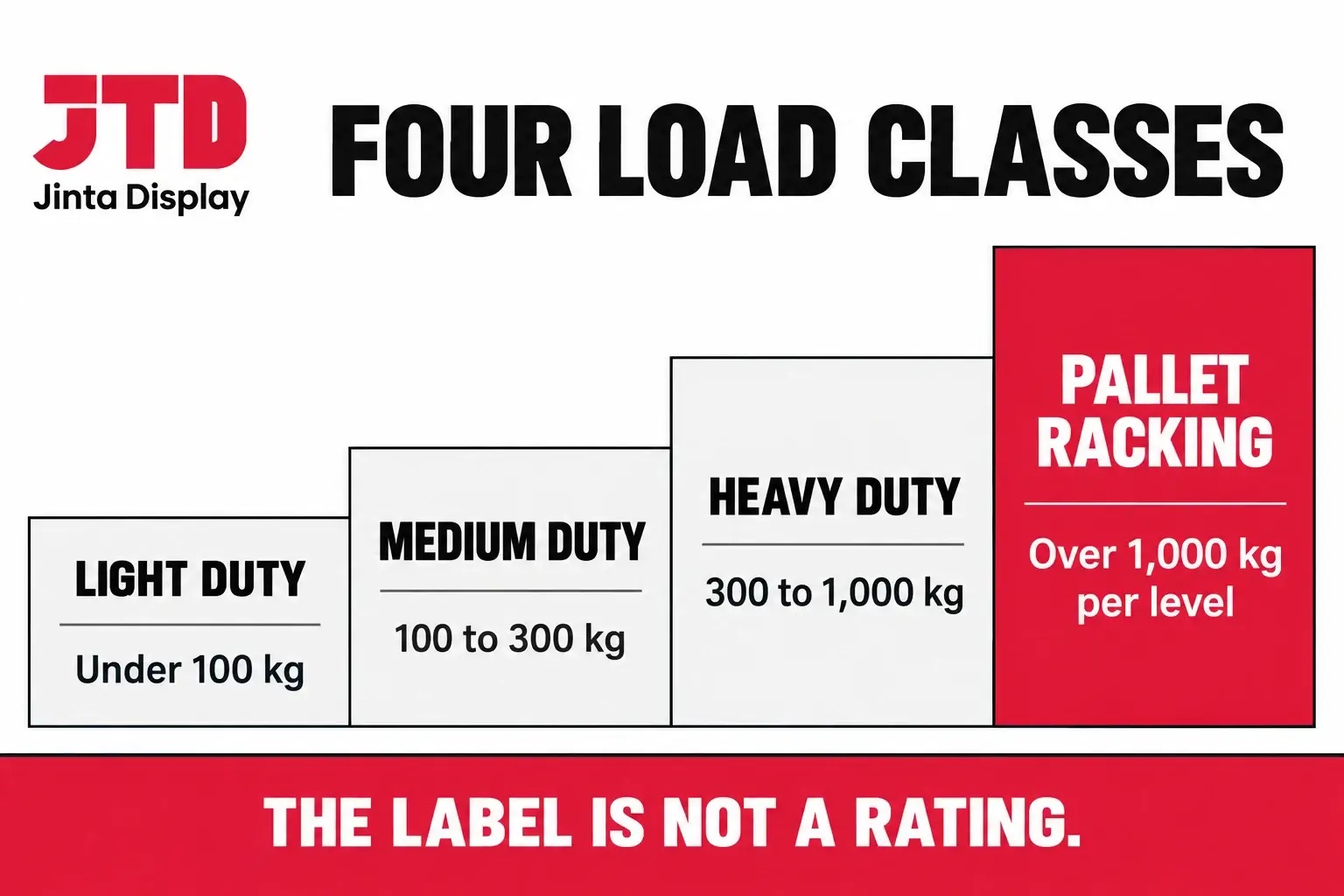
Load Classes for Heavy Duty Shelving
The groupings below are common in the trade, and they help a buyer to find the right family of product before looking at specifications. They overlap, and a given supplier may draw the lines differently.
| Class | Typical load per shelf or level | Typical use | Typical product |
|---|---|---|---|
| Light duty | Under about 100 kg | Home, office, small stock rooms | Thin shelf panels on slim uprights |
| Medium duty | About 100 to 300 kg | Cartons, parts, retail stock rooms | Boltless shelving, long span shelving |
| Heavy duty | About 300 to 1,000 kg | Heavy parts, tools, drums by hand | Reinforced long span, medium duty racking |
| Pallet racking | Over 1,000 kg per level | Palletized stock reached by forklift | Selective pallet racking |
Most buyers who search for heavy duty metal shelving want the middle two rows. The top of the heavy duty class is where shelving ends and racking begins, and the boundary is the means of loading. If goods are lifted by hand, shelving is the right product. If a forklift places them, the structure is racking, and it should be specified and rated as racking.
What Decides the Capacity of Heavy Duty Shelving
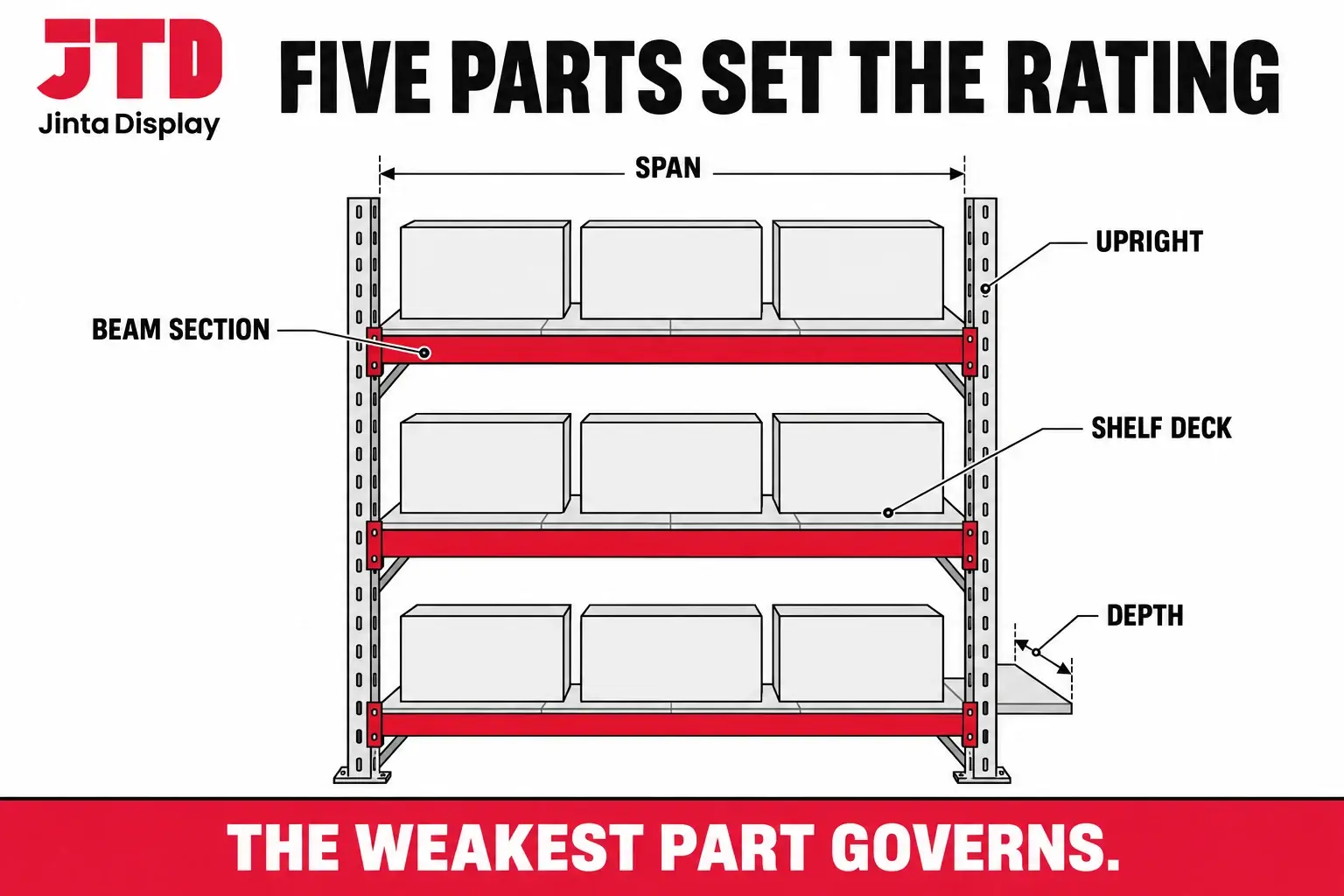
Five parts set the rating of a shelf, and the weakest one governs. Looking at them in turn shows why two units of the same size can differ by a factor of three.
Beam section and thickness. The beam is the horizontal member under the shelf. Its depth and its wall thickness decide how much it bends under load. A deeper section is far stiffer for the same steel, and a thicker wall adds strength. Our boltless beams are listed at 1.0 to 1.5 mm.
Span. The distance between uprights is the most powerful variable. For a given section, doubling the span roughly halves the load the beam can carry on strength, and it cuts the load much more when the limit is deflection. A 1,200 mm shelf holds less than a 900 mm shelf of the same section.
Shelf deck. The deck is the surface the goods sit on. A thin steel panel spreads the load to the beams but can dish under a heavy point load. Our boltless shelf panels are listed at 0.5 to 0.8 mm, which suits cartons and light parts. Heavier loads call for a thicker panel, a wood or board deck, or a wire deck on stronger supports.
Upright. The upright carries the sum of the shelves and resists the sideways forces. Its section and wall thickness set how much total load the unit can take. Our boltless uprights are 38 × 38 mm with a wall of 1.0 to 1.8 mm.
Depth. A deeper shelf carries more area and so more total load, and it puts the load farther from the upright. Rated load per shelf usually falls as depth rises for the same beam, since the same steel carries a larger area.
How to Read a Shelf Capacity Rating
A rating for heavy duty metal shelving is a statement about a configuration. Three conditions come with every honest figure, and a figure without them cannot be compared.
The first is the length and depth of the shelf. A rating of 200 kg on a 900 mm shelf says nothing about a 1,200 mm shelf. The second is the way the load is spread. Ratings assume a uniformly distributed load, which means the weight is spread along the whole shelf. A single heavy item placed in the middle bends the beam more than the same weight spread out, so a point load should be well below the rating. The third is the basis. Some ratings come from physical tests, and some from calculation. Ask which.
Look also at how the unit stands. A tall unit with heavy shelves can tip if it is not braced or fixed to a wall or the floor. The rated shelf load assumes the unit is stable, and the stability is a separate matter that depends on the base, the bracing and the fixing. Do not load the top shelves first, and put the heaviest goods low.
Boltless Shelving as Heavy Duty Shelving
Boltless shelving, also called rivet shelving, is the most common product sold as heavy duty metal shelving for stock rooms and garages. The beams drop into slotted uprights, so a bay goes up without bolts or tools and the shelf levels can be moved later. It suits cartons, parts and tools handled by hand.
Our boltless range is built in cold rolled steel with 38 × 38 mm uprights at 1.0 to 1.8 mm, shelf panels of 0.5 to 0.8 mm and beams of 1.0 to 1.5 mm. The standard bays are 900 × 300 × 1,830 mm, 1,200 × 450 × 1,830 mm and 900 × 400 × 1,830 mm, in 4 and 5 tier versions, in black or white powder coat. Our product pages do not give a rated load per shelf. Our trade listings state about 150 to 300 kg per layer for the heavy duty series and under 200 kg per layer for a standard bay. These are listing figures and not tested ratings, so confirm the rating for the exact bay on the drawing.
For heavier loads on the same system, the usual changes are a deeper beam section, a thicker panel or a board deck, and a shorter span. Our boltless shelving range is made to order, and the sections are chosen from the load you give us.
Long Span, Angle and Wire Shelving Compared
Boltless shelving is one of several types, and each suits a different load and use.
| Type | How it is built | Strength | Best for |
|---|---|---|---|
| Boltless shelving | Beams drop into slotted uprights | Medium, per shelf | Stock rooms, garages, retail back rooms |
| Long span or medium duty shelving | Beams hook into uprights, often with decking | Medium to heavy | Cartons and parts over longer spans |
| Bolted angle shelving | Slotted angle joined with nuts and bolts | Medium, fixed layout | Permanent installs with a known load |
| Wire shelving | Wire decks on posts | Light to medium | Food stores, clean areas, airflow |
| Pallet racking | Frames and beam pairs for pallets | High, per level | Palletized stock by forklift |
Our long span and medium duty shelving, such as the 2,000 × 600 × 2,000 mm bay, uses the same upright and beam principle as pallet racking and is described in the guide to warehouse racking types. It is the right step up from boltless shelving when the load or the span grows. Pallet racking is the next step again, with ratings from 1,000 to 4,000 kg per level in our listings.
Worked Examples for Choosing Shelf Capacity
Examples show how to use a rating. The loads are assumptions and should be replaced with your own.
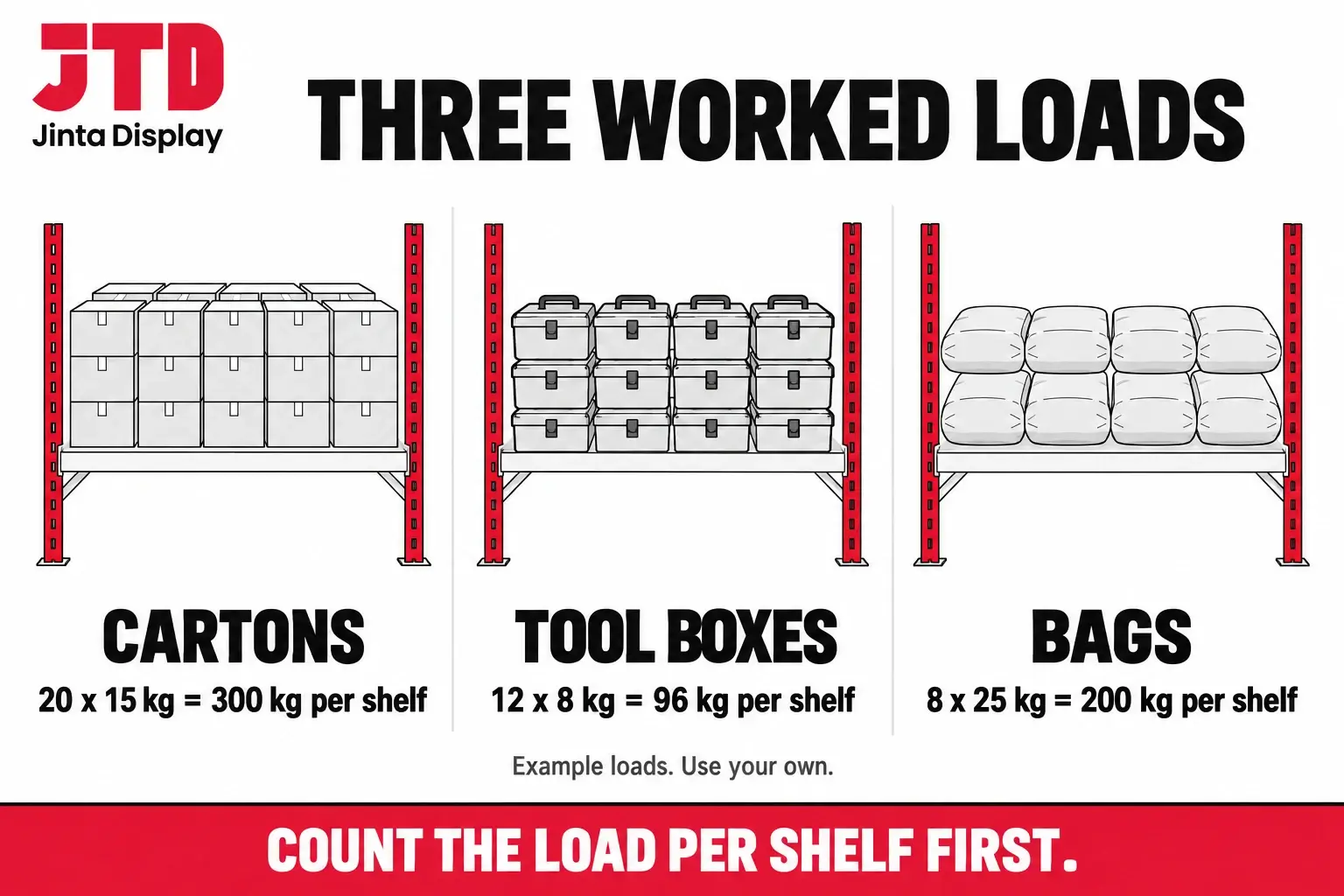
First example. A stock room stores cartons that weigh 15 kg each, and a shelf 1,200 mm long and 450 mm deep holds 20 of them at a time. The load is 20 × 15, or 300 kg per shelf. A 5 tier unit of that kind carries 1,500 kg in total on its uprights. A bay rated at under 200 kg per shelf is too light, and the choice is a heavier section, a shorter span or a different product.
Second example. A workshop stores tools and parts in boxes of about 8 kg. A 900 mm shelf holds 12 boxes, or about 96 kg. A standard boltless bay suits this, and the margin is generous, though the heaviest items should still go on the lowest shelves.
Third example. A shop stores bags of 25 kg on a 1,200 mm shelf, with eight bags per shelf. The load is 8 × 25, or 200 kg. This sits at the limit of a standard bay and in the middle of a heavy duty series, so the rating on the drawing decides the choice. In each example, add a margin for loads that are heavier than the average, and do not fill every shelf to its limit.
Heavy Duty Storage Shelves for the Garage and Workshop
Many searches for heavy duty storage shelves come from garages, workshops and small businesses that need a strong unit at a fair cost. The load is usually tools, paint, boxes of fixings and spare parts, handled by hand. A boltless unit with a deck of steel or board suits this, and it can be built in minutes and changed as the stock changes.
The practical points are the same as for any heavy duty shelves for storage. Weigh the heaviest items and put them low. Choose the shelf length by the span rule, and do not stretch a light section over a long bay. Fix tall units to a wall, because garages have uneven floors and shelves get bumped. Paint and chemicals add weight and can leak. A deck with a raised edge or a tray under cans helps.
Cold and damp matter in a garage. A powder coat finish is fine for a dry garage, and a galvanized finish lasts longer where the air is damp. If the unit stands on a concrete floor that gets wet, use feet or a base that lifts the steel off the surface.
Heavy Duty Steel Shelving in Retail and Commercial Stock Rooms
A shop or a small warehouse uses heavy duty steel shelving for cartons, spare stock, packaging and equipment. The loads are higher and the use is daily, and the shelving works harder than a garage unit. Staff load it quickly and often, and impacts from trolleys and boxes are common.
Choose a rating with a margin for daily use, and ask for sections that resist knocks. A deeper beam and a thicker upright last longer than the lightest option. Plan the layout so that aisles are wide enough for a trolley, which is usually at least 900 mm and more where two people pass. Label the shelves with their rated load to tell staff the limit, and keep the heaviest goods on the lower levels.
For a retail back room that feeds a sales floor, the shelving should sit where replenishment is quick. It pairs naturally with the front-of-store fixtures from the same plant, so the colors and finishes agree. The order of purchase for a whole store is covered in the supermarket equipment list.
Shelf Deck Options for Heavy Duty Metal Shelves
The deck is the part of heavy duty metal shelves that touches the goods, and the choice affects both capacity and use. Three options are common.
A steel panel is the standard deck. It is clean, strong for its weight and easy to wipe. Thin panels can dish under heavy point loads, and thicker ones carry more. A board deck, in wood or an engineered board, spreads load well and can be replaced if damaged. It adds weight and can hold moisture. A wire deck lets air and light through and drains water, which suits food and wet areas, but small items can fall through, and point loads are less well spread.
The rated load applies to the shelf as supplied. Changing the deck changes the rating, up or down, so confirm it with the supplier. A heavy deck on a light beam adds weight to the beam and can cut the load it carries. Decide the deck first and the beam second.
Shelf Spacing, Height and Number of Tiers
The number of tiers and the spacing between them affect how useful a unit is. Our boltless bays are 1,830 mm high with 4 or 5 tiers, and the shelf levels can be moved to suit the goods. Leave enough clearance for the tallest item plus room to slide it in and out, and avoid wasting height with spaces that are too large.
Keep the top shelf within easy reach. A shelf at about 1,800 mm is out of reach for many people. Keep light, rarely used goods there and heavy, frequently used goods lower down. A step stool is safer than climbing the shelves. For a steel shelving heavy duty unit that holds heavy items, plan so that nothing heavy sits above shoulder height.
Width matters as well. A longer bay gives more shelf per upright and lowers the cost per meter of shelf, but it lowers the rated load, as set out above. A shorter bay carries more per shelf and uses more uprights. The best length is the one that carries your load with a margin, and no longer.
Finish, Coating and Where the Shelving Stands
A shelving unit lasts longer when its finish matches its room. The coating protects the steel and affects how long it lasts. A powder coat suits dry indoor use, and a galvanized finish suits damp or outdoor areas. Our boltless range is offered in black or white powder coat, and OEM colors on request. A shelf in a garage, a cold store or a food area has different needs from a shelf in a dry office.
Check how the shelves are cleaned and whether the surface will be wiped or washed. A smooth coated panel is easy to clean. An open wire deck lets air and light through but lets small items fall. Choose the deck for the goods, and the coating for the room.
Checking Heavy Duty Metal Shelving When It Arrives
A delivery of heavy duty metal shelving should be checked against the order before it is assembled. Count the uprights, beams, shelf panels and fittings against the packing list. Measure the section sizes and the length of the beams, and compare them with the specification. Weigh a sample part if the weight is stated.
Look at the finish for scratches, bare steel and uneven coating, especially at the edges and slots. Check that the slots in the uprights are clean and well formed, because rough slots make assembly hard and can weaken the connection. Build one bay first. Load it to a safe fraction of its rating and look for bowing, noise or movement. If the first bay is sound, build the rest.
Keep records of the batch, including the drawing and the approved sample. Heavy duty metal shelving that is extended later should match the first delivery in section, profile and color. A supplier who keeps your drawing and holds the same system in production makes this easy, and a supplier who changes the profile makes it hard.
Safe Loading Habits for Heavy Duty Shelving
The rating protects the shelf only when the shelf is loaded as assumed. Spread heavy goods along the shelf and place the heaviest on the lowest shelves. Do not exceed the rated load, and do not climb the shelves. Fix tall units to the wall or the floor where the supplier advises, and keep goods from overhanging the front edge.
Look at the shelving from time to time. Check for bowed beams, loose connections, bent uprights and damaged panels. A bowed beam is a sign of overload, and a bent upright should be replaced and not straightened. These habits are general good practice, and your own safety rules apply on top of them.
What to Send a Supplier
A supplier can quote heavy duty metal shelving from a short brief, and the brief decides whether the reply is a specification or a catalog line. Give the weight of the heaviest item and the usual load per shelf, the shelf length and depth you want, the height and the number of tiers. Say how the goods are loaded and whether they are spread or concentrated. Add the finish and color, the floor and wall details, the quantity and the destination. If you already own shelving of the same kind, a photograph of one bay and its measurements help the supplier match the section and the profile. State any limit on height, since a low ceiling or a sprinkler line can cap the number of tiers and change the layout.
If you are choosing shelving for a known load, send us your load per shelf and the bay size you need and we will reply with a specification and a quotation.
Frequently Asked Questions
How much weight can heavy duty shelving hold?
How much weight heavy duty metal shelving can hold depends on the configuration. Common groupings put heavy duty at roughly 300 to 1,000 kg per shelf, and above that the structure is racking. The rating applies to a shelf length, depth and an even spread of load, so always ask for the figure for your bay and confirm whether it is tested.
What is the difference between heavy duty and light duty shelving?
Light duty carries under about 100 kg per shelf on thin panels and slim uprights. Heavy duty carries several hundred kilograms on deeper beams, thicker steel and stronger uprights. The labels have no standard definition, so compare the rated load per shelf and the conditions behind it.
How do you calculate the shelf capacity you need?
Multiply the weight of one item by the number that sit on the shelf to get the load per shelf, then add a margin for heavier items. Multiply by the number of shelves for the load on each upright. Choose a rating above both figures, for your shelf length and depth.
Does a longer shelf hold less weight?
Yes. For the same beam section, a longer span carries less, and the drop is large when deflection is the limit. A 1,200 mm shelf holds less than a 900 mm shelf of the same section. A longer shelf needs a deeper beam, a thicker wall or a board deck.
Is boltless shelving the same as heavy duty metal shelves?
Boltless shelving suits medium to heavy loads handled by hand, such as cartons, parts and tools. Our listings state about 150 to 300 kg per layer for the heavy duty series, and a tested rating for your bay is confirmed on the drawing. Loads that need a forklift belong on racking.
What steel thickness does heavy duty metal shelving use?
There is no set thickness, but capacity rises with beam and upright thickness. Our boltless uprights are 38 × 38 mm at 1.0 to 1.8 mm, with 1.0 to 1.5 mm beams and 0.5 to 0.8 mm shelf panels. Compare the section as well as the thickness, because a deeper beam is far stiffer.
When should I use pallet racking instead of shelving?
Use pallet racking when goods are on pallets and lifted by forklift, or when a level must carry more than about 1,000 kg. Shelving is for goods lifted by hand. Our beam racking is listed at 1,000 to 4,000 kg per level, and the type choice is covered in our guide to racking types.
How should I load heavy duty shelving safely?
Spread the weight along each shelf, put the heaviest goods on the lowest shelves and stay within the rated load. Fix tall units to a wall or floor where advised, and check for bowed beams or bent uprights. Replace damaged parts. Your own safety rules also apply.