
Warehouse racking types look like a long list until you notice that they answer the same question with different priorities. Every system trades selectivity, meaning the ability to reach any pallet at any time, against density, meaning the pallets stored per square meter of floor. Know which side of that trade you are on and the shortlist of types of warehouse racking drops to two or three.
This guide covers the four warehouse racking types that make up most general warehousing and that we build in Changshu. For each one you get the bay sizes, the upright and beam sections and the load per level listed on our product pages, so you can check them against your own pallets and ceiling height and not against a brochure adjective.
It does not walk you through drive-in, push-back, pallet flow, shuttle or automated storage as if we supplied them. There is a short section below on where those belong. It also stops short of installation, inspection and local compliance, which are decided by your site and your jurisdiction and not by the factory that rolls the steel.
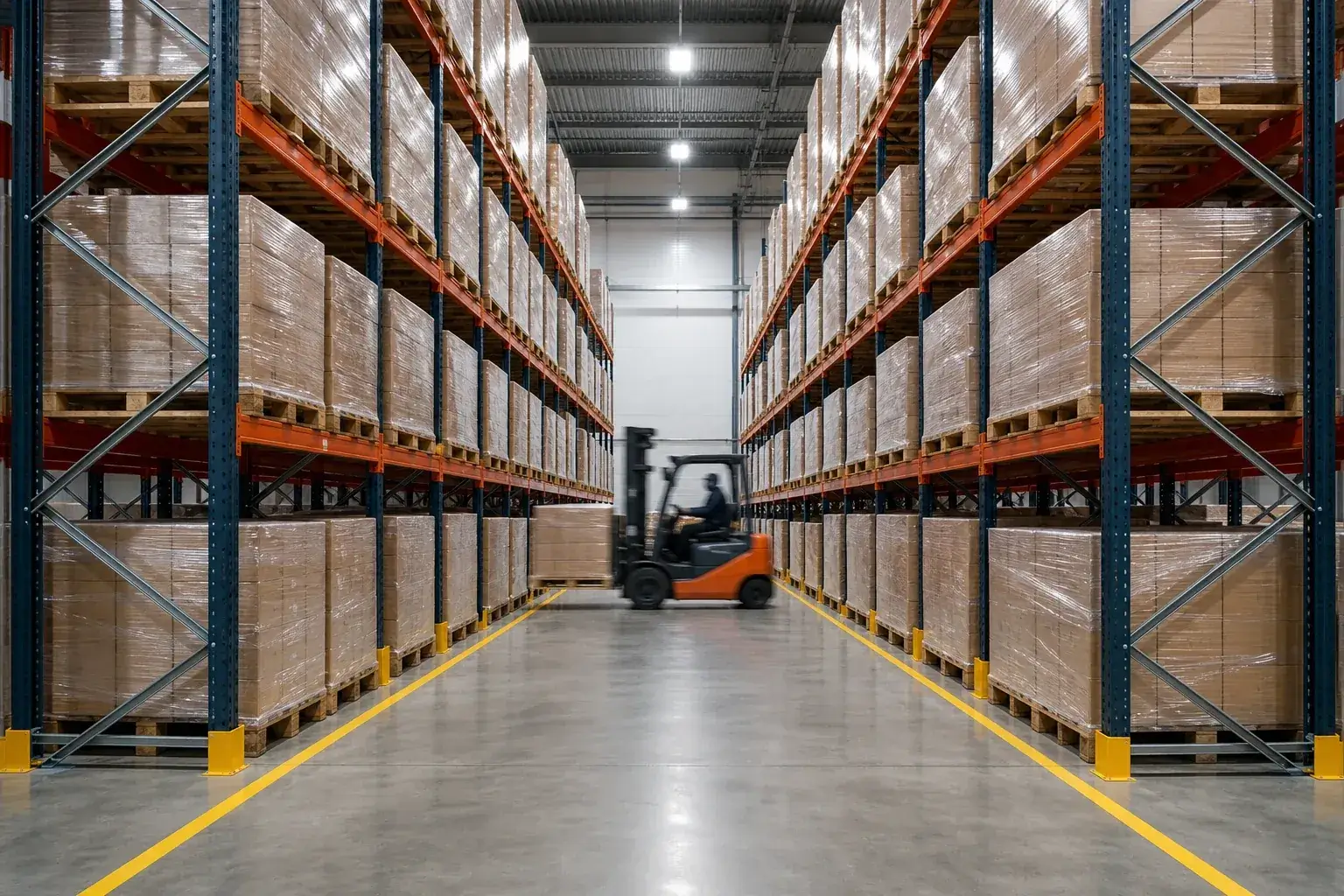
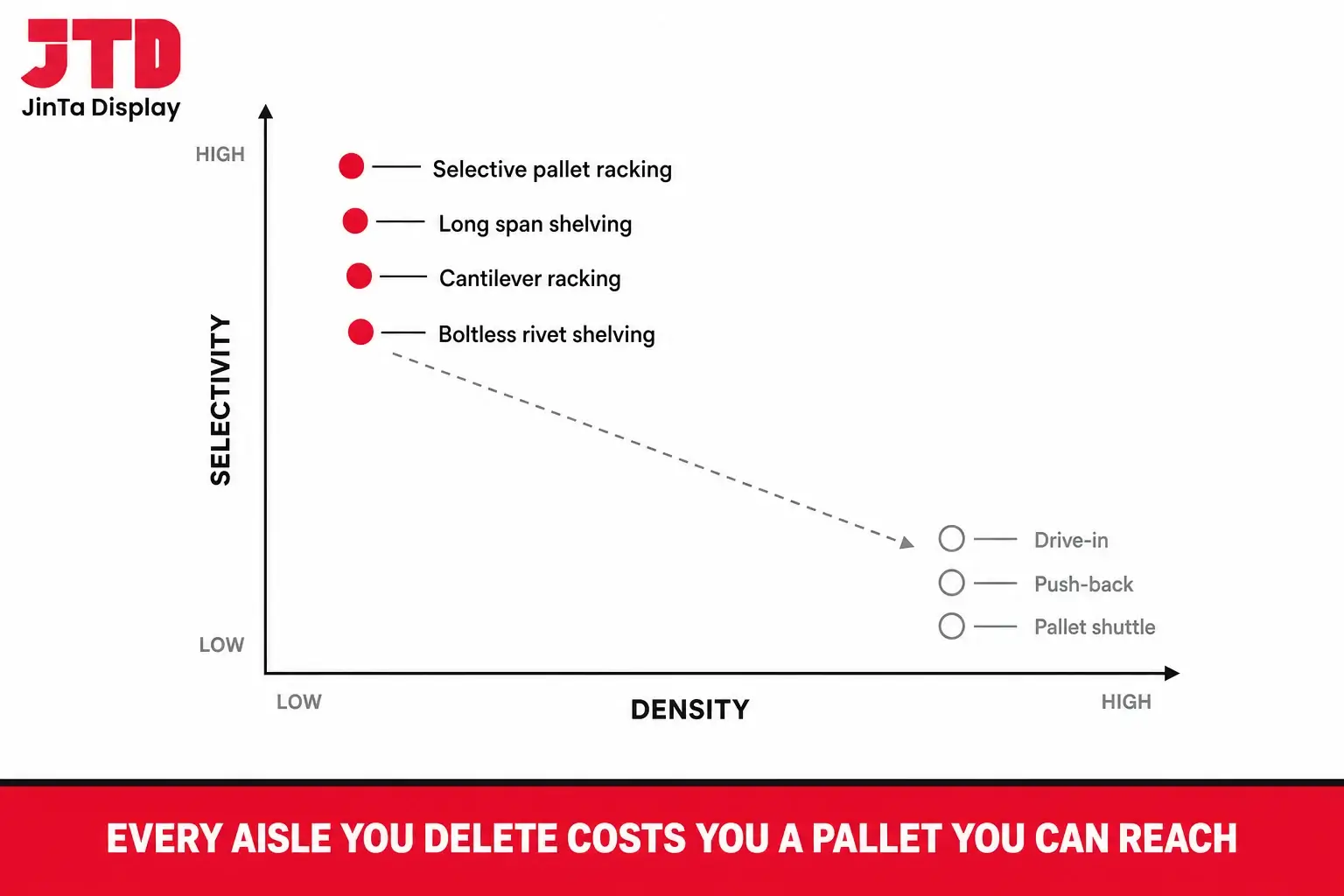
The One Trade-Off That Sorts Every Racking Type
Selectivity is the share of your stored pallets that you can pick up right now without moving another pallet first. One-deep racking with an aisle on both sides gives you 100%. Store pallets two deep and the front one blocks the back one and selectivity halves. Store them eight deep in a lane and you are down to one pallet in eight.
Density moves the other way, and it is bought with aisles. Gangways commonly absorb a third to more than half of a conventional building footprint. Every high-density system earns its claim by deleting them, and every deleted aisle costs selectivity.
Three consequences follow, and they decide more projects than any spec sheet does.
Your ratio of SKUs to pallets picks the system, not your building size. Hold 400 SKUs at roughly one pallet each and dense lane storage is actively harmful, because a six-deep lane holding one SKU wastes five positions. Hold 20 SKUs at 30 pallets each and the same lane is ideal.
Handling equipment sets your aisle width, and the aisle sets your layout. As a typical industry range, a counterbalance forklift wants roughly 3.2 to 4.3 m of clear aisle to turn and place a pallet, a reach truck manages in about 2.6 to 3.0 m, and hand picking needs only room to walk a cart through. Your existing fleet may rule out half the options before racking is discussed.
Stock rotation is structural and not procedural. Racking loaded and unloaded from the same face behaves last in, first out. Loaded from one side and picked from the other, it behaves first in, first out. With dated stock, that is decided when the steel goes in.
Type 1, Selective Pallet Racking
Selective pallet racking is a run of upright frames connected by horizontal beams, with pallets stored one deep and reached directly from the aisle. It is the default racking type worldwide, and for most warehouses that hold mixed palletized stock it is also the correct one.
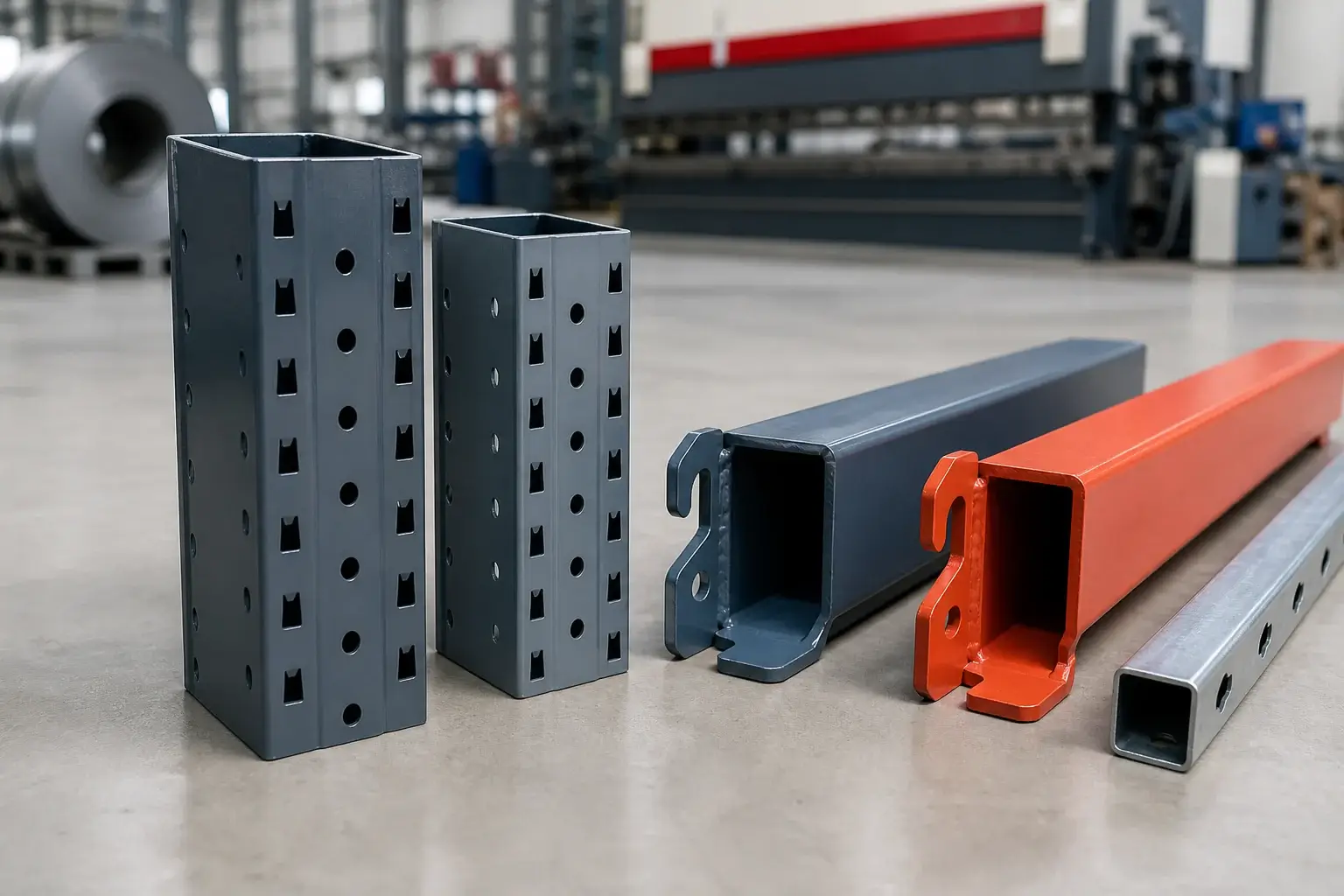
Uprights are the vertical frames, each a rolled column with punched holes down its length, braced diagonally in pairs. Beams carry the load, hook into those holes and lock with a safety pin. Because the connection is a hook and not a bolt, beam levels move up and down the frame in fixed steps, which is what lets you re-pitch a bay when your product changes.
Our bays run from 2 m to 4 m high on uprights of 80 × 60 mm in 1.5 to 2.3 mm or 90 × 70 mm in 1.8 to 2.2 mm, with beams of 100 × 50 or 120 × 50 mm, in cold rolled steel.
| Bay (W × D × H, mm) | Rated load per level | What that bay is for |
|---|---|---|
| 2500 × 1200 × 2000 | 1,000 to 4,000 kg | The 1,200 mm depth takes a standard pallet either way round |
| 2500 × 1000 × 2000 | 1,000 to 3,000 kg | Two pallets per level at low clear height |
| 2700 × 1000 × 3000 | 1,000 to 4,000 kg | Widest beam span in the range, fewer uprights on the floor |
| 2500 × 1000 × 2550 | 1,000 to 4,000 kg | Heavy duty bay at a moderate height |
| 2000 × 1000 × 3500 | 1,000 to 2,000 kg | Order-picker height, levels re-pitch freely |
| 2500 × 1100 × 4000 | 1,000 to 2,000 kg | At 4 m the top beams are forklift work and not ladder work |
Two points on that table are where specification mistakes happen.
Depth is set by the pallet and not by the product. A GMA pallet is 1,219 × 1,016 mm (48 × 40 in) and a Euro pallet is 1,200 × 800 mm. Beams normally sit slightly shallower than the pallet so the load overhangs front and rear, which is intentional because a pallet bears on its stringers or blocks and not on its deck boards. A 1,000 mm frame takes a Euro pallet loaded the long way. A 1,200 mm frame takes a GMA pallet either way round, which matters if stock arrives from mixed origins.
The load figure is per beam level, uniformly distributed, with a pair of beams working together. A level rated 3,000 kg is not 3,000 kg of point load in the middle of one beam. Widen the bay and the same section carries less, which is why a 2,700 mm span and a 2,000 mm span are not interchangeable in identical steel. Design practice limits beam deflection under full load to roughly 1/180 of the span, and a visibly bowed beam is one loaded past its rating. How ratings are derived and how to read a load plate is set out in our guide to pallet rack capacity, and the full range sits under warehouse racking. The 3000 mm heavy duty warehouse rack page lists the sections side by side, and the sizing of a bay from the pallet is worked through in our guide to pallet rack dimensions.
Type 2, Long Span and Medium Duty Shelving
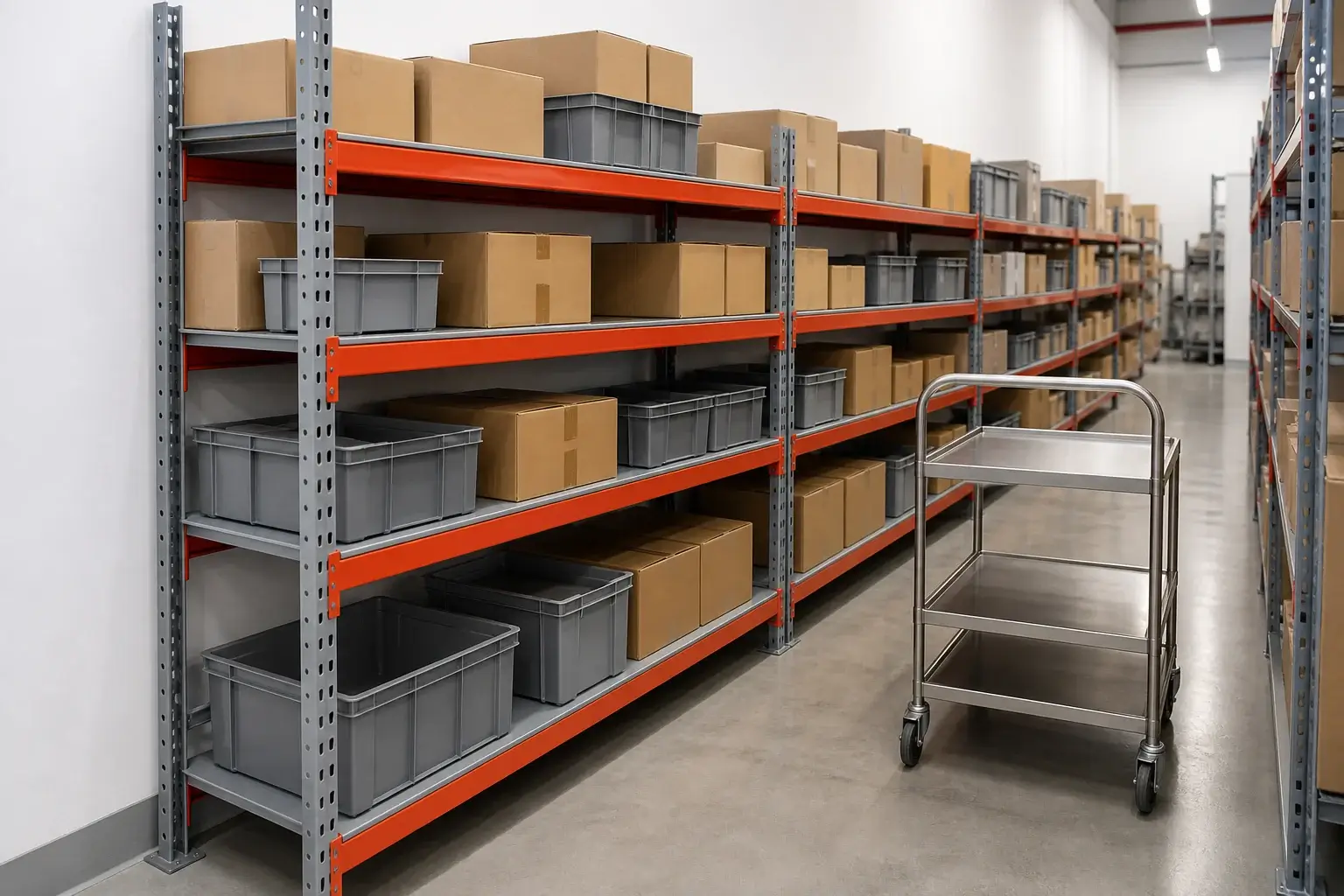
Long span shelving, also sold as medium duty racking or carton shelving, uses the same upright and beam principle as pallet racking but is sized for cartons, totes and loose stock handled by hand. The distinguishing feature is depth. Pallet racking is 1,000 mm deep or more because a pallet is, while hand-loaded shelving is 400 to 600 mm deep because that is how far a person comfortably reaches.
Of the warehouse racking types, this is the one most often bought wrongly, in both directions. Pallet racking gets ordered for a stock room where nothing arrives on a pallet, losing a meter of depth per run to product nobody can reach. Light shelving gets ordered for a parts store, and the levels then sag under boxed metal components. Two of our bays mark out the working envelope.
| Bay (W × D × H, mm) | Type | How it is worked |
|---|---|---|
| 2000 × 600 × 2000 | Long span, wide bay | Hand loaded from the aisle, and it fits down a narrow gangway where a pallet bay will not |
| 1000 × 400 × 2000 | Medium duty, compact bay | Smallest span in the range, for stock rooms and mezzanine floors, 1,000 to 2,000 kg a level |
Three notes on specifying this type.
Level pitch matters more than total height. A 2,000 mm bay split into four levels gives roughly 450 mm of clear height each once shelf thickness is counted. That is fine for cartons up to about 400 mm tall and useless for anything bulkier. Measure your tallest regular carton first, then divide.
Top shelf height should follow the picker and not the ceiling. A 2,000 mm bay puts the top level within reach of most people without a step. Going to 2,500 mm adds a level and a ladder, and the ladder is paid for on every pick.
Shelf type changes the rating. Steel panel decking, wire mesh and chipboard behave differently under point loads, and mesh also lets sprinkler water through, a detail your fire authority may have a view on. Where product is loose or awkwardly shaped, storing it in folding wire containers on pallet racking is often cheaper than shelving fine enough to hold it.
Type 3, Cantilever Racking
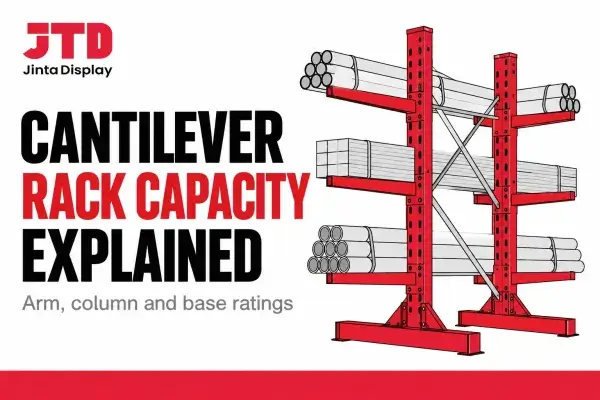
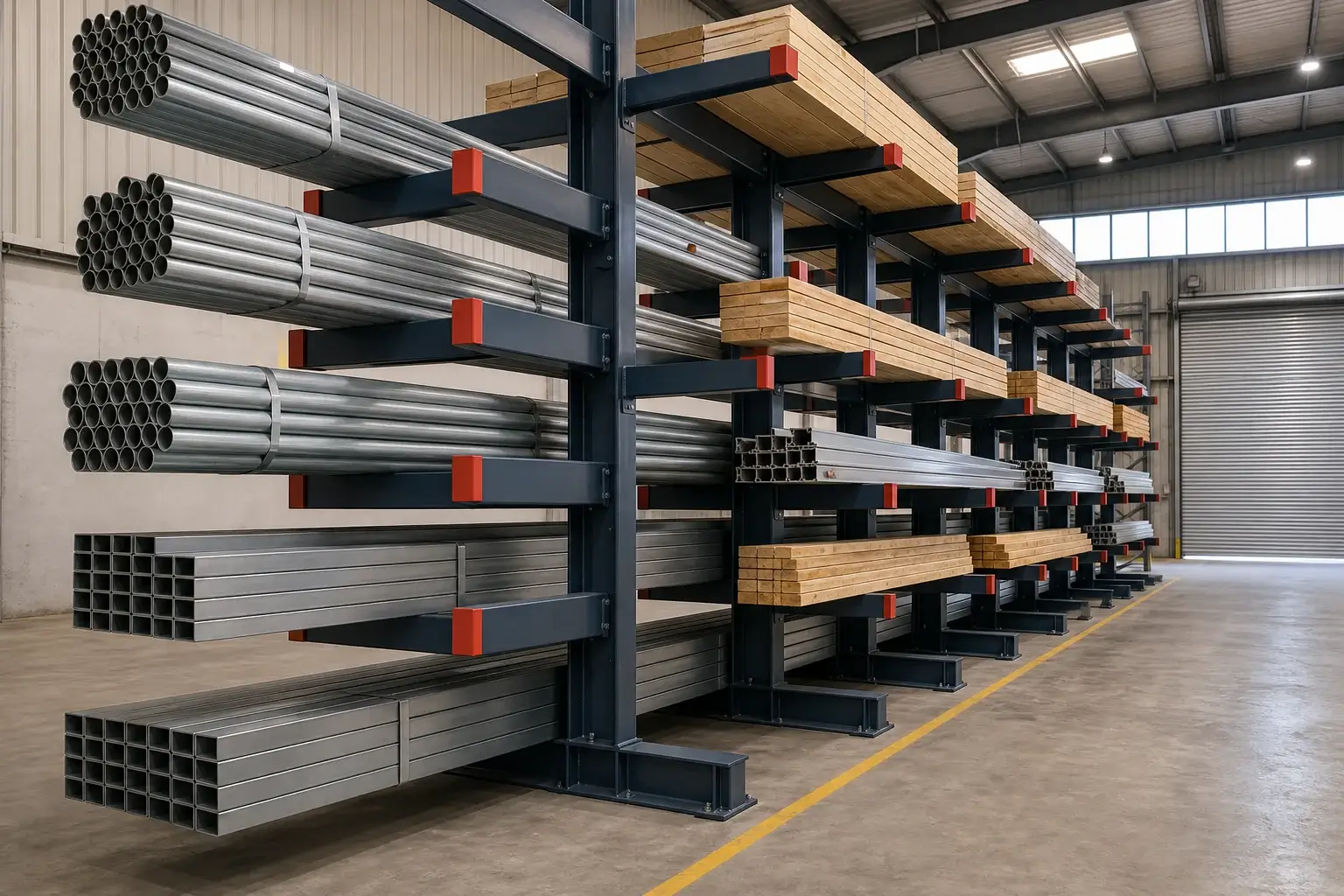
Cantilever racking replaces the front-to-back frame with arms projecting from a single column, so long stock loads from the side with nothing in the way. It exists because pallet racking has an upright every few meters, and a 6 m length of pipe does not care how well engineered that upright is.
A column stands on a base that resists the tipping moment created by loading the arms. Arms bolt or hook onto the column at adjustable heights, and a bracing set ties columns into a run. Single-sided columns take arms on one face and sit against a wall, while double-sided columns take arms both ways and stand in the open with an aisle each side.
| Configuration | Size (mm) | Column and base |
|---|---|---|
| Single sided | 1300 × 600 × 2000 | 200 × 60 mm column on a 200 × 120 mm base |
| Double sided | 1300 × 1600 × 2000 | 200 × 80 × 2.5 mm column and base |
| Double sided | 1300 × 1600 × 2500 | 200 × 80 × 2.5 mm column and base |
| Multi-column run | 5500 × 1300 × 2475 | 600 mm arms, holds stock longer than one bay |
The load rating across this range is quoted at 500 to 3,000 kg per level. One thing to understand about any cantilever figure, from any supplier, is that it is an arm rating and it depends on where along the arm the load sits. The same arm carries much less at its tip than at its root, because bending moment is force multiplied by distance. A kilogram number with no arm length attached is the figure to ask about.
Cantilever also has a failure mode the beam types do not have, and that is tipping. A double-sided run loaded heavily on one face only is trying to fall over, and the base and the floor fixing are what stop it, which makes the loading pattern part of the specification. Configurations and arm options live on the cantilever rack page.
Type 4, Boltless Rivet Shelving
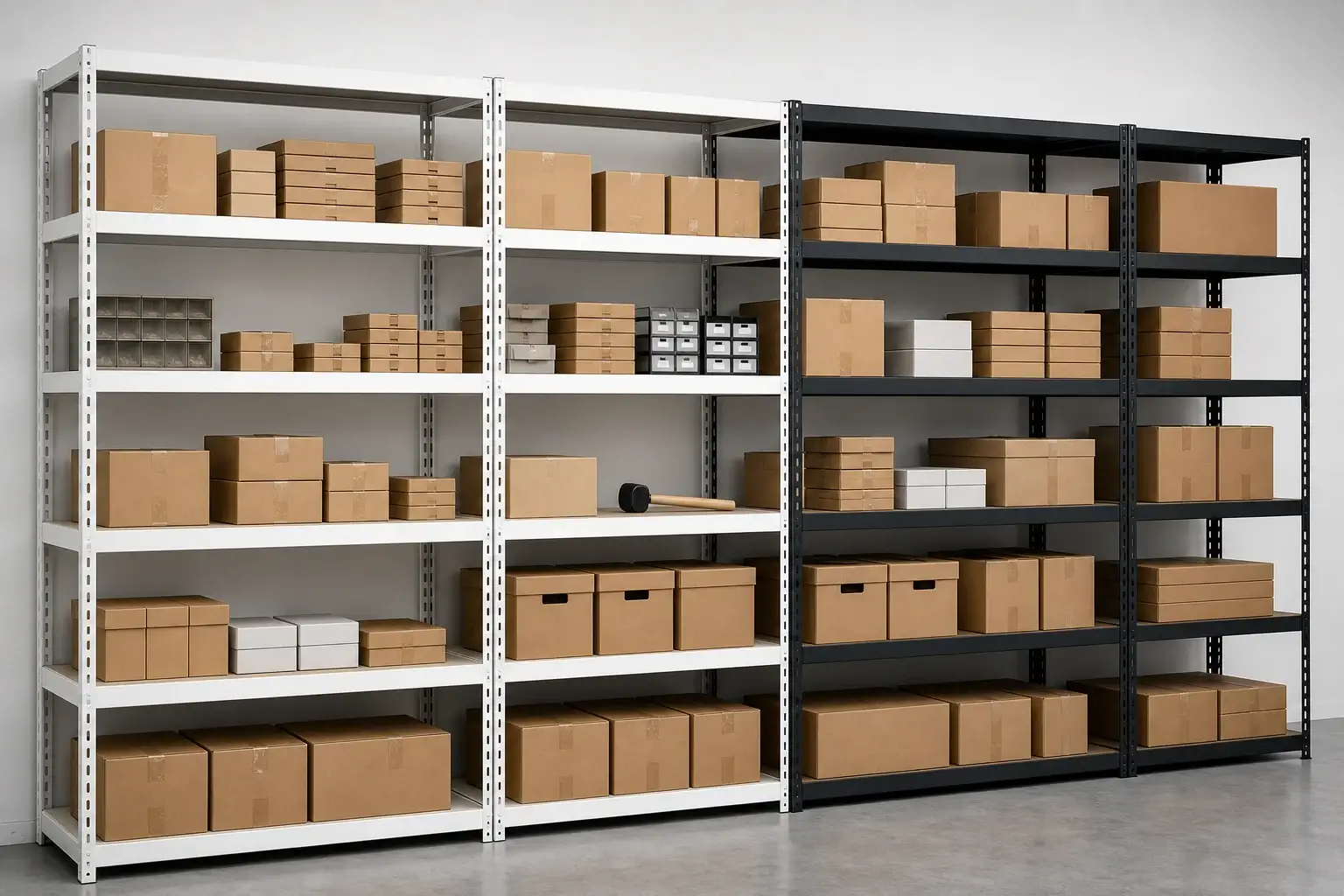
Boltless rivet shelving is a light to medium duty bay whose beams carry rivets that drop into keyhole slots in the uprights, so the unit assembles with a rubber mallet and no fasteners. Elsewhere it is called rivet shelving, rivet racking or Z-beam shelving, and the assembly method is the defining feature.
It is a real niche and not a cheap substitute for racking. The other three types are engineered installations, while rivet shelving is stock room infrastructure that goes up in minutes, is re-pitched by one person and is moved when the room changes use. In a distribution business it lands in the parts store, the returns area, the packaging store and the archive and not on the main picking floor.
Our bays use 38 × 38 mm uprights in 1.0 to 1.8 mm at 1,830 mm high, with shelf panels of 0.5 to 0.8 mm and beams of 1.0 to 1.5 mm.
| Bay (W × D × H, mm) | Tiers | Note |
|---|---|---|
| 900 × 300 × 1830 | 4 or 5 | The standard bay. Four tiers leaves taller gaps for boxed stock and five packs more levels into the same footprint |
| 900 × 400 × 1830 | 4 or 5 | 100 mm deeper than standard, for cartons that would otherwise overhang |
| 1200 × 450 × 1830 | 5 | Wide bay that mixes with 900 mm bays in one run at the same height |
Two specification points decide whether rivet shelving works for you.
Per-level capacity is the number to ask for, and it is per level and not per bay. Our product pages do not state a load figure for this type of shelving, so ask for the rated load per level for the exact bay and shelf panel you plan to order. A five-tier bay quoted at a round total without saying whether it is per level or per unit tells you very little.
Mixed widths line up. Because 900 mm and 1,200 mm bays share the 1,830 mm height, a run changes width part way along without stepping. Color is a specification item too. White reads as clean in a retail back room and black hides scuffing in an industrial one. Finishes are on the boltless rack page.
How Much Floor Do Warehouse Racking Types Give Up to Aisles
A short calculation shows why the density trade-off is a floor space question. Take back-to-back selective rows, each 1,100 mm deep with 150 mm between them, served by a counterbalance truck in a 3,300 mm aisle. One module is 1,100 plus 150 plus 1,100 plus 3,300, or 5,650 mm wide, and 3,300 of those millimeters are aisle. That is about 58% of the module. A reach truck aisle of 2,800 mm brings it to 54%.
Warehouse racking types that delete the aisle recover part of that floor and lose selectivity in exchange, while the static types in this guide keep every pallet reachable. For a hand-picked shelving run the aisle is only wide enough to walk, which is why long span shelving at 600 mm deep and boltless rivet shelving at 300 to 450 mm deep suit small rooms. Our medium duty warehouse rack at 1,000 × 400 × 2000 mm is the compact end of that range.
The Four Warehouse Racking Types Side by Side
Read this table by starting at the column that matches your stock, not at the one that matches your budget.
| Selective pallet racking | Long span and medium duty | Cantilever | Boltless rivet | |
|---|---|---|---|---|
| Stock it suits | Palletized, mixed SKUs | Cartons, totes, loose boxed goods | Pipe, timber, board, bar, profile | Light boxed stock, parts, archive |
| Handled by | Forklift or reach truck | Hand, sometimes order picker | Forklift, side loader or crane | Hand |
| Typical depth | 1,000 to 1,200 mm | 400 to 600 mm | 600 mm arms, 1,600 mm double sided | 300 to 450 mm |
| Height we build to | 2,000 to 4,000 mm | 2,000 mm | 2,000 to 2,500 mm | 1,830 mm |
| Load per level | 1,000 to 4,000 kg | 1,000 to 2,000 kg | 500 to 3,000 kg | To confirm per bay |
| Selectivity | 100% | 100% | 100% along the face | 100% |
| Assembly | Bolted uprights, hooked beams | Bolted uprights, hooked beams | Bolted columns, arms and bracing | No fasteners |
| Re-pitching levels | Yes, in fixed steps | Yes | Yes, arms move on the column | Yes, fastest of the four |
One row deserves the most attention. Selectivity is 100% for all four. These are one-deep, aisle-served systems, and none of them is a density play. If your brief begins with fitting more pallets into the same building, this is the wrong shortlist, and the next section says what the right one looks like.
Types of Warehouse Racking Systems We Do Not Build
Search for types of warehouse racking systems and you will find lists of eight to twelve, mostly published by material handling integrators in Europe and North America. Those lists are accurate and the systems solve real problems. We do not build them. Here is the short version of what each is for.
Double deep, drive-in and drive-through racking delete aisles by storing pallets two or many deep in a lane. Density rises sharply, selectivity falls to one pallet in however many the lane holds, and rotation becomes last in, first out, except drive-through, which is loaded and picked from opposite ends. They suit few SKUs in high volume, and cold storage and beverage are the classic cases.
Push-back and pallet flow racking put pallets on carts or rollers and let gravity do the moving. Push-back is last in, first out at two to six deep, and pallet flow is first in, first out and runs deeper. Both add moving parts, and moving parts add a maintenance routine that a static rack does not have.
Pallet shuttle systems place a powered carrier inside the lane, and a forklift only reaches the lane mouth. They are very dense and a different class of purchase, a machine with a battery and a service contract and not just steel.
Automated storage and goods-to-person robotics replace the aisle and forklift model altogether, as integration projects with software and a support relationship measured in years. Mezzanine floors answer a different question again, which is unused height and picking spread over two levels. They are structural steelwork with building-code implications and are engineered locally.
Three things follow for a buyer.
Dense systems are bought on throughput and not on price per pallet position. A lane that stores beautifully but cannot be worked fast enough during your receiving window has cost more than the racking saved.
Most warehouses that install a dense system still need the static types. Slow movers, oddments, packaging and long stock do not fit in a shuttle lane. Dense storage takes the fast SKUs and these four take the rest. A mixed installation is normal and not a compromise.
A supplier offering everything is not automatically better than one offering four things well. Test whether the numbers are specific, namely the upright section, the beam section and the load per level at your bay width. A supplier who answers in millimeters is telling you something, and one who answers heavy duty is not.
What the Type Choice Does to a Container
Few guides to warehouse racking types mention this. A local distributor has no reason to, while an exporting manufacturer thinks about it daily. The type you pick changes how much racking fits in a container, and freight per bay is a real line in your landed cost. All four ship knocked down, but they do not pack alike.
Beam length is the container constraint on pallet racking. Beams are the longest single component, and a 2,700 mm beam is close to the internal width of a 40 ft container and loads lengthwise. A run of 2,000 mm bays packs differently from the same total meters in 2,700 mm bays even though the pallet count is identical, so ask before bay width is fixed.
Upright frames are welded or bolted assemblies that set a floor on volume. A 4 m frame does not fold. Height costs container space in a way that load rating does not, and a warehouse that could work at 3 m sometimes finds the freight difference pays for extra floor area.
Rivet shelving packs densest of the four, because the 38 × 38 mm uprights nest and every component is flat at 1,830 mm or shorter. Cantilever is the least efficient, since columns and bases are heavy and arms are individual pieces, which is an argument for ordering long-load storage alongside other racking.
The wider structure of what you pay, covering steel, finish, fittings, packing and the landed items that never appear on a quotation, is set out in our breakdown of warehouse racking cost. Site installation and local labor are absent there for the same reason they are absent here, because they are priced where the building is.
A Four-Step Way to Choose Between Warehouse Racking Types
Work through these four steps for any of the warehouse racking types, in order, and the type usually names itself by step three.
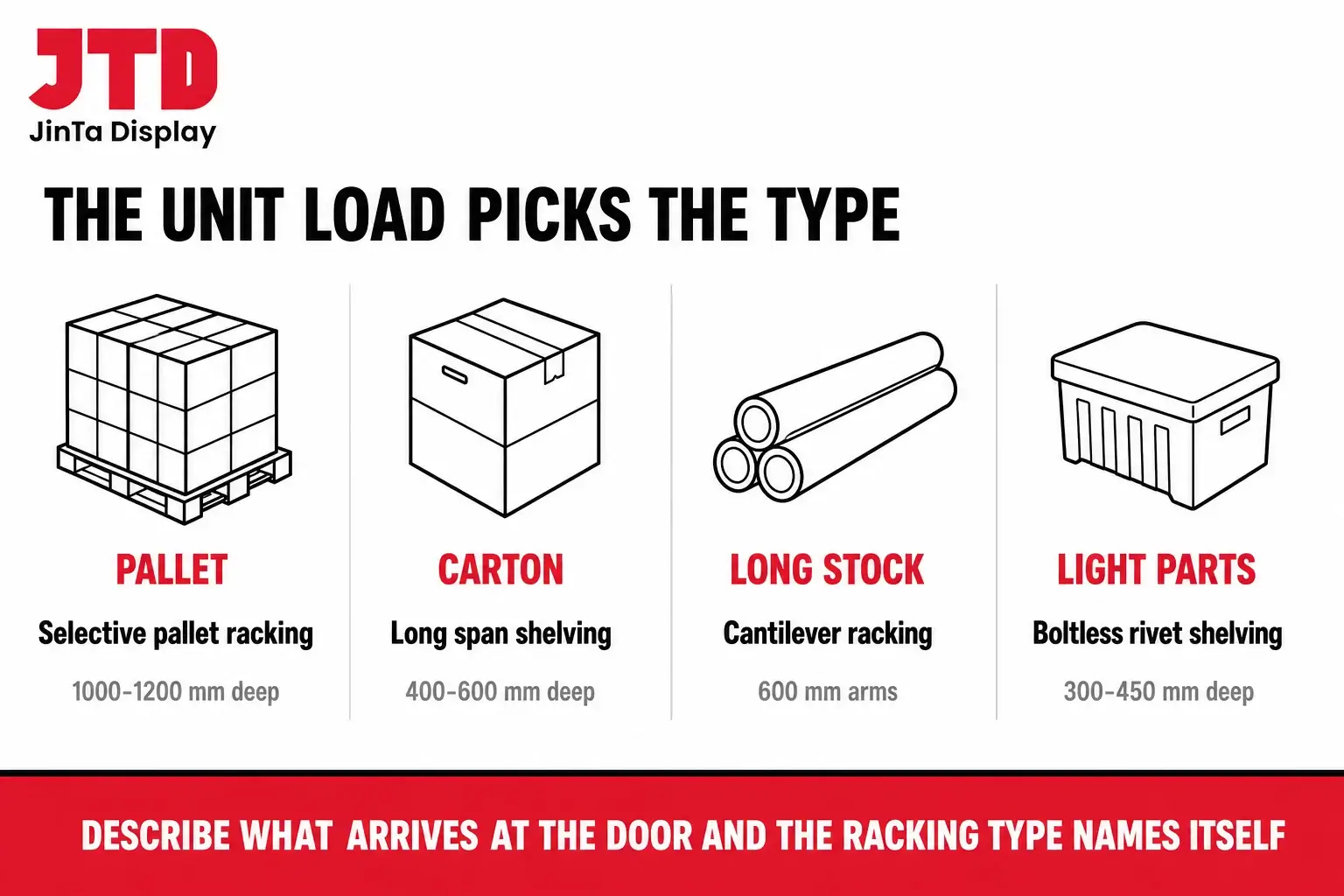
1. Describe the unit load and not the product. What physically arrives at your door, whether a pallet, a carton, a 6 m length or a loose bundle? Note its weight and the largest of its three dimensions. Long stock goes to cantilever at once, and the pallet or carton answer separates the other three.
2. Count SKUs against pallet positions. Many SKUs at low depth means one-deep selective racking. A handful of SKUs at high volume means you should be pricing a dense system instead.
3. Write down your clear height and aisle width. Clear height means the underside of the lowest obstruction, whether a sprinkler head, lighting or roof bracing, and it caps your top beam level. Aisle width comes from the trucks you already own. Together these two numbers usually remove most of the shortlist.
4. Only then ask for load ratings, in the right form. Ask for kilograms per beam level, uniformly distributed, at your bay width, and for cantilever per arm at a stated arm length. A rating without a span attached is not a rating.
Bring those four answers and a conversation about warehouse racking types takes one exchange instead of five. We build all four types to size in Changshu in cold rolled steel, shipped knocked down for container loading. Beam racking design capacities in North America are calculated against the Rack Manufacturers Institute standard MH16.1, and it is fair to ask any supplier which standard their ratings follow.
Send us your unit load, clear height and aisle width and we will reply with a suggested bay size and specification.
Frequently Asked Questions
What are the main warehouse racking types?
The static, aisle-served types that cover most general warehousing are selective pallet racking, long span or medium duty shelving for hand-picked cartons, cantilever racking for long loads and boltless rivet shelving for light stock rooms. Beyond them sit density systems such as double deep, drive-in, push-back, pallet flow and shuttle racking.
What is the difference between racking and shelving?
Racking holds unit loads and is worked by a machine, and shelving holds individual items and is worked by a person. The giveaway is depth and level pitch. A pallet rack bay is 1,000 to 1,200 mm deep, while shelving is 300 to 600 mm deep with levels spaced for a carton within arm’s reach.
Which of the warehouse racking types is the most cost effective?
For most warehouses, selective pallet racking, because it costs the least per bay, has no moving parts and suits any SKU mix. It stops being the cost effective answer when floor space is the binding constraint and you hold few SKUs in high volume. Compare cost per pallet position including the floor it occupies, not cost per bay.
Can different racking types be mixed in one warehouse?
Almost every working warehouse mixes them. A typical layout puts selective racking on the main aisles, long span shelving at a carton picking face, cantilever along one wall for long stock and rivet shelving in the parts and packaging stores. Plan the transitions, since aisle widths must suit the equipment in each zone.
How high can warehouse racking be built?
The limit is your clear height and handling equipment, not the steel. We build beam racking from 2 m to 4 m. At 3.5 m you are into order-picker territory, and at 4 m the top level is forklift work. Measure to the underside of the lowest obstruction and leave clearance above the top load.
What load capacity do I need per level?
Take the heaviest unit load you will store, multiply by the units per level and add a margin. A loaded pallet in general distribution commonly runs 500 to 1,200 kg, and a two-pallet level typically needs 1,000 to 2,500 kg. Our beam racking is rated 1,000 to 4,000 kg a level depending on bay and section.
Is cantilever racking better than pallet racking for long items?
For anything longer than a bay it is not a comparison, because pallet racking has an upright every couple of meters and the load will not go in. Cantilever arms leave the whole front open, and pipe, timber and board load from the side. The trade-off is a base sized against tipping and arms rated at a stated length.
What are the best small warehouse racking types?
For small spaces, boltless rivet shelving and compact medium duty bays work best. A 900 × 300 mm rivet bay fits a narrow stock room, and a 1,000 × 400 mm medium duty bay holds 1,000 to 2,000 kg a level in a small footprint. Choose them when nothing arrives on a pallet and the room needs to be reconfigured.