
How much does a shopping cart cost is a question where the honest answer is a structure and not a figure. A cart is a simple object made of formed wire, a tubular chassis, four wheels and a handle, and that simplicity is why prices spread so widely. There is nowhere for a specification difference to hide, so it hides in plain sight, in a wire diameter you cannot judge from a photograph, in a plating thickness measured in microns, and in a caster that looks the same and lasts a third as long.
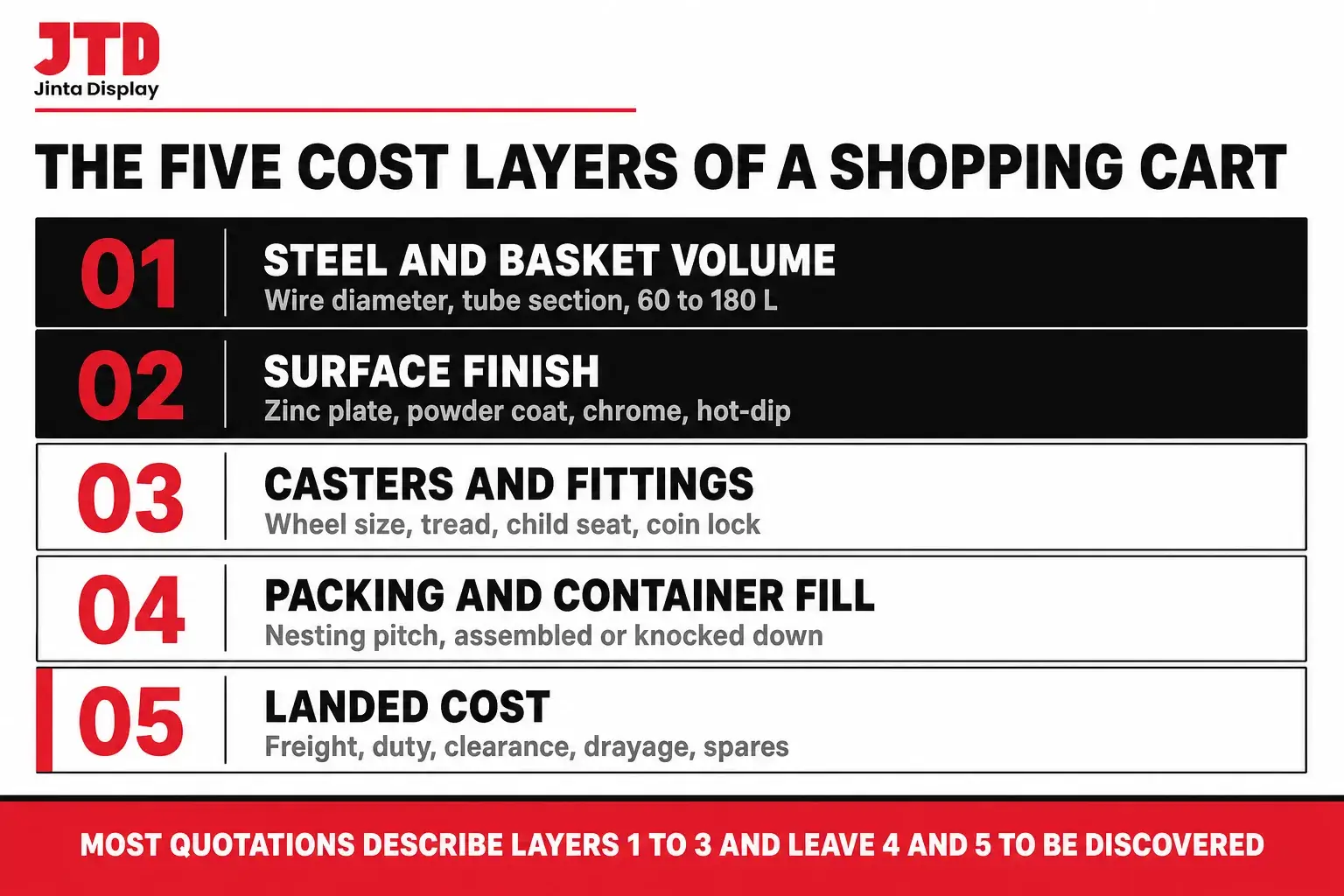
This page sets out the five cost layers a buyer pays for, in the order they appear on a quotation. It is written from the manufacturing side, so the units are millimeters of wire, microns of coating, cubic meters of container space and pieces per shipment. Where we can, it uses the actual specifications of the carts we build in Changshu, China.
This page does not publish a price. Steel, plating chemistry, ocean freight and duty all move on their own schedules, and any figure fixed here would mislead within a quarter. What does not move is the structure, meaning the layers and the questions that let you compare two documents honestly.
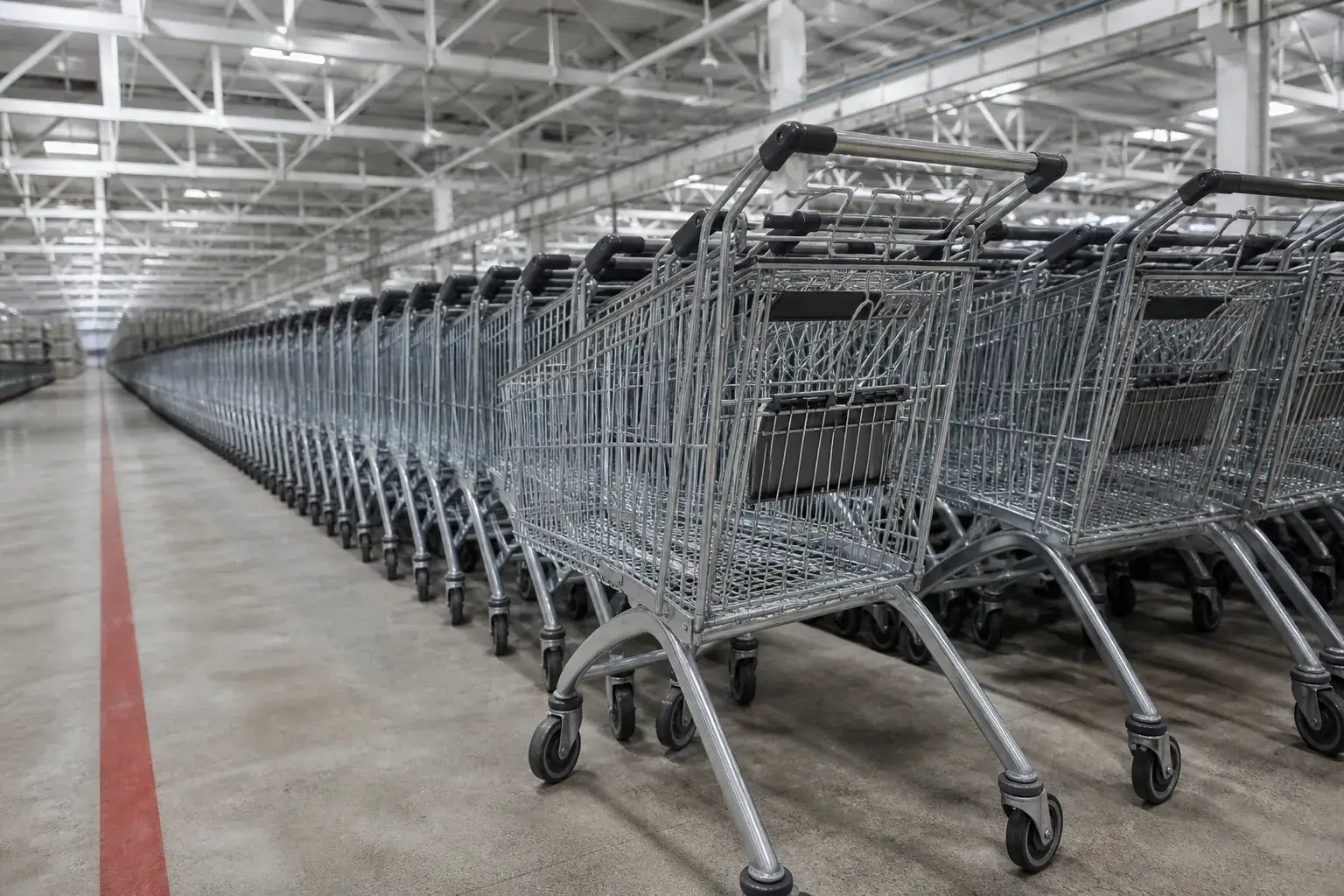
Layer 1 Steel, and the Volume It Has to Hold
Steel is the largest single line in the ex-works cost of a wire shopping cart, and decisions in this layer reach the price almost directly. When steel moves, every quotation in the market moves with it a few weeks later. The cost of a shopping cart starts with how much steel is in it, and the best public clue to that is net weight.
Basket volume is the headline, and the one buyers already know. Commercial carts are specified by basket capacity in liters. Our metal carts are listed in eight sizes from 60 to 240 L, from a convenience store aisle at the bottom to a hypermarket weekly shop at the top, with plastic bodied models from 100 to 220 L. A bigger basket costs more per cart and less per liter. A 60 L cart weighs 11.5 to 14.1 kg depending on style, which is about 0.19 to 0.24 kg of cart per liter. A 240 L cart weighs 20.1 to 26 kg, about 0.08 to 0.11 kg per liter. Volume quadruples while weight roughly doubles, because the chassis does not scale with the basket.
Style changes the steel content before any other choice does. The same capacity in a different regional style carries a different amount of metal, and the net weights on our own product pages show how much.
| Style | Net weight at 100 L | Net weight at 180 L |
|---|---|---|
| European | 14.5 kg | 19.3 kg |
| Asian | 16.8 kg | 23.1 kg |
| German | 17.5 kg | 22.3 kg |
| American | 17.6 kg | 22.0 kg |
| Russian | 17.8 kg | 25.0 kg |
Net weight includes wheels and small plastic parts, so it is a proxy for steel and not an exact count. The German style metal shopping trolley page lists all eight sizes. Even so, the heaviest style is 23% heavier than the lightest at 100 L and 30% heavier at 180 L. Two quotations for a 180 L cart can therefore describe almost 6 kg of difference before wire diameter or finish enters. The full weight table for every style and size is in our guide to shopping cart dimensions, weight and capacity.
Wire diameter and tube section are what you cannot see. Basket wire in this class of product typically runs 4.5 to 6.5 mm, with perimeter and load-bearing members heavier than the infill mesh. Chassis tube commonly falls between 22 and 32 mm outside diameter. These are industry ranges and not our specification. A supplier can take half a millimeter off the mesh wire and a tenth off the tube wall, deliver a cart that photographs identically, quote several percent cheaper, and hand you something that flexes at the basket-to-chassis weld inside two years of trolley bay use. It is the commonest reason two quotations for the same liter rating do not match.
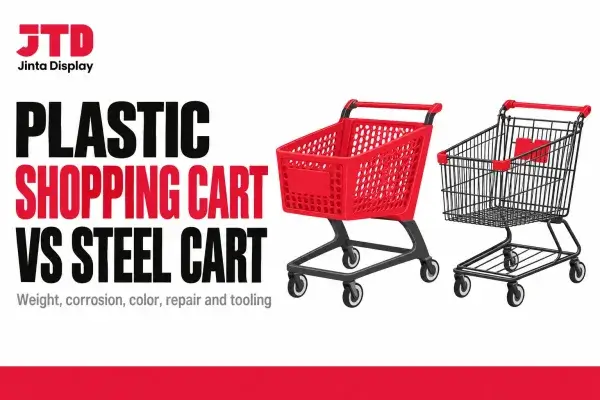
Structure type changes the material bill outright. A mesh basket, a plastic bodied trolley and a platform trolley are three different material bills for the same nominal duty. Plastic is not automatically lighter either. Our plastic bodied trolleys on Q195 carbon steel frames run 18.4 kg at 100 L and 24.5 kg at 200 L, because the frame is still steel. The same liter figure on two structures is not a like-for-like comparison. The full line is in our shopping trolley range.
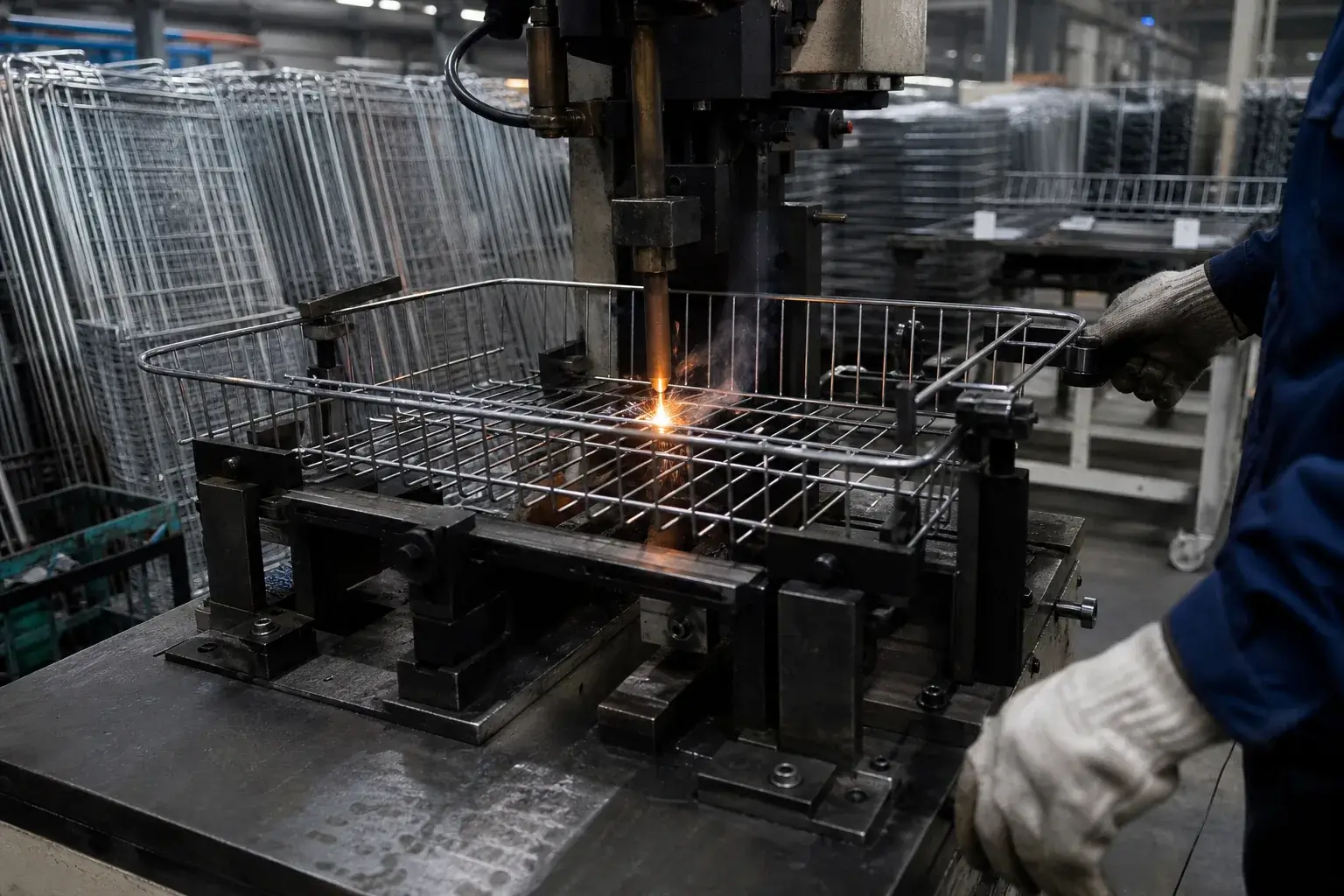
Layer 2 Surface Finish, the Layer That Decides Service Life
If layer one decides what the cart costs to make, layer two decides how long it survives. It holds the widest quality gap in the product, because coatings are quoted by name and not by thickness. Zinc plated is not a specification. It is a family of processes covering roughly an order of magnitude of corrosion protection.
| Finish | Typical coating thickness | Where it belongs | Cost effect |
|---|---|---|---|
| Electro-zinc plated | 5 to 12 µm | Indoor, dry, climate-controlled floors | Baseline |
| Zinc plated then powder coated | 5 to 12 µm plus 60 to 100 µm | Indoor with color or branding needs | Moderate increase |
| Decorative chrome | Multi-layer, nickel typically 10 to 20 µm | High-visibility front of store | Significant increase |
| Hot-dip galvanized | 45 to 85 µm | Outdoor trolley bays, coastal and humid climates | Largest increase |
These are industry-typical ranges for this class of product and not a published specification of ours. Our product pages list the metal carts as zinc plus clear coat, or chrome plate, and the finish applied to a given order is a line to confirm on the quotation.
The mistake this layer produces is almost always the same one. A buyer specifies for the showroom and pays for it in the car park. Carts that live outdoors in a coastal or humid market and were quoted with a thin electro-zinc finish show rust at the weld points and wheel mounts within a couple of seasons. Once corrosion starts at a joint the repair is not economic and the cart is scrap. Buying the heavier finish up front is one of the few places in this product where paying more lowers the cost per year of service.
The reverse error wastes money just as quietly. Hot-dip galvanizing for a fleet that never leaves an air-conditioned mall buys protection the environment will never test. Match the finish to where the cart stands and not to how the sample looks on a desk. In the UK and Australia the same item is a shopping trolley or a supermarket trolley, and the finish question is identical.

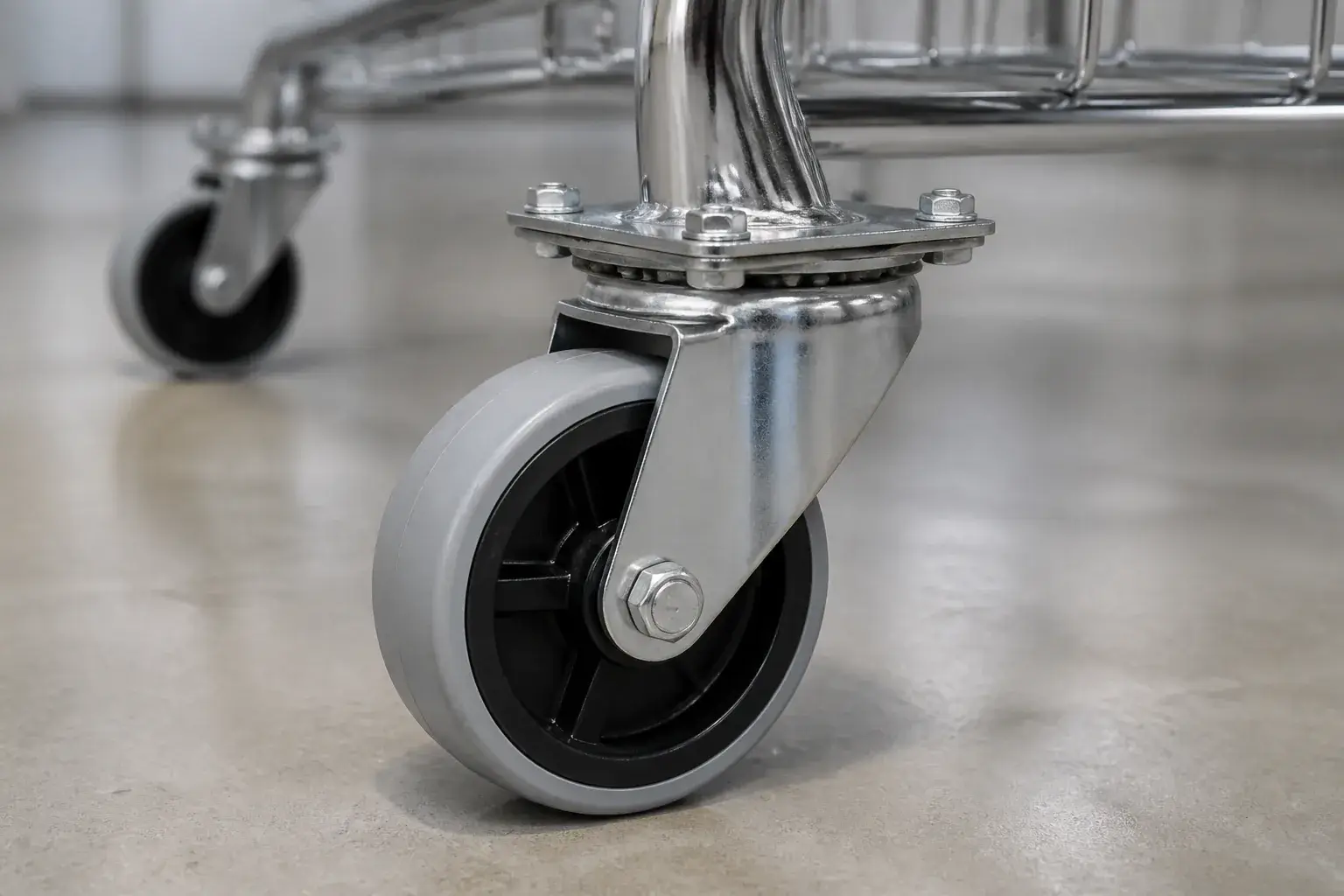
Layer 3 Casters and Fittings, Where the Complaints Come From
Casters are a small fraction of the bill of materials and a large fraction of the after-sales conversation. They are also the part most often downgraded to make a quotation competitive, because a wheel is a wheel in a photograph.
Diameter sets rolling resistance and threshold behavior. Commercial carts run 4 in (100 mm), 5 in (125 mm) or 6 in (150 mm) wheels. Bigger wheels cross door thresholds, tile joints and car park expansion gaps with less effort and noise, and they matter more as the basket gets heavier. Our trade listings show 4 in wheels in PU or rubber. A 180 L or larger cart destined for an outdoor bay is a candidate for stepping up.
Tread material is a three-way trade-off. Polypropylene is the cheapest and loudest, and it marks resilient flooring. TPR is quieter and gentler on floors for a modest extra cost. Polyurethane is the quietest, rolls best under load and lasts longest, and costs the most. Where noise is part of the shopper experience, this is not purely an economic decision.
Swivel configuration is a specification and not a detail. Two fixed rear wheels with two swivel front wheels track straight and are easier for staff to collect in long nested trains. Four swivel wheels turn far better in tight aisles and are harder to push straight across a sloped car park. Both are correct for different stores, and they are not the same cost.
Then come the fittings, each a real line item. A folding child seat with a restraint strap, a coin lock, a handle in PVC or molded plastic, an advertising frame, a lower rack and color-matched trim all add up. A cart with a child seat, a coin lock and a printed frame is a different product from a bare basket on a chassis, and comparing the two on price compares two different purchases. If your shopping mission is a small basket, check whether part of the fleet should be hand baskets, which cost a fraction of a cart and often serve the trip better.
Layer 4 Packing and How Many Carts Fit in the Container
This layer separates shopping carts from almost every other retail fixture, and buyers underestimate it more consistently than any other. Freight is not a small addition to the cost of a cart. On a low-value, high-volume steel product shipped across an ocean, it is one of the largest single lines in the landed cost.
Carts are unusual because they nest. A cart designed to nest well collapses a train of twenty units into a fraction of the floor space twenty separate carts would need. Every cart in our range is built to nest for container loading and for the trolley bay. The nesting pitch, which is the distance from one cart in a nested train to the next and typically runs around 200 to 260 mm on standard designs, decides how many units a container swallows. A deeper nest ships more cheaply per unit than an otherwise identical cart with a shallower one, and that difference never appears as a line on a quotation.
The arithmetic is worth doing yourself. A 40 ft high-cube container offers roughly 67 to 68 m³ of usable loading volume against about 33 m³ in a standard 20 ft box. Divide that by the effective volume one nested cart occupies and you have the loadability. Freight per cart then follows from the current all-in rate to your port. Ask any supplier for two numbers, units per 20 ft and units per 40 ft high cube on the exact configuration quoted, and a bare FOB price becomes comparable in a spreadsheet.
Two things move loadability, and both are negotiable.
Assembly state. Carts can ship substantially assembled, which is fast to deploy and expensive to freight. They can also ship knocked down, with baskets, chassis, handles and casters packed separately, which loads far denser and moves assembly labor to your end. Neither is wrong. A distributor with a warehouse and staff will often take knocked down, while a retailer who wants carts rolling the day the container is stripped will pay the extra freight. Never compare the two without adjusting for freight and for the labor hours on your side.
Packing method. Individual cartons protect the finish best and consume the most volume. Pallet or frame packing with edge protection is denser. Bare nested loading with interleaving protection is densest and carries the highest risk of transit scuffing on a plated finish. On a chrome or bright-plated cart this trade-off has teeth, because a scuffed finish on the shop floor is a rejected unit. Our product pages list pearl cotton and foam, or plastic film and steel strap, as the standard packing.
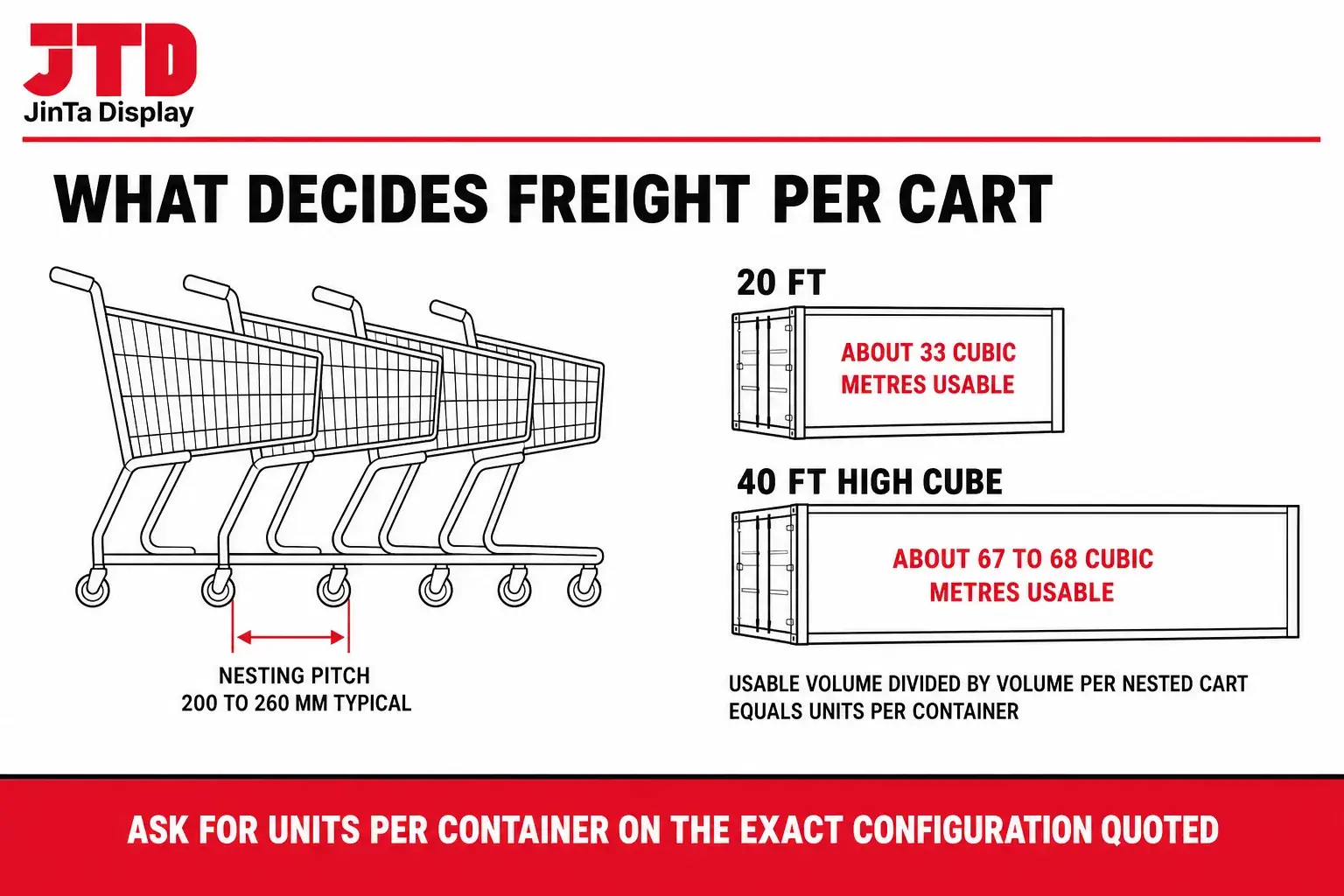
The container quantity for a given configuration is a figure to request with the quotation and not one to read off a web page, because it changes with basket size, assembly state and packing method on every order.
Layer 5 The Landed Cost Lines That Are Not on the Quotation
An FOB price is the cost of the cart standing at the port of loading. Everything between that point and a cart rolling in your store is a layer of its own, and it is where budgets built on a single number come apart.
Ocean freight and the surcharges attached to it. The base rate is quoted, while bunker adjustment, peak-season surcharge, currency adjustment and terminal handling ride behind it. Rates on the main east to west lanes have moved by multiples inside a single year more than once in the last decade, which is why no supplier can quote a meaningful landed figure months ahead.
Import duty, and getting the classification right. Hand carts and trolleys fall under heading 8716.80 in the Harmonized System, and the rate applied depends on your country and on any trade-remedy measures in force for goods of Chinese origin at the time of entry. In the United States this line has been volatile enough to belong in a current check with your customs broker and not in a rule of thumb. Use the official schedule, the USITC Harmonized Tariff Schedule for US entries, and confirm the rate for the week you import.
Customs clearance, drayage and inland delivery. Broker fees, port charges, drayage to your warehouse and the cost of stripping the container. On a container of carts the last mile can rival a meaningful share of the ocean leg.
Assembly labor, if you bought knocked down. Real hours at your local wage, worth costing honestly before choosing the denser packing.
Spares held against the fleet. Casters are consumable on a cart in daily service. A fleet ordered without a spares allocation will need them sourced locally at retail prices, which is the expensive way to buy a wheel. Order them with the container.
Where the 75 to 150 Dollar Figure Comes From
Search how much do shopping carts cost, or how much are shopping carts, and you will meet a widely repeated range of roughly $75 to $150 a cart, with chrome and branded models quoted higher. That number is real, but it answers a different question. It comes from the viewpoint of a North American retailer replacing individual carts, which is a domestic transaction in small quantities from a distributor or a reconditioner, with local freight, local margin and often local refurbishment already inside it.
If you are a store manager replacing eleven damaged carts, that is what you will pay. If you are placing a container order as a chain, a distributor or a fit-out contractor, it is the wrong benchmark in both directions. It includes distributor margin and domestic handling you are not paying, and it leaves out ocean freight, duty and clearance you are. Neither figure is a discount on the other, because they price two different transactions.
The same caution applies to the resale figures that circulate beside it. Searching how much is a shopping cart worth returns what a cart fetches as recovered steel, which has no connection to what it costs to manufacture and land and is no way to sanity-check a quotation.
How Much Does a Shopping Cart Cost, and Why Two Quotations Differ by More Than Double
Put the five layers together and the spread in shopping cart price stops being mysterious. Anyone asking how much does a shopping cart cost for a fleet should expect the answer to be a table like this one. Each row below is a variable that moves the number, and each is worth asking about directly.
| Variable | Effect on the quotation | Effect afterwards |
|---|---|---|
| Regional style at the same liter size | Higher for heavier styles | Steel content differs by up to 30% at 180 L |
| Basket wire diameter and mesh density | Higher | Decides whether the basket holds its shape under load |
| Chassis tube diameter and wall thickness | Higher | Decides service life at the welds and not day-one appearance |
| Coating thickness behind the words zinc plated | Often where a cheap quote is cheap | Decides corrosion life, especially outdoors |
| Hot-dip galvanized or chrome instead of electro-zinc | Substantially higher | Only earns it back in humid, coastal or outdoor use |
| Caster diameter and tread material | Higher | Decides rolling effort, floor marking, noise and wheel life |
| Child seat, coin lock, advertising frame, lower rack | Higher, itemized | Each is a separate product decision and not a trim level |
| Nesting pitch of the design | Neutral on the quote | Changes freight per cart, invisibly |
| Assembled against knocked down | Assembled looks worse on freight | Shifts labor hours between supplier and buyer |
| Individual cartons against bare nested packing | Cartons higher | Decides how many units arrive with a saleable finish |
| Order quantity against the supplier minimum | Lower per unit at volume | Sets tooling and setup share per cart |
| Custom color, printed logo, buyer label | Higher, with a setup charge | One-off cost spread across the run |
Read a quotation against that list and most of the gap resolves itself. A document that is cheaper on every row is not a better deal. It is a different specification with the same liter rating.
Order Quantity, Minimums and What Volume Actually Buys
Unit price falls with quantity on this product, but not for the reason buyers usually assume. The steel does not get much cheaper. What gets cheaper is everything spread across the run, namely tooling and jig setup for a custom basket size, a plating line changeover, a powder-coat color change, printing plates for a branded advertising frame, and the fixed administrative cost of an order and a shipment.
That is why minimum order quantities in this trade vary by configuration more than by supplier. On our trade listings the minimums for shopping trolleys run from 10 pieces on some catalog models to a few hundred on others, and anything that needs a setup carries a higher minimum because the setup has to be worth doing. The minimum for your order is confirmed with the quotation.
Separate two questions that usually get merged. What is your minimum matters far less than at what quantity the price breaks for this exact specification. The second tells you whether consolidating next year’s replacement fleet into this order pays for itself, and on a container-scale purchase it often does.
Reading a Cart Quotation Properly
Everything above reduces to a short list that a quotation should state and often does not. Ask for these in writing and an incomparable set of numbers becomes a decision.
Start with basket capacity in liters and the external dimensions that go with it, then the style. Ask for the basket wire diameter and the chassis tube diameter with wall thickness. Get the coating process by name and the target thickness in microns. Ask for caster diameter, tread material and swivel configuration, and have every fitting listed as a separate line. Request the empty weight per cart, the units per 20 ft and per 40 ft high-cube container, the assembly state and the packing method. Finish with warranty terms, and in particular whether casters are covered, and with the lead time for the first order and for repeats.
A supplier who answers all of these without hesitation is quoting a specification. One who answers in adjectives is quoting a photograph.
Matching the Cart to the Store Before Matching It to a Budget
One last point, because it saves more than any negotiation. The cheapest fleet, and the lowest grocery cart cost per year, is the one specified for the actual shopping mission and not for the largest basket available.
A convenience store with a two-minute average visit does not need 180 L carts. Buying them wastes money twice, once on the purchase and once on the aisle space they block. A hypermarket doing weekly family shops needs the large tier, and undersizing there costs basket value on every transaction. An outdoor market or garden center needs the finish decision taken seriously and the caster diameter stepped up. A transport hub is a different category altogether, which is why luggage trolleys carry braking systems that carts do not have.

To size a whole fleet and not just one cart, the method is in our supermarket equipment list. Get that match right and the cost per year of service falls further than any line-item negotiation above will move it. We have built shop fittings and trolleys in Changshu since 1998, and the orders that go smoothly are consistently the ones where the specification conversation happened before the price conversation.
If you are also fitting out shelving in the same project, the same layer logic applies to supermarket shelving, where gauge and finish drive the number in the same way. Send us your basket size, quantity and destination port and we will reply with a specification and quotation.
Frequently Asked Questions
How much does a shopping cart cost?
There is no single answer, because five variables move it. They are steel and basket volume, finish thickness, caster and fitting grade, container fill, and the landed cost lines outside the FOB price. The widely quoted $75 to $150 range describes a North American retailer buying replacement carts locally, not a container import. For wholesale, fix the specification first and the price follows.
How much is a shopping cart at wholesale compared with buying one locally?
They are different transactions and not different prices for the same thing. A local purchase includes distributor margin, domestic freight and often refurbishment, and leaves out ocean freight, duty and clearance. A direct factory purchase reverses both. The only fair comparison is landed cost per cart at your door, using the container quantity and current freight and duty for your port.
What makes one supermarket shopping cart more expensive than another?
Most often the regional style, the wire and tube gauge, and the coating thickness. A heavier style can carry 30% more steel at the same liter size, and the other two cannot be judged from a photograph. After those come caster diameter and tread, the fittings, and assembled or knocked down shipping. Ask for wire diameter in millimeters and coating thickness in microns.
How many shopping carts fit in a shipping container?
It depends on basket size, nesting pitch and whether carts ship assembled or knocked down. The method is fixed even though the answer is not. A 40 ft high cube gives roughly 67 to 68 m³ of usable volume and a 20 ft box about 33 m³, so dividing by the volume of one nested cart gives loadability. Ask for units per container on the exact configuration quoted.
Is a galvanized shopping cart worth the extra cost?
Outdoors, in coastal or humid markets, yes. Hot-dip galvanizing runs 45 to 85 µm against 5 to 12 µm for standard electro-zinc plating, and corrosion at a weld joint usually writes the cart off. Indoors on climate-controlled floors it is extra money for protection the environment will never test, and a zinc plated finish is the appropriate specification.
What is the minimum order quantity for shopping carts from a Chinese manufacturer?
It depends on the configuration and not on the factory. On our trade listings the minimums for shopping trolleys run from 10 pieces to a few hundred. Custom sizes, colors and printed logos carry higher minimums because a tooling or line changeover has to be spread across the run. The more useful question is where the price breaks for your exact specification.
Should I buy carts assembled or knocked down?
Knocked down loads denser and cuts freight per cart, but moves assembly hours to your site. Assembled carts roll off the container ready to use and cost more to ship. Cost both at your local wage before deciding, and never compare an assembled quotation with a knocked down one without adjusting for freight and labor.
How long should a commercial shopping cart last?
Service life is governed by the finish and the environment far more than by the steel. Indoors on a correctly specified finish, a well-built cart is a long-term asset and casters are the consumable part. Outdoors on an under-specified coating, corrosion at the welds can end its life in a few seasons. Budget caster replacement as a running cost and order spares with the container.