
Anyone searching for shopping cart dimensions expects a single answer. A cart has no single answer because the word covers five regional styles, eight common capacities and two body materials, and the same capacity in two styles can weigh 6 kg apart. A buyer who asks for the size of a shopping cart has usually named one of three different things.
This guide separates the three kinds of shopping cart measurements. It gives the real net weights of every metal cart style and size we build, then the external dimensions that cart makers and retail researchers publish for each size class, and then explains what those numbers do to aisle layout, trolley bays, container loading and shipping cost. It is written for the person who has to specify a fleet, not for the shopper who wants to know whether a cart fits in a car boot.
Where a figure comes from our own product pages it is marked as ours. Where it comes from published industry charts it is marked as an industry range and not our specification. Price is covered in a separate guide on how much a shopping cart costs.
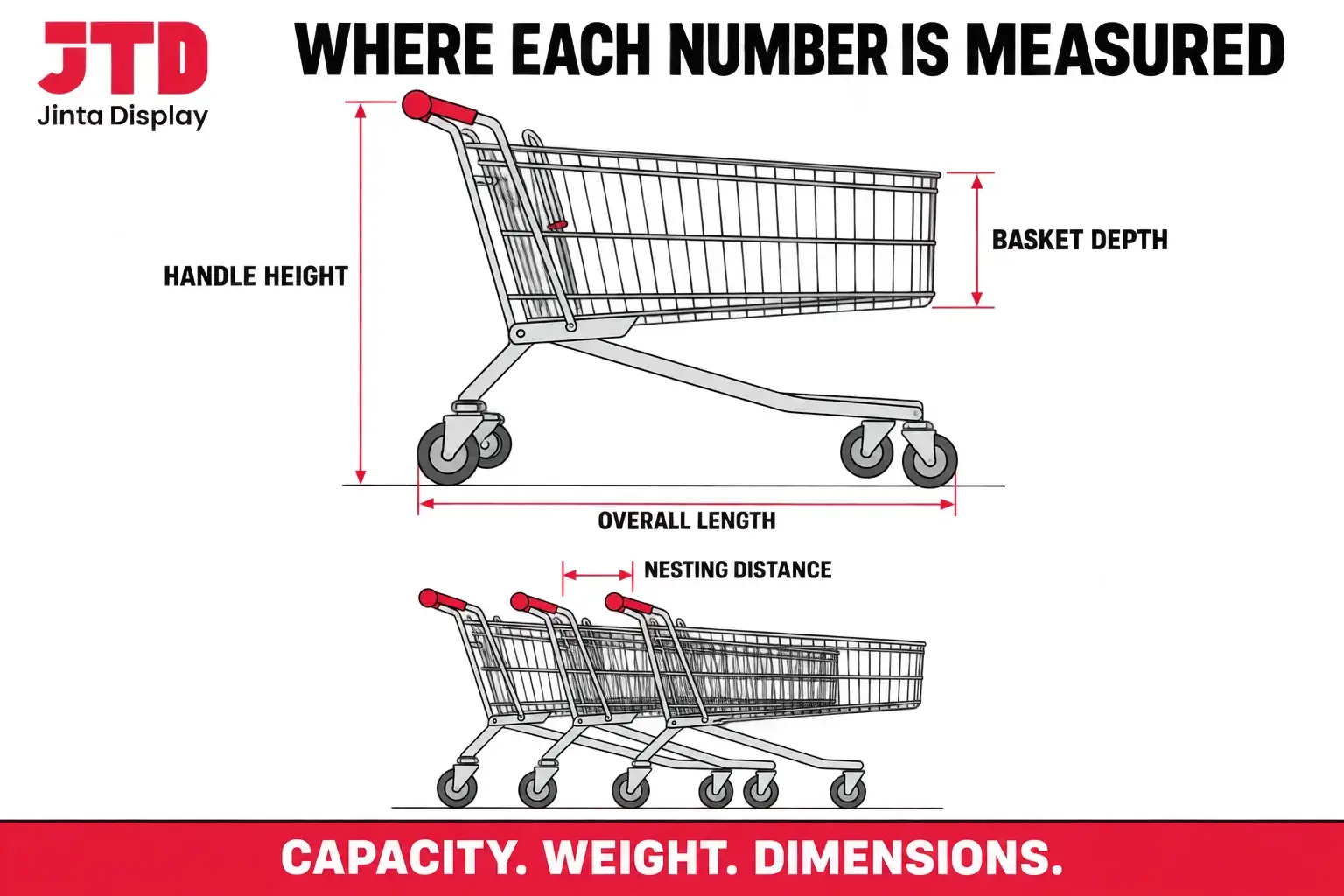
Shopping Cart Dimensions Come in Three Kinds
It helps to keep three questions apart, because suppliers answer them in different places and buyers mix them up.
Capacity. The volume of the basket, written in liters. It tells you how much a shopper can load, and it is the figure most catalogs lead with. It does not tell you how big the cart is on the floor, because the chassis, the handle and the wheels add length and height beyond the basket.
Weight. The net weight of the empty cart. It tells you how much steel is in the cart, which drives cost and freight, and how hard the cart is for staff to push in a train of twenty. It also hints at build quality, since a cart that is unusually light for its capacity has thinner wire or tube.
External dimensions. Length, width and height of the whole cart including handle and wheels, plus the nesting distance, which is how far each cart pushes into the one in front. These decide aisle fit, trolley bay length and how many carts fit in a container.
A quotation that lists only capacity and not the full shopping cart dimensions is incomplete. A quotation that gives capacity and external dimensions but not weight hides the steel content. Ask for all three, and ask for them on the exact style, because the numbers change from one style to the next.
Shopping Cart or Shopping Trolley, and the Five Styles
The same object has different names depending on where you buy it. In the United States and Canada it is a shopping cart or a grocery cart. In the UK, Ireland, Australia and New Zealand it is a shopping trolley or a supermarket trolley. In Spanish speaking markets it is often called a carro de supermercado or a carrito. A search for how big is a shopping trolley and a search for shopping cart size are the same question in two vocabularies.
Style matters more than the name. The nesting angle, the handle height and the basket taper that suit a European store are not what an American or a Russian chain expects, so carts are built in regional styles. We build five metal styles, American, Asian, European, German and Russian, in capacities from 60 to 240 L, plus plastic bodied trolleys on steel frames from 100 to 220 L. The next sections use the net weights of every one of them.
Capacity, and How to Read the Liter Figure
Capacity is the first of the shopping cart dimensions to pin down, and it is calculated from the inside of the basket. Multiply the inside length, width and depth in millimeters and divide by one million to get liters. As a worked example, a basket 800 mm long, 500 mm wide and 450 mm deep holds 180 L. Shrink the same footprint to 250 mm deep and it holds about 100 L. The numbers in this example are an illustration of the arithmetic and not the dimensions of any particular cart.
Common capacities are 60, 80, 100, 125, 150, 180, 210 and 240 L, and our metal range covers all eight. The first three suit convenience stores, pharmacies and small supermarkets. The middle sizes suit the majority of grocery shopping. The top two are warehouse and hypermarket sizes for families who shop once a week. A bigger basket is not free, and the gain per liter falls as the cart grows, because the chassis stays about the same size while the basket expands.
Retail measurements show how wide the spread is. A research team that put a tape measure to carts at nine US chains found basket volumes from about 6,720 cubic inches at Dollar Tree to 15,548 cubic inches at Sam’s Club. That is roughly 110 L to 255 L. Between them were Trader Joe’s at about 127 L and Aldi at about 245 L. Their published measurements also give handle heights from 38 inches at Dollar Tree to 45 inches at Costco, which is a reminder that handle height is a separate dimension and not a function of capacity.
How Much Does a Shopping Cart Weigh, Style by Style
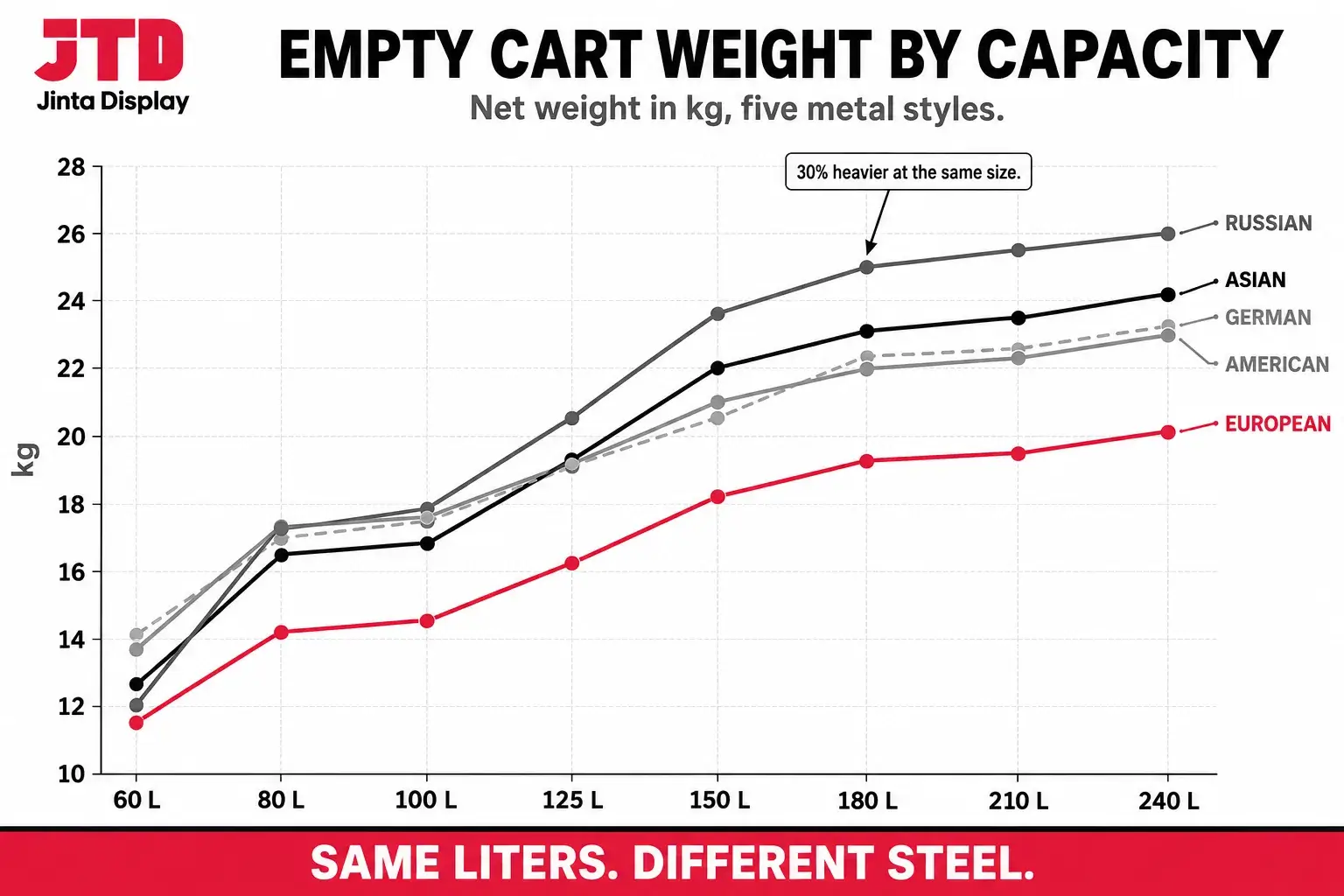
Most searches for how much does a shopping cart weigh, or the weight of a shopping cart, get a single figure, often 25 to 35 pounds. A real range is wider, and it depends on the capacity and the style. These are the net weights printed on our own product pages for the five metal styles, in kilograms, for the empty cart.
| Capacity | European | Asian | Russian | American | German |
|---|---|---|---|---|---|
| 60 L | 11.5 | 12.6 | 12.0 | 13.7 | 14.1 |
| 80 L | 14.2 | 16.5 | 17.2 | 17.3 | 16.9 |
| 100 L | 14.5 | 16.8 | 17.8 | 17.6 | 17.5 |
| 125 L | 16.2 | 19.3 | 20.5 | 19.2 | 19.2 |
| 150 L | 18.2 | 22.0 | 23.6 | 21.0 | 20.6 |
| 180 L | 19.3 | 23.1 | 25.0 | 22.0 | 22.3 |
| 210 L | 19.5 | 23.5 | 25.5 | 22.3 | 22.5 |
| 240 L | 20.1 | 24.2 | 26.0 | 23.0 | 23.2 |
Three patterns stand out. First, weight rises with capacity much more slowly than volume. A 240 L cart holds four times what a 60 L cart holds but weighs only 1.6 to 2.2 times as much, because the chassis, handle and wheels are almost the same size. In kilograms of cart per liter of basket, a 60 L cart carries 0.19 to 0.24 kg per liter and a 240 L cart only 0.08 to 0.11.
Second, style matters as much as size. At 100 L the heaviest style is 23% heavier than the lightest, and at 180 L it is 30% heavier. The European cart is the lightest at every size, and the Russian cart is the heaviest from 100 L upward. Third, the weights flatten at the top. From 180 to 240 L, the European cart gains under 1 kg, which says the largest sizes share a frame and differ mainly in basket height.
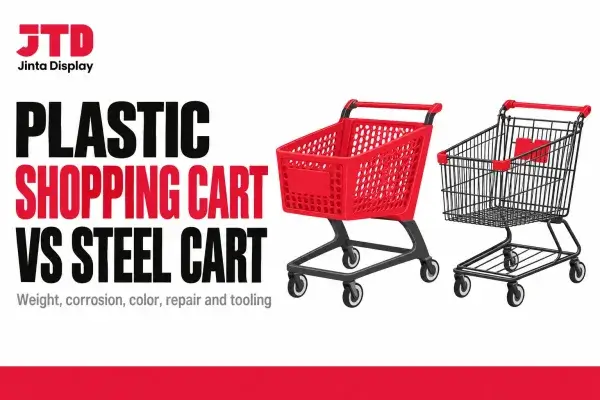
Plastic bodied trolleys are not automatically lighter. Ours use a Q195 carbon steel frame with a plastic body, and the net weights on the product page run 18.4 kg at 100 L, 19.6 kg at 125 L, 21.0 kg at 165 L, 22.3 kg at 180 L and 24.5 kg at 200 L. A 100 L plastic bodied trolley is within a kilogram or so of a 100 L metal cart of the German, American or Russian style, since the frame is still steel. The saving from plastic is in corrosion and color, not in weight.
Weight matters beyond cost. A heavier cart is harder to push in a train and harder to lift over a kerb, and it raises the freight line, since containers fill on weight as well as volume. A lighter cart is easier on staff and cheaper to ship, but it should be lighter because the style is leaner and not because the wire or tube was thinned. Ask for the empty weight on the exact style and capacity, and compare it with the table above as a sanity check.
Standard Shopping Cart Dimensions by Size Class
Shopping cart dimensions in the sense of overall length, width and height are not on our product pages, which list capacity and net weight only because they depend on the style, the handle and the wheel option for each order. We confirm them on the drawing for each order and do not publish one set for the whole range. For planning, the published charts of cart makers give a useful range by size class.
| Size class | Capacity | Length | Width | Height | Nesting distance |
|---|---|---|---|---|---|
| Convenience | 60 to 90 L | 750 to 915 mm | 500 to 560 mm | 965 to 1,050 mm | 160 to 200 mm |
| Small | 60 to 125 L | 760 to 914 mm | 460 to 559 mm | 950 to 1,010 mm | 150 to 200 mm |
| Medium | 130 to 160 L | 930 to 1,070 mm | 550 to 584 mm | 1,000 to 1,050 mm | 170 to 220 mm |
| Large | 180 to 250 L | 990 to 1,160 mm | 584 to 754 mm | 995 to 1,067 mm | 200 to 333 mm |
These are industry ranges taken from a published size chart of one cart maker and they overlap, because styles differ. They are not our specification. Use them to answer a planning question, such as whether a large cart will pass in a 1,200 mm aisle, and then get the real figures from the drawing.
Two things in the table are easy to overlook. Height barely changes with size. A small cart and a large cart stand within about 100 mm of each other, because the handle height is set for the shopper and not for the basket. Length and width grow with capacity, and the large class is the one that gets wide enough to matter in a narrow aisle. The nesting distance also grows with size, which is why larger carts ship fewer to the container.
Nesting Distance and What It Does to the Trolley Bay
Among shopping cart dimensions, the nesting distance is the extra length a cart adds to a train when it is pushed into the cart in front. If a cart is 1,000 mm long and nests 200 mm into the next, a train of twenty is about 1,000 plus 19 times 200, or 4,800 mm long. That is less than a quarter of the 20,000 mm the same carts would take lined up end to end.
That arithmetic is the reason nesting distance appears on every serious data sheet. A shorter nesting distance means a longer train in the same bay and fewer carts per container. A longer nesting distance means a shorter train and a denser pack, but it needs a basket shape that tapers well. For a trolley bay, work backward. Take the length of the bay in millimeters, subtract the length of one cart, and divide the remainder by the nesting distance to find how many carts follow the first. Our carts are built to nest for container loading and for the bay, and the geometry is matched to the aisle width they will be used in.
Shopping Cart Measurements, and How to Take Them on a Cart You Already Own
If you are replacing carts or matching a trolley bay, measure an existing one before you ask for a quotation. Grocery cart dimensions are easy to take with a tape measure and a helper, and five readings are enough.
Overall length. From the rear of the handle to the front of the basket, with the cart standing on level ground. Include the child seat only if it projects beyond the basket.
Overall width. At the widest point, which is usually the top rim of the basket. Do not measure the chassis, which is narrower.
Handle height. From the floor to the top of the handle. This is the number that decides whether the cart suits your shoppers, and it varies from store to store even where the baskets are equal.
Basket depth and the inside length and width. Take the inside figures and calculate the liters, as in the worked example above. Many carts are sold at a rounded capacity that differs a little from the true volume.
Nesting distance. Nest five carts, measure the length of the train, subtract the length of one cart and divide by four. Measuring across five carts gives a more reliable figure than one pair.
Photograph the cart from the side and from above, and weigh it on a floor scale. Send the five numbers, the weight and the photographs with your inquiry, and a supplier can match the geometry without a site visit.
Aisle Width, Weight and How the Cart Is Used
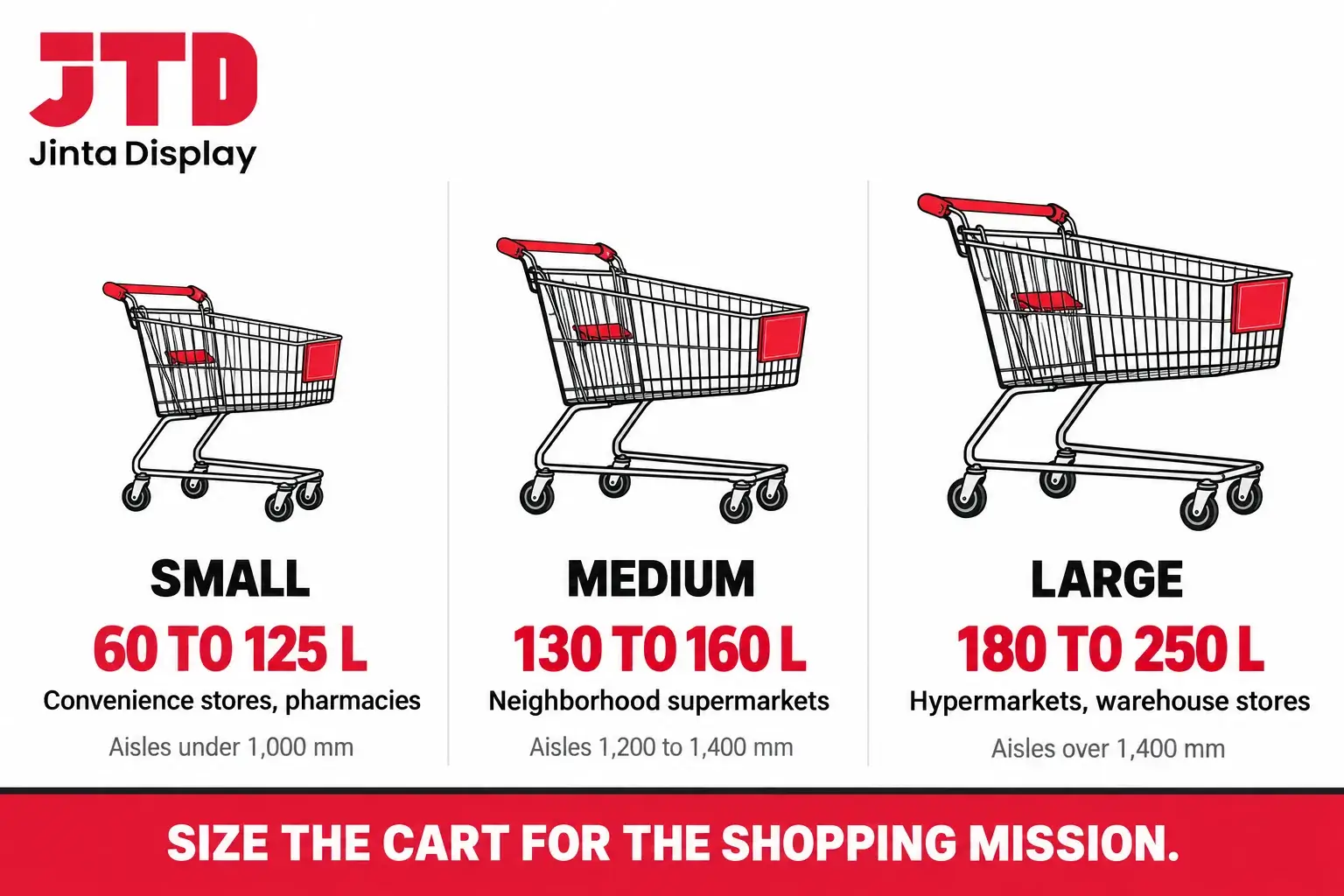
Shopping cart dimensions decide the aisle, and cart width sets the minimum. A rule of thumb in published guidance is to use small carts where aisles are under 1,000 mm, medium carts for 1,200 to 1,400 mm and large carts above 1,400 mm. Those are planning figures and not codes. Two carts passing in an aisle need roughly twice the cart width plus a margin for shoppers, so a 700 mm wide large cart in a 1,400 mm aisle leaves almost no room for a second cart to pass.
Weight shapes the staff side of the job, and shopping cart dimensions shape the layout side. Collecting a long train of carts from a car park is heavy work, and the heaviest styles are the hardest on staff. If your carts are collected by hand in large numbers, weight and the nesting distance matter as much as capacity.
Why the Weight of a Shopping Cart Matters for Staff and Freight
The weight of a shopping cart is a design signal as well as a cost. A cart that is unusually light for its capacity usually has thinner wire or tube, and thin members flex at the welds in trolley bay use. A cart that is unusually heavy for its capacity may carry extra steel that the shopper never needs. Comparing a quoted net weight with the table above is a quick way to spot either case before you order.
On the freight side, weight matters less than people expect. A container of carts fills by volume first, so extra kilograms of steel raise the price of each cart more than they raise the freight. Where weight does matter is in the labor of collecting and pushing a long train, and in the cost of the steel itself. A style that is 30% heavier at the same capacity is carrying roughly 30% more material in the frame and basket, and that is reflected in the price per cart.
If you buy knocked down, the shipment is denser and the weight per container is higher, but it still sits well under the payload limit. The decision between assembled and knocked down is a labor and freight question and not a weight question.
Wheels, Load Rating and the Child Seat
Wheels set how the cart rolls and how much it can carry. Our trade listings show 4 in wheels in PU or rubber on metal carts, and larger wheels of 5 in or 6 in are common on heavier carts. A larger wheel crosses door thresholds and tile joints more easily, which matters more as the basket gets heavier. The load capacity on our listings is stated as 100 to 200 kg for the metal carts, and the exact figure depends on the frame and the wheel option.
The child seat is a separate item. It folds into the basket space, so it changes the usable capacity slightly and adds weight. If the child seat matters to your shoppers, ask for the weight and the rated load of the seat as separate lines.
How Many Carts Fit in a Container
Shopping cart dimensions, together with the nesting distance, decide container loading. A 40 ft high-cube container offers roughly 67 to 68 m³ of loading volume and about 33 m³ in a 20 ft box. Published data sheets from cart makers show anything from about 300 to about 800 carts per 40 ft high cube, with the small, light carts at the top of that range and the large, heavy ones at the bottom.
The method for working it out yourself is short. Take the length of one cart and the nesting distance, work out the length of a train that fits across the container, then divide the container volume by the volume one train takes up. Weight is rarely the limit for carts. Four hundred and fifty carts at 20 kg each weigh 9 tonnes, well under the 19 to 26 tonnes a 40 ft container can carry, so volume fills the container long before payload does. Ask your supplier for units per container on the exact style and capacity.
Choosing the Size for the Store
The cheapest fleet is the one sized for the actual shopping mission and not for the largest basket available.
Convenience stores and pharmacies. Shopping cart size here means 60 to 90 L carts, or hand baskets for many of the trips. The aisles are narrow, so the small class fits and a large cart blocks the floor.
Neighborhood supermarkets. 100 to 150 L carts cover most of the shop. This is the largest group by volume sold.
Hypermarkets and warehouse stores. 180 to 240 L carts, with wider aisles to match. These shoppers buy for a week or a month at a time.
Mixed estates. Many chains run two sizes, a larger cart for the main store and a small one near the entrance for quick trips. If you do this, pick two styles that nest at compatible dimensions so that the trolley bay can take both.
To turn a size into a fleet count, the method for how many shopping carts a store needs is in our supermarket equipment list. If many of your visits are a handful of items, check whether part of the fleet should be hand baskets instead of carts. They cost far less and use no bay space. For the full metal and plastic line, see our shopping trolley range, and the German style metal shopping trolley page shows the eight sizes with weights.
What to Put in an Inquiry
To get a quotation you can compare, include these items.
Start with the style, since American, Asian, European, German and Russian differ in weight and shape. Give the capacity in liters. State the surface finish you want, such as zinc plated or chrome. Say whether the carts need a child seat, a coin lock or an advertising frame. Give the aisle width and the trolley bay length, which let the supplier check the fit and the nesting. State the destination port, because container weight limits differ between countries. Finally ask for the empty weight per cart, the external length, width and height, the nesting distance and the units per 20 ft and 40 ft high cube.
With those items on the page, a supplier is quoting a specification and not a photograph.
If you are choosing a cart size, send us your aisle width and quantity and we will reply with the models that fit and their dimensions and weight.
Frequently Asked Questions
What are the standard shopping cart dimensions?
It depends on the size class. Published charts give about 750 to 915 mm long for convenience carts, 930 to 1,070 mm for medium carts and 990 to 1,160 mm for large carts. Widths run about 460 to 750 mm and heights about 950 to 1,070 mm. Ask for the exact figures on the style you are buying.
How much does a shopping cart weigh?
An empty metal cart in our range weighs from 11.5 kg for a 60 L European cart to 26 kg for a 240 L Russian cart. Most grocery carts of 100 to 180 L fall between 14.5 and 25 kg, which answers how much do shopping carts weigh in general. Style changes weight by up to 30%, and plastic bodied trolleys run 18.4 to 24.5 kg.
What is the capacity of a shopping cart?
Capacity is the basket volume in liters. Common sizes are 60, 80, 100, 125, 150, 180, 210 and 240 L. Convenience carts sit at 60 to 90 L, mainstream supermarket carts at 100 to 160 L, and hypermarket and warehouse carts at 180 to 250 L. Measured US retail carts run from about 110 L to 255 L.
How big is a shopping trolley in the UK?
A shopping trolley is the UK and Australian word for a shopping cart, and the sizes are the same classes. A typical supermarket trolley is 100 to 180 L, roughly 0.9 to 1.1 m long and just under 1 m high. European style trolleys are the lightest, at 14.5 kg for 100 L in our range.
How much does a grocery cart weigh compared with a plastic trolley?
A 100 L metal grocery cart in our range weighs 14.5 to 17.8 kg depending on style. A 100 L plastic bodied trolley weighs 18.4 kg, because its frame is still steel. Plastic changes corrosion and color more than it changes weight, so choose it for those reasons and not to save weight.
What is the nesting distance of a shopping cart?
It is how far each cart pushes into the one in front when nested, usually 150 to 333 mm depending on size and design. A shorter distance makes a longer train in the same bay and fewer carts per container. A longer distance makes a shorter train and a denser pack. Ask for it on the data sheet.
How many shopping carts fit in a 40 ft container?
Published data sheets show roughly 300 to 800 carts per 40 ft high cube, with small, light carts at the top of the range. The result depends on size and nesting distance, and volume almost always governs because carts are light for their bulk. Ask your supplier for units per container on the exact configuration.
What size shopping cart should a store buy?
Start from shopping cart dimensions and the aisle. Match the cart to the shopping mission and the aisle width. Use 60 to 90 L carts or baskets for convenience stores, 100 to 150 L for neighborhood supermarkets, and 180 to 240 L for hypermarkets. As a planning rule, small carts suit aisles under 1,000 mm and large carts need aisles over 1,400 mm.