
Racking is not really a machine. It is a measured quantity of formed steel sold by the pallet position, and that makes warehouse racking cost unusually traceable. You can rebuild most of a quotation from the section drawings and a coil price, and that is not true of a forklift or a conveyor.
It also makes it easy to compare the wrong two things. Ask how much does pallet racking cost and the published US answers run from $50 to $200 per pallet position for single-deep selective and up to $150 to $450 for drive-in. Those are domestically stocked, delivered and often installed prices in a market with its own steel costs. An ex-works quotation from a manufacturer describes bare bundled steel standing on a factory floor. The cost of pallet racking is quoted honestly on both bases. The two figures sit a factor of two to three apart, and almost none of that gap is profit.
This article follows the manufacturer’s side of the number. It covers what sits inside an ex-works price, what builds up between the factory gate and your yard, and which lines on a quotation move the total. Installation, permits and local labor are real costs, but they are bought in your own market at your own rates, so they appear here only where they change what you should ask a supplier for.
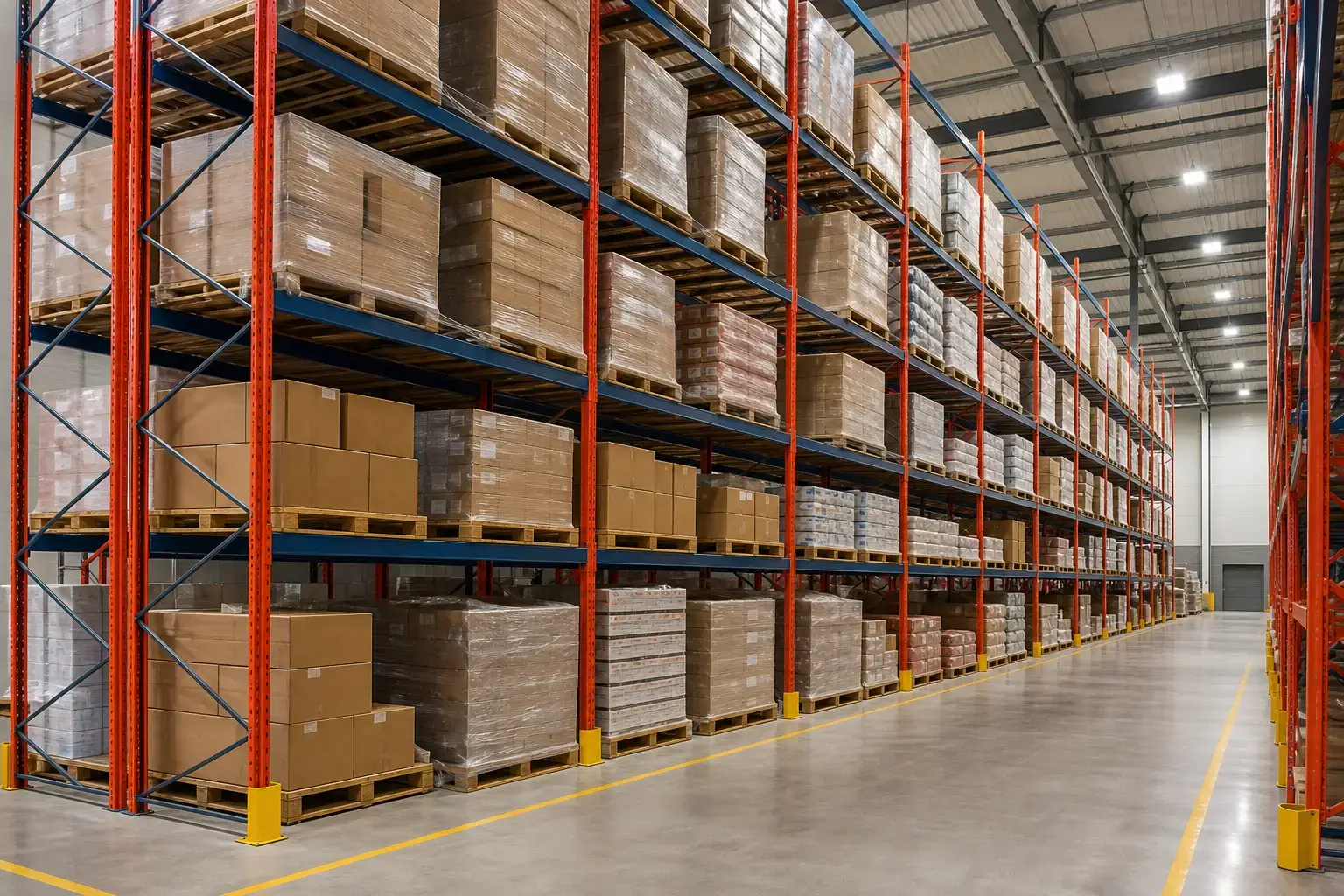
Fix the Unit Before You Compare Anything
Most arguments about warehouse racking cost are arguments about units. Four are in circulation, people swap them freely in conversation, and they do not convert into each other without extra information.
Per pallet position is the only one that travels between suppliers. One pallet position is one pallet on one beam level. A standard selective bay two pallets wide with four beam levels holds eight. A quotation of $480 per bay is therefore $60 per position. Normalize every quotation to this number before you read any of them.
Per bay is what most factories quote, because a bay is what they build. It only compares once you know how many beam levels are in it, and beam levels are exactly the variable a competitive quotation quietly reduces.
Per square foot shows up in North American estimator tools. It is covered in the next section because it needs a warning label.
Per tonne of steel is what your supplier manages internally, and it explains why quotations move from month to month.
One structural point falls out of the arithmetic immediately. Uprights are shared between neighboring bays. A run of ten bays needs eleven frames, not twenty, and a two-bay island needs three frames for two bays. On a typical four-level selective bay, frames and beam sets weigh about the same, so the ten-bay run comes out roughly 15% cheaper per pallet position than the two-bay island built from identical parts. Before you negotiate anything, redraw the layout into the longest continuous runs the building allows. It is the cheapest saving on the list and it does not depend on the supplier.
Warehouse Racking Cost per Square Foot, and Why It Misleads
Buyers search for warehouse racking cost per square foot because floor area is the number they already have. The figure is useful for a first feasibility sketch. It cannot be used to compare two quotations, because it hides the three things that set the price, which are the aisle width, the clear height and the type of rack.
The arithmetic is short. Take back-to-back selective rows with a 3.3 m aisle, a width that suits a standard counterbalance truck. Each bay is about 2.7 m wide and the double row plus aisle occupies roughly 5.65 m of depth. One bay module then covers about 15.3 square meters, or 165 square feet. At four beam levels that module holds 16 pallet positions, about 10 square feet of floor per position. At six levels the same footprint holds 24 positions, about 7 square feet each.
| Beam levels | Pallet positions per 165 sq ft module | Floor per position | Cost per sq ft at $50 per position | Cost per sq ft at $200 per position |
|---|---|---|---|---|
| 3 levels | 12 | 13.8 sq ft | $3.6 | $14.5 |
| 4 levels | 16 | 10.3 sq ft | $4.9 | $19.4 |
| 6 levels | 24 | 6.9 sq ft | $7.3 | $29.1 |
Read the table the right way round. The cost per position barely changes when you add levels, because each extra level adds one set of beams and a share of taller uprights. The cost per square foot of floor climbs because you are storing more pallets on the same footprint. A building with a 12 m ceiling and a building with a 6 m ceiling can share a footprint and still differ by a factor of two in cost per square foot, and neither number says anything about whether the racking was a good price.
The rule that holds up is simple. Use per square foot to size a budget, then convert every quotation back to per pallet position before comparing. The figures above are an example with stated assumptions, and they cover the racking itself without freight, duty or installation.
Steel Is Most of the Number
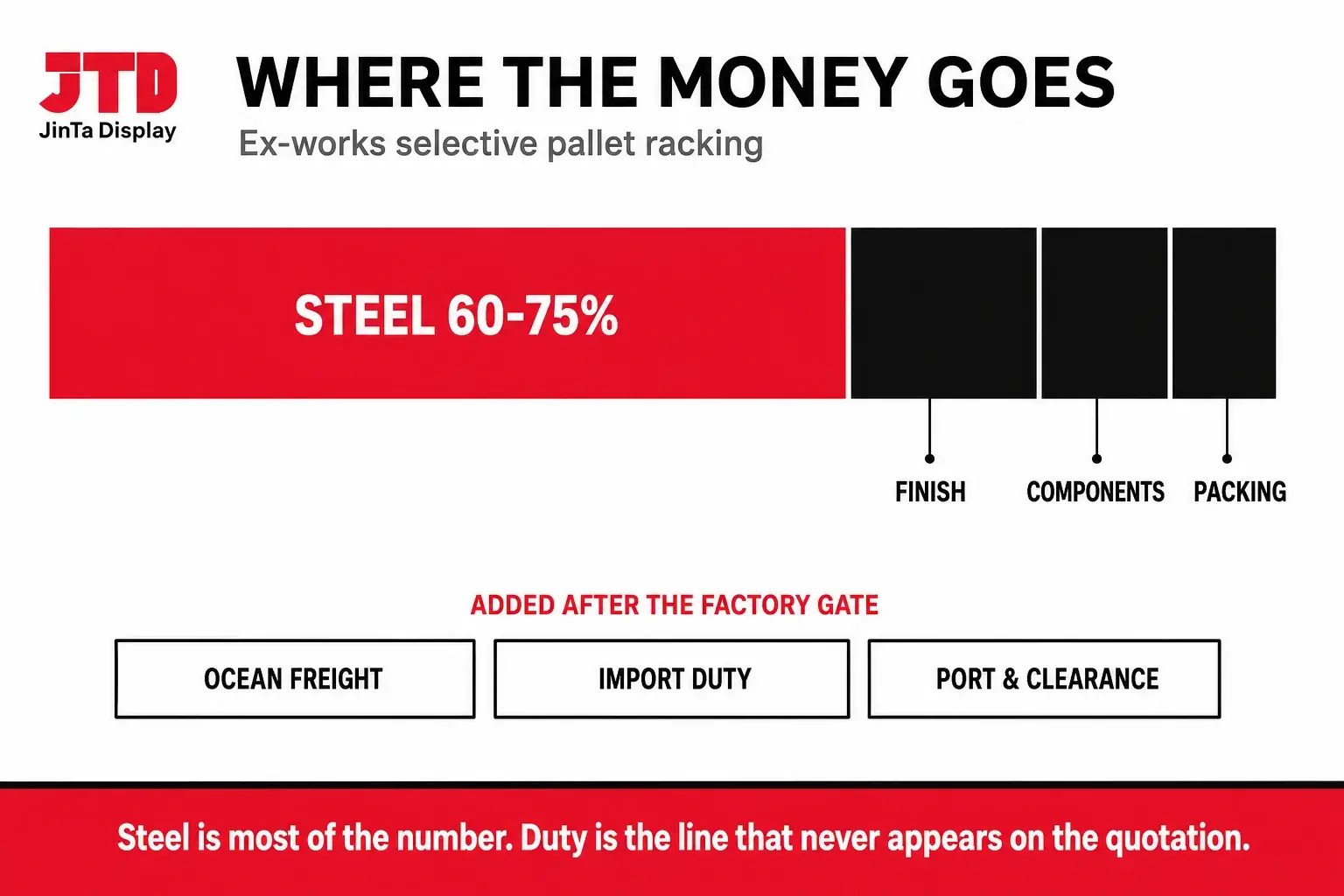
On a selective system, steel is normally 60 to 75% of the ex-works price, which is the first thing to know about pallet rack cost. Every other item in this article competes for the remaining quarter to two-fifths. Three choices inside the steel figure do the real work, and they are where warehouse racking cost is won or lost.
Upright gauge. Roll-formed uprights are commonly supplied in 1.8, 2.0, 2.3, 2.5 and 3.0 mm. The step from 2.0 to 2.5 mm adds about 25% to the mass of every column in the building, and columns are the heaviest item on the list. This is the most common place for two quotations to diverge without anyone noticing, because the finished frames look identical from three meters away and the difference is one line on a drawing.
Upright profile depth. Column sections of 80, 90, 100 and 120 mm face width are the usual ladder. Depth buys buckling resistance far more efficiently than thickness does. A supplier who moves you up a profile size instead of up a gauge is usually giving you more capacity per kilogram of steel. Ask which lever they pulled. For a reference point, our own 3000 mm heavy duty warehouse rack is listed with 80×60 mm uprights in 1.5 to 2.3 mm or 90×70 mm uprights in 1.8 to 2.2 mm, and with 100×50 or 120×50 mm beams.
Steel grade. Q235B and Q345B, broadly equivalent to S235JR and S355JR, are the two grades in ordinary use. Q345B carries roughly 45% more yield strength for a single-digit extra cost per tonne. That makes grade the cheapest capacity on the whole quotation. Uprights in Q345B and uprights in Q235B at the same gauge are different products, and the price gap between them is much smaller than the capacity gap.
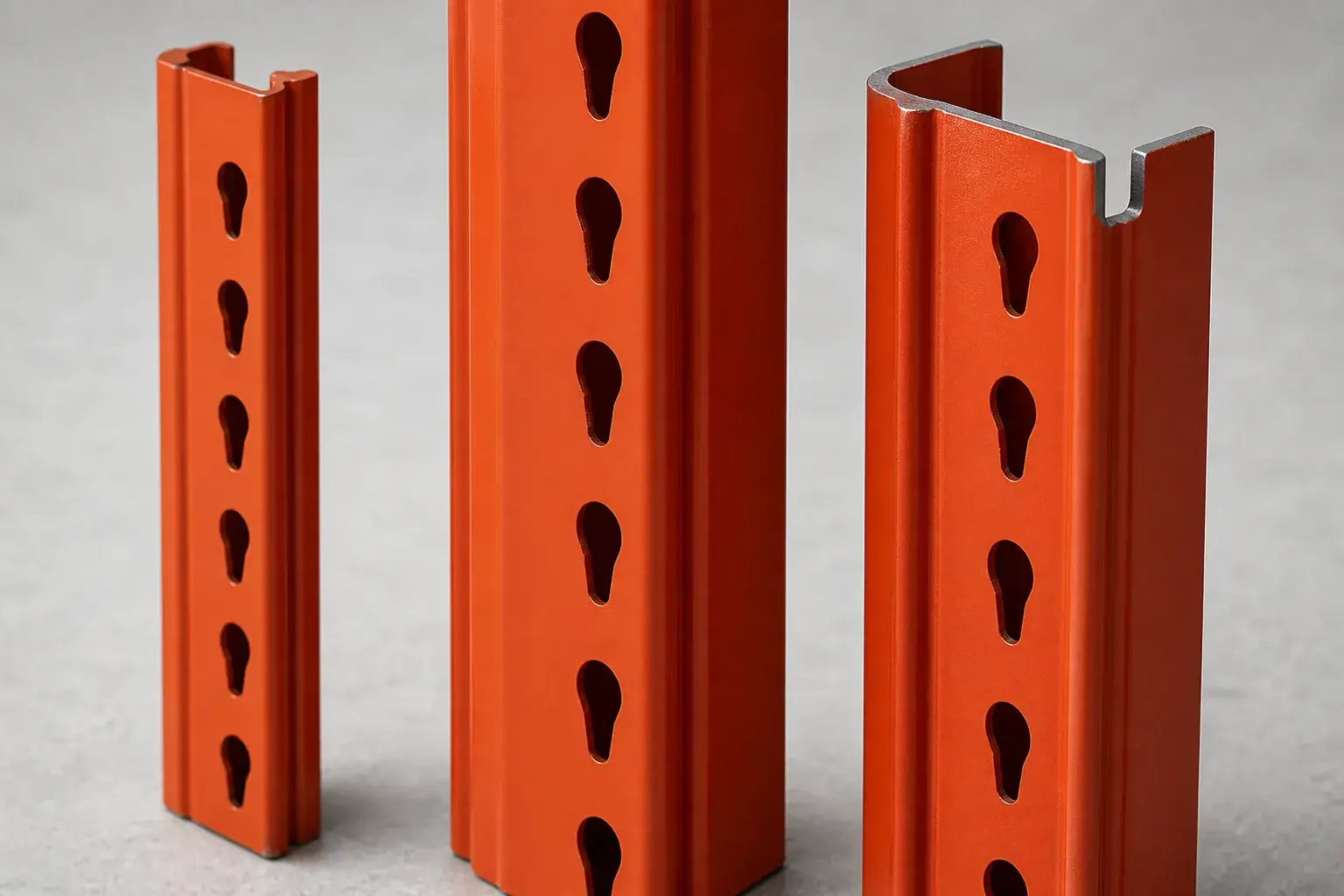
Beams follow the same logic on a smaller scale. Step beams and box beams at 80×50, 100×50 and 120×50 mm in 1.5 to 2.0 mm thickness cover most selective work. Beam length is the hidden driver. A pair sized for two 1,000×1,200 mm pallets at 2,300 mm clear does not behave like the same pair stretched to 2,700 mm, because deflection grows sharply with span and the usual design limit of span divided by 180 forces a heavier section. Widening a bay to take three pallets instead of two often costs more in beam section than it saves in frames.
If you are sizing a bay from the pallet first, our guide to pallet rack dimensions shows how. If you are working out what section you need and not what you were quoted, the companion article on pallet rack capacity and what decides it covers the load side. The warehouse racking range shows the profiles and beam types on offer, and the spec table on the 3000 mm heavy duty warehouse rack lists upright, beam and layer shelf sizes side by side. That matters because a non-standard section means new roll-forming setup and a minimum order quantity attached to it.
Finish Is Where a Cheap Quotation Is Usually Cheap
Surface finish is the layer of warehouse racking cost with the widest quality range and the smallest visible difference on delivery day. That combination is why it is the first place a quotation gets thinned.
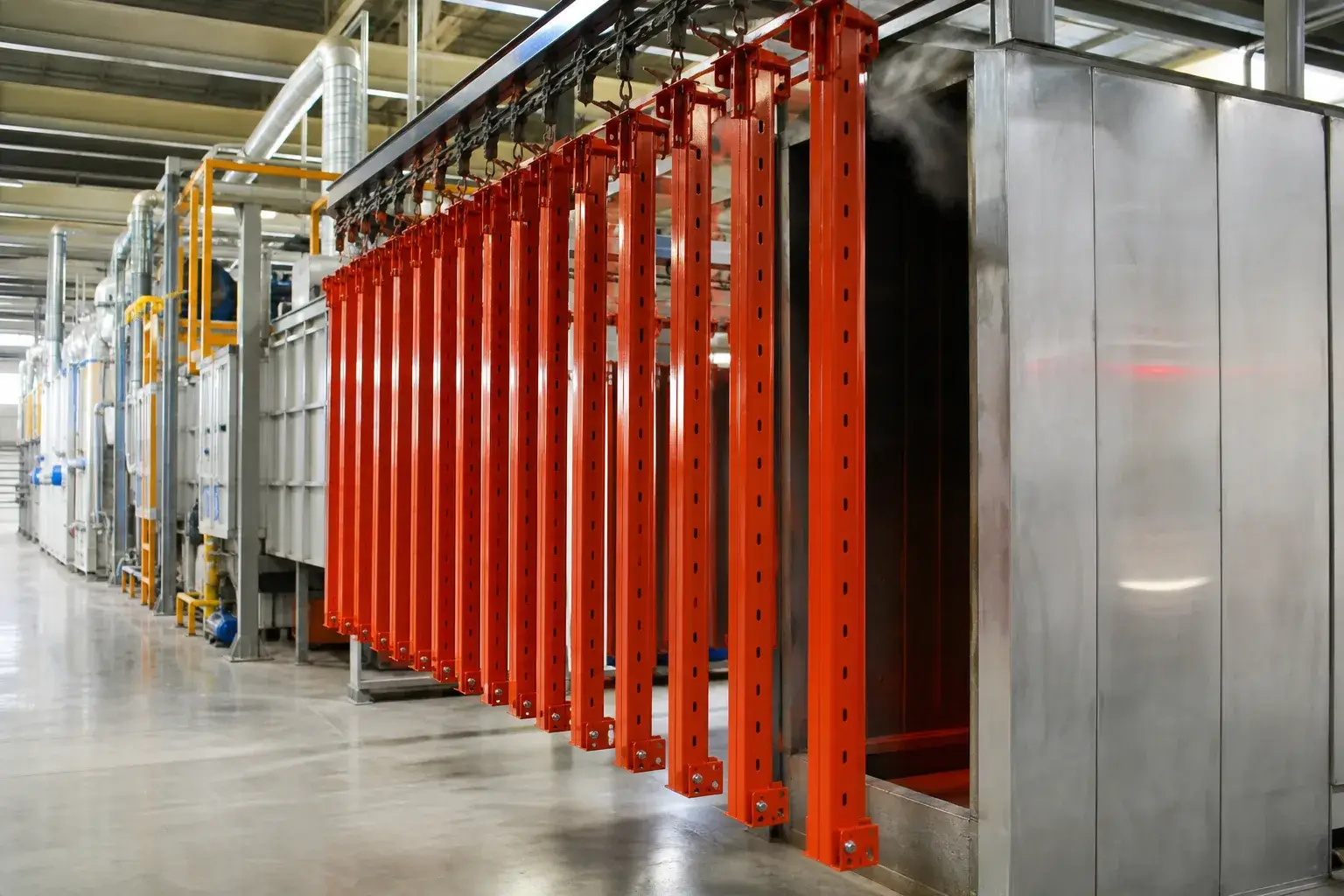
Powder coating thickness normally runs 60 to 80 microns on export racking. Economy work comes in at 40 to 50. Both look the same under warehouse lighting in week one. They part ways at the first forklift scuff and again at the first winter in a humid building.
Pre-treatment is the part you cannot see and the part that decides the outcome. A proper line degreases, rinses, applies a phosphate or zirconium conversion coat, rinses again and dries before powder touches the steel. Skipping stages costs nothing on day one and shows up two years later as coating lift around cut edges and punched holes. When you compare two quotations, ask directly which pre-treatment stages are included, because powder thickness alone does not tell you whether the coating will stay attached.
Pre-galvanized coil at Z80 to Z275 g/m² is an alternative worth pricing for humid or coastal sites. Hot-dip galvanizing after fabrication is the specification for cold stores, wash-down food areas and outdoor canopies. It is a real uplift on the steel line and not a small surcharge, and specifying it late is expensive because it changes the production route and not a setting on the coating line.
Color is the one finish variable that barely matters. Standard stock colors in the orange-upright and blue-beam convention, or gray and green, carry no extra charge. A custom RAL match needs its own powder batch and a minimum quantity to justify it, a real cost on a small order and rounding on a large one.
The Parts That Turn Frames and Beams Into a Working Bay
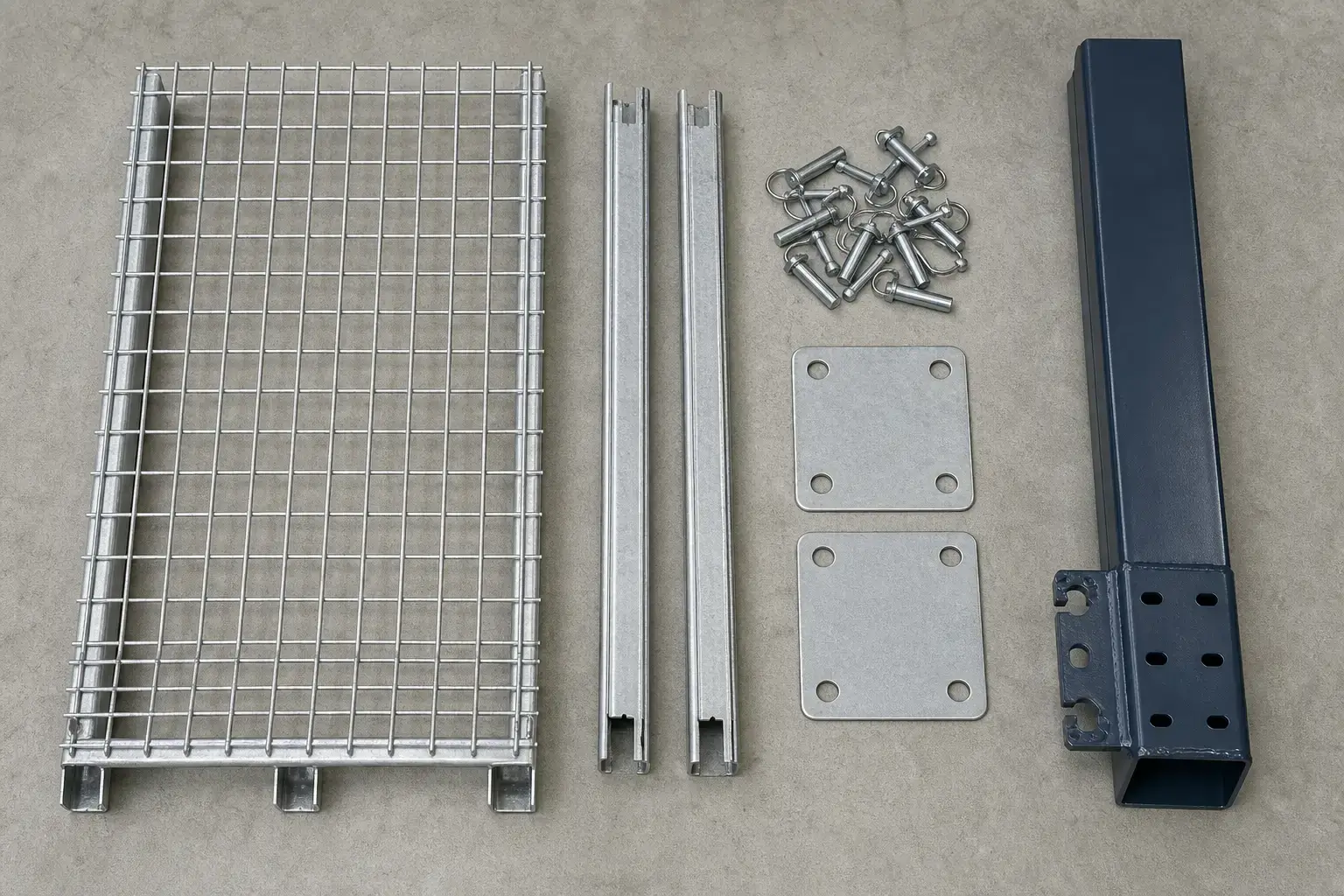
Frames and beams alone are a skeleton, and the quotation that stops there is the cheapest one on paper. What goes between them is where quotation scopes differ most, and it is where the largest optional cost of the project sits.
Wire mesh decking is the big one. Across every level of a system it commonly adds 15 to 25% to the equipment total, and it is heavy enough to change your container arithmetic as well. Mesh at 50×100 mm on 2.4 to 4.0 mm wire with three or four support channels per deck is the usual specification, in waterfall or flush styles. The decision worth making on purpose is coverage and not brand. Decking every level is standard for mixed cartons and hand-picking, while a system holding uniform, sound, correctly sized pallets may need none. Choosing coverage well moves the total more than changing supplier does.
Pallet support bars are the middle option, a pair of channels per position. They are lighter and cheaper than a full deck, and they suit consistent pallets where the worry is a broken bottom board and not loose product.
Baseplates, safety pins and row spacers should be standard inclusions, and occasionally they are not. Beam locking pins in particular deserve a line of their own on the quotation. Anchor bolts are usually left out of an export quotation on purpose, because the right anchor depends on your slab and is bought locally. Capacity plates normally come with the system.
Column guards, end-of-aisle protectors and frame splices are priced individually and add up fast across a large layout. Splices are the one to watch. They appear whenever frame height exceeds what ships economically in one piece. A very tall system carries a component cost that a shorter one does not.
Where the stored goods are hand-loaded and not palletized, run the comparison against boltless rivet shelving before anything else. It arrives at a much lower cost per shelf level and needs none of the parts above. Long stock such as tube, timber and profile belongs on cantilever racking, where the cost structure is arms and columns and not frames and beams. Picking the wrong system and then trimming its components is the most expensive mistake available here, and the overview of warehouse racking types sets out which system suits which load.
Packing and How Much Racking Fits in a Container
Racking ships knocked down, bundled and strapped, and packing has its own share of warehouse racking cost. It is one of the few products where the packing decision is made at the design stage and not at the dispatch bay.
Welded frames against bolted knock-down frames is the decision. A welded frame is cheaper to make, but it ships as a rigid ladder full of air. A bolted frame costs more in labor and hardware and ships as flat bundles of columns and braces. On a container-scale order the bolted frame is usually the cheaper landed product despite the higher ex-works price, and on a small order it is not. That one line reverses with volume. That is why quotations from two suppliers can rest on different assumptions without either being wrong.
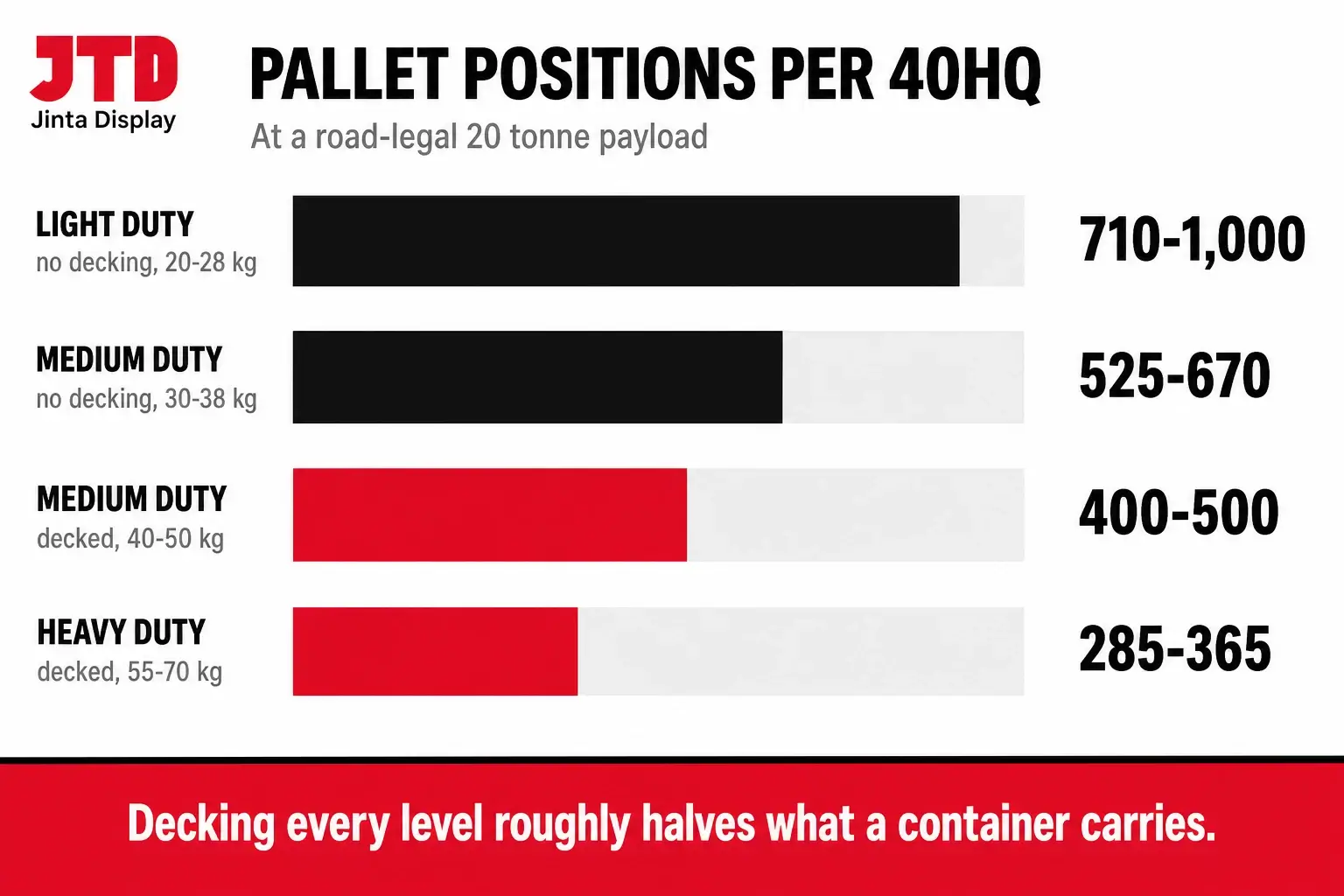
Racking loads out on weight and not on volume. A 40 ft high-cube container has a nominal payload around 26 to 28 tonnes, but destination road limits often cap the practical figure at 19 to 21 tonnes, and the road limit is what governs how much you can ship. The arithmetic is simple and worth doing before you finalize a specification.
| Configuration | Steel per pallet position | Positions per 40 HQ at 20 t | Positions per 40 HQ at 26 t |
|---|---|---|---|
| Light-duty selective, no decking | 20 to 28 kg | 710 to 1,000 | 930 to 1,300 |
| Medium-duty selective, no decking | 30 to 38 kg | 525 to 670 | 685 to 870 |
| Medium-duty selective, decked throughout | 40 to 50 kg | 400 to 500 | 520 to 650 |
| Heavy-duty, deep box beam, decked | 55 to 70 kg | 285 to 365 | 370 to 470 |
These are typical export ranges and not any one supplier’s figures. Replace them with the weights from your own drawing before they go into a budget. The pattern is the useful part. Decking every level roughly halves the number of pallet positions a container carries. A choice made on the equipment list for handling reasons quietly doubles the freight line, and the two costs are rarely shown side by side.
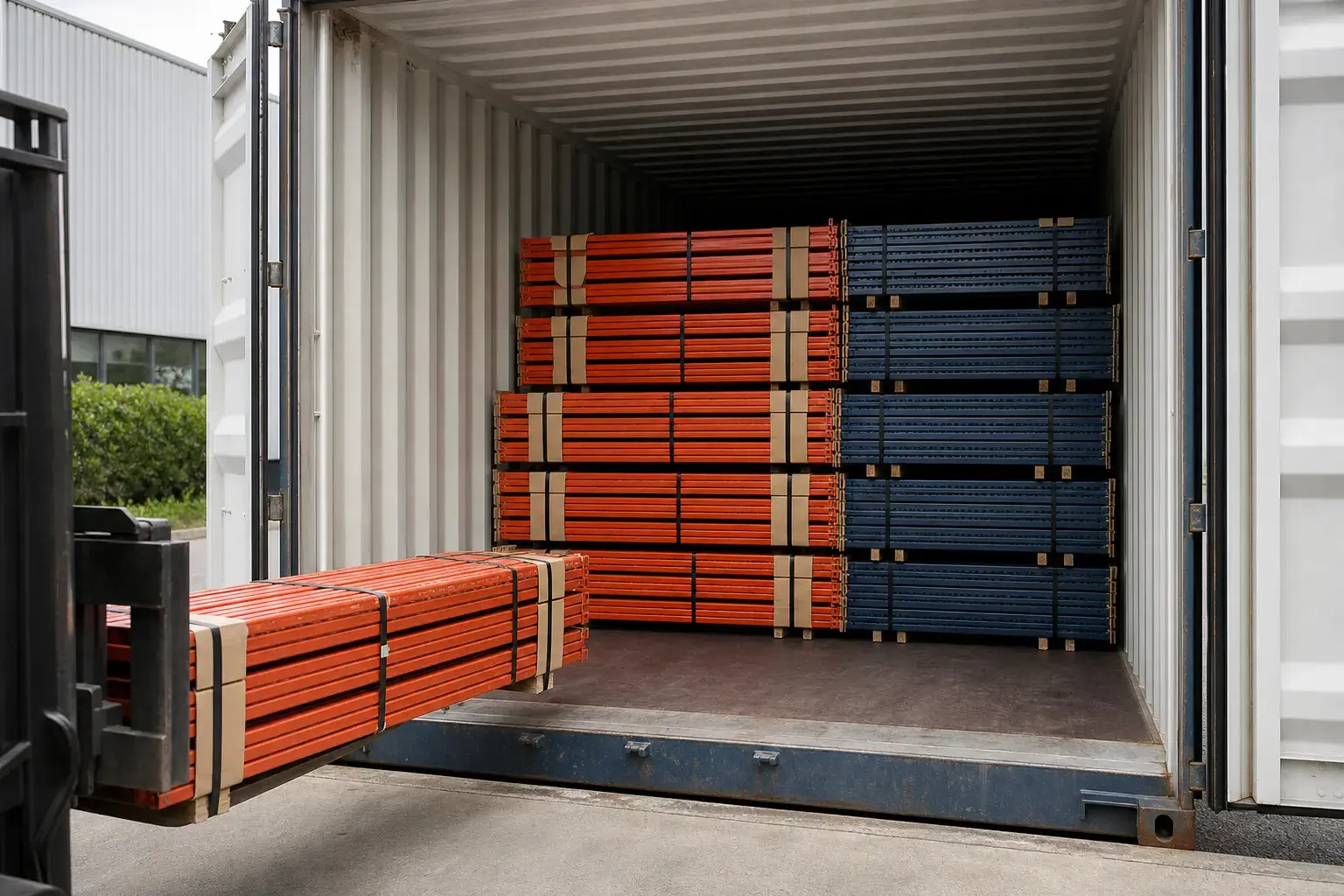
Bundling quality is the small print. Coated steel rubbing on coated steel for six weeks at sea arrives scuffed. Confirm edge protection, separator strips and strapping instead of assuming them. Transit damage is not covered by the price difference that caused it.
Landed Cost and the Line Most Buyers Get Wrong
Everything above is visible on a quotation. The last layer of warehouse racking cost is assembled from four or five documents that nobody reads together until the goods are on the water.
HS classification is the biggest single variable and the one most often left to chance. Steel racking is classified variously under 9403.20 as other metal furniture and under 7308.90 as structures of iron or steel. The choice changes the duty rate and the exposure to trade remedies attached to that code. Get a broker’s written opinion, or a binding ruling from your customs authority, before you place the order and not after the vessel sails. A supplier’s view on your tariff code is no substitute, because they are not the importer of record and carry none of the consequence.
Trade-remedy rates change, often with little notice. Section 301 lists, anti-dumping and countervailing determinations and steel derivative product lists all move. Any percentage in an article or from a salesperson is a snapshot. Check the rate for your classification and country of origin on the day you commit, and build the arithmetic so you can rerun it if the rate moves before shipment.
Ocean freight is smaller than most buyers expect. Take the table above. A 40 HQ rate anywhere between $2,500 and $5,000 spread over 500 pallet positions lands at roughly $5 to $10 per position. Next to a steel specification choice worth tens of dollars per position, and a duty rate worth a percentage of the whole, freight is rarely the line to chase. It is the line everybody negotiates, and that is a fair summary of why landed-cost models come out wrong.
Port charges, terminal handling, clearance and drayage are fixed per container and not per position. A part-container order carries them at a much worse rate. LCL shipment of racking is legitimate for a small system, but price it as a different product and not as a fraction of a container price.
Steel index and quotation validity. Because coil is 60 to 75% of the ex-works figure, a 10% move in coil price moves the quotation by roughly 6 to 8%. That is why racking quotations carry a 15 to 30 day validity as normal practice and not as pressure, and why a quotation revalidated three months later is a different number.
Installation, floor preparation, permits and local engineering sign-off sit outside all of this. They are sourced in your market at your market’s labor rates, they vary by an order of magnitude between regions, and no manufacturer’s quotation should be read as including them. Keep the equipment figure and the local figure in separate columns, or you will end up comparing an ex-works price against a delivered-and-installed one and draw the wrong conclusion about both.
Where Industrial Shelving Price Fits In
Searches for industrial shelving price and for warehouse racking cost overlap more than the products do. Industrial shelving means hand-loaded steel shelving in bays, usually boltless rivet or clip-together units, and it is bought per unit and not per pallet position. If your goods are cartons, tools or spare parts and nobody needs a forklift to reach them, this is the comparison to run first.
The same discipline applies, with a different unit. Normalize every quotation to cost per shelf level and then to cost per 100 kg of rated load per level. A unit with five levels at 200 kg looks cheap beside a unit with four levels at 500 kg until you divide through. For example, a $120 unit with five levels at 200 kg works out at $24 per level and $12 per 100 kg of level capacity. A $160 unit with four levels at 500 kg works out at $40 per level and $8 per 100 kg. The cheaper unit costs more for each kilogram it can carry.
Three lines move the price. Level load rating comes first, since it sets the beam and panel thickness. Overall size comes second, because height and depth change the steel in every upright and panel. Panel material comes third, with particleboard, steel and wire decking at different prices and different fire and moisture behavior. The boltless rivet shelving range is where we hold this category, and the rule from earlier still applies. Compare the specification and not the total.
Why Pallet Racking Cost Differs by Half Between Two Quotations
Put the layers together and the spread in warehouse racking cost between two suppliers stops being mysterious. Each row below is a question worth asking directly, and each has a defensible answer in both directions. The failure is not picking the cheaper option, it is not knowing which option you bought.
| Variable | Effect on the quotation | What it decides afterwards |
|---|---|---|
| Upright gauge, 2.0 against 2.5 mm | Higher | Capacity and residual strength, invisible on delivery |
| Steel grade, Q235B against Q345B | Slightly higher | About 45% more yield for a single-digit extra cost |
| Beam section relative to span | Higher | Deflection under load at the span you use |
| Pre-treatment stages before powder | Higher | Whether the coating is still attached in year three |
| Powder thickness, 40 to 50 against 60 to 80 microns | Higher | Scuff and corrosion resistance |
| Wire decking coverage | Often the largest optional line | Handling flexibility, and roughly half your container yield |
| Welded against bolted knock-down frames | Lower ex-works, higher landed | Reverses above roughly one container |
| Run length and frame sharing | Set by your layout, not the supplier | About 15% per position between a two-bay island and a ten-bay run |
| HS classification and origin | Not on the quotation at all | Often the largest single landed-cost line |
A quotation that is cheaper on every row is not a better deal. It is a different specification with the same pallet count, and warehouse racking cost follows the specification.
What to Send a Supplier to Get Comparable Quotations
A warehouse racking cost comparison usually fails because the brief was incomplete, not because the supplier was evasive. Eight inputs settle almost everything.
Start with the pallet itself, meaning its dimensions, its maximum loaded weight, whether it overhangs, and which face enters the rack, since a pallet entered on its 1,200 mm face needs different beam spacing from one entered on its 1,000 mm face. Then give the total pallet positions you need and your preferred number of beam levels. Add the clear height to the top beam and anything hanging above it. Describe the run layout, because single rows against a wall and back-to-back double rows behave differently on frame count and row spacers. State your seismic zone, since it changes the upright section and the baseplate and cannot be added later. Give the forklift type and lift height, because they set aisle width and the number of runs that fit. State decking per level and not as a yes or no. Finish with the destination port and any road weight limit below the container’s rated payload.
With those eight inputs, quotations from different factories become comparable, and the remaining differences are the specification differences in the table above and not guesswork. Send us those details and we will reply with a bay layout and a quotation. What you compare between suppliers is then scope, not a single number at the bottom of a page.
Frequently Asked Questions
How much does warehouse racking cost per pallet position?
US distributors commonly publish $50 to $200 per pallet position for single-deep selective, $80 to $300 for double-deep and $150 to $450 for drive-in, as domestically supplied and often installed prices. A manufacturer’s ex-works price sits well below that because it leaves out freight, duty, local distribution and installation. Check which basis a figure is quoted on before it goes into a budget.
How much does pallet racking cost when it is bought ex-works?
The specification decides it, and there is no honest single number. Ex-works means bundled steel at the factory gate, with ocean freight of roughly $5 to $10 per pallet position, import duty on your HS classification, container charges and inland haulage added afterwards. Installation is priced in your own market. Add those layers and an ex-works price and a published US price move much closer together.
What percentage of warehouse racking cost is steel?
Around 60 to 75% of an ex-works selective racking price. That share is why quotations carry a 15 to 30 day validity, and why a 10% move in coil price moves the quotation by roughly 6 to 8%. It also explains why heavier gauge, deeper profile or longer beams move the total far more than any other kind of change.
How many pallet positions fit in a 40 ft container?
Racking fills a container on weight and not volume, and the answer depends on kilograms per pallet position and on the weight limit at your destination. At a road-legal 20 tonnes, light-duty selective without decking runs to roughly 700 to 1,000 positions, medium-duty about 525 to 670, and a decked heavy-duty system nearer 285 to 365. Use the weights from your own drawing once you have them.
Is wire decking worth the cost?
It depends on what sits on the beams. Decking every level commonly adds 15 to 25% to the equipment total and roughly halves container yield. It earns that cost where you hand-pick cartons, store loose items or mix pallet sizes. Where pallets are uniform and sound, support bars or nothing may do, and the saving is worth deciding on purpose.
Does used pallet racking actually save money?
On the capital line it generally does, and the commonly cited saving is 20 to 25%. The catches are commercial. Connector profiles are proprietary, so extending a used system means matching the original maker’s beam connection. Available lots also decide your bay dimensions, and that can waste more cube than the purchase saved. Used works best for a known quantity of a common configuration needed quickly.
Does racking get cheaper per pallet position at higher volumes?
Yes, in three ways. Longer runs share frames and save about 15% per position between a two-bay island and a ten-bay run. Container charges are fixed, so a full container removes the LCL penalty. Roll-forming setup is spread across the order. The steel itself scales almost linearly, so savings run to tens of percent and not multiples.
What should I check first when one quotation is much cheaper?
Check four lines in order. Upright gauge and steel grade come first, because that is where most of the money is and the difference is invisible on arrival. Then the number of beam levels, then decking coverage, then whether safety pins, baseplates and row spacers are included. If all four match and a gap remains, ask about pre-treatment stages and powder thickness.