
If you are fitting out a shop, the retail cash wrap is the one fixture every customer walks to. It is where the sale closes, and it is also where the last impression of the shop is made. The term turns up on quotations and layout drawings without much explanation, so this guide starts with the definition and then moves on to the practical questions, which are what is on one, how it differs from a checkout counter, how big it should be and what to put in an inquiry.
It stays on definitions, types and sizing. Where we quote dimensions of our own counters, they come from our product pages. Where we describe the wider trade, we say so.
What Is a Cash Wrap in Retail
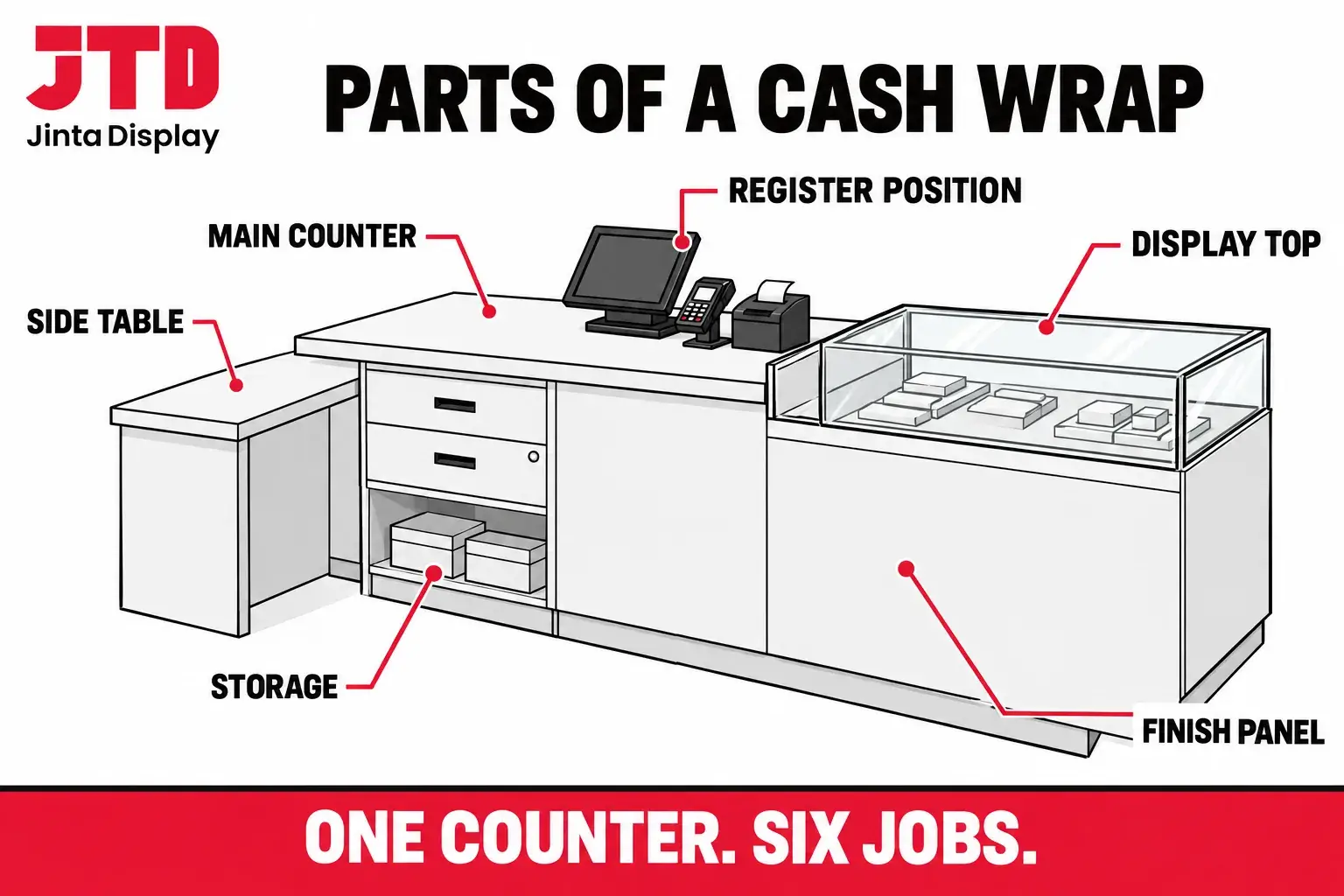
A cash wrap is the sales point of a shop. It is a counter, often with shelving, drawers or a cabinet underneath, where the till or register stands, where customers pay, and where staff wrap or bag what has been bought. In the largest sense it also covers the display space around it, such as impulse shelves, a gift area or a brochure rack, because that space is part of the same fixture.
The phrase is American. Searches for what is a cash wrap in retail come mostly from US shop owners, boutique buyers and fixture dealers, and the word is rare in British English. In a supermarket the same fixture is called a checkout counter, and it usually carries a conveyor belt and a bagging area as well as the till.
Three things set a cash wrap apart from an ordinary table. It is built for the job, with a finished top at a set height, space for a card terminal and a cash drawer, and a place to bag goods. It is part of the fit-out, finished to match the shelving and the shop front. And it is designed with the queue in mind, so that customers know where to stand and staff can see the shop floor.
Where the Name Comes From
The usual explanation is that the counter is where the shopkeeper took the cash and wrapped the purchase, in paper or tissue before plastic bags became common. The name stuck after the wrapping stopped. No single source documents the first use of the term, so treat the story as a trade explanation and not a record.
The word matters more than its history. Because cash wrap is an American term, a buyer in another country who searches for it will find American suppliers. If you source from a factory abroad, name the fixture by what it is, a counter with a side table and a bagging shelf, and give the dimensions. That avoids a misreading when the supplier’s own word for it is different.
What a Cash Wrap Is Made Of
The parts vary by store, and the list below covers most designs.
Main counter. The long surface where the transaction happens. Its length sets how much room there is for the till, the terminal and the goods being scanned.
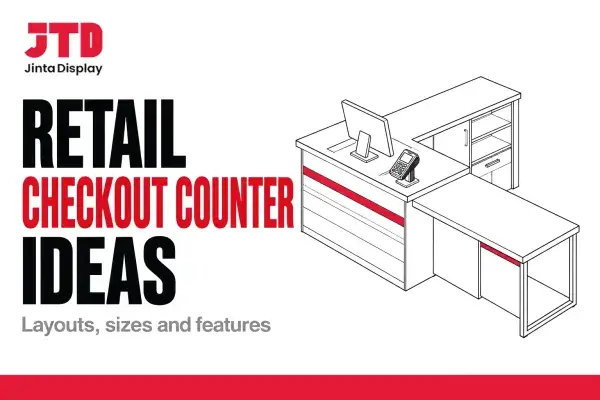
Side table. A shorter second surface set at right angles or in line with the main counter. In supermarkets it is the bagging table. In boutiques it is a packing station. Many of our counters are sold as a main counter plus an assistant table.
Register position. A recess, a shelf or a cut-out for the till, card terminal and printer, with space for cables. Planning this early avoids visible wiring later.
Storage. Drawers and shelves under the counter for bags, receipts, wrapping paper and cleaning supplies. In many cash wraps the front panel is also a display face.
Display top. Glass or shelving built into or beside the counter for impulse items, jewelry, gift cards or promotions.
Conveyor belt. Used in supermarkets and larger stores where the customer unloads a basket or cart onto a belt. It makes the counter deeper and changes the lane layout.
Finish. The panel and top material, color and logo. This is the part customers see, and it is usually chosen to match the shelving.
Cash Wrap, Checkout Counter and the Other Names
Several words describe the same fixture or close relatives of it. The differences are mostly about the store type.
| Term | Where you hear it | What it usually means |
|---|---|---|
| Cash wrap | United States, retail and boutique | The sales counter with its register and packing space |
| Checkout counter | United States, supermarkets, general | A counter in a lane, often with a belt and bagging table |
| Till counter | United Kingdom and Ireland | The counter where the till stands |
| Sales counter | Australia, New Zealand, UK | The point of sale, in small shops and service businesses |
| Cashier counter, cash counter | Asia and the Middle East | The paying counter of a supermarket or shop |
| Mostrador de caja | Latin America (Spanish) | The counter at the cash point |
A warning on the phrase cash counter. In product searches it often returns banknote counting machines, which are a different thing. When you ask a supplier for a cash counter, add that you mean the checkout fixture and include a dimension.
The practical split is between a cash wrap and a supermarket checkout counter. A cash wrap serves a shop where customers carry their goods to a desk, such as a boutique, pharmacy, hardware store or gift shop. A supermarket checkout counter serves a lane, with a belt, a bagging area and often a trolley space. The frame and finish can be the same, and the difference is the layout.
What Is a Cash Wrap Used For in Each Type of Store
The right design depends on what goes through it.
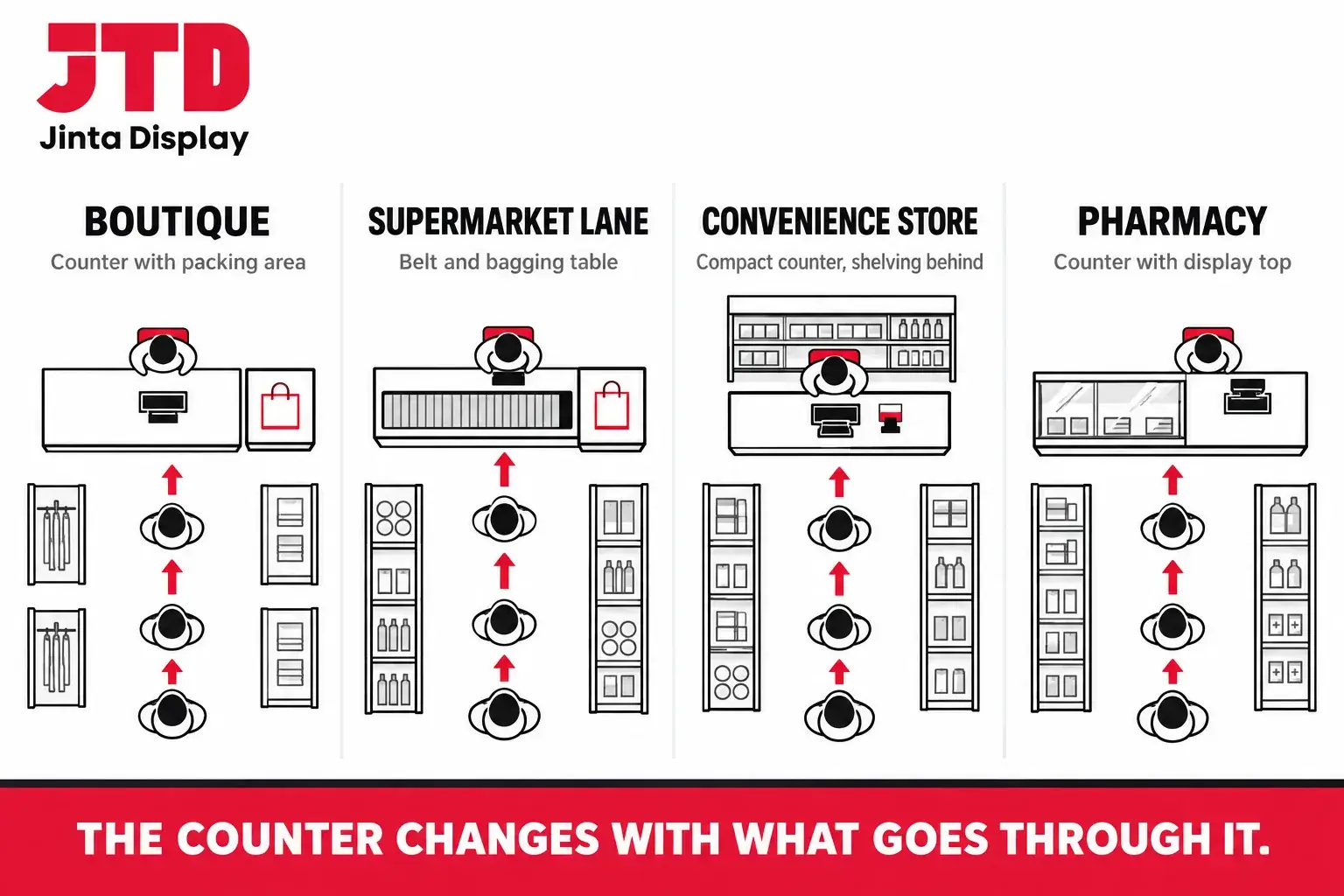
Boutiques and fashion stores. A cash wrap here is usually a single counter with storage underneath, a packing shelf and a display top. Wrapping and bagging are part of the service, so depth and surface quality matter more than belt length.
Supermarkets and grocery stores. A lane counter with a belt, a bagging table, and space for a scanner and a card terminal. It has to be built for many transactions an hour.
Convenience stores and pharmacies. A compact counter with shelving for tobacco, lottery or over-the-counter items behind or beside it. The footprint is small, and storage and security are the main concerns.
Hardware and specialty shops. A longer counter with a heavy-duty top, space to place bulky items and sometimes a cutting or measuring surface.
Service desks and returns. A lower, simpler counter, separate from the main sales point, used for returns, pickups and inquiries.
Types of Cash Wrap Counter by Construction
Beyond the store type, cash wraps differ in how they are built, and the construction decides cost, lead time and how easily the counter can move later.
Freestanding steel counter. A frame of cold rolled steel with panels and a top, shipped knocked down and assembled on site. It is stiff, quick to deliver and easy to match to steel shelving. This is how our counters are built.
Built-in millwork. A counter built from wood or board by a joiner to the shop’s design. It can be any shape, and it is also the slowest and the hardest to move or reuse.
Modular counter. Sections that bolt together to make an L or a longer run, which suits shops that expect to add a second sales point later. The sections must be ordered with matching tops and edges.
Glass display counter. A counter whose front or top is a glass case, common for jewelry, cosmetics and watches. It trades storage for display and needs lighting and a lock.
Mobile or pop-up counter. A lighter counter on casters, used for markets, events and seasonal shops. It sacrifices stiffness and storage for flexibility.
For a supermarket or a chain, the steel freestanding counter is usually the right choice, because every lane can be identical and spare parts are interchangeable. For a single boutique with a distinctive look, built-in millwork may justify the extra time.
How Big Should a Cash Wrap Be
Three dimensions set the size, and each answers a different question.
Length. Length is how much working surface you need. A single-clerk boutique counter is commonly 1,200 to 1,800 mm. A busy shop that needs room for two staff, a packing area and a display runs from 2,000 mm upward. Our range goes from 1,200 to 4,000 mm.
Depth. Depth decides what fits on top. At 550 to 660 mm a counter holds a terminal and a small pile of goods. At 960 to 1,200 mm it holds a terminal, a packing area and a display, and is the depth boutiques and retail shops use for a cash wrap proper. Supermarket lanes are deeper again once a belt is added.
Height. Our counters stand 850 to 870 mm high, which is about 33.5 to 34.3 in. Counter height is a balance between standing comfort for staff and easy reach for customers. Accessibility rules in some countries set maximum heights for at least part of a sales counter, so check the local code before you fix the height of a counter in a public shop.
Beyond the counter itself, plan the space around it. Leave a clear queue area in front, and a gap behind for staff to move past one another. Keep sightlines from the counter to the door and to the shop floor, which is why many cash wraps sit near the entrance or in the center of the back wall.
Cash Wrap Dimensions in Our Range
These five counters are listed on our product pages. All are cold rolled steel, and sizes are customized to order.
| Model | Main counter (L × W × H) | Side table (L × W × H) | Best suited to |
|---|---|---|---|
| Supermarket Checkout Counter 1800 × 600 | 1,800 × 600 × 850 mm | 600 × 600 × 850 mm | Compact lane, convenience store |
| Supermarket Checkout Counter 2000 × 600 | 2,000 × 600 × 850 mm | 600 × 600 × 850 mm | Standard supermarket lane |
| Supermarket Checkout Counter 1800 × 660 | 1,800 × 660 × 850 mm | 560 × 560 × 850 mm | Lane with a deeper main top |
| Retail Checkout Counter 2000 × 960 | 2,000 × 960 × 870 mm | 560 × 560 × 870 mm | Retail shop cash wrap with packing space |
| Checkout Counter 1800 × 1200 | 1,800 × 1,200 × 860 mm, one piece | None | Wide top for a display and packing area |
The 2,000 by 960 mm retail checkout counter is the model closest to a boutique cash wrap, with a deeper top and a small side table. The 1,800 by 1,200 mm one-piece wide top suits a shop that wants one broad surface for packing and display. The 600 mm deep models in the supermarket line suit lanes where a belt and bagging table do most of the work. The category as a whole runs 1,200 to 4,000 mm long, 550 to 1,200 mm wide and 850 to 870 mm high, with an optional assistant table of about 560 × 560 mm or 600 × 600 mm.
Counters ship in wooden export cases and assemble on site without special tooling, and the finish can match your shelving, as our counters are built to sit beside our supermarket shelving and shopping trolleys.
A Worked Example, Sizing the Cash Wrap Zone for a Small Shop
Take a shop of about 120 square meters with two staff on the floor at peak times. The brief is one counter with a packing area, space for a card terminal and a printer, and a queue of three or four customers. The figures below are an example of the method and not a rule.
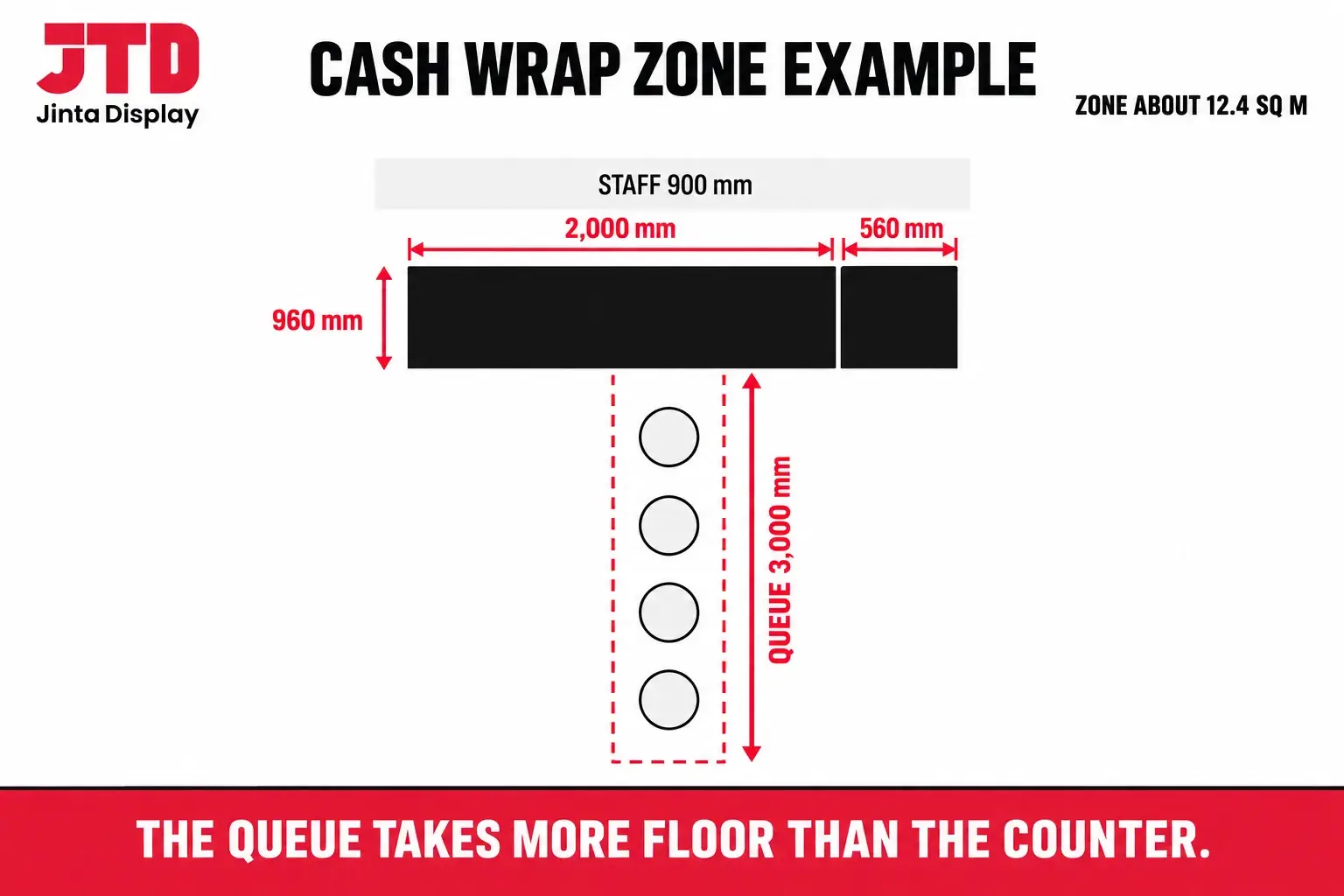
Start with the counter. A 2,000 mm main counter at 960 mm deep gives room for the terminal and printer at one end and a packing surface at the other. Add a 560 mm side table for bagging, and the working front is 2,560 mm long. That is close to our 2,000 by 960 mm retail counter with its 560 by 560 mm side table.
Next add the staff side. Allow about 900 mm behind the counter so one person can pass another. Counter depth plus staff space is then 960 plus 900, or 1,860 mm.
Then add the queue. Three customers standing one behind another need about 2,400 to 3,000 mm, and a lane 1,500 mm wide leaves room for a trolley or a bag. Take the larger value. The zone is then 2,560 mm along the counter and 1,860 plus 3,000, or 4,860 mm deep, which is about 12.4 square meters. In a 120 square meter shop that is roughly a tenth of the floor in this example.
Planning the Layout Around the Cash Wrap
The counter is one piece of a small system, and the system is what customers experience.
Position. Near the entrance gives control over entry and exit. At the back of the shop pulls customers through the whole floor. Center positions suit large floors with several sales points. Choose by what you want the customer to walk past.
Queue. A queue needs depth, not just width. Allow room in front for a line of three or four customers without blocking an aisle, and use floor markings or a barrier where the queue could spill into the shop.
Impulse zone. The shelves and displays beside the counter earn their place because customers wait next to them. Small items at low prices work best here. Keep the display shallow so it does not narrow the queue.
Staff side. Leave enough room behind the counter for two people to pass and for a bag stock to sit within reach. A counter that looks right from the front and cramps the staff slows every sale.
Power and data. Run power and network to the register position before the counter is installed. A cut-out and a cable route in the counter make a cleaner result than a cable strapped to the outside.
Mistakes to Avoid With a Cash Wrap
The same few errors appear in shop after shop.
Making the counter too short. A counter that fits the till and nothing else forces staff to stack goods on the floor. Add the packing surface to the length before you fix it.
Forgetting the cable route. Plan the cut-outs for power, network and the printer before the counter is made. Retrofitting a hole in a finished top is harder than specifying it.
Blocking the sightline. A tall display on the counter hides the staff from the customers and the customers from the staff. Keep the top low where it faces the queue.
Ignoring the queue. The counter is a small part of the zone. A shop that gives the counter all the space and the queue none finds customers standing in the main aisle.
Choosing a finish that does not match. A counter in one color beside shelving in another reads as a mistake. Match the color and the edge detail to the shelving at the order stage.
Putting a supermarket counter in a boutique. A 600 mm deep lane counter has no room for packing. Choose the depth for what the counter must do.
Materials, Finish and Matching the Shop
Our counters are cold rolled steel, which gives a stiff, durable frame and a surface that takes powder coating. Because the counter is the most touched fixture in the shop, the finish is worth specifying. A hard-wearing top, an edge that resists knocks from carts and baskets, and panels in the same color as the shelving make the fit-out read as one design.
Customization is part of the order. Color, logo and size can all be set, and printing your own logo on the counter is available. Production time on our counter listings is 15 days, and the exact lead time is confirmed with the quotation.
Security and Staff Comfort at the Counter
The cash wrap holds the day’s takings, so its position and build affect security as much as sales. Place the counter where staff can see the door and the main aisle. Keep the cash drawer on the staff side, out of reach of customers, and provide lockable storage for spare cash and receipts. A raised edge on the customer side keeps small items from being swept off the top, and a clear sightline lets staff notice a problem before it grows.
Staff comfort matters too, because cashiers spend most of the day at the counter. A height of 850 to 870 mm suits standing work for most adults, and a footrest or an anti-fatigue mat behind the counter makes a long shift easier. A counter that is too high or too low shows up as sore backs and slower service, which a short site visit can prevent.
Care and Maintenance of a Steel Cash Wrap
A steel counter is simple to look after. Wipe the top and panels with a damp cloth and mild cleaner, and avoid abrasive pads on a painted or powder coated finish. Check the edge for chips after the first year of heavy use, and touch up the paint early to stop rust from starting at a knock. Because the frame is knocked down and bolted, loose fixings can be tightened with ordinary tools, and a damaged panel can be replaced without changing the whole counter.
For a chain with many counters, keep a short list of spare panels and fixings. When every counter is the same model, one spare set covers all of them, which is a practical advantage of a standard steel design over one-off joinery.
Fitting the Cash Wrap Into the Rest of the Shop
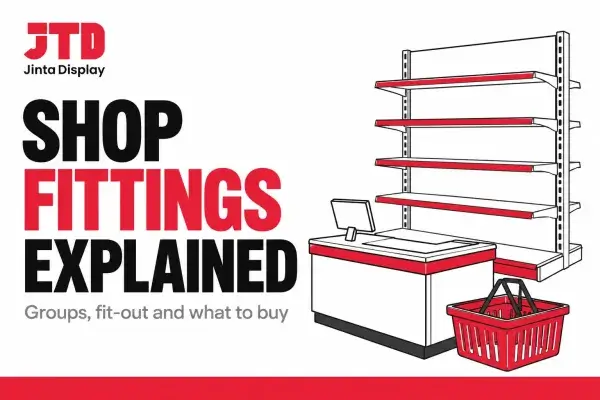
A cash wrap looks right when it belongs to the same family as the shelving around it. Matching the color, the edge detail and the logo makes the sales point read as part of the design and not as an afterthought. Our counters are built to sit beside our supermarket shelving, shopping trolleys and baskets, so a store can be ordered from one plant to one specification. The same logic applies to the shelving beside the counter, whose height and depth should leave the queue and the sightlines open.
If you are fitting out a whole shop and not replacing one counter, plan the order together, as set out in our supermarket equipment list for a new store. The counter, the impulse shelving, the baskets and the trolleys share a finish, and ordering them in one shipment saves freight and keeps the colors matched.
What to Put in an Inquiry for a Cash Wrap
A supplier can quote a retail cash wrap quickly when the brief names these items.
Give the type of store and the number of staff at the counter. Give the length, depth and height you want, or the space available. Say if you need a side table, a belt, a display top or storage. Name the finish, the color and any logo. State the equipment that has to fit, namely the till, terminal, printer and scanner, with their sizes. Give the destination port and the quantity. With these, the supplier can send a drawing and a quotation that you can compare with others.
If you are planning a counter, send us your store type and the counter length you have in mind and we will reply with a drawing and dimensions.
Frequently Asked Questions
What is a cash wrap?
A cash wrap is the sales counter of a shop, where customers pay and staff bag or wrap purchases. It includes the counter, the till and terminal position, a packing shelf and often storage and a small display. Cash wrap is the American term for what other countries call a till counter, sales counter or cashier counter.
What is cash wrap in retail?
In retail it names the checkout point of a shop, usually a counter with a finished top, space for a register and card terminal, a place to bag goods and storage underneath. The phrase is used mainly in the United States, and in supermarkets the same fixture is more often called a checkout counter.
What is the meaning of cash wrap?
The cash wrap meaning is the place where a customer pays and the purchase is wrapped or bagged. The name is usually explained by the old practice of wrapping goods in paper at the counter. The explanation is a trade story and not a documented record, but the meaning today is simply the sales counter.
What is the difference between a cash wrap and a checkout counter?
A cash wrap serves a shop where customers carry goods to a desk, such as a boutique or pharmacy. A checkout counter serves a lane, usually with a conveyor belt, a bagging table and room for a trolley. The frame and finish can be the same, and the difference is the layout and the depth.
How big is a cash wrap counter?
Most are 1,200 to 2,400 mm long, 550 to 1,200 mm deep and 850 to 870 mm high. A small boutique counter is about 1,200 to 1,800 mm long. A busy shop with a packing area needs 2,000 mm or more and a deeper top of 960 to 1,200 mm.
What do you call a cash wrap in the UK?
In the UK and Ireland the usual words are till counter or shop counter, and in Australia sales counter or cash desk. In Asia and the Middle East buyers say cashier counter or cash counter. In Spanish the counter at the cash point is the mostrador de caja.
What goes on a cash wrap counter?
The till or register, a card terminal, a receipt printer and sometimes a scanner. Beside or beneath them are a packing shelf, drawers for bags and receipts, and a small display of impulse items or gift cards. A supermarket version adds a conveyor belt and a bagging table.
Can a cash wrap counter be customized?
Yes. Length, depth, height, finish, color and logo can all be set to the shop. Our counters are cold rolled steel, made to order with a listed production time of 15 days, and the side table, belt and storage are options. Send the equipment sizes so the register position fits.