
A shopping cart looks like one object, and a buyer ordering a fleet or a spare part has to see it as a set. The basket, the frame and the wheels come from different processes, wear at different rates and are replaced separately. Knowing the names and the jobs of the parts makes a quotation easy to read and a repair easy to order.
This article names the parts of a shopping cart, says what each one is made of and what it does, and shows which ones wear and fail. It then explains how to measure a part for replacement and how many spares a fleet needs. It does not cover sizes, which are in shopping cart dimensions, weight and capacity, or the materials in depth, which are in what shopping carts are made of. The styles are compared in types of shopping carts.
In the UK, Ireland, Australia and New Zealand the same object is a shopping trolley, and in the United States and Canada it is a shopping cart or a grocery cart. The parts are the same in all of them.
The Main Shopping Cart Parts at a Glance
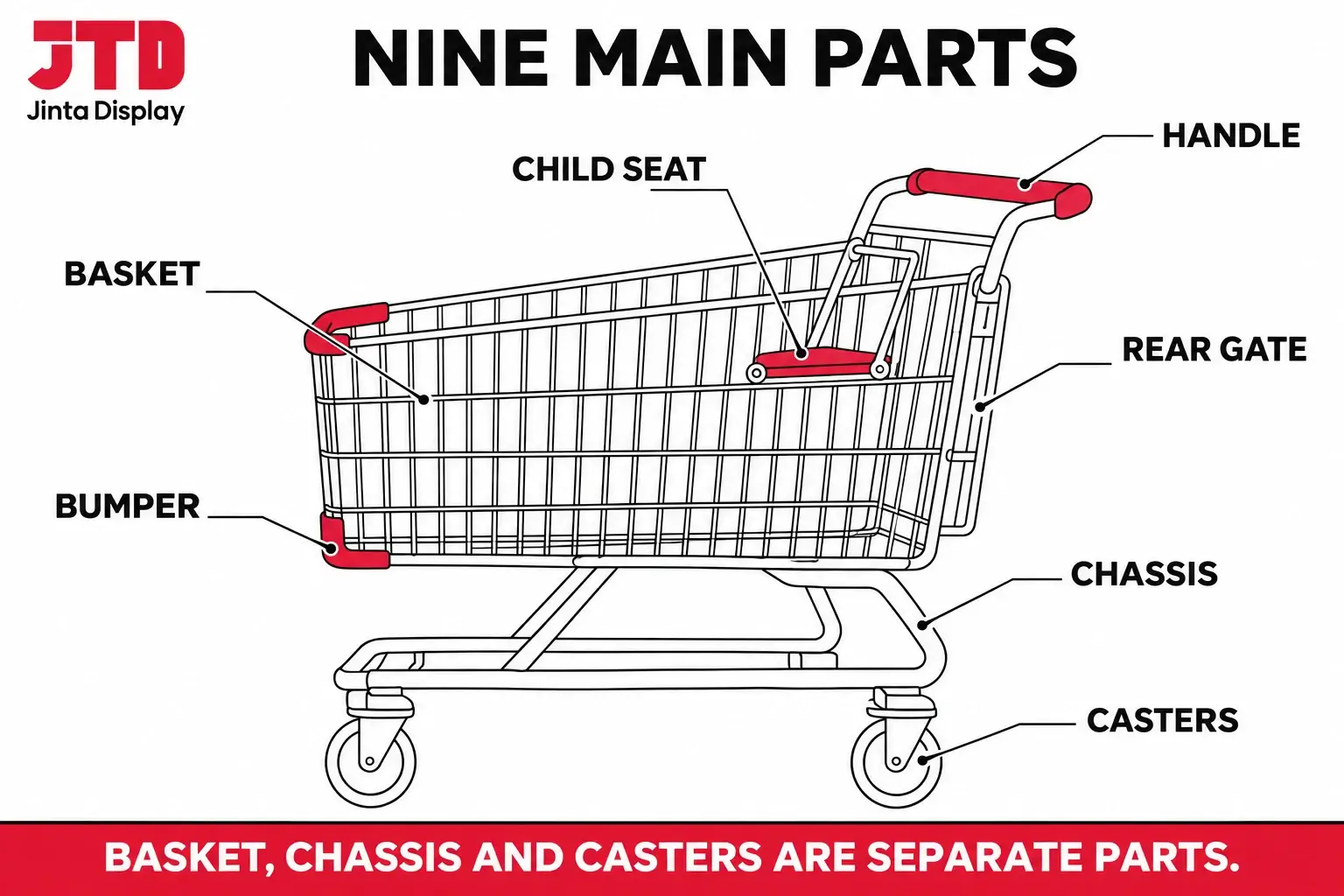
A metal shopping cart has nine main parts, and the table lists them with their material and their job.
| Part | Typical material | Job |
|---|---|---|
| Basket | Welded low carbon steel wire | Holds the goods |
| Rear gate | Steel wire frame on a hinge | Swings in to let carts nest |
| Chassis | Bent and welded steel tube | Carries the basket, the wheels and the push |
| Handle | Steel tube with a plastic grip | Where the shopper pushes |
| Child seat | Plastic flap or seat on a steel pivot | Carries a small child |
| Casters | Plastic or rubber wheel on a steel stem and bracket | Roll, turn and carry the weight |
| Bumper | Plastic or rubber | Protects the cart, the goods and the cars |
| Bottom tray | Steel wire or sheet | Holds heavy items low |
| Fittings | Plastic and steel | Coin lock, ID plate, advertising panel |
The list is for a standard supermarket cart. A plastic bodied trolley swaps the wire basket for a molded plastic body on the same steel frame, and our plastic bodied trolleys list Q195 carbon steel for the frame. Other types, such as a rolling basket or an airport luggage cart, have their own parts, and some of the names below apply to them as well.
The Basket and the Rear Gate
The basket is the first of the shopping cart parts and the one the shopper fills. It is a grid of welded steel wire, with a few heavier wires to carry the load and many lighter wires to keep the goods in. The wire is low carbon steel, which is strong, light, easy to clean and lets the shopper and the cashier see the contents.
Three things set the quality of a basket. The wire diameter sets the stiffness, and a thin wire bends under a heavy load. The number of cross wires sets how well small items are held, and a basket with too few lets a bottle or a packet fall through. And the welds set the life, since a basket fails at a weld, where a wire breaks away from the frame. A cheaper basket uses thinner wire and fewer cross wires, and it shows in the weight.
The rear gate is the flap at the back of the basket, hinged so that it swings inward when another cart is pushed into it. It is what lets carts nest, one inside the next, and it matters for the trolley bay and for the container. A gate that sticks, bends or breaks stops a cart from nesting, and the cart blocks the bay.
The basket is also where the capacity is set. Our metal carts are listed in sizes from 60 to 240 L, in the American, Asian, European, German and Russian styles, and the capacity is the volume of the basket.
The Chassis and the Handle
The chassis is the frame under the basket, and of all the shopping cart parts it is the one that sets the life of the cart. It is bent steel tube, welded, and it carries the casters, the handle and the weight of the load. It is the part that gives a cart its stiffness, and the geometry of the frame, more than the hardness of the steel, makes it stiff.
The wall thickness of the tube sets how much the chassis can take. A thin tube bends when a cart is pushed into a curb or into another cart, and it can twist so that the cart pulls to one side. The finish on the tube matters as well, since the chassis is the part most scratched by trolley bays and car park surfaces. Our metal carts list zinc with clear coat or chrome plate as the finish.
The handle is part of the chassis, a tube bent into a bar at the height of the shopper’s hands, with a plastic grip over it. The grip is the part the shopper touches, and it can carry a logo or a color. A grip that cracks or loosens is a common repair. The handle height is set for the shopper and not for the size of the basket, and a small cart and a large cart stand at nearly the same height.
The Child Seat and the Bottom Tray
The child seat is a small plastic flap or seat that folds down from the handle end of the basket, with leg openings and a belt in some designs. It is a safety item, and the rules that apply to it differ from place to place. The buyer should ask the supplier which standard the seat is built to.
The seat has a hinge or a pivot, and the pivot is the weak point. A hinge that is loose or worn lets the seat drop under a child’s weight, and a broken one has to be replaced at once. Check the seat on every inspection of a fleet.
The bottom tray is the lower shelf under the basket. It carries heavy goods such as bags of rice, cases of water and large packs, so that the shopper does not lift them into the basket. It is steel wire or sheet, welded to the chassis, and its strength comes from the same wire and weld quality as the basket.
The Casters
The casters are the four wheels, and they are the part that wears first. Each one has a wheel, a bearing, a bracket and a stem or plate that attaches it to the chassis. The wheel is plastic or rubber, the bracket is steel, and in a good caster the bearing is a ball bearing and not a plain one.
On most carts the front two casters swivel and the rear two are fixed, or all four swivel. Swivel casters let the cart turn, and fixed casters keep it tracking straight. Some carts have a directional lock on one wheel, which stops the cart from skewing sideways. The wheel diameter is commonly 4, 5 or 6 inches, which is 100, 125 or 150 mm. Our trade listings show 4 inch wheels in PU or rubber.
A caster looks the same from a distance whether it is good or poor, and that is why it is the part most often downgraded to make a quotation competitive. A cheaper caster has a thinner tread, a plain bearing and a thinner bracket, and it wears out in a third of the time. The next guide in this series covers casters in detail, with the load arithmetic, in shopping cart wheels and casters.
The Bumper and the Fittings
The bumper is a plastic or rubber strip around the rear of the basket or the chassis. It protects the cart when it is pushed into another, protects the goods in a nested line and protects cars and walls from the steel.
The fittings are the small parts added to a cart for use in a particular store. A coin lock fastens carts together and returns a deposit when the cart is returned. An ID plate or a number carries the store’s name or a fleet number. An advertising panel fits on the handle or the basket. A pocket or a clip can hold a list or a phone. All of them are plastic or steel, and all of them are chosen by the store.
The fittings are where a fleet’s look is set. Our product pages list a logo that can be printed and OEM colors, which gives each store its own identity, and the fittings can match the same colors. They are also the parts most often damaged or lost, and a spare stock is worth holding.
Shopping Cart Parts by Material and Finish
The material and finish of shopping cart parts decide how long each one lasts, and they differ from part to part.
The steel parts, the basket, the chassis, the gate and the tray, are low carbon steel, and their protection is the finish. Zinc plating is a thin layer that protects the steel and is clear coated to keep its look, and chrome plating gives a brighter and harder surface. Powder coat gives a color and a thicker film. Our metal carts list zinc with clear coat or chrome plate as the finish, and a finish that is too thin shows rust first at the weld points and at the wheel mounts.
The plastic parts, the handle grip, the child seat, the bumper and the fittings, are molded in plastics chosen for impact strength and color. They are the parts that carry the store’s colors and logo. A plastic part left in strong sun can fade and turn brittle, and a part in a cold climate can crack. Ask for the resin and for the weather the cart will see.
The casters combine both. A steel bracket and stem carry a plastic or rubber wheel, and each has its own way of wearing. The bracket bends or rusts and the wheel wears or flat spots. A good specification names the wheel material, the bearing and the bracket thickness separately, which is the way the caster guide treats them.
How the Parts Work Together in a Trolley Bay
Shopping cart parts are designed as a set for nesting, because carts spend much of their life stored in a line in a bay. The rear gate swings in, the basket tapers, and the chassis is shaped so that each cart slides into the one ahead and stops against a bumper.
The distance each cart pushes into the one in front is the nesting pitch, and a typical pitch is 200 to 260 mm. The pitch sets how long a line of carts is. Take a cart 1,000 mm long, which is an assumed figure, and a pitch of 230 mm. A line of 20 carts is 1,000 plus 19 times 230, which is 5,370 mm, a little over 5 m. A tighter pitch shortens the line and makes the bay smaller, and it needs a gate and a basket shape that allow it.
This is why the parts of a style have to match. The bumper, the gate and the basket taper of one style are made to nest with the same style, and a cart of another style does not slide in. A store that adds carts of a different style to a bay ends up with a bay that does not work.
Which Parts Wear and Fail First
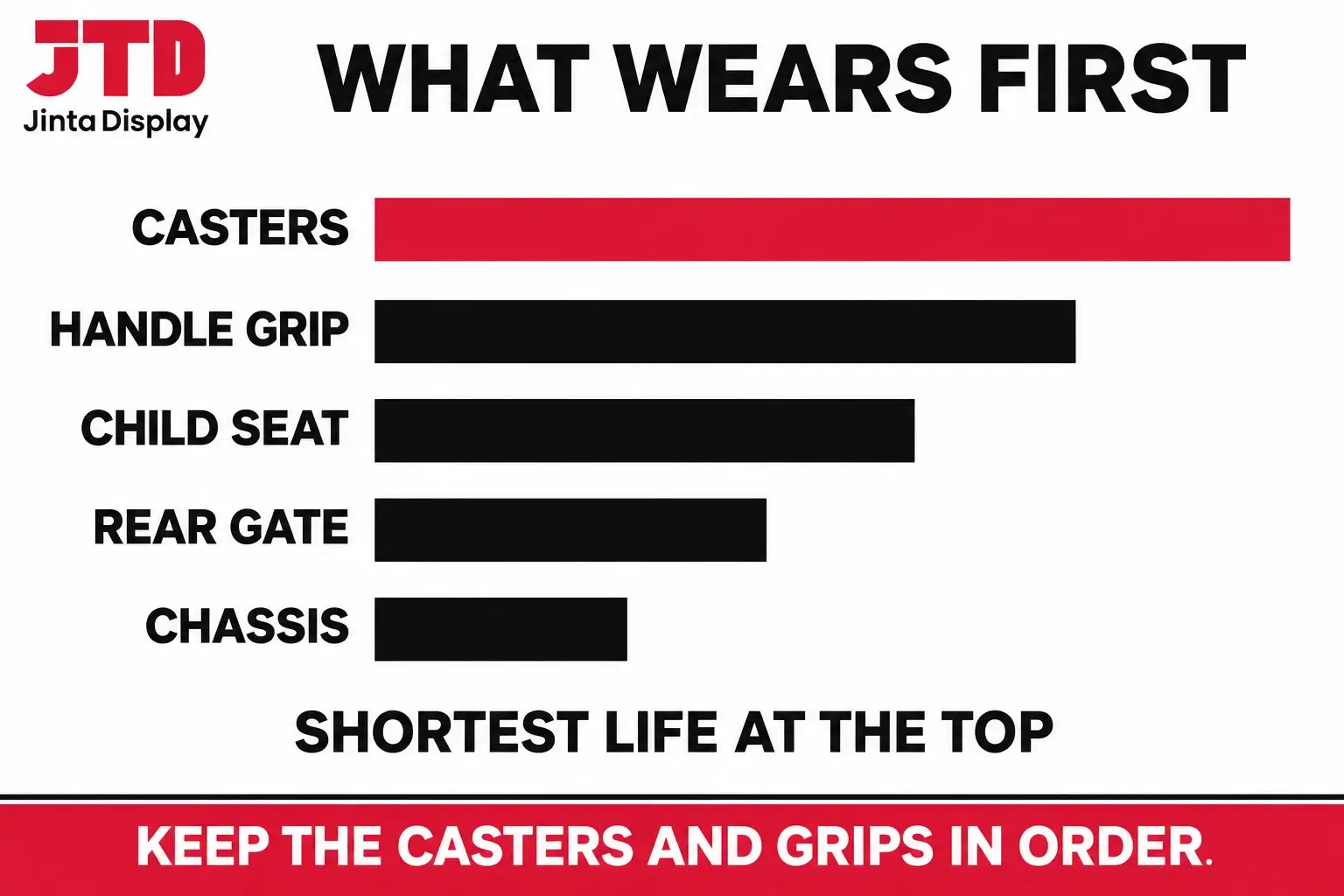
The shopping cart parts do not wear at the same rate. The wear follows the use, and knowing the order helps with spares and with the inspection routine.
| Part | Usual wear or failure | Typical response |
|---|---|---|
| Casters | Tread wear, worn bearings, bent brackets, loose stems | Replace the caster, keep spares |
| Handle grip | Cracking, loosening, wear | Replace the grip |
| Child seat | Loose hinge, cracked plastic | Replace the seat, check at every inspection |
| Rear gate | Bent, sticking, broken hinge | Repair or replace the gate |
| Bumper | Cracks, missing pieces | Replace the bumper |
| Basket wire | Broken welds, bent wires | Weld or replace the basket |
| Chassis | Bent tube, cracked welds, rust | Straighten if minor, else retire the cart |
The casters are first because they carry the weight and meet the floor, and the chassis is last because it is the strongest and the most expensive to replace. A fleet that keeps its casters and grips in good order keeps its carts in service far longer.
Counting Parts for a Fleet
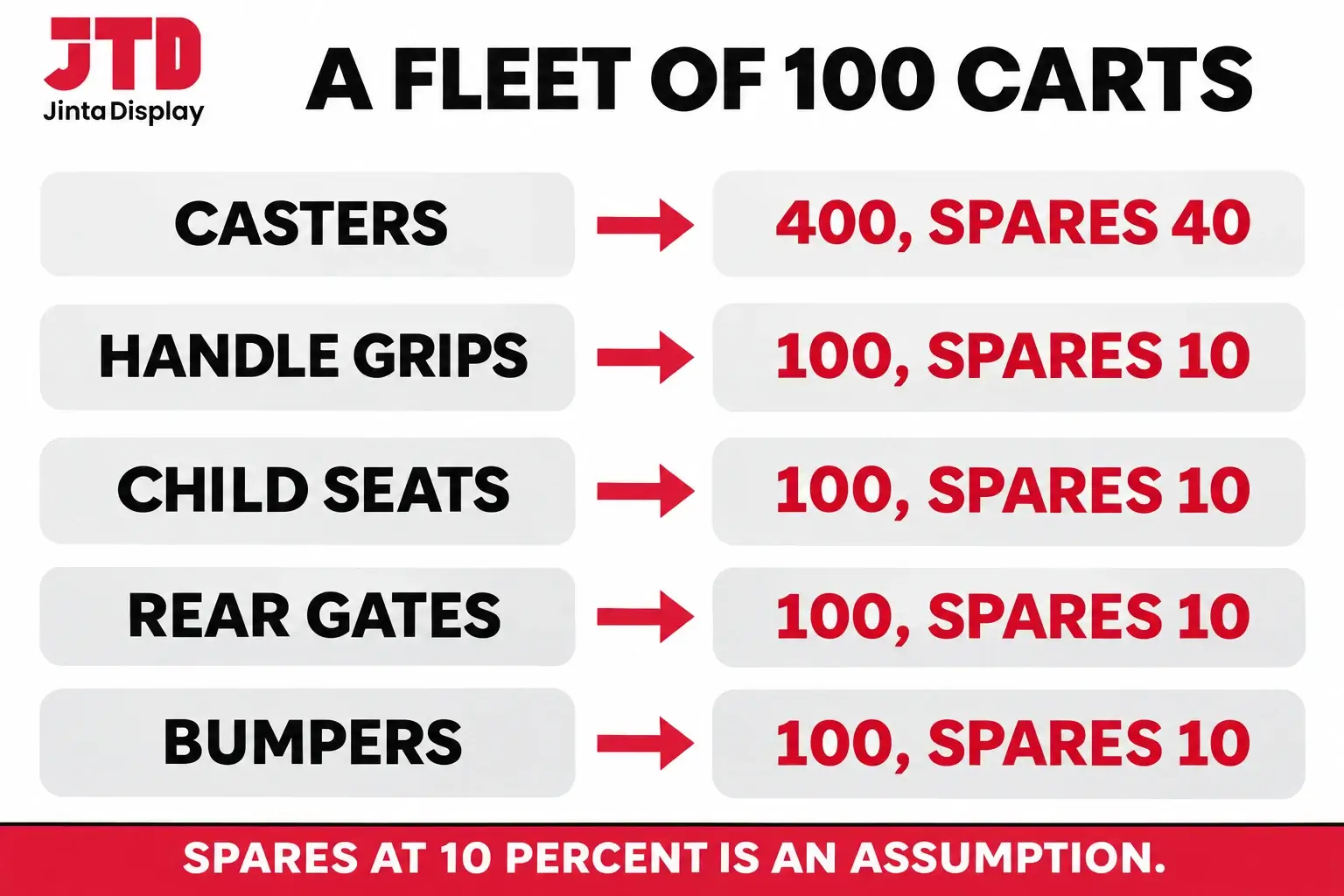
The number of parts in a fleet follows from the number of carts, and the count is the basis for spares. Take a fleet of 100 carts, and assume a spare stock of 10% of the parts that wear.
| Part | Per cart | Fleet of 100 | Spares at 10% |
|---|---|---|---|
| Casters | 4 | 400 | 40 |
| Handle grips | 1 | 100 | 10 |
| Child seats | 1 | 100 | 10 |
| Rear gates | 1 | 100 | 10 |
| Bumpers | 1 set | 100 | 10 |
A fleet of 100 carts has 400 casters, and a 10% spare stock is 40 casters. The 10% is an assumed figure, and the right one depends on the use, since a fleet in a busy store with rough floors wears casters faster than a quiet one. Count your own replacement rate over a year and set the spare stock from it.
Measuring a Part for Replacement
The right part is the one that fits, and a few measurements give it. The table lists what to take for the main parts.
| Part | Measure | Also note |
|---|---|---|
| Caster | Wheel diameter, tread width, mounting height | Stem type, plate bolt spacing, swivel or fixed, bearing type |
| Handle grip | Inner diameter, length | Color, whether it carries a logo |
| Child seat | Width between the pivots, hinge type | Color, safety rules that apply |
| Rear gate | Width, hinge position | Wire diameter, finish |
| Bumper | Length, section, fixing | Color, material |
Photograph the part in place and take it off for measuring where you can. If the cart is one of ours, give the style and the capacity, such as the German style at 180 L, and we reply with the parts that fit. Parts from different styles often differ in small ways, so a part that fits one style may not fit another.
Plastic Bodied Carts and Other Types
A plastic bodied trolley changes the parts list. The wire basket and the rear gate are replaced by a molded plastic body, and the steel frame, the casters and the handle stay. The body is a single part, which is easy to clean and does not rust, and a cracked body is replaced as a whole. The frame is the same Q195 carbon steel as in our other carts, so the chassis, the casters and the fittings are inspected in the same way.
A rolling basket has a plastic body on a small frame with two wheels and a telescopic handle, and the parts are the body, the wheels, the handle and the frame. An airport luggage cart has a larger steel frame, a platform and a hand brake, and its parts are listed in our guide to airport luggage cart specs.
Reading a Parts Quotation
A quotation for shopping cart parts or for a fleet should name each part, and a few lines show whether it is a good one.
For casters, look for the wheel diameter and width, the tread material, the bearing type, the bracket thickness and whether the caster swivels or is fixed. For the basket, the wire diameter and the number of cross wires. For the chassis, the tube diameter and wall thickness. For the finish, the type and the thickness. For the fittings, the material and the color reference.
A quotation that says only caster, handle and basket has told you very little, and the cheaper price may be a thinner part. Compare two quotations line by line on the same basis, and ask for the net weight of the cart. Our product pages list net weights for every style and size, and a cart that is much lighter than the listed weight for the same capacity and style has less steel in it.
Care and Cleaning of Shopping Cart Parts
A little care extends the life of the parts. Wipe the grips and the child seat with a mild cleaner, since they are touched by every shopper, and check them for cracks as they are cleaned. Clear hair, thread and dirt from the casters, where it winds round the axle and wears the bearing. A drop of oil on a swivel bracket keeps it turning, and a caster that has seized should be replaced and not forced.
Look at the welds of the basket and the chassis for cracks and rust, and treat any small chip in the finish before the steel under it starts to rust. Store carts indoors or under cover where you can, and keep them out of standing water. A routine that looks over every cart each month finds most faults while they are small.
When to Repair and When to Retire a Cart
Most faults in shopping cart parts are repaired by replacing the part, and the cart goes back into service. A worn caster, a cracked grip, a loose seat and a bent gate are all cheap to put right.
Some faults are not. A chassis that is bent beyond what can be straightened, a basket with many broken welds or a frame with cracks at the joints is a cart to retire. The cost of a repair that is not reliable is higher than the cost of a new cart, and a cart with a weak frame is a safety risk. Keep a record of the faults by cart number, so that a cart that returns again and again to the repair bench is noticed and retired. The guide to what shopping carts are made of explains why the frame is the part that decides the life of the cart.
Measure First, Then Order the Spares
Parts ordered from a picture go wrong. A caster or a gate that looks right can be wrong in a dimension, so measure and send the details. Be strict about the caster above all, since it is the part that wears. Ask for the wheel material, the bearing and the bracket thickness, and do not accept a vague specification.
Keep spares from the start. A fleet without spare casters and grips loses carts to small faults, and a cart out of service is a cart that does not earn. Keep to one style within a fleet as well, because carts of different styles do not nest, and parts of different styles often do not fit.
For shopping cart parts, send the style, the capacity, the quantity and the part you need, with a photograph and the measurements above. For a new fleet, say the store type, the trolley bay and the finish and logo you want. We reply with the specification and the parts that go with it. For the range, see our shopping trolley range, the German style trolley and the European style trolley.
For locks, barriers and payback, see shopping cart theft prevention.
If you are ordering shopping cart parts, send us your cart style, capacity and the part you need and we will reply with the part and the details to confirm.
Frequently Asked Questions
What are the parts of a shopping cart?
The main parts are the basket, the rear gate, the chassis, the handle, the child seat, four casters, the bumper, the bottom tray and fittings such as a coin lock and an ID plate. The basket and chassis are steel, the casters are plastic or rubber on steel, and the handle and fittings are plastic.
What is the rear gate on a shopping cart for?
The rear gate is the hinged flap at the back of the basket. It swings inward when another cart is pushed into it, so that carts nest one inside the next. It matters for the trolley bay and for container loading, and a gate that sticks or breaks stops a cart from nesting.
What is a shopping cart frame called?
The frame under the basket is called the chassis. It is bent and welded steel tube, and it carries the basket, the handle, the casters and the weight of the load. The handle is part of it, and its stiffness comes mainly from the geometry of the tube and not from the hardness of the steel.
Which shopping cart parts wear out first?
The casters. They carry the weight and meet the floor, and the tread, bearing and bracket wear first. The handle grip, the child seat hinge and the rear gate come next, and the chassis lasts longest. A fleet that keeps its casters and grips in good order keeps its carts in service far longer.
How many casters does a shopping cart have?
Four. On most carts the front two swivel and the rear two are fixed, or all four swivel, and some have a directional lock. A fleet of 100 carts has 400 casters, and a spare stock of 10% is 40. The wheels are commonly 4, 5 or 6 inches, and our listings show 4 inch.
How do I measure a shopping cart part for replacement?
For a caster take the wheel diameter, the tread width, the mounting height and the plate or stem type. For a grip take the inner diameter and the length. For a seat take the width between the pivots. Photograph the part in place and send the style and capacity of the cart.
What is a plastic bodied shopping trolley made of?
A plastic bodied trolley has a molded plastic body in place of the wire basket and rear gate, on a steel frame. Our plastic bodied trolleys list Q195 carbon steel for the frame. The body is one part, does not rust and is replaced whole if it cracks.
Can parts from different shopping cart styles be mixed?
Often not. Carts of different styles do not nest together, and parts of different styles can differ in small dimensions, and a part that fits one style may not fit another. Keep to one style within a fleet and give the style and capacity when you order parts.