A gondola frame is neutral. Two uprights, a back panel, a base and a row of shelves can hold a hardware stock, a bottle range or a rack of snacks, and the frame does not care. What makes it a hardware aisle or a bottle aisle is the set of parts added to it. Those parts are the gondola shelving accessories, called gondola shelf accessories in some catalogs, and they are the part of the order that buyers leave until the end and then find most urgent.
This article lists the main groups of gondola shelving accessories, says what each one does, and says what has to match between the accessory and the frame. It then works an example, counting the parts for a 10 bay wall run. It does not cover the frame itself, which is in what a gondola is in retail and gondola shelving sizes, and it does not cover the choice between wall and island builds, which is in single against double sided gondola shelving.
Why the Accessories Decide Whether a Gondola Works
A shelf bay holds product, and gondola shelving accessories control how the product sits on it. Without accessories, a shelf of small packs slides forward as shoppers take them, bottles lean on each other and a price tag has nowhere to go.
Retailers describe a store by what is on its walls and in its aisles, and most of that is accessory work. A convenience store that sells small goods needs hooks and dividers. A pharmacy needs price strips and headers that name the category. A hardware store needs perforated backs and heavy hooks. The same frame serves all three, which is why a manufacturer sells the frame and the accessories as separate lines.
There is also a practical reason to settle the accessories at the time of ordering. They are made in many more variants than frames, they are small and easy to lose in a container, and a missing accessory stops a bay from opening. Counting them before the order is placed saves a second shipment.
Compatibility Comes First
Gondola shelving accessories have to fit the system they hang on, and gondola systems are not interchangeable. The two things to check are the slot pitch of the uprights and the type of back panel.
Slot pitch is the vertical spacing of the slots in the upright. Shelf brackets and many accessories hook into those slots, and a part made for one pitch will not sit properly in another. Our sizes guide describes three pitch systems and explains that none of them interchange, which means an accessory bought from one system should not be assumed to fit a second.
The back panel is the second check. A plain panel takes no hooks, a perforated panel known as hole back takes pegs and hooks through its holes, and a slatwall or a slotted panel takes a different hook again. Our hole back gondola takes pegs and shelf merchandise on the same run, which means a hook has to fit the hole pattern and the hole size. For a bay on the Lozier system, such as the Lozier style bay on our site, accessories must follow the profile of that system.
The simplest way to avoid trouble is to name the system and the panel in the order and to say which bays will take hooks. If you are adding to an existing store, send a photo of an upright and a hook that already fits, and the supplier can match them.
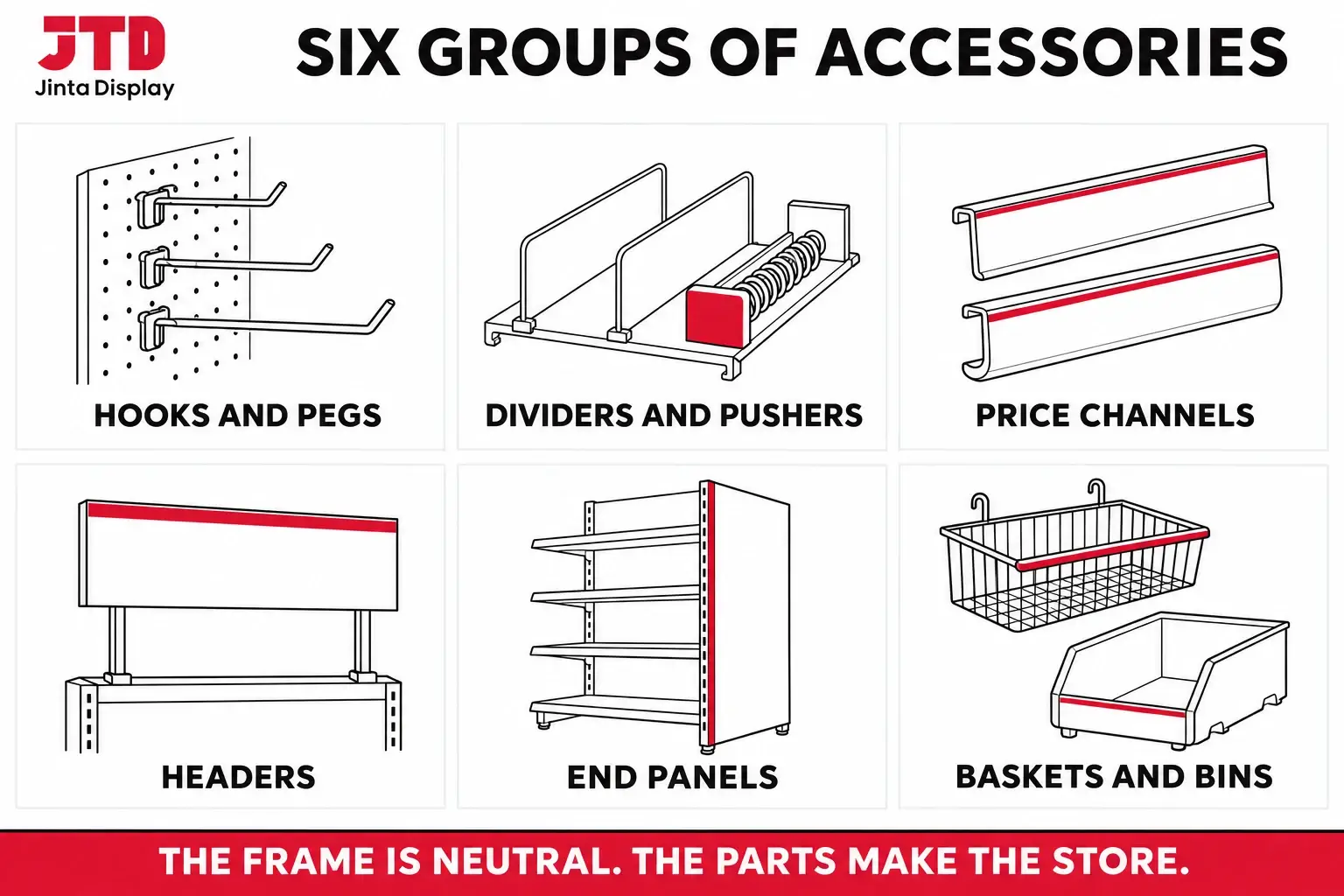
Hooks and Pegs
Hooks are the accessory that changes a shelf bay into a hanging display. They carry small packs, tools, accessories and impulse goods, and they are the first thing a hardware store, a pharmacy and a convenience store ask for.
A hook is described by its length, its load, how it locks and what it hangs in. Length decides how many packs fit on one hook and how far the display comes out into the aisle. Load decides what it can carry, since a hook for a light card is not the same as a hook for a tool. The lock decides whether the hook stays put when a shopper pulls a pack off it.
Single hooks hold one line of packs, and double hooks hold two lines, one above the other, which gives more capacity on the same hole. Our listings on third party platforms include metal peg board double hooks, perforated hook racks for auto supplies and hardware tools, and gum and small impulse hook racks for checkout and aisle ends. All of them are made to a customized size, color and logo, and the listings show small minimum orders of 10 to 50 pieces for the accessories alone.
A point that is easy to miss is the one in the island guide. On a double sided run the hole back panel is shared, so a long peg on one face can poke through into the space of the other face. Choose a peg length that fits an island and not only a wall bay.
Shelf Dividers and Pushers
Dividers and pushers keep goods in rows. They matter most for small packs, cans, bottles and boxed goods, where a loose shelf turns into a pile.
A divider is a vertical panel that splits a shelf into lanes. It is usually a wire or a sheet that slides on the shelf or clips to it. Lane width is set by the pack, and a divider every 200 to 300 mm is a common spacing for small packs. A pusher is a spring loaded tray that moves the stock forward as the front item is taken, which keeps the shelf looking full at the front. It suits cigarettes, bottles, boxed medicines and similar lines, and it saves staff the work of facing the shelf.
A front fence or a low lip is a third kind of part. It keeps bottles and cans from sliding off the front under a bump. Choose a lip height that does not hide the pack, since a high lip hides small goods.
The question to ask is whether the divider or pusher needs a particular shelf profile. Some clip into a flange on the shelf edge, and a shelf without the flange cannot take them. This is a second compatibility check, after the slot pitch.
Price Channels, Shelf Talkers and Label Holders
The price channel is the long strip along the front edge of a shelf that holds the price tag. It is the accessory with the highest total length in a store, because every shelf in the store has one.
A channel can be a C shaped strip, a clip on strip or a snap in label holder, and each carries a printed ticket or an electronic shelf label. A strip is usually sold by the meter or cut to the bay length. Count it, since it is one of the largest lines on an accessory list. In the example below, a 10 bay run uses 50 m of it.
A shelf talker, called a shelf wobbler in some markets, is a small card that sticks out from the shelf edge to flag an offer. It clips to the channel or to the shelf. A label holder for a promotional card is a similar small part. These are cheap and are easy to forget until the first promotion.
The fit question here is the channel height and the shelf edge profile. A channel made for one shelf edge does not snap onto another, so tell the supplier the shelf thickness and edge, or send a sample.
Headers, Canopies and Signs
The header is the sign board or frame at the top of a bay, and it carries the category name or the brand. A canopy is a wider top that may carry a light. Both make an aisle readable from a distance and give an island or a wall run its identity.
Our supplier listings include a round head gondola with a half circle header, which is a styled top on an island. Headers can be printed, painted or fitted with a lightbox, and they are made in the color and logo of the store. A header adds height, so check it against the ceiling and the sprinkler clearance, and against the sightline rules from the island guide.
The decision to make early is whether the header is part of the gondola or a separate fixture. A header that clips to the upright is simple to change. A header welded into a canopy is hard to change and gives a cleaner finish. Pick the one that matches how often the store changes its categories.
End Panels, End Caps and Bumpers
An island needs something at each end. An end panel closes the side of the run so the back of the shelves is not seen. An end cap is a short run of shelves that finishes the island and uses the same frame, and it is where promotions go. Our guide to end caps in retail covers how a store uses them.
Bumpers and kick plates are the quiet accessories. A bumper at the base of an upright protects the frame from trolley and pallet knocks. A kick plate closes the gap at the bottom of a bay so a shopper cannot push a foot under the base. In a store that moves a lot of stock by trolley, a bumper pays for itself.
The fit question is whether the end panel is built for the exact bay depth and height. A panel made for a 450 mm base will not close a 570 mm run, so give the supplier the bay depth and the height of the uprights.
Baskets, Dump Bins and Lower Shelf Extras
The lowest part of a bay is the hardest to sell from, and a store often fills it with a basket, a bin or a deep tray. Wire baskets hang on the shelf front or sit on the base, and dump bins hold loose goods for clearance and promotion. A base deck can carry heavy items, and the load rating of the lowest shelf is higher than that of an upper shelf because the base transfers load straight to the floor.
For a store that wants to keep the base for heavy goods and use the upper shelves for light ones, the useful number is the rated load of the base deck against the rated load of an upper shelf. It is in the sizes guide, and it is worth confirming for the exact model.
Adding and Replacing Parts After the Store Opens
The order does not end when the store opens. Promotions change, ranges move and parts get lost or bent, and a store that has planned for this keeps the work to a few minutes.
Keep the part names, the system, the finish and the color reference from the first order on file, because a part ordered a year later has to match the first batch. Keep a small spare stock of the parts that wear or go missing, which are hooks, dividers, channel strips and shelf talkers. Photograph the first bay as built, so a new member of staff can rebuild it the same way. If the store adds a second shop, order the accessories together with the frame and count them with the method in the example below, and the second opening will not wait for a small box.
Gondola Shelving Accessories by Store Type
The right set of gondola shelving accessories depends on the store, and the same frame ends up with a different parts list in each one.
Convenience store. Small packs, impulse lines and a mix of shelves and hanging goods. The list is price channels on every shelf, dividers on the snack and drink shelves, a few hook rows for small accessories, and shelf talkers for offers. Gum and small impulse goods hang from hook racks at the counter and the aisle ends.
Pharmacy. Small boxes in tidy rows and a clear category sign. The list is price channels, dividers or pushers for boxed medicines, headers that name each category, and a few hooks for small accessories. Pushers earn their cost here because staff do not have to face the shelf every hour.
Hardware and tool store. Heavy hanging goods on a perforated back. The list is heavy duty hooks with a rated load, a hole back panel, deeper hook lengths and a bumper at the base. Our channel has a video of a yellow metal tool display rack for exactly this use, with hooks on a perforated panel.
Supermarket dry grocery. Wide runs and many lines. The list is price channels in large quantity, dividers for cans and bottles, headers at every category change, end panels on every island and bumpers along the main aisles where trolleys run.
Clothing and accessories shop. Light hanging goods and display faces. The list is hook rows, headers with the brand, and a few shelf talkers. Our supplier listings include a clothing store hook rack with solid shelves and an adjustable back, made in a customized size, color and logo.
The pattern across the five is that the frame stays the same and the accessories carry the category. If a store changes its range, it changes the accessories and not the frame, which is the main reason to keep the two as separate lines on the order.
Finish, Material and Load of Gondola Shelving Accessories
Gondola shelving accessories are small parts in large numbers, and the material and finish decide how they look and last after a year of handling.
Hooks and pegs are bent steel wire or rod, and the finish is usually zinc plating, chrome or powder coat. Zinc and chrome give a bright, thin finish and suit light loads. Powder coat gives a colored finish and suits a hook that has to match the frame. A hook that is plated but not coated can rust where the plating is scratched, so ask for the finish and the thickness. The listings for our accessories show surface treatments of polished, galvanized and epoxy powder coating.
Channels and dividers are steel, aluminum or plastic. Plastic is light and cheap, snaps in easily and comes in colors. Steel is stiffer and lasts longer under heavy tickets and repeated changes. In a store that changes prices often, the clip on and snap in styles matter more than the material, since staff handle them every week.
Load matters for hooks above all. A hook has a rated load in kilograms for a given length and the way it is locked, and a longer hook carries less than a shorter one because the load acts further from the panel. For tools and heavy packs, ask for the rating of the exact hook and not of the family.
Color is the last item. A gondola frame is often painted in a store color, and the accessories should match it or contrast with it deliberately. Give one color reference, in the same system as the frame, so that parts made in different batches do not drift. A different shade between the hooks and the uprights is a common complaint after delivery.
A Worked Example, Counting the Parts for a 10 Bay Wall Run
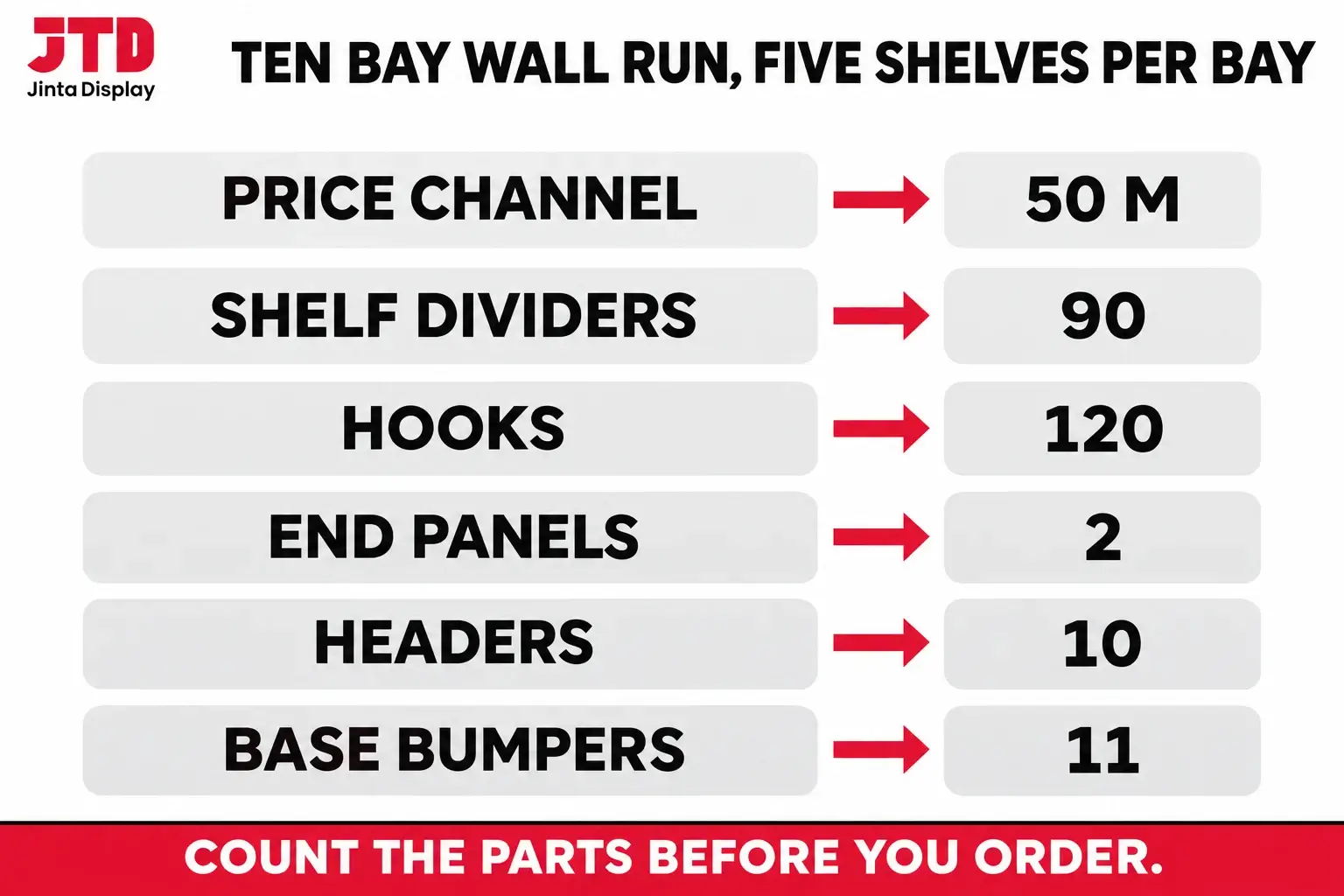
The easiest way to see the scale of gondola shelving accessories is to count the parts for one run. Take a single sided wall run of 10 bays, each 1,000 mm long, with five shelves per bay. The numbers below come from the assumptions in the table, which are ours and should be replaced with your own.
| Accessory | Assumption | Quantity |
|---|---|---|
| Price channel | One strip along each shelf, 1,000 mm per shelf | 50 m |
| Shelf dividers | One lane every 250 mm, so 3 dividers per shelf on 3 of the 5 shelves | 90 |
| Hooks | One hook row per bay, 12 hooks per row on a hole back panel | 120 |
| End panels | One at each end of the run | 2 |
| Headers | One per bay | 10 |
| Base bumpers | One per upright, 11 uprights | 11 |
The dividers come from 3 dividers per shelf, 3 shelves per bay and 10 bays, which is 90. The hooks come from 12 hooks per row and 10 bays, which is 120. The bumpers come from the uprights, since a run of 10 bays shares uprights and has 11. The numbers change with the pack and the layout, and the point of the table is the method. It turns an accessory list from a guess into a count.
Two Videos of Hooks and Accessories as Built
Two videos from our channel show hooks and shelf accessories as built, and they help a buyer judge the style and the finish.
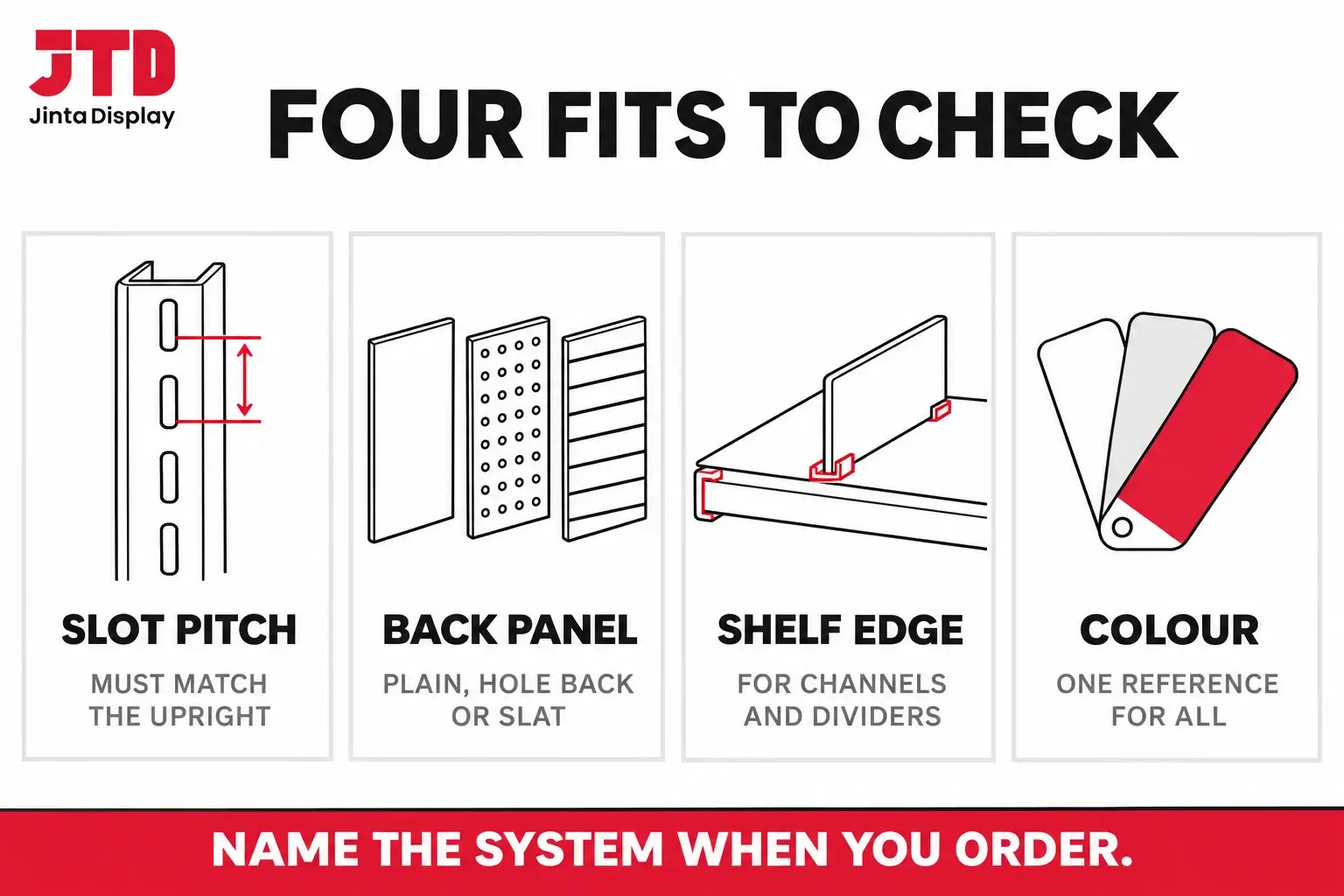
Four Fits to Check Before You Order
Gondola shelving accessories work on a bay only when four things fit, and each of them goes wrong in its own way on a new store.
Pitch and hole size come first. A hook or a channel that looks right in a picture can be made for a different pitch, a different hole size or a different shelf edge. Name the system and send a sample. Delivery comes next. Accessories are small and low in value per carton, but an order that waits for them delays the opening of the bays. Put them in the first container and count them as above.
Finish is the third. An accessory in a slightly different color from the frame looks wrong on the floor. Give a color reference for all of them and ask whether the powder coat is applied to the accessories as well. Load is the fourth. A hook rated for a card of sweets will bend under a tool, and the answer is to state what goes on each hook and ask for its rated load.
To order gondola shelving accessories, tell us the system you use, the back panel, the number of bays and shelves, and the goods on each run. In the UK and Australia these parts are part of the shop fittings order. Add the color and logo, and a photo of any part that already fits. We reply with the parts list and the quantities. See the supermarket shelf range for the frames and the hole back gondola for a bay that takes pegs and hooks. For store planning, see the supermarket equipment list.
For depth, trays and a worked wall, see bakery display shelves. For shelf levels and facings, see visual merchandising principles for shelving. For the frames these parts hang from, see supermarket shelf.
If you are ordering gondola accessories, send us your system, back panel and bay count and we will reply with a counted parts list.
Frequently Asked Questions
What are gondola shelving accessories?
They are the parts added to a gondola frame to display goods, mainly hooks and pegs, dividers and pushers, price channels and shelf talkers, headers and canopies, end panels and bumpers, and baskets and bins. Most hang from the slots or holes of the system and have to match its pitch and back panel.
Do gondola accessories fit every brand of gondola?
No. Slot pitch, hole size and shelf edge differ between systems, and an accessory made for one often does not fit another. Name the system when you order, and send a photo or a sample of a part that already fits. A bay built to a given system, such as a Lozier style bay, takes parts for that system.
How do I hang hooks on a gondola?
Use a perforated hole back panel and hooks made for its hole size and pattern. The hook pushes into the holes and locks at the back. Check the hook length, since on a double sided run a long peg can poke through into the other face. Ask for the rated load of the hook.
What is a shelf divider used for?
A shelf divider splits a shelf into lanes so small packs, cans and bottles stay in rows and do not pile up. A lane every 200 to 300 mm is typical for small packs. Some dividers clip to a shelf flange. Check that the shelf profile takes them.
What is the strip on the front of a shelf called?
It is the price channel, also called a ticket strip or shelf edge strip. It holds the price tag or an electronic shelf label. It is the accessory with the greatest total length in a store, because every shelf has one, and a 10 bay run with five shelves per bay needs about 50 m.
What is an end panel on a gondola?
An end panel closes the side of a run so the back of the shelves is not seen. It is made for a given bay depth and upright height, and a panel for a 450 mm base will not close a 570 mm run. Give the supplier the depth and the height when you order.
Can I order gondola accessories separately from the frame?
Yes, and many stores do, especially when adding to an existing run. Send the system name, the back panel and a sample or photo of a fitting part. Our listings show small minimum orders for accessories, though the exact quantity and lead time for your order are confirmed by our team.
How many accessories does a store need?
Count them from the plan. For a single sided wall run of 10 bays at 1,000 mm with five shelves each, that is about 50 m of price channel, 90 dividers if three shelves per bay take them, 120 hooks at 12 per bay, 2 end panels, 10 headers and 11 bumpers.