
The same piece of shelving goes by many names, and the names cause more orders to go wrong than the steel does. In India it is a slotted angle rack and the room it stands in is a godown. In the UK and Australia it is slotted angle shelving. A buyer writing to a Chinese factory searches for an angle rack, and the factory answers with a product that may not be slotted angle at all.
This article sorts that out. It explains what slotted angle shelving is, how it is built and where it is used, then works the load and parts arithmetic for a real stockroom wall, and ends with a checklist of what to confirm before buying an angle rack. It does not repeat the comparison of bolted and boltless shelving in full, which is in boltless against bolted shelving, and it leaves the wider choice between shelving classes to heavy duty shelving capacity.
What Slotted Angle Shelving Is
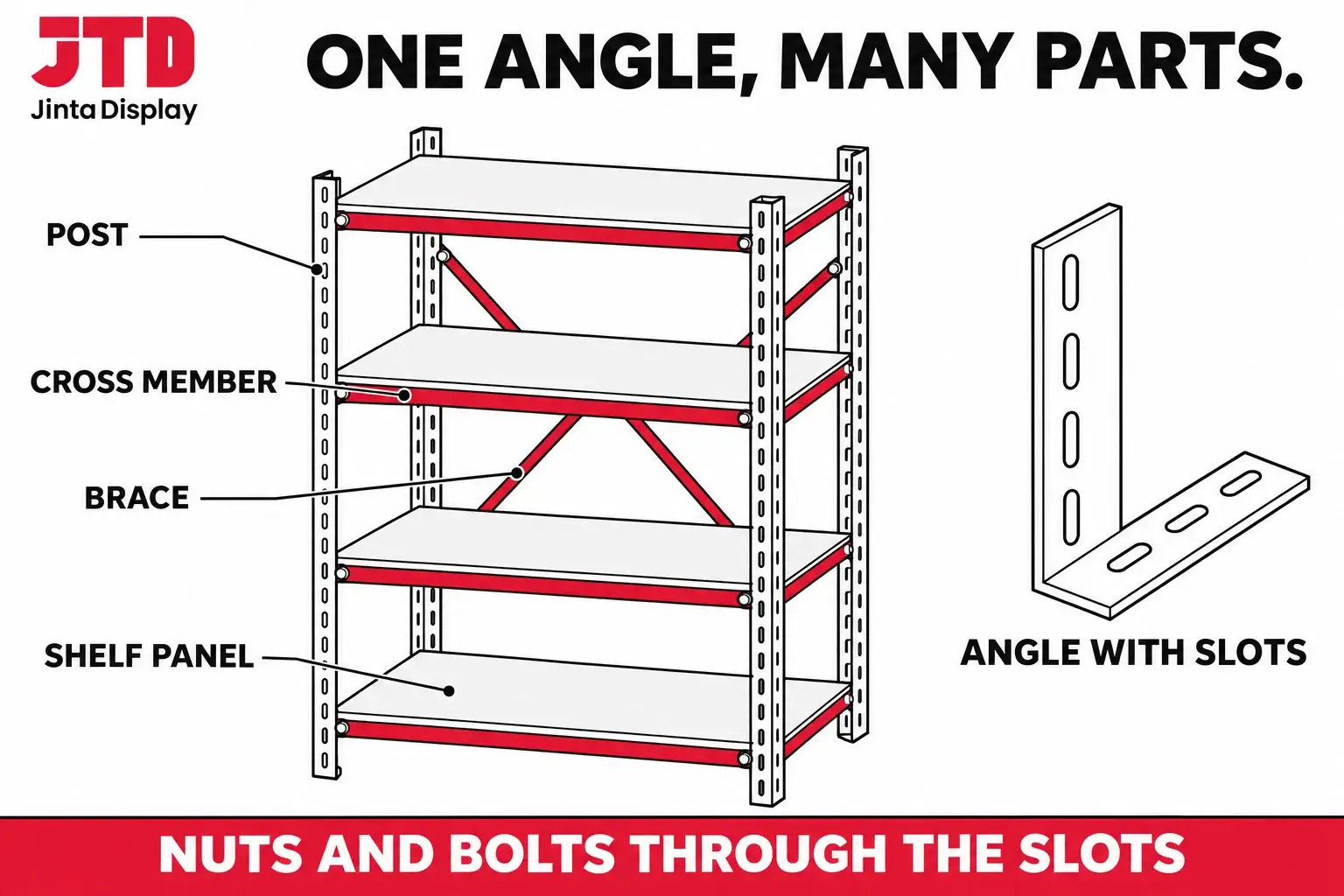
Slotted angle shelving is built from one kind of part, a steel angle. The angle has an L shaped section, which gives it stiffness in two directions, and a row of slots or holes punched along it at a regular spacing. The slots are the whole idea. A part can be bolted to another at any slot, so one length of angle can be a post, a brace or a shelf support.
A unit has four kinds of part. The posts are the vertical angles at the corners. The cross members carry the shelves from front to back and side to side. The braces are diagonal angles that stiffen the frame against swaying. The shelf panels sit on the cross members and are steel sheet, mesh or board. Everything is joined with nuts and bolts, and the unit is assembled with a spanner.
The result is a rigid, permanent frame. A shelf level can be moved by undoing and refitting its bolts, and the adjustment steps are the slot spacing. The rigidity comes from the angle section and from the triangle that a bolted brace forms with a post and a cross member.
The Many Names for an Angle Rack
The names matter because buyers and suppliers use the same words for different things.
| Name | Where it is common | What it usually means |
|---|---|---|
| Slotted angle shelving | UK, Australia, India | Bolted steel angle with slots, built with nuts and bolts |
| Slotted angle rack | India | The same bolted system, sold by the set |
| Angle rack | India, and in factory export listings | Either slotted angle or a boltless rack, so check |
| Angle iron shelving | United States | Home and garage shelving of bolted angle |
| Rivet rack or boltless rack | Export listings and Asia | Beams that drop into slotted uprights with no bolts |
The confusing one is angle rack. Our own listings on third party platforms use the name angle rack for racks described as rivet racks or boltless racks, with adjustable levels and an easy assembly, rated under 200 kg per layer in a reference size of 900 by 450 by 1,800 mm, with a steel deck or an MDF board. Those are boltless racks that look like angle shelving. Our listings are boltless. We do not list a bolted slotted angle system, so a buyer who wants one should look for a specialist maker.
Search interest shows where the name lives. A search count taken in November 2026 put angle rack at about 1,000 searches a month across five English language markets, with India alone at 880, and slotted angle shelving at about 300, with India at 170. It is mainly an Indian and Asian buyer’s term.
How to Tell Bolted From Boltless
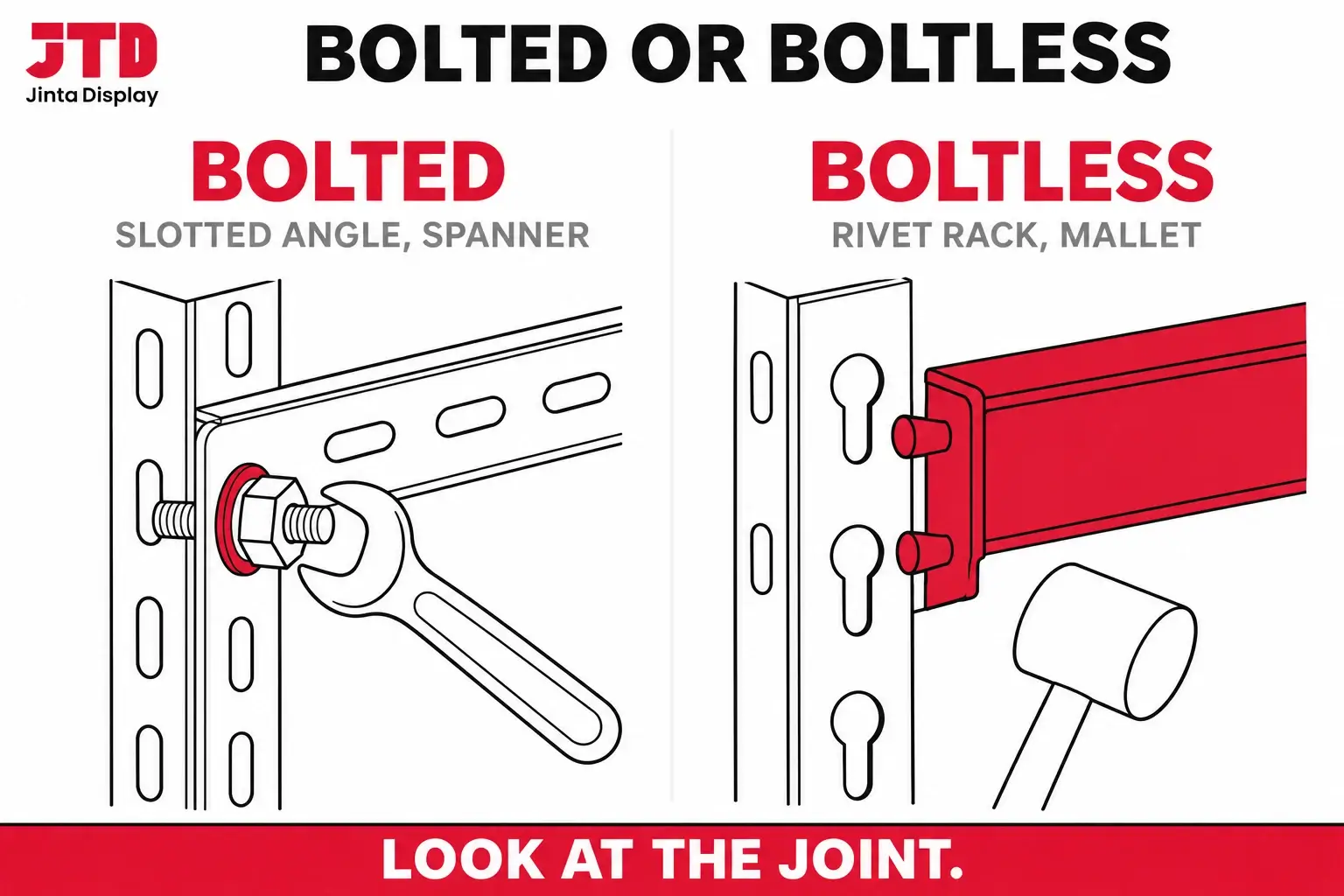
You do not need a catalog to tell the two apart. Look at the joint.
In slotted angle shelving, every joint has a nut and a bolt. The posts and the cross members are the same kind of angle, and the frame can be taken to pieces with a spanner. Diagonal braces are common on the back and the sides.
In a boltless rack, the shelf beams have ends that hook or drop into slots in the upright, and a shelf locks into place with no fastener. The uprights are usually a box or a slotted section, and the beams are separate pieces. Our boltless uprights are listed as 38 by 38 mm in 1.0 to 1.8 mm steel, with shelf panels of 0.5 to 0.8 mm and beams of 1.0 to 1.5 mm.
The two look alike from across a room, and they behave differently. Slotted angle is stiffer, slower to build and fixed in layout. Boltless is quicker to build and easy to adjust, and it relies on the beam locks and a shelf panel for stiffness. See our guide on boltless against bolted shelving for the full comparison.
Where an Angle Rack Is Used
Slotted angle shelving is a light to medium duty system, and it suits places where a unit is built once and left.
Common uses are stockrooms, workshops, garages, archives and school stores, and the back rooms of small shops. In India it is also found in godowns and small warehouses holding cartons and bags. It handles boxes, tools, files and parts on shelves, and it does not hold pallets. A pallet is a job for pallet racking, and our guide to warehouse racking types covers the step up.
Two properties make it a good fit for these places. It is cheap per shelf, since it is made of simple steel angle in large volumes, and it can be built in any size, because the slots allow a part to be cut and bolted where it is needed. The cost is time to assemble and a layout that is not easy to change.
The Load Arithmetic for an Angle Rack Run
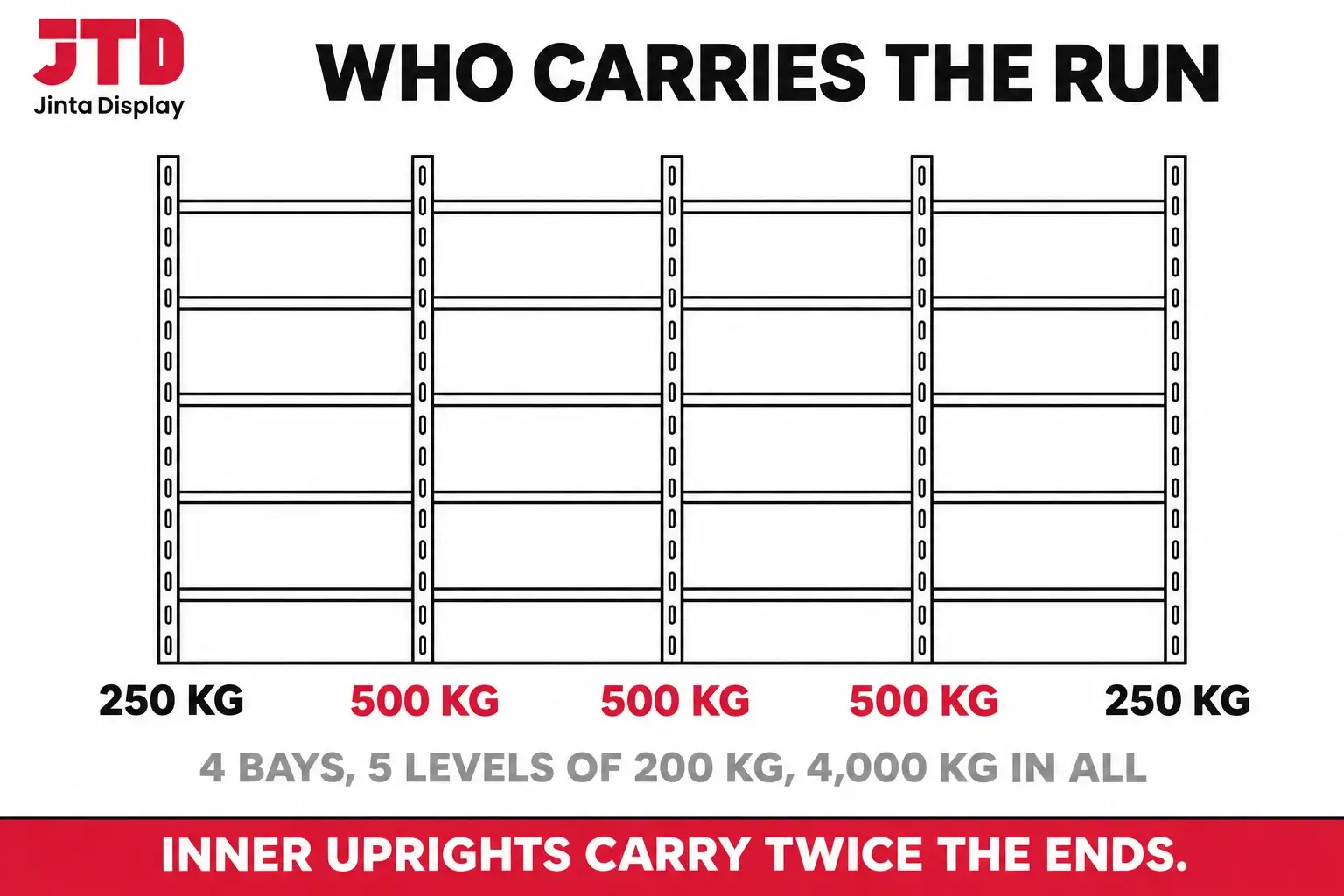
The easiest way to understand an angle rack is to work through a real wall. Take a stockroom wall of 3.6 m, shelved with bays of 900 mm, and a bay size of 900 by 450 by 1,800 mm with five levels. Assume each level is rated at 200 kg, which is the figure on our listing for this size.
| Item | Working | Result |
|---|---|---|
| Bays on the wall | 3,600 mm divided by 900 mm | 4 |
| Load per bay | 5 levels × 200 kg | 1,000 kg |
| Load on the run | 4 bays × 1,000 kg | 4,000 kg |
| Uprights in the run | (4 bays + 1) × 2 rows | 10 |
| Average load per upright | 4,000 kg divided by 10 | 400 kg |
| Shelf area per level | 0.9 × 0.45 m | 0.405 m² |
| Rated load per square meter | 200 kg divided by 0.405 m² | 494 kg per m² |
The average of 400 kg hides an uneven split. A bay’s 1,000 kg is carried by its four uprights, which is 250 kg each. An end upright serves one bay and carries 250 kg when every shelf is full. An inner upright is shared by two bays and carries 500 kg, twice as much. The inner uprights need the stronger rating, and the section and its thickness decide whether they have it.
Two more numbers are worth knowing. The rated load per square meter of shelf is about 494 kg, a useful check against the weight and density of what you store. And the run’s footprint is 3.6 by 0.45 m, or 1.62 m², so its stored load of 4,000 kg is about 2,470 kg per square meter of floor under it. That is worth confirming with whoever knows the floor, especially above ground level.
A Parts List for a Four Bay Angle Rack Run
Counting the parts for the 3.6 m run shows the scale of the job, and how many bolts a bolted system really uses. The count below is for one common arrangement, and the assumptions are listed because designs differ. Assume a side member at every upright position on every level, a front and a back long member for every bay on every level, one shelf panel per bay per level and two diagonal braces per bay.
| Part | Working | Quantity |
|---|---|---|
| Posts | 5 upright positions × 2 rows | 10 |
| Side members, 450 mm | 5 positions × 5 levels | 25 |
| Long members, 900 mm | 4 bays × 2 sides × 5 levels | 40 |
| Shelf panels | 4 bays × 5 levels | 20 |
| Diagonal braces | 4 bays × 2 | 8 |
| Bolts and nuts, 4 per member | (25 + 40 + 8) members × 4 bolts | 292 |
The run is built from 83 posts, members and braces, 20 shelf panels and about 290 bolts and nuts, and every one of the bolts is tightened with a spanner. That is the practical meaning of slow assembly. A team of two can build a run like this in a few hours, and it is why a boltless rack, with no fasteners at all, is attractive wherever the layout may change. Each bolted joint is also a joint to check later, which is worth remembering for a rack in a store where vibration from trolleys or machines loosens fasteners over time. A yearly check with a spanner, one walk along the run, keeps the frame rigid and costs very little.
The count also shows what to order. Buy bolts and nuts with a spare of 5 to 10%, since they are the part that gets lost or cross threaded, and ask the supplier whether the bolts are included in the set and in which grade. A set that arrives without enough fasteners stops the whole job.
Slotted Angle Against a Boltless Rivet Rack
The choice between the two comes down to five points, and the table sets them side by side for a stockroom.
| Point | Slotted angle | Boltless rivet rack |
|---|---|---|
| Joints | Nuts and bolts through slots | Beams drop into slotted uprights |
| Build time | Slow, with a spanner | Fast, often with only a mallet |
| Changing a shelf | Undo and refit bolts | Lift and drop the beam |
| Stiffness | High, with braces | Depends on the beam lock and panel |
| Best for | Permanent layouts with a known load | Stock that changes |
Neither is better in general. A permanent store of heavy items with a known load suits angle. A stockroom where the range changes every season suits boltless. Many shops use both, with angle for the fixed back wall and boltless for the parts that move.
Finish and Material
The steel is usually cold rolled, and the finish decides how long it lasts. A powder coat gives a colored finish that resists scratches. Galvanizing gives a zinc coating that resists rust in a damp store. Stainless steel is used where the room is wet or clean, such as a food preparation area.
Our listings on third party platforms include angle racks with a powder coat finish and others in stainless steel 304 for shop and storage use. The finish should be named on the order, together with the thickness of the steel, because a thin angle with a good finish bends sooner than a thick one with a plain finish.
Bay Height and How Many Levels Fit
The number of levels in a slotted angle bay comes from the height of the goods and the height of the bay, and a short calculation saves wasted space. Leave about 150 mm at the bottom for the first shelf and add 50 mm of clearance above each box so a hand can slide it out.
| Height of the box or part | Pitch with 50 mm clearance | Levels in a 1,800 mm bay |
|---|---|---|
| 250 mm | 300 mm | 5 |
| 350 mm | 400 mm | 4 |
| 450 mm | 500 mm | 3 |
The working is 1,800 mm less 150 mm, which is 1,650 mm, divided by the pitch and rounded down. It gives 5 levels for 250 mm boxes, 4 for 350 mm and 3 for 450 mm. A bay of five levels at 200 kg is therefore right for small boxes and parts, and a bay for taller boxes holds fewer levels and fewer kilograms in total. If the stock is mixed, group the tall items low and the small items high, and set the pitch of each level by the box it will carry. The slots let you do that.
Shelf Panels, Mesh and Board
The panel is the part of an angle rack that touches the goods, and the choice affects the load rating and the look.
A steel panel is a sheet of steel, often with a formed edge, and it spreads a load evenly and suits boxes, tools and parts. A mesh panel is welded wire, and it suits stores where air movement and visibility matter, such as a food stockroom. A board panel, such as MDF, is a flat deck that is quiet, cheap and easy to wipe. Our listings for this size offer a steel deck or an MDF board.
The panel decides how the load is carried between the cross members. A thin panel sags in the middle under a heavy point load, and a board can swell if the room is damp. The rating of a level assumes an evenly spread load, so a single heavy item on the middle of the panel is a harder case than the same weight spread across it. Say what the heaviest single item is, not only the total.
Extending and Changing an Angle Rack
Slotted angle is easy to extend, and a few points make it easy to extend well.
Add bays at the end of a run and the new bay shares an upright with the old one. A run of four bays uses 10 uprights, and a fifth bay needs only 2 more, which makes 12, and it is cheaper than a separate bay of 4. The shared upright carries load from both bays, so check its rating when a run grows.
Move a level by undoing the bolts and refitting them at another slot, so the pitch changes in steps of the slot spacing. Parts from different suppliers do not always match, since slot spacing and hole size differ. If you plan to extend a rack in a year, keep the supplier and the part code, or buy a few spare parts at the start.
Angle Rack in a Shop and a Back Room
Angle racks are not only a warehouse item. They are a common fitting in the back room of a shop, where cartons wait to be put out, and some versions are made for the sales floor.
Our listings on third party platforms include a stainless steel 304 angle rack with a back panel, single sided, for shop, supermarket, drug store and convenience store use. A stainless finish suits a clean or damp area and looks neat from the front. For the sales floor, a gondola is the usual choice, and our guide to gondola shelving sizes covers the frame. For the back room, an angle rack is a cheap and flexible way to hold stock in cartons close to the shelves.
Damp, Corrosion and the Choice of Finish
The room decides the finish. A dry stockroom is happy with a powder coat. A damp one, such as a cellar, a garage or a godown in a humid climate, rewards galvanizing or stainless steel, because rust starts at scratches and at the cut edges and slots where the coating is thin.
Ask how the slots and cut edges are treated, since they are the first place rust shows. Ask for the steel thickness, and keep the unit off a wet floor with feet or a plinth. A slotted angle rack that is rusty after two monsoons was probably chosen by price and not by room, and the cost of replacing it is more than the cost of a better finish.
An Angle Rack in Use on Video
Our channel has a short video on the use of an angle rack, and it shows a finished unit and what is stored on it.
Assembly and Safe Use
A bolted unit is built from the bottom up, and a few habits keep it square and safe.
Lay the parts out and count the bolts before starting. Build the two end frames first, with the posts, the cross members and the braces, and keep the nuts finger tight until the frame is square. Stand the frames, join them with the front and back cross members and tighten everything once the unit is level. Add the shelf panels last.
Work with two people when the frames are stood up, since a half built frame is awkward and sharp edges on cut angle can cut a hand. Wear gloves, keep the floor clear of loose bolts, and do not load the unit until every nut is tight. A rack that is loaded before it is finished is a common way for a bay to rack sideways.
Fix the unit to the wall or to its neighbors, because a tall narrow unit can tip if it is loaded unevenly or climbed. Put the heavy items low and the light ones high. Mark the rated load of each level on the unit, and do not load a level past it. Check the bolts now and then, since vibration and load changes can loosen them.
What to Check Before You Buy an Angle Rack
A short list prevents most disappointments.
Ask whether it is bolted or boltless, using the joint test above. Ask for the leg size and the thickness of the angle, because those decide the stiffness. Ask for the rated load per level and the basis of the rating, and ask for the load an inner upright carries, since it is the highest. Ask about the shelf panel, its material and thickness, and whether the load is rated for an evenly spread load. Ask for the finish. And ask what is in the box, how many bolts and what tools, since a unit that arrives short of fasteners stops the job.
For the boltless range with adjustable levels, see our boltless rack range and the 4 tier boltless rivet shelving. For heavier loads, see the heavy duty warehouse rack.
Two readings of the answers cause most of the trouble. A level rated at 200 kg is 200 kg for that level, and a bay of five levels is 1,000 kg only if the uprights, the base and the floor carry it, so ask for the upright rating, and remember that in a long run the inner uprights carry twice the load of the ends. And a supplier can use the name angle rack for either system, so confirm by the joint and not by the name. Slotted angle shelving is for cartons, tools and parts. Pallets need pallet racking.
To get a quote for slotted angle shelving, send the wall length and height, the depth you want, the number of levels and the heaviest item on a level. Say whether the unit should be bolted or boltless, whether the layout is fixed, and what finish you need. We reply with what we can supply, the rated load and the parts list. In India and across Asia, angle racks are a staple of the godown, and the same questions apply there.
For medium duty bays and decking, see long span shelving.
If you are buying an angle rack, send us your wall length, levels and heaviest load and we will reply with what we can supply and the parts list.
Frequently Asked Questions
What is slotted angle shelving?
Slotted angle shelving is a bolted shelving system made from steel angle with a row of slots along its length. Posts, cross members and braces are joined with nuts and bolts through the slots. The unit is rigid and fixed in layout, and it suits stockrooms, workshops and garages.
What is an angle rack?
An angle rack is a shelving rack built from steel angle. The name is used for bolted slotted angle shelving, mainly in India, and for boltless racks that look similar in factory export listings. Check whether the joints are bolted or dropped into slots, because the two systems behave differently.
How much weight can an angle rack hold?
It depends on the angle, its thickness and the shelf panel. Our listings give 200 kg per layer for a 900 by 450 by 1,800 mm rack, which is 1,000 kg over five levels. Ask for the rated load per level and the load on the inner uprights, which carry twice the end ones.
Is an angle rack the same as a boltless rack?
No, although the names overlap. A slotted angle rack is joined with nuts and bolts, goes up slowly and is rigid. A boltless rack has beams that drop into slotted uprights and goes up fast, often with only a mallet. Boltless is easier to adjust, and angle is stiffer.
Can an angle rack hold pallets?
No. An angle rack is light to medium duty shelving for cartons, tools and parts. Pallets need pallet racking, with frames and beam pairs rated for the load. Our warehouse racking is listed at 1,000 to 4,000 kg per layer for the heavy duty range.
How do you assemble slotted angle shelving?
Build the two end frames first, with posts, cross members and braces, keeping the nuts finger tight until the frame is square. Stand them, join them with the front and back cross members, level the unit and tighten everything. Add the shelf panels last, and fix the unit to the wall.
What is a godown?
A godown is the Indian and South Asian word for a warehouse or a large store room. Slotted angle racks are a common fitting in them, holding cartons, bags and parts on shelves, and the same bolted or boltless choice applies there as anywhere.
Do you make slotted angle shelving?
Our listings use the name angle rack for rivet and boltless racks with adjustable levels, and we also list a 4 tier boltless rivet shelving. We do not list a bolted slotted angle system, so for that you would need a specialist maker.