
Ask for a standard pallet and you will get a different answer in Chicago, Rotterdam, Birmingham and Sydney. Pallets began as a tool for forklifts, and each region built its own around its trucks, its trailers and its pallet racking. The result is a short list of sizes that dominate by region and a longer tail of others. A buyer who ships goods, buys racking or orders containers has to know which one applies.
This guide lists the standard pallet sizes in millimeters and inches, explains where each is used and shows what the size decides downstream. It covers height and load, orientation, container loading, and how to match racking to the pallet. It is written from the manufacturing side. Our racking and wire containers are sized from the pallet, so the footprint is the first number we ask for.
It does not cover the strength grading of wooden pallets, the pallet pooling schemes or the freight rules of any one carrier, which differ by country and by company. Where we quote another source, it is a published industry figure and not a specification of ours.
Why There Is No Single Standard Pallet Size
A pallet is a platform for a unit load, and the right size depends on what carries it. A pallet has to fit the trailer and the container it travels in, the racking it is stored in and the trucks that lift it. Each region built its sizes around its own equipment before global trade connected them, and the sizes stayed.
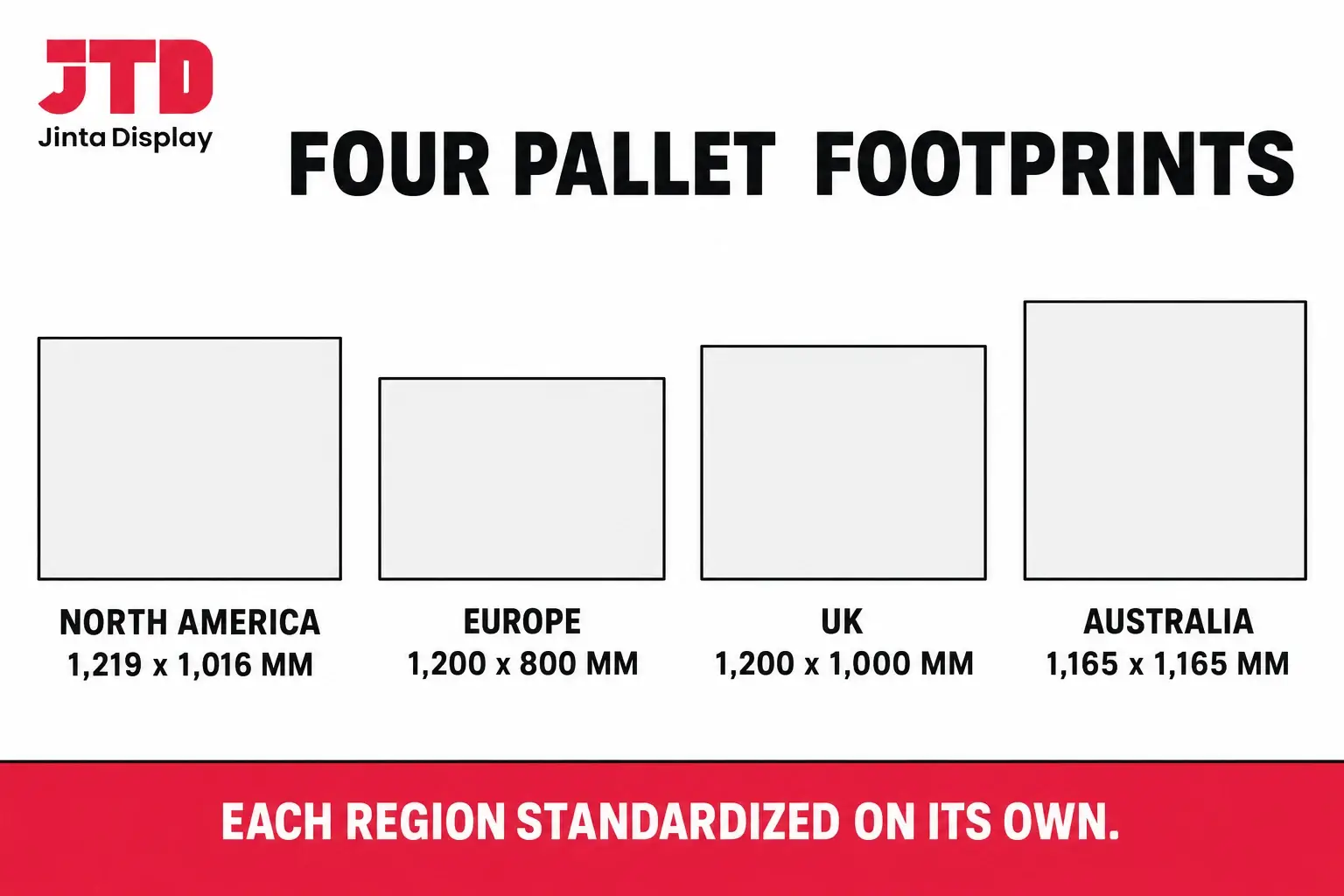
International standards bring some order. The ISO standard for flat pallets lists six footprints, among them 1,200 × 800 mm, 1,200 × 1,000 mm, 1,219 × 1,016 mm and 1,100 × 1,100 mm. Listing a size does not make it the one in your country. In practice a shipper meets a few regional sizes and has to choose or convert between them. For export, the pallet that suits the destination may not be the one used at home.
Standard Pallet Sizes by Region
The table lists the standard pallet sizes you will meet most often. The inch sizes are nominal, and the millimeter sizes are the ones to use in a drawing.
| Pallet | Millimeters | Inches | Where it is common |
|---|---|---|---|
| GMA or North American standard | 1,219 × 1,016 | 48 × 40 | United States and Canada |
| Euro pallet, EUR 1 or EPAL | 1,200 × 800 | 47.2 × 31.5 | Europe, and widely in export cargo |
| UK standard pallet | 1,200 × 1,000 | 47.2 × 39.4 | United Kingdom and Ireland |
| Australian standard pallet | 1,165 × 1,165 | 45.9 × 45.9 | Australia and New Zealand |
| Asian square pallet | 1,100 × 1,100 | 43.3 × 43.3 | Parts of Asia |
| Square 42 in pallet | 1,067 × 1,067 | 42 × 42 | Used in North America and elsewhere |
Together these are the standard pallet sizes most buyers meet. The pallets to know first are the first four. The 48 × 40 pallet is the most common single size in North America, and the Euro pallet is the most common in Europe. The UK standard pallet is larger than the Euro pallet by a quarter in area, which matters for a shipper who moves between the two. The Australian pallet is square, so it can be turned either way in a rack.
The 48 × 40 North American Pallet and the American Pallet Size
The American pallet size is 48 in long and 40 in wide, which is 1,219 × 1,016 mm. It is often called the GMA pallet after the Grocery Manufacturers Association, which promoted it for the grocery trade. It is the size that US and Canadian trailers, warehouse racking and pallet jacks assume.
The pallet is usually a stringer or block design with an overall height of about 5 to 6 in. Entry is normally from the 40 in side with two-way entry or from all four sides with four-way entry. In racking, the 48 in length is usually placed deep, which means the rack frame is about 42 in deep, and two pallets sit side by side across a 96 in beam with the 40 in side along it.
Many buyers confuse the nominal and exact sizes. 48 in is 1,219.2 mm and not 1,200 mm. A 1,200 mm figure used in place of 48 in causes a gap of 19 mm per pallet, which matters on a beam that is already tight.
The Euro Pallet and the Euro Pallet Size
The Euro pallet size is 1,200 × 800 mm. The pallet measures 1,200 × 800 mm and is built to a European specification, with a height of 144 mm in the EPAL design. It is defined by a European standard, EN 13698, and is marked by its maker. Its strength comes from a fixed arrangement of boards and blocks, and it can be exchanged between users in pooling schemes.
Euro pallets are everywhere in international trade. Many goods are packed on them for export to Europe, and they fit many racks around the world. In a rack, they can sit with the long side along the beam, giving three in a 2,700 mm bay, or with the short side along the beam. The orientation changes the bay width and the frame depth, and we show the arithmetic in the guide to pallet rack dimensions.
The UK Standard Pallet
The standard UK pallet is 1,200 × 1,000 mm, with a base height of about 150 mm. It is available in grades, often called Grade A and Grade B or Grade 1 and Grade 2, which differ in strength and condition. The grade decides how much the pallet can carry, so the grade matters as much as the size when you fix a rack rating.
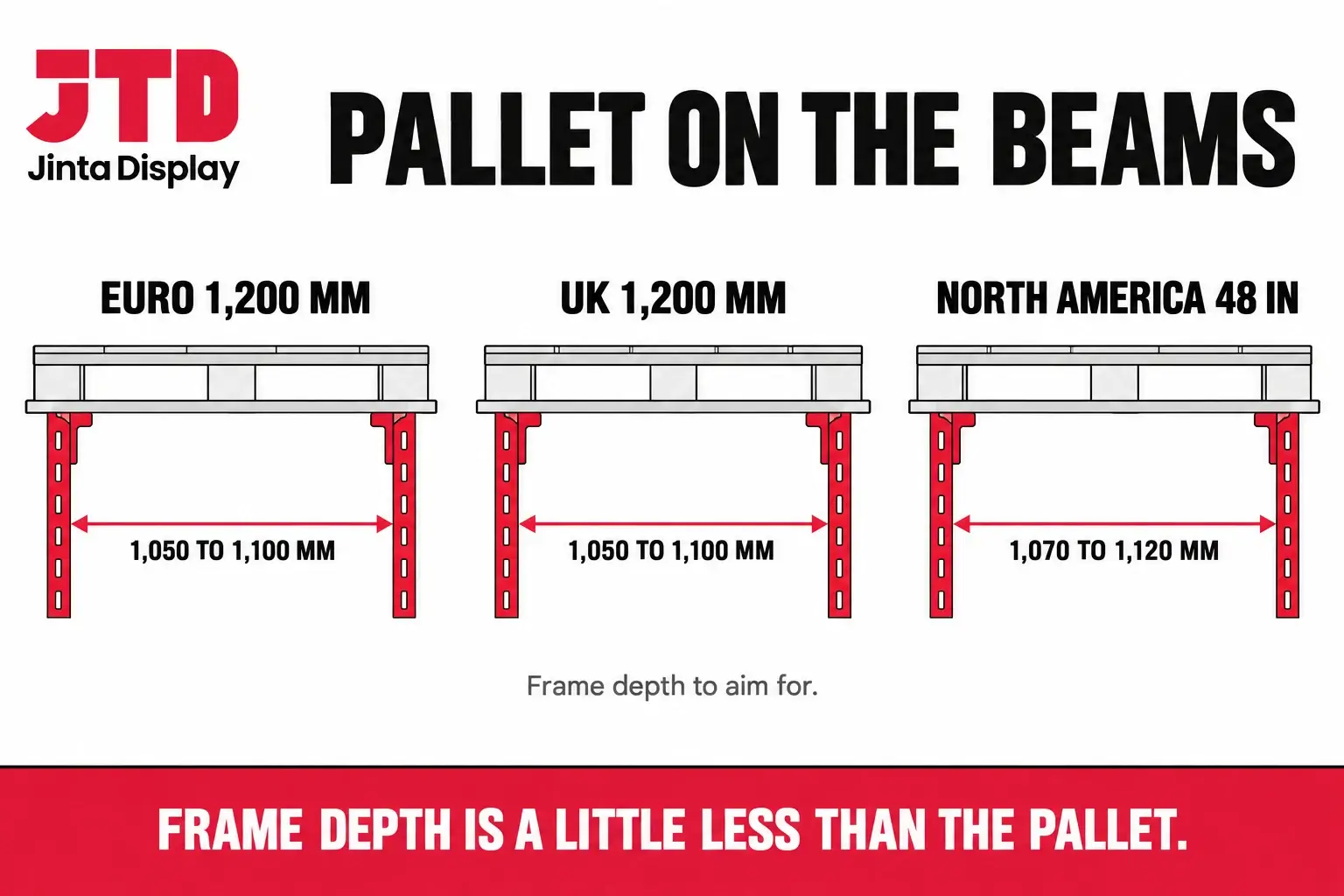
The UK pallet is larger than the Euro pallet. Its area is 1.2 square meters against 0.96, so a shipper loading 1,200 × 1,000 mm pallets gets about a quarter more floor per pallet. Many UK buyers use both sizes, and a rack that must take both needs a bay and frame depth chosen with care. A frame of about 1,050 to 1,100 mm suits both when they are loaded with the 1,200 mm side deep.
The Australian Pallet and Other Sizes
The Australian standard pallet is square, at 1,165 × 1,165 mm. Because it is square, it can be entered by the forks from any side, and its racking is sized from that footprint. Australian and New Zealand buyers often receive goods on Euro or UK pallets as well, so racking in the region commonly has to handle more than one size.
Other sizes appear in particular trades. The 1,100 × 1,100 mm square pallet is used in parts of Asia, and the 1,067 × 1,067 mm pallet, which is 42 × 42 in, appears in several markets. Half pallets and quarter pallets, such as 800 × 600 mm and 600 × 400 mm, are used for retail display and for light goods, and they are sized to fit standard shelves and display bays.
If you receive an unusual pallet, measure it before you plan the rack. Record the length, the width and the height of the deck, and note whether the pallet has stringers or blocks. The numbers decide the gaps that a forklift needs, and the difference between a pallet that fits and one that does not is a few millimeters.
Standard Pallet Sizes in Inches, Feet and Centimeters
Buyers search for standard pallet sizes in several units, and it helps to have one table that converts them. The millimeter figures are the ones to put on a drawing, and the others are for conversation and for checking a quotation in a different unit.
| Pallet | Millimeters | Centimeters | Inches | Feet |
|---|---|---|---|---|
| North American GMA | 1,219 × 1,016 | 122 × 102 | 48 × 40 | 4.0 × 3.3 |
| Euro EUR 1 | 1,200 × 800 | 120 × 80 | 47.2 × 31.5 | 3.9 × 2.6 |
| UK standard | 1,200 × 1,000 | 120 × 100 | 47.2 × 39.4 | 3.9 × 3.3 |
| Australian standard | 1,165 × 1,165 | 116.5 × 116.5 | 45.9 × 45.9 | 3.8 × 3.8 |
The conversions explain some common confusion. A 1,200 mm pallet and a 48 in pallet are both called four foot, but they are 19 mm apart. A pallet that is 100 cm wide is the UK pallet and one that is 80 cm wide is the Euro pallet. Standard pallet dimensions quoted in feet are rounded, and a rack or a cage should never be sized from a rounded figure.
How Wide Is a Pallet, and What Counts as Normal Pallet Dimensions
How wide is a pallet depends on which side you call the width. By convention the length is the longer side and the width is the shorter one, and the pallet is described as length by width. The width is 800 mm on a Euro pallet, 1,000 mm on a UK pallet, 1,016 mm on a North American pallet and 1,165 mm on an Australian pallet.
Normal pallet dimensions are therefore a region by region answer. A shipper who says a normal pallet usually means the standard pallet at home. For international work, always state the size in millimeters and name the type, such as a Euro pallet or a UK standard pallet, because 1,200 × 1,000 and 1,200 × 800 mm are both normal somewhere.
Pallet or Skid
In North America the word skid is sometimes used for a platform with no bottom deck, which has runners only. A pallet has a top deck and a bottom deck, or at least a top deck on blocks or stringers that can be entered by forks. Skids are cheaper and lighter and are used for heavy single loads, while pallets suit unit loads that must be moved by pallet jacks and stored in racking.
Outside North America the word skid is used less, and a platform of this kind is also called a pallet. The distinction matters for racking, because a skid without a bottom deck may bear on the beams differently from a pallet with runners. Describe the exact platform to your supplier, and give photographs if the platform is unusual.
Mixing Pallet Sizes in One Warehouse
Many warehouses receive goods on more than one pallet size. A UK distributor may get Euro pallets from the continent and UK pallets from local suppliers. An Australian importer may receive North American pallets in container loads of goods. Racking that has to handle a mix needs a plan.
The usual approach is to choose the frame depth for the largest pallet and the bay width for the greatest number of pallets of the commonest size. A frame of about 1,050 to 1,100 mm takes Euro and UK pallets loaded the long way. A beam rated for the heaviest pallet and a span that fits the widest case covers the rest. Using decking or support bars can help when a pallet is narrower than the opening, because it stops the pallet from sinking between the beams.
Where the mix is large, consider repalletizing at goods-in to one standard size. It adds a step, but it simplifies the racking, the truck pattern and the stock count. Decide this early, since the cost of a mixed system grows with the number of sizes.
Half Pallets and Retail Display Pallets
Retail uses smaller platforms alongside full pallets. A half pallet, about 800 × 600 mm, and a quarter pallet, about 600 × 400 mm, are used for display in stores and for lighter goods. They are sized to fit standard shelves and display bays, and they let a retailer move product straight from the truck to the shop floor.
These sizes tie in with fixtures. A display bay or a gondola must be sized to the platform so that the pallet sits on the shelf without hanging over. The sizing of retail shelving is covered in the guide to gondola shelving sizes, and the rest of a store fit-out is in the supermarket equipment list.
Pallet Height, Weight and Loaded Height
The pallet itself is low, and the load on top sets the height. A UK pallet has a base height of about 150 mm, and the Euro pallet is 144 mm. A GMA pallet is roughly 5 to 6 in. These heights matter for fork entry and for the level pitch in a rack, which is the load height plus the beam depth plus clearance.
The loaded height depends on the goods and on the trailer or container. A shipper often limits the loaded height to fit a trailer door, to keep the stack stable or to suit a rack. The load weight depends on the pallet grade, the construction and how the load is spread. A UK pallet in a lower grade carries less than one in a higher grade, and a worn pallet carries less again. Always check the actual pallet and not a catalog value.
For racking, weight and height are the inputs that set the beam rating and the level pitch. The guide to pallet rack capacity shows how a rack rating is built from them.
Pallet Orientation and Fork Entry
A rectangular pallet can enter the rack on its long side or its short side, and the choice changes the geometry. With the long side deep, the frame is about 1,050 to 1,120 mm deep for the 1,200 and 1,219 mm pallets, and the pallets sit across the beam with their short side along it. With the short side deep, the frame is shallower at about 870 to 920 mm, and the pallets sit with their long side along the beam, so fewer fit per bay.
Orientation also changes the entry. Two-way pallets can be entered from two sides, and four-way pallets from all four. Some pallets can be lifted by a pallet jack only from the narrow side. A pallet that is loaded the wrong way may not fit the rack. The rule is to decide the orientation first and keep it the same across the warehouse.
How Many Pallets Fit in a Container
For exporters, the choice among standard pallet sizes decides the container load. A 20 ft container holds about 10 to 11 pallets on the floor, and a 40 ft container about 20 to 25, depending on the pallet size and the loading pattern. Euro pallets fit more per container than larger pallets, and the pattern can change the count by one or two. Your forwarder can confirm the exact number for your pallet and your goods.
The loaded height and the container door height set how many layers you can stack. Wooden pallets that cross borders must also meet the treatment and marking rules for wood packaging, known as ISPM 15, which require heat treatment or an equivalent and a mark on the pallet. Plastic and metal pallets avoid this requirement, at a higher cost per pallet.
Matching Racking and Containers to the Pallet
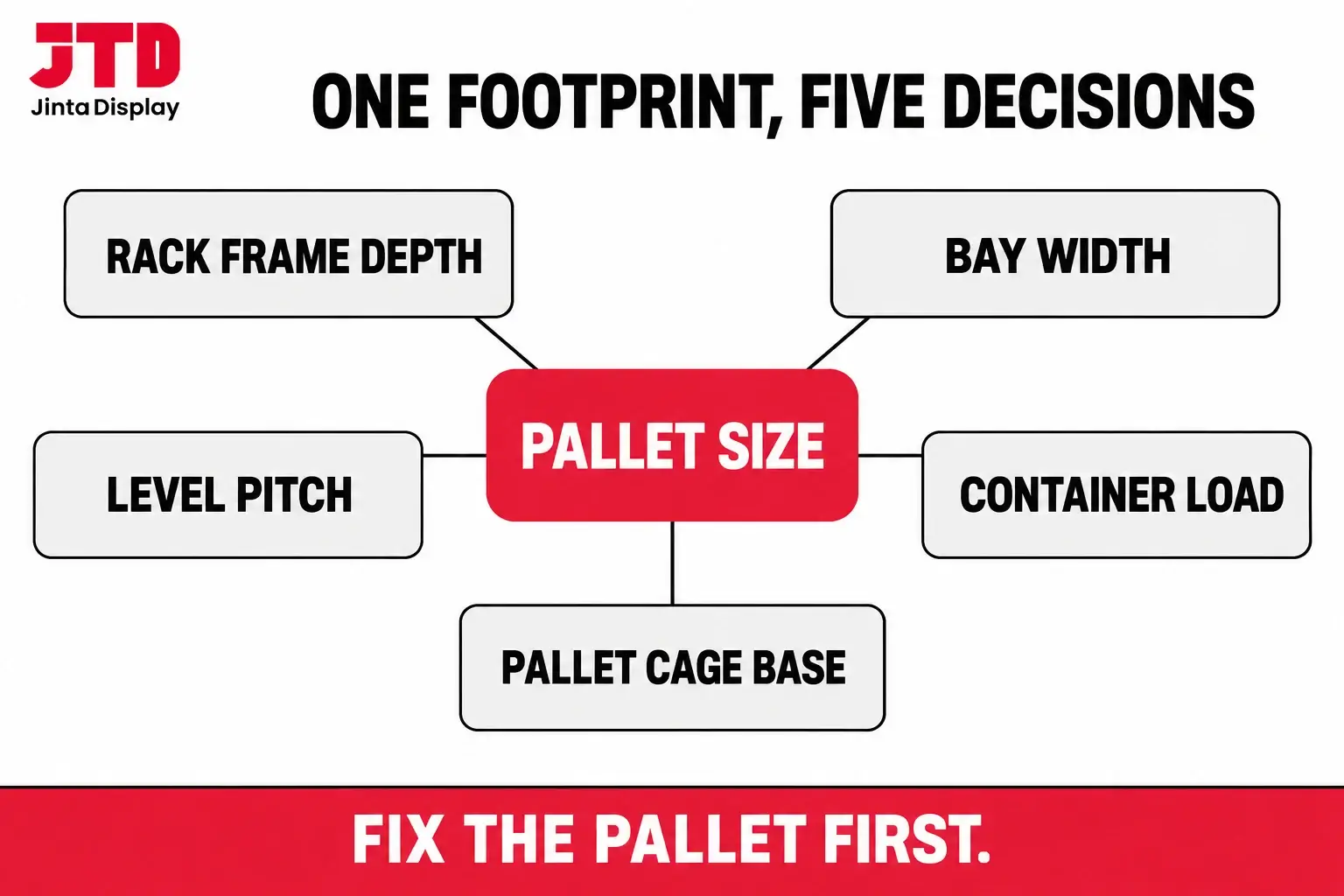
The pallet is the one size you do not choose, and everything else follows from it. The frame depth is a little less than the pallet depth, so the pallet overhangs the beams. The bay width is the pallets per level times their width plus gaps. The level pitch is the load height plus the beam depth plus clearance. The aisle comes from the truck.
| Pallet | Orientation | Frame depth to aim for | Note |
|---|---|---|---|
| 48 × 40 in GMA | 48 in deep | About 1,070 to 1,120 mm | Pallets sit with the 40 in side along the beam |
| Euro 1,200 × 800 mm | 1,200 mm deep | About 1,050 to 1,100 mm | Three fit across a 2,700 mm bay only with tight gaps |
| UK 1,200 × 1,000 mm | 1,200 mm deep | About 1,050 to 1,100 mm | Check the pallet grade and the load |
| GMA short side deep | 40 in deep | About 870 to 920 mm | Fewer pallets per bay, a shallower rack |
Our frames are 1,000, 1,100 and 1,200 mm deep, and our bays are 2,000, 2,500 and 2,700 mm wide. The sums for each pallet, with the gaps and the clear opening, are worked through in the rack dimensions guide. For loose goods that go into steel containers on pallets, the same footprints apply to pallet cages and stillages, which are usually sized from a 1,200 × 1,000 or 1,200 × 800 mm base.
Wood, Plastic and Metal Pallets
Most pallets are wood. They are cheap, repairable and widely available, and their strength varies with the timber and the build. Plastic pallets are lighter, easy to clean and uniform, and they cost more. Metal pallets, made of steel or aluminum, are the strongest and the most durable, and they suit heavy or hygienic work. The material does not change the footprint of any of the standard pallet sizes, but it changes the weight rating, the weight of the pallet itself and the way it behaves in a rack.
Block pallets have solid blocks under the deck and allow four-way entry. Stringer pallets have long runners and often allow two-way entry. The type matters for the rack because a pallet bears on its stringers or blocks and not on its deck boards. A pallet with broken or missing boards should not go into a rack, whatever its size.
How to Measure a Pallet
Measure at least three pallets from the stock you plan to store, because used pallets vary, and compare the numbers with the standard pallet sizes above. Take the length and the width of the deck, and measure the height of the base. Check the underside to see where the load bears, and note the fork entry height and width. Measure the loaded height of a typical load, and the tallest one you expect.
Record the results in millimeters and keep the original photographs. When you give the numbers to a supplier, state the largest size you expect and not the average, because a rack sized to the average will not hold the largest. A supplier who knows the true range can set the gaps with confidence.
Choosing Among Standard Pallet Sizes
If you are free to choose a pallet, pick the size that matches your market and your equipment. A business that sells in North America should use the 48 × 40 in pallet, and one that sells in Europe should use the Euro pallet. A business that exports to several regions faces a trade-off, and the usual answer is to pack on the pallet of the destination and to hold the stock at home on the pallet of the home market.
If you are not free to choose, as when your suppliers decide, learn the standard pallet sizes in use and design your storage around them. A rack sized from the biggest pallet in the flow, with the right gaps, will handle the rest. Write the sizes into the specification and into the goods-in procedure, so a pallet that does not fit is caught at the door and not in the rack.
What to Send a Supplier
Give the pallet size and type, the loaded height and weight, and the orientation you want. Say how many pallets sit on each level, and whether more than one pallet size must be handled. Add the clear height of the building and the truck type with its aisle requirement. With those items, the supplier can draw a bay or a container that fits your pallets.
If you want racking or cages sized to your pallets, send us your pallet size and loaded height and we will reply with a drawing. See our warehouse racking range and the guide on what pallet racking is.
Frequently Asked Questions
What are the standard pallet sizes?
There are several, and the most common pallet size depends on the region. In North America the 48 × 40 in pallet, 1,219 × 1,016 mm, is the most common. In Europe it is the Euro pallet at 1,200 × 800 mm, and in the UK the standard pallet at 1,200 × 1,000 mm. Australia uses a square 1,165 × 1,165 mm pallet.
What are the dimensions of a standard pallet?
There is no single standard. The standard pallet dimensions by region are as follows. The North American pallet is 1,219 × 1,016 mm, the Euro pallet is 1,200 × 800 mm, the UK pallet is 1,200 × 1,000 mm and the Australian pallet is 1,165 × 1,165 mm. Deck height above the ground is typically about 144 to 150 mm for the Euro and UK pallets.
What is the standard UK pallet size?
The standard UK pallet is 1,200 × 1,000 mm, with a base height of about 150 mm. It comes in grades with different strength. It is about a quarter larger in area than the Euro pallet, which is 1,200 × 800 mm.
What size is a 48 × 40 pallet in millimeters?
It is 1,219 × 1,016 mm, taken from 48 in being 1,219.2 mm and 40 in being 1,016 mm. It is the North American standard, often called the GMA pallet. Do not substitute 1,200 mm for 48 in in a drawing, because the 19 mm difference matters on a tight beam.
What is the difference between a Euro pallet and a UK pallet?
The Euro pallet is 1,200 × 800 mm and the UK pallet is 1,200 × 1,000 mm, so they share a length and differ in width. The UK pallet has about 25% more area. A rack that must take both needs a frame depth and bay width chosen for each.
How many pallets fit in a 40 ft container?
Typically about 20 to 25 on the floor, depending on the pallet size and the loading pattern, and about 10 to 11 in a 20 ft container. Euro pallets fit more than larger pallets. Your forwarder can give the exact count for your pallet and goods.
What is the Australian standard pallet size?
It is a square pallet at 1,165 × 1,165 mm. Because it is square, forks can enter from any side. Racking in Australia and New Zealand often has to handle Euro and UK pallets as well, so confirm the sizes you will use before sizing the bay.
What size pallet rack do I need for my pallets?
Work from the pallet. The frame depth is usually 100 to 150 mm less than the pallet depth, the bay width is the pallets per level plus gaps, and the level pitch is the load height plus the beam depth plus about 100 mm. Send the pallet size and loaded height for a bay drawing.