
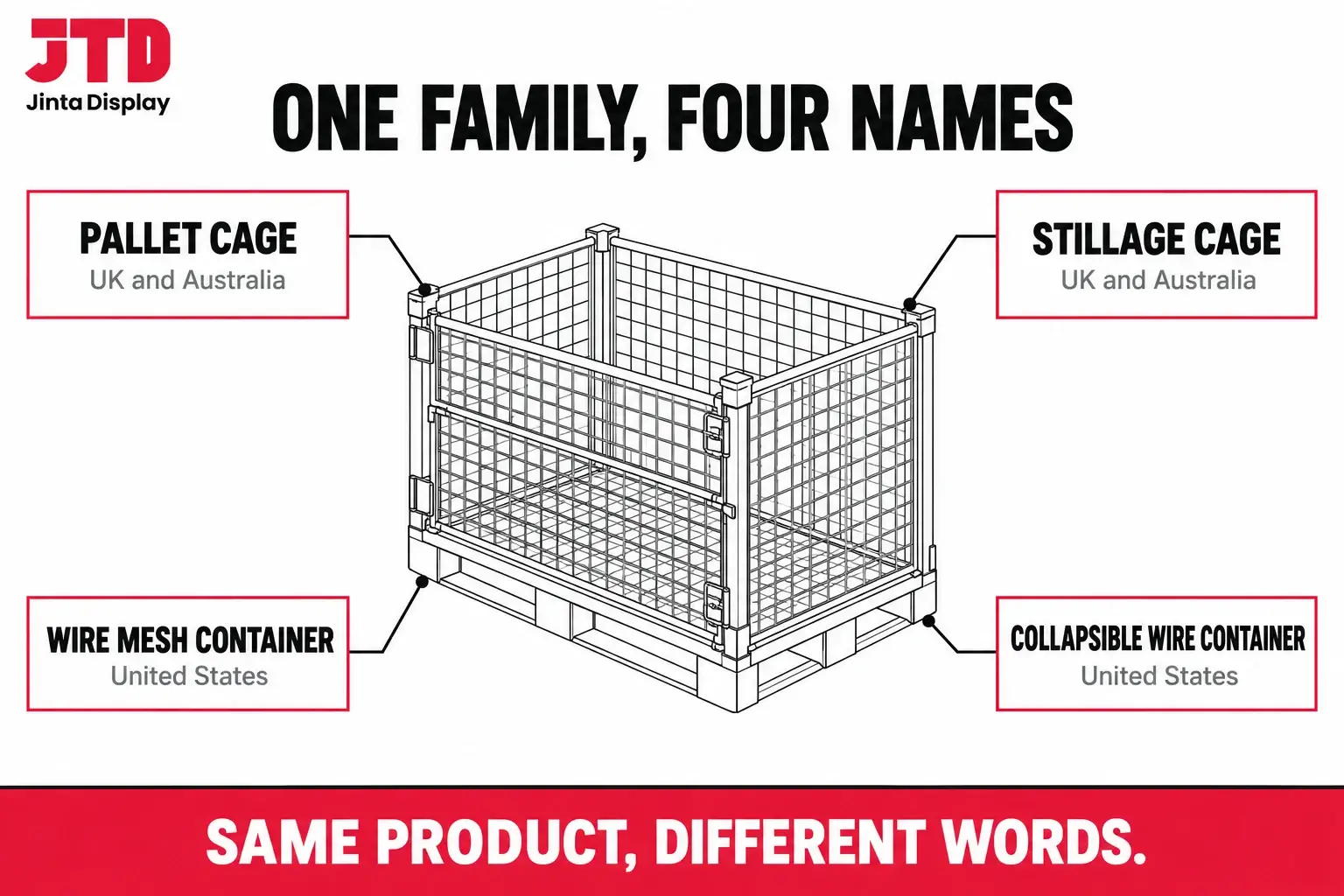
A pallet cage is one of the simplest pieces of warehouse equipment and one of the most confusingly named. A buyer in Manchester asks for a pallet cage, a buyer in Perth asks for a stillage, and a buyer in Ohio asks for a wire mesh container. They are looking at the same family of steel boxes, and a supplier who understands the vocabulary can quote any of them from one drawing.
This guide explains what a pallet cage is, how it differs from a stillage cage, which types exist, how big they are and what they carry. It then covers mesh, stacking, lifting and the questions to ask before you order. It is written from the manufacturing side. Our own folding wire container is described from our product page, and market figures from other suppliers are marked as published ranges.
It does not cover price, which depends on steel, finish and freight, or the inspection rules for lifting equipment, which are set by local regulation. For the pallet racking that these containers often sit on, see the guides to pallet rack capacity and warehouse racking types.
What Is a Pallet Cage
A pallet cage is a container with a steel frame and welded mesh sides, made to hold goods and to be lifted by a forklift or a pallet truck. Most have a flat base that matches a standard pallet, and many have a gate on one side so the contents can be reached without lifting everything out. The mesh lets the contents be seen, keeps loose items in and lets air pass through.
People use a pallet cage where a pallet alone is not enough. Loose parts, awkward shapes, returns and items that would shift in transit need sides. A pallet cage turns a pallet into a box that can be stacked, and it protects what is inside from the knocks of forklift traffic. It is also used to move goods between a supplier, a warehouse and a production line, where the same container goes round a loop many times.
The container is a reusable asset and not packaging that is thrown away. That is why the specification matters more than the price per piece. A cage that deforms after a few dozen forklift lifts is more expensive than one that lasts years, and the difference sits in wire diameter, frame section and finish.
Pallet Cage vs Stillage Cage, and the Other Names
The words overlap, and usage differs by country. The table shows what each term usually means and where it is common.
| Term | What it usually means | Where it is common |
|---|---|---|
| Pallet cage | A mesh cage that holds goods on a pallet or as a pallet-sized container | UK, Australia |
| Stillage cage | A rigid steel container with built-in feet or legs, often stackable | UK, Australia |
| Cage pallet | A pallet with mesh sides, the same product in a different word order | UK |
| Wire mesh container | A welded wire box, often collapsible | United States |
| Collapsible wire container | A wire container that folds flat when empty | United States |
| Wire storage cage | A general name for a wire container used for storage | All |
The usual distinction is that a pallet cage is built to sit on a pallet or to act like one, and a stillage cage is a self-standing container with its own base. Suppliers apply both words to the same product often enough that you should specify by drawing and not by name. Our page for the folding wire container lists the alternative names together, because a buyer in one market may search for any of them.
Do not confuse a pallet cage with a roll cage. A roll cage stands on castors and is pushed by hand through a store or a distribution center. A pallet cage sits on the floor and is moved by forklift or pallet truck. The two are used in different parts of a supply chain, and they are priced and rated differently.
Types of Pallet Cage
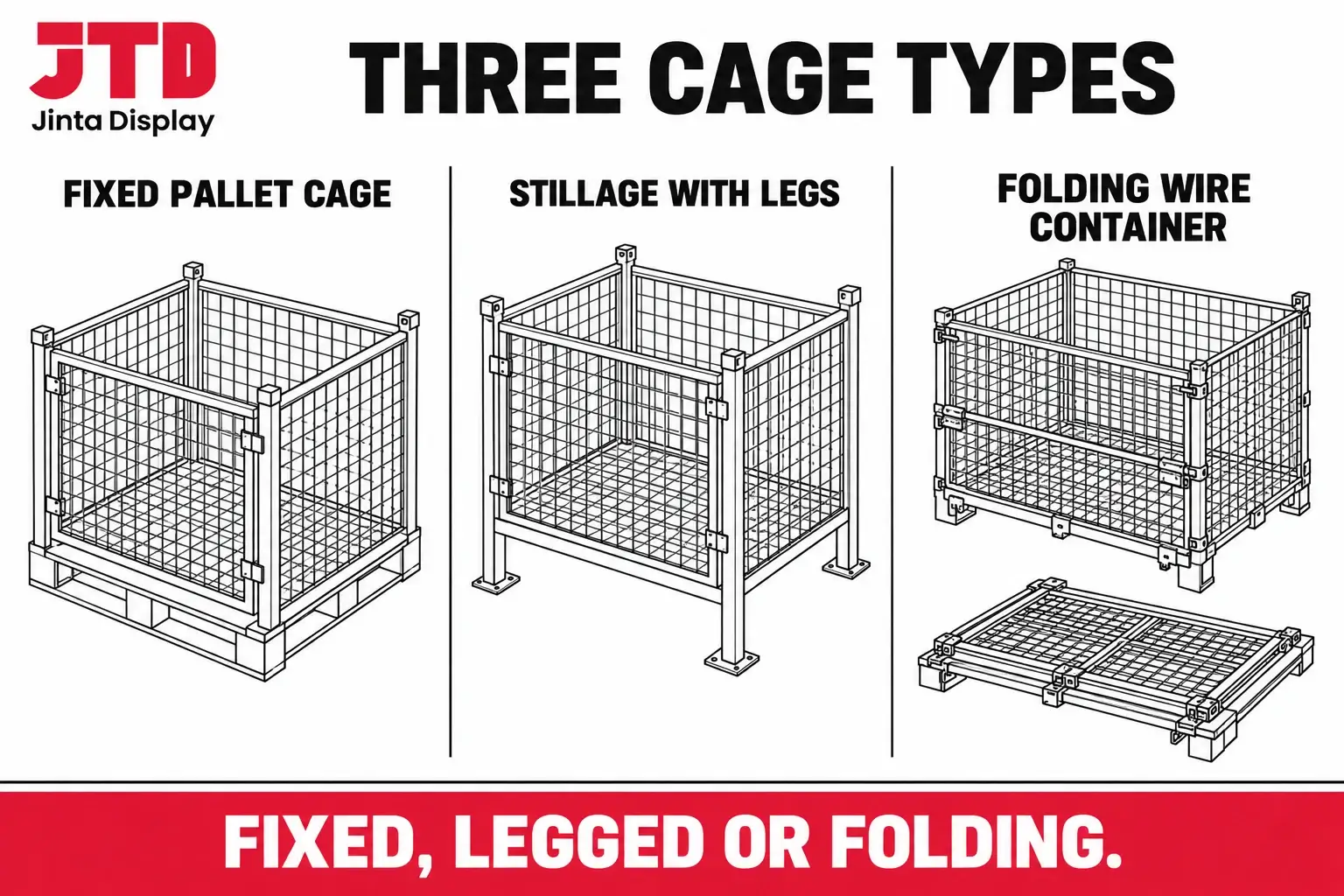
Four design choices separate most pallet cages, and each one changes what the container can do.
Fixed or collapsible. A fixed cage is welded into one rigid piece. It is stronger for the same weight of steel and has no hinges to fail, but it takes the same floor and truck space empty as it does full. A collapsible cage has hinged sides that fold down so the empty container is a fraction of its full height. Return legs and storage between uses cost much less, and this is the reason collapsible cages are common in returnable packaging loops.
With or without a gate. A half-drop or full-drop front gate lets staff reach the contents without lifting items over the sides. Gates add a hinge and a latch that must be checked, so the choice is between convenience and a simpler structure.
Stackable or not. A stacking cage has feet and corner posts that locate into the cage below. Stacking multiplies storage per square meter, and the stacking rating is as important as the load rating. Some cages stack only when empty and some stack when loaded.
With legs or on a base. A stillage has legs or runners that let a forklift enter underneath. A cage on a pallet base uses the pallet for entry. Legs add height and rigidity, and a pallet base adds a wooden or plastic part that can break.
Pallet Cage Sizes and Load Ratings
Most pallet cages are sized from the pallet they sit on. A base of 1,200 × 1,000 mm matches the standard UK pallet. A base of 1,200 × 800 mm matches the Euro pallet, and a base near 1,219 × 1,016 mm, which is 48 × 40 in, matches the North American GMA pallet. Heights vary from low cages under 600 mm to tall ones near 1,000 mm or more, and the clear opening inside is smaller than the outside size by the frame.
Load ratings in published products run from about 500 kg to 2,000 kg, with heavy stillages at the upper end and light folding mesh containers near the lower end. The figure is only meaningful with its conditions. Ask whether the rating is a static load on a flat floor, a lifted load or a stacked load, and ask how many cages may be stacked at that rating.
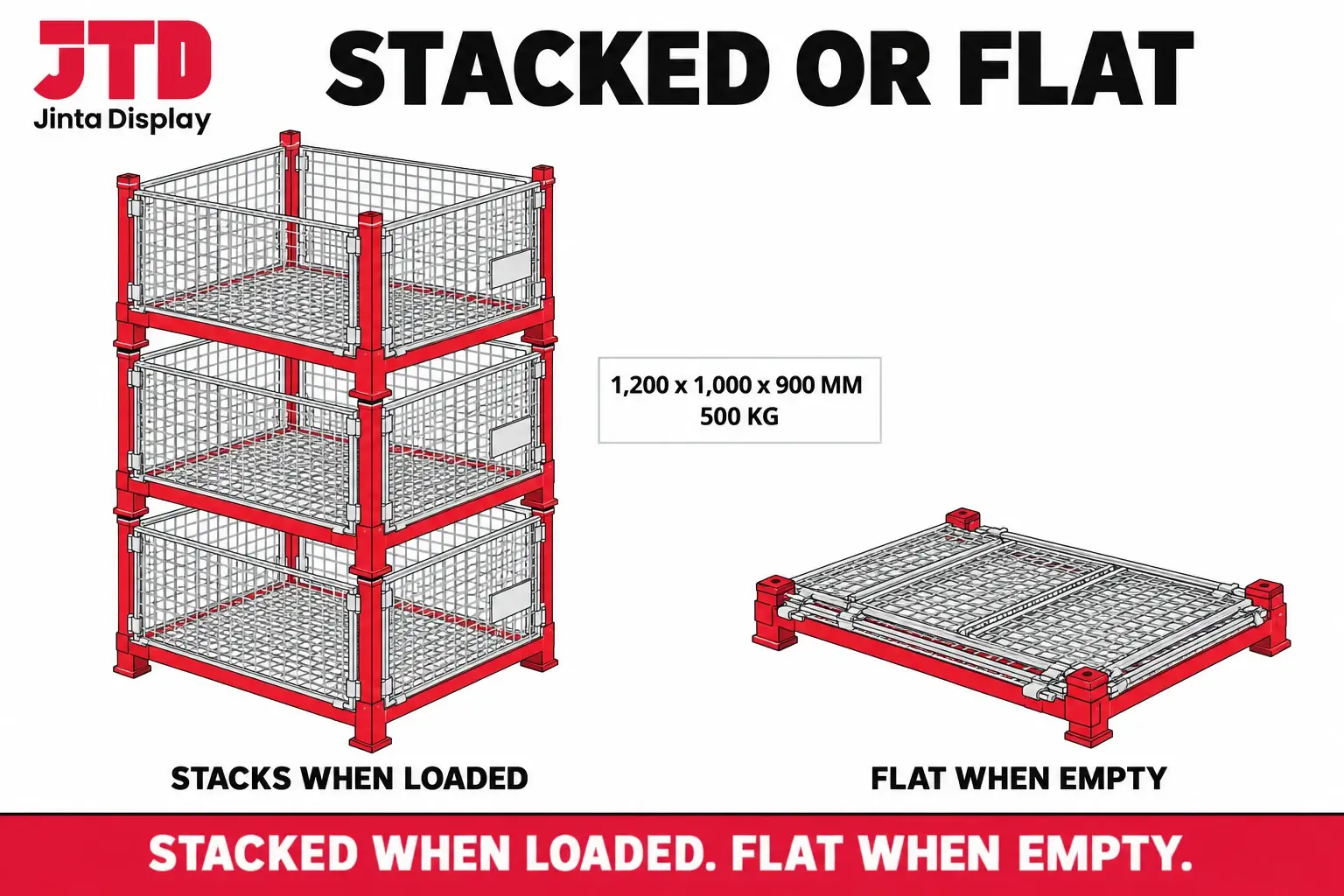
Our own folding wire container is listed at 1,200 × 1,000 × 900 mm, rated 500 kg, in cold rolled steel. It stacks when loaded and folds flat when empty. A trade listing for a smaller model gives 1,000 × 800 × 850 mm with 50 × 50 mm mesh in 5 mm wire, a load of 200 to 500 kg, and a galvanized or chrome finish. Both are trade and product page figures and not a certified test result, so confirm the rating for your size on the drawing.
Size the cage to the pallet and to the goods. If you plan to load pallets of loose parts into cages, the cage base should match the pallet used in your racking. The relationship between pallet sizes and bay widths is worked through in the guide to pallet rack dimensions.
Mesh, Wire and Finish
The mesh decides what the cage can hold. A coarse mesh passes small parts, and a fine mesh keeps them in. A common welded mesh opening in published products is 50 × 50 mm, and some containers use a finer opening for small items. Choose the opening from the smallest item you will store, and add a margin, because parts shift and rotate.
Wire diameter is the main strength figure for the sides. Thicker wire resists bulging when the container is full and a forklift tine pushes on a side. A trade listing for our container gives 5 mm wire, and we confirm the diameter on the drawing for each order. The frame section and the quality of the welds at the crossings matter as much as the wire.
The finish protects the steel. Galvanized or zinc finish suits storage in a dry warehouse, and a heavier galvanized finish suits outdoor stacking or wet environments. A painted finish gives a color code, which is useful for sorting by department or customer. Our container is listed in cold rolled steel with OEM color and logo available.
Stacking, Folding and Putting a Pallet Cage on Racking
Stacking is the main reason to buy a cage over a plain pallet. A published Australian listing describes a cage stacked four high when empty and two high when loaded, which shows the usual pattern. Loaded stacking is limited by the cage below, and your floor and your fork must be able to place the top cage safely. Always confirm the stacking rating of the exact model.
Folding changes the other half of the economy. A collapsible container folds flat when empty, so a fleet of them uses a fraction of the floor in storage and a fraction of the truck on the return trip. Our product page describes this as the reason returnable packaging loops use them instead of rigid boxes. The saving shows up in the return leg and the off-season storage, and it grows with the number of containers in the loop.
Many buyers ask whether a steel cage can sit on pallet racking. Some can, when the cage is designed with a base that spans the beams, and when the beams are rated for the cage plus its load. A cage with the wrong base can slip or deflect between beams. Ask the supplier whether the model is rated for racking, and confirm the beam rating separately. Our product page does not claim rack compatibility, so for racking use we confirm the base against your beams on the drawing.
Lifting and Handling a Pallet Cage
Most pallet cages are moved by a forklift entering from the base, or by a pallet truck on a pallet-style base. Check the entry points and the fork spacing against your trucks. A stillage with legs gives clearance for the tines, while a cage on a pallet depends on the pallet. A cage with a damaged foot or a bent runner should be taken out of service.
Lifting a cage by crane or overhead hoist is a different use with its own rules. In many countries it needs a container designed and tested for lifting, with certification, and regulations such as LOLER in the UK apply. Do not lift a standard stacking cage from its corners unless the supplier has rated and certified it for that use. If you need crane lifting, say so in the first message.
Where Pallet Cages Are Used
Pallet cages appear wherever loose or irregular goods have to be moved and stored in unit loads. Manufacturers use them to carry components from a supplier to an assembly line, and the same cages come back empty to be filled again. Distribution centers use them for returns, for slow-moving small items and for order consolidation. Retailers use them in back rooms for stock that has no pallet of its own.
Other uses are less obvious. Recycling and waste handling use mesh containers for bottles, cans and offcuts. Engineering workshops use stillages for tools, castings and finished parts. Building suppliers use them for fittings and small lengths. In each case the common point is that the goods are too small, too awkward or too easily damaged to stack on a bare pallet.
The environment shapes the specification. A cage that spends its life in a dry warehouse can use a light finish and a modest wire size. A cage that is stacked outdoors, left in the rain or used in a food area needs a heavier finish and a design with no places where water or dirt collects. Say where the cage will live when you ask for a quotation, because the same container is not right for every site.
Looking After a Pallet Cage in Service
A pallet cage is a working asset, and its life depends on how it is loaded and handled. Load it evenly, and keep heavy items low and near the center. Do not exceed the rated load, and do not use the sides as a lifting point unless the supplier has rated them for it. Stack only on a flat, level floor, and set each cage centered on the one below.
Check cages at regular intervals. Look at the frame for bends, at the welds for cracks, at the feet and runners for wear and at the gate and latches for damage. A cage with a bent frame or a broken weld should be taken out of use and repaired or replaced. Folding cages need extra attention at the hinges, because a worn hinge can let the side fold under load.
Keep spare parts for the fleet. Gates, latches and hinge pins are the parts that wear first, and a supplier that can ship the same parts years later keeps the fleet in service longer. Record the specification of the first order, so a replacement cage matches the others and stacks with them.
New, Used or Hired Pallet Cages
Search results for this product show strong demand for used and hired cages as well as new ones. Used cages can suit a short project or a tight budget, but their condition varies. A used cage with a hidden crack or a fatigued weld is a risk when it is loaded and stacked. If you buy used, inspect each cage and treat the rating as unknown until you can confirm it.
Hire suits peaks, such as a seasonal rush, when you do not want to own a fleet. The cost is a running charge and a dependence on the hire company’s stock. A new fleet suits a loop that runs all year, where the same containers go round many times and the specification matters. For a new fleet, a factory order means the cage can be made to your size, color and logo and held to one specification across reorders.
Whichever route you choose, write down the size, the rating and the stacking limit before the cages arrive. Then check the first delivery against the document, in the same way as you would for any batch of equipment.
Pallet Cage, Roll Cage, Plastic Box or Pallet Racking
A pallet cage is not always the right answer, and it helps to see the alternatives side by side.
| Option | Best for | Limit |
|---|---|---|
| Pallet cage or stillage | Loose or awkward goods moved by forklift, stacked storage | Heavy when empty, needs forklift space |
| Collapsible wire container | Returnable loops, seasonal storage | Hinges and latches need checking |
| Roll cage | Store replenishment moved by hand | Wheels are not for rough yard use |
| Plastic pallet box | Food, liquids and hygiene use | Higher cost for the same volume |
| Pallet racking | Palletized stock reached by forklift | Does not contain loose goods |
Many sites use cages and racking together. Loose goods go into cages, and the cages sit on racking or stack on the floor. The choice between stacking cages and building racking depends on how often each item moves and how high you can stack safely. If you are starting from the racking side, the basics are explained in the guide on what pallet racking is.
Packing and Shipping Pallet Cages
Freight is a large part of the cost of a steel container, because the product is bulky for its weight. A fixed cage ships as it is, so a container load holds only as many as the volume allows. A collapsible cage can ship folded flat, and a container holds many more of them. If your cages will be used far from the factory, the folding design can pay for itself in freight on the first order.
Packing matters for the finish. Our product page for the folding wire container lists packing in plastic wrapping film and steel belt, with a production time of 15 days and a delivery time of 10 to 30 days. The finish is protected in transit by the wrap, and the load is held together by the steel strap. Ask any supplier how the cages are packed, because loose cages rub and scratch the coating.
Ask for the units per 20 ft and per 40 ft container, folded and unfolded, for the exact size you are buying. A supplier who has loaded the product can answer at once, and the answer is the basis for comparing landed cost per cage between quotations. The method is the same as for any bulky product, and it uses the volume of one folded cage and the volume of the container.
What to Check on a Pallet Cage Quotation
Two quotations for a pallet cage can look the same and describe different products. Check the points below before you compare prices.
Ask for the outside and inside dimensions, and for the base size against your pallets. Ask for the rated load and its conditions, including the stacking rating. Ask for the wire diameter, the mesh opening and the frame section. Ask whether the container is fixed or collapsible and how the folding sides are locked. Ask for the finish by process and the color. Ask about the gate, if any, and the fork entry. Ask for the weight per container and the units per 20 ft and 40 ft container, folded and unfolded. Finally ask for a sample, and load it and stack it yourself.
The weight is a useful cross-check. A cage that is much lighter than others of the same size is carrying less steel, and the saving will show up as bulging or bent frames in service. The same applies to the finish, because a thin coating rusts at the welds first.
What to Send a Supplier
A short brief gets a comparable reply. Give the pallet size or the footprint you need, the height, the heaviest load and the stacking height. State if you need folding sides, a gate or legs, and how the cage will be lifted. Give the quantity, the color and logo, and the destination port. Photographs of an existing cage you want to match are useful, along with the goods that will go inside.
If you are specifying cages, send us your size, load and quantity and we will reply with a drawing and a specification. The range is listed under our wire container category.
Frequently Asked Questions
What is a pallet cage?
A pallet cage is a steel mesh container that holds goods for storage and forklift handling. Most have a base that matches a standard pallet and often a gate on one side. It turns a pallet into a stackable box that protects loose or awkward items and lets the contents be seen.
What is the difference between a stillage cage and a pallet cage?
A stillage cage is usually a rigid steel container with its own legs or feet, while a pallet cage often sits on or acts like a pallet. In practice suppliers use both words for the same product, so specify by drawing with the base size, load and stacking rating and not by name alone.
What is a stillage container?
It is the UK and Australian name for a steel container used to store and move goods by forklift. It is usually made of mesh or sheet steel with a rigid frame and built-in feet, and it is often stackable. In the United States a similar item is called a wire mesh container.
How high can you stack pallet cages?
It depends on the model and the load. One published Australian listing stacks four high when empty and two high when loaded. Our folding wire container stacks when loaded and folds flat when empty. Always confirm the stacking rating for the exact cage and check that your floor and truck can place the top cage safely.
Can a pallet cage be placed on pallet racking?
Some can, if the base spans the beams and the beams are rated for the cage and its load. A cage with the wrong base can slip or bend between beams. Ask the supplier whether the model is rated for racking and confirm the beam rating separately for your bay.
How much weight can a pallet cage hold?
Published products range from about 500 kg to 2,000 kg, with heavy stillages at the top. Our folding wire container is rated 500 kg. Ask whether the rating is a static, lifted or stacked load, because the same cage carries a different weight in each condition.
What size is a pallet cage?
Most are sized from the pallet. A 1,200 × 1,000 mm base matches the standard UK pallet, 1,200 × 800 mm matches the Euro pallet and about 1,219 × 1,016 mm matches the North American pallet. Heights run from under 600 mm to about 1,000 mm or more. Our listing is 1,200 × 1,000 × 900 mm.
What is a collapsible wire container used for?
It is used to store and move goods in returnable loops between a supplier and a plant, and for storage that changes with the season. It folds flat when empty, so return trips and off-season storage take far less space. It stacks when loaded, so it also saves floor area in use.